10 April 2010

Life History of the Grey Sailor

Life History of the Grey Sailor (Neptis leucoporos cresina)


Butterfly Biodata:
Genus: Neptis Fabricius, 1807
Species: leucoporos Fruhstorfer, 1908
Subspecies: cresina
Fruhstorfer, 1908
Wingspan of Adult Butterfly: 60mm
Caterpillar Host Plants:
Gironniera nervosa (Ulmaceae), G. subaequalis, G. parviflora.


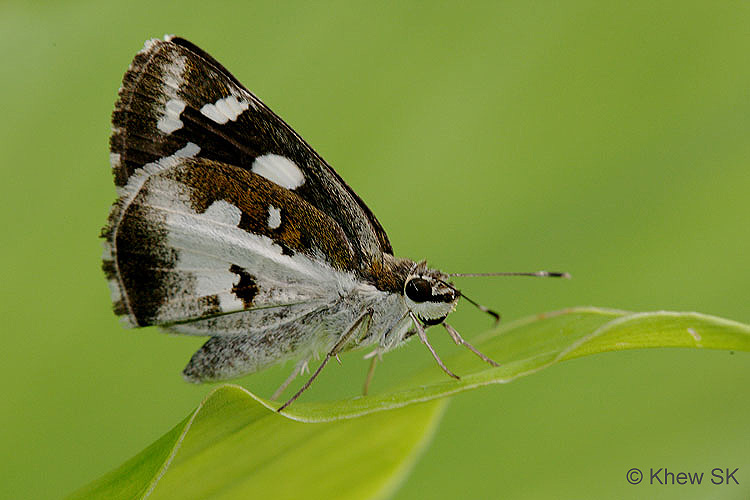
A Grey Sailor perching on a leaf of the Singapore Rhododendron.


A frontal view of a Grey Sailor enjoying the ripen fruit of the Singapore Rhododendron.

Physical Description of Adult Butterfly:
On both wings the cells are open, and vein 8 on the hindwing ends on the costa. Above, the wings are dark brown to black with white markings as seen in Athyma spp. On the forewing, there is a cell streak with a triangular spot lying beyond. Post-discal spots in spaces 2 and 3 are in echelon. The discal band on the hindwing does not reach the costa. Underneath, the wings are greyish brown with similar markings as on the upperside. The hindwing has a subbasal streak passing through base of cell and continued below vein 8, and a basal streak passing along costa but not reaching vein 8. The dorsum of the abdomen has a small white band aligned with the hindwing discal band.


A close-up view of the upperside. Note the white patch on the dorsum lining up with the white discal patches on the hindwing, and the large yellowish green marking on the thorax lining up with the cell streaks on the forewing.


A Grey Sailor sunbathing on a perch in the nature reserve.


A mating pair of the Grey Sailor sighted on a perch under the mid-day sun.

Field Observations of Butterfly Behaviour:
This species is common in Singapore especially in the nature reserves where the host plants are rather widespread. The sun-loving adults are often observed gliding in a "sailing" fashion that gives the origin to the common name "sailer/sailor" for members of this genus and related genera. The adults also visit flowers and ripening fruits for energy intakes.


Host plant: Gironniera nervosa.

Early Stages:
The caterpillars of the Grey Sailor feed on the young to middle-aged leaves of various Gironniera spp. They typically feed in the open on the leaf surface, and rest on the midrib between feeds. The lamina of each leaf is usually eaten from the tip, leaving the midrib uneaten. But unlike the Athyma spp., there is no attempt to construct frass chain or frass barrier. There is no attempt to attach pieces of cut lamina to the midrib as in the case of some Lasippa spp.


Another mating pair of the Grey Sailor perching on a fern leaf.


A female Grey Sailor ovipositing an egg at the leaf tip of its host plant.

The eggs of the Grey Sailor are laid singly at the tip of a leaf on the host plant. The ovipositing female shares the same ovipositing routine with quite a few Nymphalidae species: After landing on a leaf and finding it suitable, the female reverses along the leaf surface, typically along the midrib, until its abdomen tip reaches the leaf tip, and there it deposits an egg.


Two views of an egg laid at a leaf tip. Diameter: 1.1mm.

The eggs are somewhat globular in shape, with surface marked with hexagonal pits and bearing spines at pit corners, giving them the appearance of minute sea-urchins. The micropylar sits atop. Freshly laid eggs are green in colour, but turning pale green and then yellowish green when maturing. Each egg has a diameter of about 1.1mm.


Two views of a mature egg. The head and mandibles are visible.

The egg takes about 2.5-3 days to hatch. The young caterpillar emerges by eating away part of the egg shell. The rest of the egg shell becomes the first meal for the newly hatched, which has a cylindrical pale green body covered with many small tubercles and short setae. The head capsule is pale brown in color.


A newly hatched caterpillar, length: 2.5mm.

As the caterpillar grows, the body turns increasingly green in base colour, and small tubercles turn yellowish green to whitish in coloration. Three pairs of subdorsal tubercles becomes much larger and prominent on the 2nd and 3rd thoracic segments, and the 8th abdominal segment. After reaching about 5.0mm in 2 days, the caterpillar moults to the 2nd instar.


Two views of a 1st instar caterpillar, length: 4.5mm.


A 1st instar caterpillar of the Grey Sailor feeding on leaf lamina.

The body color of the 2nd instar caterpillar is yellowish green with a series of lateral oblique streaks and a faint dorsal band. Besides tiny tubercles covering most of its body surface, the 2nd instar caterpillar also features longer white-tipped spines on the 2nd and 3rd thoracic segment and the 8th abdominal segment. The dorsum on the thorax and the sides of the 6th-8th abdominal segments are shaded in light to dark brown. The head capsule is light brown and dotted with a number of whitish conical tubercles with a longer and more pointed apical pair. This instar lasts about 2 days with the body length reaching about 9mm.


2nd instar caterpillar, newly moulted and negotiating the surface hairs on the leaf, length: 4.5mm


Two views of a 2nd instar caterpillar, late in this stage, length: 8.2mm

The 3rd instar caterpillar has similar body markings as the 2nd instar with the following changes: The subdorsal spines are much longer and featuring prominent branches, with the pair on the 3rd thoracic segment much longer than the other two pairs. Its head capsule is longer vertically, featuring dark lateral and median stripes with the earlier apical spines now longer, more pointed and black on the front surface. This instar takes about 2 days to complete with body length reaching about 15mm.


Two views of a 3rd instar caterpillar, early in this stage, length: 8mm


Two views of 3rd instar caterpillar, later in this stage, length: 13mm.

The 4th instar caterpillar resembles the 3rd instar caterpillar closely. Laterally the oblique streaks gain greater contrast with an increase in dark brown coloration between white streaks. On the head capsule, tiny circular pits dot the frontal surface, and the two apical spines (horns) are white-tipped. This instar lasts 3 days with body length reaching about 20mm.


Two views of a newly moulted 4th instar caterpillar.


Two views of 4th instar caterpillar, early in this stage, length: 12mm


Two views of a 4th instar caterpillar, length: 17mm.

The 5th instar caterpillar is little changed from the 4th instar in all body markings and features.


A new moulted 5th instar caterpillar of the Grey Sailor.

One noticeable change is in spines and horns on the head capsule which are now proportionally shorter.


Frontal view of head capsules of Grey Sailor caterpillars. Left: 4th instar. Right: 5th instar.


Two views of 5th instar caterpillar, lengths: 22mm (top) and 25mm (bottom).

The 5th instar lasts for about 4 days, and the body length reaches up to 30-32mm. On the last day, the color of the body and the spines changes to pale/pinkish brown. The caterpillar ceases feeding and wanders around. Eventually it comes to a halt on a leaf underside, where the caterpillar spins a silk mound on the midrib from which it soon hangs vertically to take on the pre-pupatory pose.


A 5th instar caterpillar found on a leaf in the field.


Two views of a pre-pupa of the Grey Sailor.

Pupation takes place a day later. The pupa suspends itself via a cremastral attachment to the silk mound with no supporting silk girdle. It is almost entirely pale pinkish brown in color. The abdominal segments are slender. The thoracic portion being larger with wing cases dilated laterally. The dorsum of the thorax is angular. The head is bluntly cleft at its front edge with small pointed lateral vertices. Length of pupae: 16-17mm.


Three views of a pupa of the Grey Sailor.

After about 5 days of development, the pupal turns dark as the development within the pupal case comes to an end. The spots and streak on the forewing upperside also become discernible. The following day, the adult butterfly emerges from the pupal case.


Three views of a mature pupa. White markings on the forewings are now visible.


A newly eclosed Grey Sailor, proudly showing us its upperside.

References:
  • The Butterflies of The Malay Peninsula, A.S. Corbet and H.M. Pendlebury, 4th Edition, The Malayan Nature Society.
  • Butterflies of Thailand, Pisuth Ek-Amnuay, 1st Edition, 2006
Text by Horace Tan, Photos by Federick Ho, Sunny Chir, Khew SK and Horace Tan

06 April 2010

Butterfly of the Month - April 2010

Butterfly of the Month April 2010
Grass Demon (Udaspes folus)


As the dust settles over the furore over the installation art piece at the SAM, members at ButterflyCircle continue to discuss the inappropriateness of the dining table setting in which killed butterflies were featured. It was a time of soul-searching and also wonder at the passion with which the nature-loving community had responded to the ironical work of "art". I'm sure that if the artist had portrayed some dead kittens (not that I'm suggesting it to him for his next project!), the response from the Cat Welfare Society in Singapore would not have been any less passionate and emotional.


Everyone will have his or her point of view, and is definitely entitled to their opinion as to what constitutes "art". But the message to artists like FX Harsono would be that they should strive for a "zero harm" philosophy (as far as Mother Nature's creatures, big and small, are concerned) in their attempts to portray their esoteric artistic theories to "lesser" mortals.


The article and video clip at ChannelNews Asia shows the interview of ButterflyCircle member Sunny Chir, the Director of SAM and a few others. We thought that the Director, being a senior official of a public institution, would have done his research on butterflies and some basic entomological sciences more carefully before appearing on National TV and looking rather ill-informed, merely based on what the artist tells him.


Of Demons but no Dungeons


This month, Singapore saw a change in the dry weather from the preceding two months, with the intermonsoon rains bringing much relief to the hot spell. New growth in flora will be good news for our butterfly friends. Here, we feature a species of the Hesperiidae, or Skipper family for April 2010 - the Grass Demon (Udaspes folus)


The Grass Demon (Udaspes folus) is more often seen in urban areas than in the nature reserves. A relatively large skipper with a wingspan of 50mm, the butterfly is dark brown on the upperside with white spots at patches on both the fore and hindwings.


The underside is paler, a rusty brown with more extensive white patches, particularly on the hindwings. The underbelly of the butterfly is whitened whilst the antennae has a white patch just after the apiculus.


The skipper is usually active in the early morning hours of the day, flitting amongst the low shrubbery in search for nectar from flowers. It is a fast flyer, like most skippers, and can zip off at tremendous speeds when disturbed, showing just a fleeting flash of white as it takes off to safety.


It is usually found in urban gardens where its preferred host plants - various species of the ginger family and in particular, Turmeric (Curcuma domestica) is cultivated. The butterfly is usually found singly, and likes to perch at a few choice spots where it opens its wings to sunbathe in the typical skipper fashion - forewings held at an angle with the hindwings opened flat.


A visit to the various herb gardens where the Turmeric grows would be a good choice if one wants to look for this species. Places like Pasir Ris Park Kitchen Garden, Bishan Park Herb Garden and the Herbs and Spices Garden at Fort Canning Park would be ideal locations where the Grass Demon is often seen.


This blog article is dedicated to long-time friend and butterfly enthusiast Steven Neo, who uses the Grass Demon as his avatar in ButterflyCircle.

Text by Khew SK ; Photos by Goh LC; Federick Ho; Khew SK; Jayne Kok; Horace Tan; Benedict Tay & Wong CM

04 April 2010

Murder in the name of Art??

Murder in the name of Art??


One of ButterflyCircle's members paid a visit to the Singapore Art Museum recently, and saw amongst the exhibits displayed, in the name of "art" was this supposedly delectable dining installation art, featuring dead butterflies titled Bon Appetit 2008.


Most, if not all of our butterfly- and nature-loving community in Singapore would be outraged at this totally insensitive display, killing so many butterflies just so that some artist can make a statement? It is totally in bad taste, even as Singapore is celebrating the International Year of Biodiversity 2010 and priding ourselves in biodiversity conservation. Is this the message that we are sending out to the rest of the world - the hypocrisy and the duplicity that we are saying one thing, and then condoning exactly the opposite?


Does the artist, and even those people who are responsible for featuring this "work of art" realise that no living thing as gentle as butterflies deserves to die, just so that some people can partake of this demented orgy of what is considered art? Has Singapore's society degenerated into such abject decadence that we need to kill these beautiful creatures so that some people can appreciate this repulsive display that is even considered worthy of being featured at the Singapore Art Museum?

Even if the specimens are not real or farm-bred butterflies, the message sent to people viewing the exhibition is that "it is ok to kill beautiful creatures for human enjoyment". Butterflies are expendable, and that their lives can be forfeit for human 'enjoyment' - such as what is being displayed.

The metaphorical association with a gastronomic experience further emphasises that these are insects whose lives are not worth considering, and that they die for our pleasure. Whatever the artist explained about "the unequal power relations in society, and the relationship between the powerful and the powerless" is exactly what he is guilty of - that he has killed these innocent and harmless beauties in the name of art, by exacting his "power" over these poor defenseless creatures.

A totally sick and repulsive act of cruelty and senseless mass murder that reflects the demented and decadent mind of Man. I hope that the people in "power" at the Singapore Art Museum can think with some conscience, take stock of the message that this exhibit portrays and withdraw it immediately from public consumption.


Bon Appetit 2008

Installation with table, cloth, chairs, tableware, needles and butterflies. In this installation, a table is laid for a meal, the cutlery and chinaware meticulously arranged according to the table etiquette of the elite, anticipating the arrival of diners possessing social status and privilege. Startlingly, the bowls and plates are filled not with food but with butterflies, neatly fastened to the chinaware. Much of Harsono’s recent work has employed the butterfly as a symbol of a victim — beautiful and vulnerable, and inevitably, destined for destruction or attack. The butterflies in Bon Appetit are forcibly pinned down, about to be consumed. While the work appears charming on the surface, it nonetheless hints at unequal power relations in society, and the relationship between the powerful and the powerless. The suggestion of a domestic or interior setting also marks a shift from Harsono’s earlier works, where the streets and public areas were the theatres of violence, and sites of protest and resistance. Now, as Bon Appetit suggests, violence and danger have subtly infiltrated the home, the most personal and private of spaces.

Text by Khew SK ; Photos by a BC member

31 March 2010

Where Have All the Butterflies Gone?

Where Have All the Butterflies Gone?


"Where have all the flowers gone?
Long time passing
Where have all the flowers gone?
Long time ago
Where have all the flowers gone?
Girls have picked them everyone
When will they ever learn?
When will they ever learn?"*
* (c)1955 folk classic song by Pete Seeger
(Videoclip of the song by the legendary folk singers, The Kingston Trio)


I was back in Penang over the weekend for a short family visit and also to participate in Qing Ming Festival (also known as All Souls' Day). I hadn't visited my grandparents' graves for many years now, and it was time to get back to some good ol' tradition (at least whenever I can).


The wildflowers and grasses at the cemetary were blowing in the early morning breeze as there were many families paying their respect to their loved ones, each person lost in their own pensive memories of good times gone by.

Where Have All the Butterflies Gone?


In my three days of stay in Penang, I noticed a strange absence of butterflies in the usual areas where I would expect to see them. In my parents' home garden, the grassy patches in the neighbourhood, all around town and the usual vegetated areas, and even at the open areas of Mount Erskine where my paternal grandparents' were laid to rest and where the graves were covered with wild flowers, weeds, renegade trees that sprung up out of nowhere. Zilch. Not a single butterfly in sight - not even the common Striped Albatrosses, Lesser Grass Blues or Common Grass Yellow!


The weather was excruciatingly hot - almost in the mid 30's (that's a sweltering 93 deg F!). A taste of global warming to come? But our butterfly friends' absence probably suggest that they too, cannot tolerate this unfriendly weather and may have taken off to the sanctuary of the forests and hills.


Outdoors, it was unbearable by late morning as temperatures soared. It was rather saddening to see the near absence of any butterflies all around town, and in places where I used to see them, even in recent years. Fortunately, though, the sunbirds and spiderhunters that frequent my home garden were still up and about and their early morning chirps still pervade the air.


As with most of my trips back to my hometown, I made a short trip to the Penang Butterfly Farm to visit my friends there. It is always nice to walk amongst our 'flying jewels' and to try to photograph any species that I've not taken a good shot of before.


A female Jacintha Eggfly that may be an undescribed new form in the breeding cage at Penang Butterfly Farm

The Technical Director at Penang Butterfly Farm showed me a curious female "form" of the Jacintha Eggfly that has more orange patches on her wings than is usual. The submarginal markings on the hindwing of this new form appear to be consistent with subspecies jacintha rather than subspecies bolina. As suggested in my earlier article on a possible new form of the female Jacintha eggfly, it appears that the variability of this butterfly continues to intrigue enthusiasts like us. Hence at the moment, PBF is breeding a number of the offspring of this new form to see if there will be more consistent appearance of this different coloured variety of this subspecies.


The months of Mar through July are considered good butterflying months in Malaysia and Singapore. In PBF's controlled environment, there was an abundance of many species and their caterpillars were bred in good numbers. However, I wonder if it were the same for the free-ranging butterfly species around the island?


A old friend, the Blue Branded King Crow (Euploea eunice leucogonis)

This visit, I encountered the Blue Branded King Crow (Euploea eunice leucogonis), a species that I've not seen for a long time. This rather large crow, which resembles a supersized Dwarf Crow, has rather unique behaviour as described in C&P4 - "... erratic in appearance ; it may be abundant in a locality for a few months, then disappear completely for a year or two before reappearing and becoming as common as before."


There were also a number of Pieridae flying around in the flight cage - Great Orange Tip, Chocolate Albatross, Orange Albatross, etc.


And so ended a short weekend trip back home. It was a relief to get back to Singapore's "cooler" temperatures. I hope the signs of climate change back in Penang is something temporary and will not have a permanent impact on the butterfly biodiversity there. We will see on my next trip back.

And the melancholic tune and haunting lyrics of Pete Seeger's song played over in my mind...

Text & Photos by Khew SK