Part 2 : An Analysis of Name Changes
We had earlier discussed the changes to the common names of butterflies in Part 1 of this series, where we agreed with Dr Kirton's changes due to "socially unacceptable reasons". In that article we featured butterflies with names like Nigger, Darkie or Brownie, which carried ethnic slurs that would be politically incorrect in today's social context.

Nigger no more...
In Part 2 of our discussion on the changes to the common names of butterflies, we take a look at some of the name changes and in some cases, offer an alternative perspective to these changes. In the study of zoology, and in particular, Lepidoptera, scientists often divide the world into eight specific faunistic zones, often referred to as ecozones. An ecozone is the broadest biogeographic division of the Earth's land surface, based on distributional patterns of terrestrial organisms.

The eight ecozones are, (based on World Wildlife Fund definition) the Palearctic, Nearctic, Afrotropic, Neotropic, Indo-Malaya, Australasia, Oceania and Antarctic. The Indo-Malayan region, which is the area of interest as far as butterflies of Malaysia and Singapore are concerned, comprises South Asia covering India, Bangladesh, Pakistan and Sri Lanka, Thailand, Myanmar, Laos, Cambodia, Vietnam and southern China, the Malay Peninsula and Singapore, the Large Sunda islands (Sumatra, Borneo and Java), the Philippine Islands, Sulawesi and Lesser Sunda Islands as far east as Timor.

The eight ecozones are, (based on World Wildlife Fund definition) the Palearctic, Nearctic, Afrotropic, Neotropic, Indo-Malaya, Australasia, Oceania and Antarctic. The Indo-Malayan region, which is the area of interest as far as butterflies of Malaysia and Singapore are concerned, comprises South Asia covering India, Bangladesh, Pakistan and Sri Lanka, Thailand, Myanmar, Laos, Cambodia, Vietnam and southern China, the Malay Peninsula and Singapore, the Large Sunda islands (Sumatra, Borneo and Java), the Philippine Islands, Sulawesi and Lesser Sunda Islands as far east as Timor.

Sundaland map
The zoogeographical subregion of the Indo-Malayan ecozone, known as the Sundanian Subregion (or often called Sundaland) comprises the Malay Peninsula (including Singapore), Sumatra, Borneo, Java and their satellite islands, and Palawan in the Philippines. It is largely the Sundaland subregion which we are concerned with, pertaining to the butterfly fauna of this region, and from which we base our literature reviews of books published about the butterflies in these countries.

Left : Butterflies of the Malay Peninsula 1st Edition (1934) Right : The Identification of Indian Butterflies (1927)
Whilst there is no doubt that one of the first published literature which coined English common names for butterflies was already available for butterflies in the Indian subcontinent, e.g. "The Identification of Indian Butterflies by W.A. Evans in 1927, we also take into account that the earliest reference to the butterflies in Malaya/Malaysia and Singapore is "The Butterflies of the Malay Peninsula" by A.S. Corbet & H.M. Pendlebury in 1934.

Left : Common Malayan Butterflies (1960) Right : Malaysian Butterflies - An Introduction (1983)
In the 60's and 80's, two more reference books, targeted for the amateur butterfly enthusiasts were published. The use of English common names (or trivial names) was more evident in these two references. These were "Common Malayan Butterflies" (CMB) by R. Morrell (in 1960) and "Malaysian Butterflies - An Introduction" (MBAI) by Prof Yong Hoi-Sen (in 1983). In the meantime, the 2nd, 3rd and 4th editions of "The Butterflies of the Malay Peninsula" were printed in 1956, 1978 and 1992 respectively.

It is with the background of these references, that we base our discussions and opinions on the English common names of butterflies in Malaysia and Singapore, and any revisions or publications that come thereafter, on butterflies of the Sundaland subregion.

In the review of the English common names suggested in Dr Kirton's latest book "A Naturalist's Guide to the Butterflies of Peninsular Malaysia, Singapore and Thailand" (BPMST) we will start with a discussion on the species that are found in Singapore first. Future discussions will dwell on the species beyond Singapore's shores.

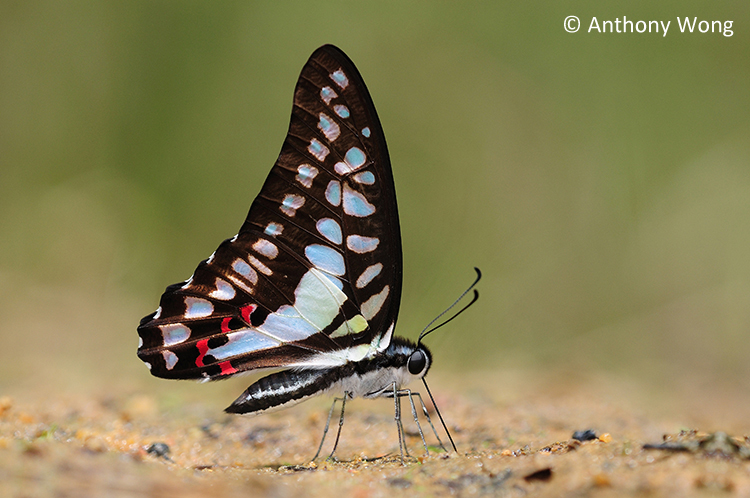
Dealing with the names by the butterfly families, we first take a look at the genus Graphium. In particular, the species Graphium evemon eventus. Based on our literature research on the early references, the name "Lesser Jay" was first used by Evans in his 1927 book. Other early authors declined to give a common name to this species. In the 90's the name "Blue Jay" was coined for the Singapore butterfly fauna, and through regular usage over the years, the name stuck.


Text excerpt from Evans book "Identification of Indian Butterflies" 1927
ButterflyCircle's "Butterflies of Singapore" (BOS) launched in 2010, the name Blue Jay was also adopted for Graphium evemon eventus. Many online references also used Blue Jay. To be consistent with the names used in the Indo-Malayan ecozone, the common name Lesser Jay should be adopted for this species henceforth.
Recommendation : Graphium evemon eventus should be referred to as the Lesser Jay.

The next species in the list is Ypthima horsfieldii humei. This species was given the common name the Malayan Five Ring by Pisuth Ek-Amnuay in his book, Butterflies of Thailand 1st Edition (BOT1) in 2006. The same name was also used in BOS. None of the early references by Evans nor C&P had a common name for this species.

In BMPST, Dr Kirton used the name Horsfield's Five Ring for this species. We do not see the rationale nor necessity to change the name, as the name does not appear to be used for any other species nor is confusing. The closely related species, Ypthima baldus newboldi is called the Common Five Ring, which causes no ambiguity with Ypthima horsfieldii humei.
Recommendation : Ypthima horsfieldi humei should retain its name Malayan Five Ring.

We move on to the subfamily Danainae and start with the Euploea or commonly referred to as the "Crows". The first proposed change in BPMST was Euploea phaenareta castlenaui. The English common name is the Great Crow. This name was first coined by Evans for the species Euploea corus corus. This species was later revised to E. phaenareta, hence the reference to the Great Crow.

Closer to home, BOT1 and BOT2 also refers to E. phaenareta as the Great Crow. Through regular usage in Singapore, the English common name for this species is the King Crow, and is used in BOS as well as many online checklists. Again, for consistency and due to the taxonomic changes to the species' latin name, we acknowledge that E. phaenareta should be changed to Great Crow.
Recommendation : Euploea phaenareta castelnaui should be known as the Great Crow.


© Dr Laurence G Kirton : Explanation for the rationale of name revision for Striped Black Crow
The next species for discussion is Euploea eyndhovii gardineri. Evans gave the name Striped Black Crow for E. doubledayi. Dr Kirton explains that there was a split in the two species to E. doubledayi and E. eyndhovii and proposed that Striped Black Crow is retained for E. doubledayi and Lesser Striped Black Crow for E. eyndhovii. BOT2 also uses Lesser Striped Black Crow for E. eyndhovii but calls E. doubledayi the Greater Striped Black Crow. In his book, (MBAI), Prof Yong Hoi-Sen calls E. doubledayi the Larger Striped Black Crow.

It appears to be logical to retain the original name of Striped Black Crow for E. doubledayi and adopt the new name of Lesser Striped Black Crow for E. eyndhovii. Hence we support Dr Kirton's proposed change for the smaller species that flies in the southern parts of Malaysia and Singapore. In practice, however, the four-word name for this species may be a mouthful and butterfly enthusiasts may continue to use Striped Black Crow for this species this is more common, compared to its cousin up north.
Recommendation : Euploea eyndhovii gardineri should be called the Lesser Striped Black Crow.

The next species in the Danainae sub-family belongs to the Tigers. In BPMST, Dr Kirton calls Danaus melanippus hegesippus the White Tiger. This was also the name given to the species Danaus melanippus indicus by Evans. In Borneo, there is a subspecies Danaus melanippus thoe which is completely black and white. In recent years, various Indian butterfly groups have begun to call their subspecies the Indian White Tiger.

Recent local references, CMB (Morrell), BMAI (Yong HS), BOS (KhewSK) and even Kazuhisa Otsuka's Butterflies of Borneo and South East Asia all refer to Danaus melanippus as Black Veined Tiger. Over regular usage in the past six decades, the species has come to be referred to as the Black Veined Tiger in Malaysia and Singapore. As the descriptor "white tiger" may be a misnomer for this species, we propose that the English common name Black Veined Tiger be retained for this species.
Recommendation : Danaus melanippus hegesippus should retain its name Black Veined Tiger.

The next species of interest is the large black and white butterfly, Idea stolli logani. The current local English common name is the Common Tree Nymph. It is interesting to note that Evans coined several names for the subspecies of Hestia (now known as Idea) lynceus, ranging from Malabar Tree Nymph, Ceylon Tree Nymph, Kanara Tree Nymph, Tavoy Tree Nymph and so on. It may be confusing, as it would appear that it would be quite exceptional to have English common names for so many subspecies of I. lynceus when the physical differences between two or more subspecies may not be very apparent.

Multiple subspecies and multiple English Common Names for a single species - Idea lynceus

Subsequently in C&P1, Hestia lynceus reinwardti was called the Tree Nymph. This was repeated by Prof Yong in MBAI. In CMB, Morrell referred to Idea jasonia logani as the Common Tree Nymph. The revised scientific name for Idea jasonia logani is Idea stolli logani. Hence we continued the name coined by Morrell in 1960 for this species - Common Tree Nymph.

Tree Nymph (Idea lynceus). Note heavier shading on the wings
In BPMST, Dr Kirton adopted the name Ashy-White Tree Nymph for Idea stolli logani. It would appear that this 'newly invented' name originated from BOT1 by Pisuth. The descriptor "ashy-white" would normally refer to something that is greyish in colour (ash), and does not appear to be appropriate for Idea stolli which certainly appears much whiter than Idea lynceus. If anything, this name could be more suited to Idea lynceus. But it is already called the Tree Nymph. Hence we propose that the name Common Tree Nymph continues to be adopted for Idea stolli logani.
Recommendation : Idea stolli logani should retain its name Common Tree Nymph.

The final species of Part 2 of this series on English Common Names is the related Idea leuconoe chersonesia. In Evan's book, he called this the Siam Tree Nymph - largely due to the subspecies Idea leuconoe siamensis. The common name for this subspecies name is also used in BOT2 by Pisuth. There are many other common names coined for this species, ranging from Paper Kite, Rice Paper, White Tree Nymph, Large Tree Nymph and others. In BOS, we used the name Mangrove Tree Nymph for this species.

There are many subspecies of I. leuconoe and certain subspecies are easily bred as display species in many butterfly parks all over the world. In particular, the subspecies from Taiwan, ssp clara appears to be the one that is abundant in butterfly parks. However, the subspecies that occurs as a native species in Malaysia and Singapore (including the Indonesia islands close to Singapore) is ssp chersonesia. Morrell in CMB and Corbet in C&P4 both describe this subspecies as "a seashore species and frequents mangrove areas" and "confined to mangrove swamps". In BPMST, Dr Kirton refers to Idea leuconoe as Large Tree Nymph. It would be more definitive and appropriate to refer to Idea leuconoe chersonesia as the Mangrove Tree Nymph to better describe its association with mangrove habitats in Malaysia, Singapore and Indonesia.
Recommendation : Idea leuconoe chersonesia should retain its common name as the Mangrove Tree Nymph.

Left : Common Malayan Butterflies (1960) Right : Malaysian Butterflies - An Introduction (1983)
In the 60's and 80's, two more reference books, targeted for the amateur butterfly enthusiasts were published. The use of English common names (or trivial names) was more evident in these two references. These were "Common Malayan Butterflies" (CMB) by R. Morrell (in 1960) and "Malaysian Butterflies - An Introduction" (MBAI) by Prof Yong Hoi-Sen (in 1983). In the meantime, the 2nd, 3rd and 4th editions of "The Butterflies of the Malay Peninsula" were printed in 1956, 1978 and 1992 respectively.

It is with the background of these references, that we base our discussions and opinions on the English common names of butterflies in Malaysia and Singapore, and any revisions or publications that come thereafter, on butterflies of the Sundaland subregion.

In the review of the English common names suggested in Dr Kirton's latest book "A Naturalist's Guide to the Butterflies of Peninsular Malaysia, Singapore and Thailand" (BPMST) we will start with a discussion on the species that are found in Singapore first. Future discussions will dwell on the species beyond Singapore's shores.

Dealing with the names by the butterfly families, we first take a look at the genus Graphium. In particular, the species Graphium evemon eventus. Based on our literature research on the early references, the name "Lesser Jay" was first used by Evans in his 1927 book. Other early authors declined to give a common name to this species. In the 90's the name "Blue Jay" was coined for the Singapore butterfly fauna, and through regular usage over the years, the name stuck.


Text excerpt from Evans book "Identification of Indian Butterflies" 1927
ButterflyCircle's "Butterflies of Singapore" (BOS) launched in 2010, the name Blue Jay was also adopted for Graphium evemon eventus. Many online references also used Blue Jay. To be consistent with the names used in the Indo-Malayan ecozone, the common name Lesser Jay should be adopted for this species henceforth.
Recommendation : Graphium evemon eventus should be referred to as the Lesser Jay.

The next species in the list is Ypthima horsfieldii humei. This species was given the common name the Malayan Five Ring by Pisuth Ek-Amnuay in his book, Butterflies of Thailand 1st Edition (BOT1) in 2006. The same name was also used in BOS. None of the early references by Evans nor C&P had a common name for this species.

In BMPST, Dr Kirton used the name Horsfield's Five Ring for this species. We do not see the rationale nor necessity to change the name, as the name does not appear to be used for any other species nor is confusing. The closely related species, Ypthima baldus newboldi is called the Common Five Ring, which causes no ambiguity with Ypthima horsfieldii humei.
Recommendation : Ypthima horsfieldi humei should retain its name Malayan Five Ring.

We move on to the subfamily Danainae and start with the Euploea or commonly referred to as the "Crows". The first proposed change in BPMST was Euploea phaenareta castlenaui. The English common name is the Great Crow. This name was first coined by Evans for the species Euploea corus corus. This species was later revised to E. phaenareta, hence the reference to the Great Crow.

Closer to home, BOT1 and BOT2 also refers to E. phaenareta as the Great Crow. Through regular usage in Singapore, the English common name for this species is the King Crow, and is used in BOS as well as many online checklists. Again, for consistency and due to the taxonomic changes to the species' latin name, we acknowledge that E. phaenareta should be changed to Great Crow.
Recommendation : Euploea phaenareta castelnaui should be known as the Great Crow.


© Dr Laurence G Kirton : Explanation for the rationale of name revision for Striped Black Crow
The next species for discussion is Euploea eyndhovii gardineri. Evans gave the name Striped Black Crow for E. doubledayi. Dr Kirton explains that there was a split in the two species to E. doubledayi and E. eyndhovii and proposed that Striped Black Crow is retained for E. doubledayi and Lesser Striped Black Crow for E. eyndhovii. BOT2 also uses Lesser Striped Black Crow for E. eyndhovii but calls E. doubledayi the Greater Striped Black Crow. In his book, (MBAI), Prof Yong Hoi-Sen calls E. doubledayi the Larger Striped Black Crow.

It appears to be logical to retain the original name of Striped Black Crow for E. doubledayi and adopt the new name of Lesser Striped Black Crow for E. eyndhovii. Hence we support Dr Kirton's proposed change for the smaller species that flies in the southern parts of Malaysia and Singapore. In practice, however, the four-word name for this species may be a mouthful and butterfly enthusiasts may continue to use Striped Black Crow for this species this is more common, compared to its cousin up north.
Recommendation : Euploea eyndhovii gardineri should be called the Lesser Striped Black Crow.

The next species in the Danainae sub-family belongs to the Tigers. In BPMST, Dr Kirton calls Danaus melanippus hegesippus the White Tiger. This was also the name given to the species Danaus melanippus indicus by Evans. In Borneo, there is a subspecies Danaus melanippus thoe which is completely black and white. In recent years, various Indian butterfly groups have begun to call their subspecies the Indian White Tiger.

Recent local references, CMB (Morrell), BMAI (Yong HS), BOS (KhewSK) and even Kazuhisa Otsuka's Butterflies of Borneo and South East Asia all refer to Danaus melanippus as Black Veined Tiger. Over regular usage in the past six decades, the species has come to be referred to as the Black Veined Tiger in Malaysia and Singapore. As the descriptor "white tiger" may be a misnomer for this species, we propose that the English common name Black Veined Tiger be retained for this species.
Recommendation : Danaus melanippus hegesippus should retain its name Black Veined Tiger.

The next species of interest is the large black and white butterfly, Idea stolli logani. The current local English common name is the Common Tree Nymph. It is interesting to note that Evans coined several names for the subspecies of Hestia (now known as Idea) lynceus, ranging from Malabar Tree Nymph, Ceylon Tree Nymph, Kanara Tree Nymph, Tavoy Tree Nymph and so on. It may be confusing, as it would appear that it would be quite exceptional to have English common names for so many subspecies of I. lynceus when the physical differences between two or more subspecies may not be very apparent.

Multiple subspecies and multiple English Common Names for a single species - Idea lynceus

Subsequently in C&P1, Hestia lynceus reinwardti was called the Tree Nymph. This was repeated by Prof Yong in MBAI. In CMB, Morrell referred to Idea jasonia logani as the Common Tree Nymph. The revised scientific name for Idea jasonia logani is Idea stolli logani. Hence we continued the name coined by Morrell in 1960 for this species - Common Tree Nymph.

Tree Nymph (Idea lynceus). Note heavier shading on the wings
In BPMST, Dr Kirton adopted the name Ashy-White Tree Nymph for Idea stolli logani. It would appear that this 'newly invented' name originated from BOT1 by Pisuth. The descriptor "ashy-white" would normally refer to something that is greyish in colour (ash), and does not appear to be appropriate for Idea stolli which certainly appears much whiter than Idea lynceus. If anything, this name could be more suited to Idea lynceus. But it is already called the Tree Nymph. Hence we propose that the name Common Tree Nymph continues to be adopted for Idea stolli logani.
Recommendation : Idea stolli logani should retain its name Common Tree Nymph.

The final species of Part 2 of this series on English Common Names is the related Idea leuconoe chersonesia. In Evan's book, he called this the Siam Tree Nymph - largely due to the subspecies Idea leuconoe siamensis. The common name for this subspecies name is also used in BOT2 by Pisuth. There are many other common names coined for this species, ranging from Paper Kite, Rice Paper, White Tree Nymph, Large Tree Nymph and others. In BOS, we used the name Mangrove Tree Nymph for this species.

There are many subspecies of I. leuconoe and certain subspecies are easily bred as display species in many butterfly parks all over the world. In particular, the subspecies from Taiwan, ssp clara appears to be the one that is abundant in butterfly parks. However, the subspecies that occurs as a native species in Malaysia and Singapore (including the Indonesia islands close to Singapore) is ssp chersonesia. Morrell in CMB and Corbet in C&P4 both describe this subspecies as "a seashore species and frequents mangrove areas" and "confined to mangrove swamps". In BPMST, Dr Kirton refers to Idea leuconoe as Large Tree Nymph. It would be more definitive and appropriate to refer to Idea leuconoe chersonesia as the Mangrove Tree Nymph to better describe its association with mangrove habitats in Malaysia, Singapore and Indonesia.
Recommendation : Idea leuconoe chersonesia should retain its common name as the Mangrove Tree Nymph.
Text by Khew SK : Photos by Sunny Chir, Goh LC, Khew SK, Loke PF, Simon Sng and Anthony Wong
References :
[BPMST] A Naturalist's Guide to the Butterflies of P. Malaysia, Singapore & Thailand, Laurence G Kirton : John Beaufoy Publishing 2014
[C&P1] The Butterflies of The Malay Peninsula, A.S. Corbet and H.M. Pendlebury, 1st Edition, Kyle & Palmer, 1934.
[C&P4] The Butterflies of the Malay Peninsula, A.S. Corbet and H.M. Pendlebury, 4th Edition, Revised by Col John Eliot, Malaysian Nature Society, 1992
[BOT1] Butterflies of Thailand, Pisuth Ek-Amnuay, 1st Edition, Amarin Printing & Publishing, 2006
[BOT2] Butterflies of Thailand, Pisuth Ek-Amnuay, 1st Edition, Amarin Printing & Publishing, 2012
[CMB] Common Malayan Butterflies, R. Morrell, Longmans Malaysia, 1960
[MBAI] Malaysian Butterflies - An Introduction, Yong Hoi-Sen, Tropical Press, Malaysia, 1983
[BOS] Field Guide to the Butterflies of Singapore, Khew SK, Ink On Paper Publishing, Singapore, 2010
[BBSEA] Butterflies of Borneo & South East Asia, Kazuhisa Otsuka, Hornbill Books, Malaysia, 2001
[IIB] Identification of Indian Butterflies, W.A. Evans, Diocesan Press, India, 1927




.jpg)


