21 March 2015

Life History of the Ultra Snow Flat

Life History of the Ultra Snow Flat (Tagiades ultra)


Butterfly Biodata:
Genus: Tagiades Hübner, 1819
Species: ultra Evans, 1932
Wingspan of Adult Butterfly: 37-43mm
Caterpillar Local Host Plant: Dioscorea glabra (Dioscoreaceae).


Physical Description of Adult Butterfly:
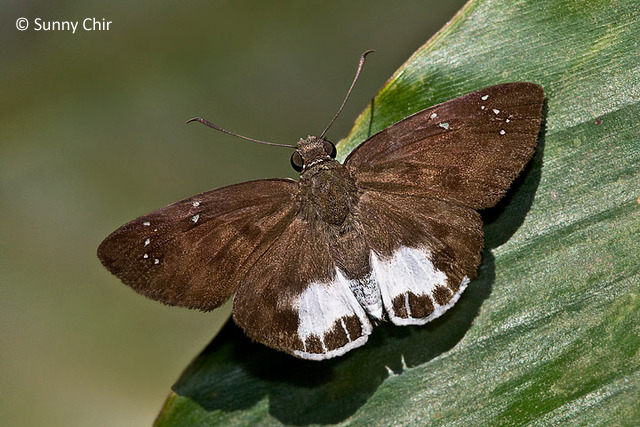
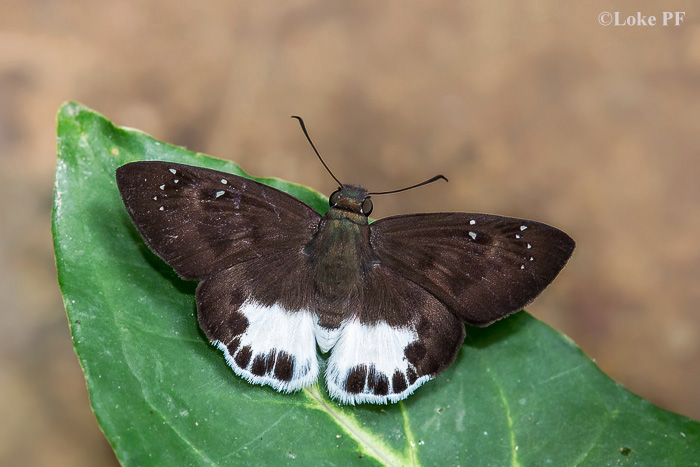
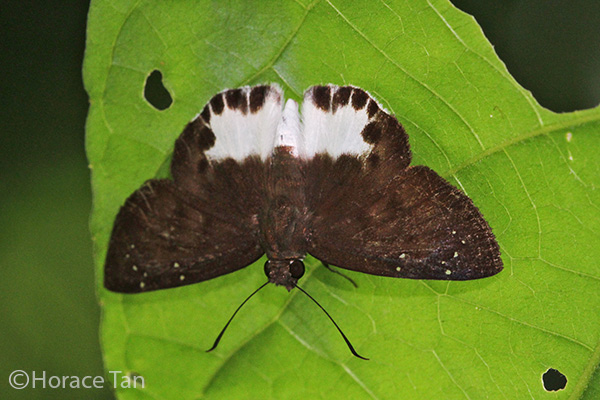
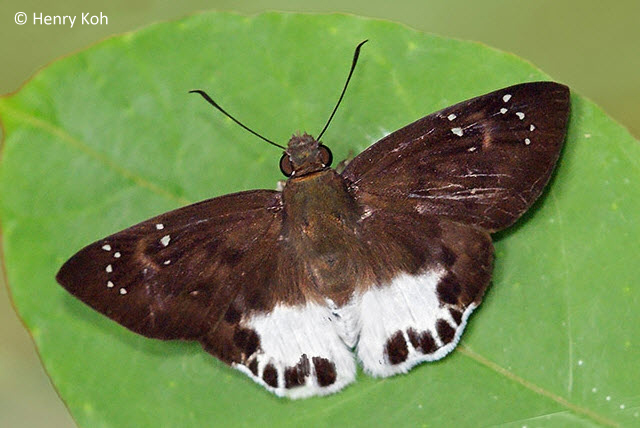
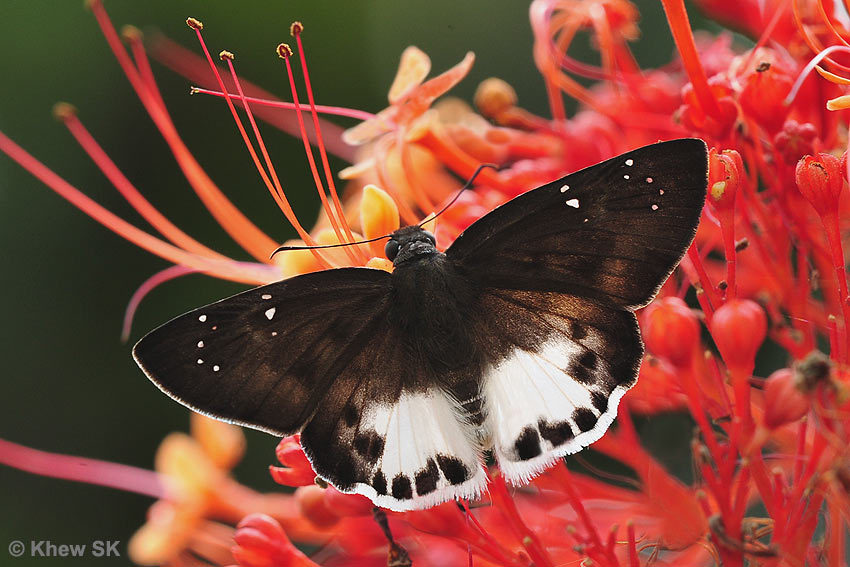
On the upperside, the wings are dark brown. On the forewing, there is a white hyaline spot in each of spaces 4,5,6,7,8 and 11.  The forewing cell features an upper spot, which usually accompanied with a smaller lower spot. On the hindwing, there is a large white tornal area with its inner edge reaching vein 6. In this whitened area,  there are black marginal spots at the end of veins 1b, 2 3 and 4. There are additional black post-discal spots in spaces 5 and 6, lying at the edge of the whitened area. Underneath, the wings are similarly marked as per above but with the whitened area on the hindwing   extended to the basal area.


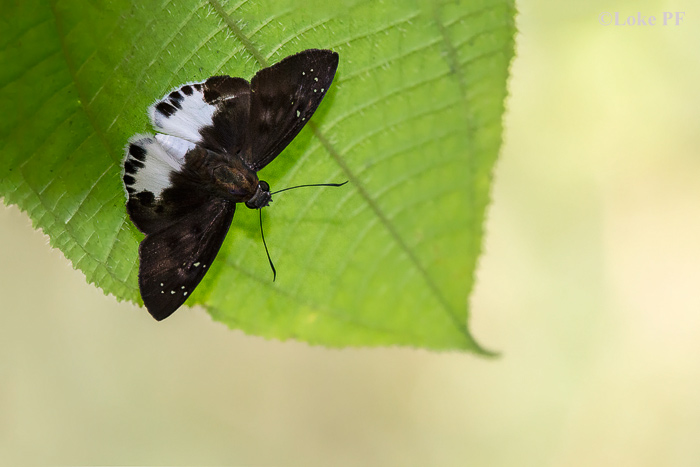
A Ultra Snow Flat perching on the underside of a leaf.

Field Observations of Butterfly Behaviour:  
This species is moderately rare in Singapore and its distribution is restricted to forested areas of the catchment reserves and in western wastelands. The adults are strong flyers and are more active in the cooler hours of the day. As is the case for the other Tagiades species, the adults have the habit of perching on the underside of a leaf between flights, and with its wings opened flat.

14 March 2015

Butterfly of the Month - March 2015

Butterfly of the Month - March 2015
The Bamboo Tree Brown (Lethe europa malaya)


The 3rd month of 2015 started quite uneventfully, with nothing out of the ordinary with regard to world news, besides the usual stuff filling our news portals daily. The weather is a lot drier now in Singapore, as the shift from the wet months of the year end gave way to rainless days and parched landscapes. Some sporadic bush fires that occurred were promptly put out by our efficient Fire Service (SCDF).


We are well into the Chinese zodiac's Year of the Goat now, as our new year celebrations ended after 15 days of feasting and tossing raw fish salad with vociferous "huat ah" during our numerous traditional "lo-hei" sessions to bring good luck for the coming year. And lucky were two punters, who won S$6M apiece in the Singapore Toto Lunar New Year Hongbao draw!


Speaking of fish, the spate of fish deaths in the waters of Singapore continues to be a mystery. It was reported that on Feb 28, a wave of plankton bloom wiped out almost all fish stock at several fish farms on the eastern coast of Singapore. The authorities said that as of early March, the bloom had killed an estimated 500 to 600 tonnes of fish after affecting 55 out of 63 fish farms along the East Johor Straits and like an invisible spectre, continues to spread within Singapore's waters. The plankton bloom is known to suck oxygen from the sea, hence killing all life in the water. Another symptom of global warming?


This month's feature butterfly is the Bamboo Tree Brown (Lethe europa malaya). The Bamboo Tree Brown primarily occurs in lowland forests where its preferred host plant, the bamboo, is cultivated. It is likely that its caterpillars may also feed on several species of Bambusa and other related types of monocotyledons in Southeast Asia.


A Bamboo Tree Brown shot in Southern Thailand, where the same subspecies malaya is also found

The butterfly appears to be more often observed during the rainy season months of the year and is most active the early and late hours of the day. In rural areas, it is occasionally attracted to the lights in houses, perching on the walls under the lights until a hungry house lizard (or locally known as the chichak) comes by.


This species is surprisingly uncommon and local in Singapore, where only a small number of sightings of the butterfly has been recorded and in very localised areas. Some areas where it was seen were at the Khatib Bongsu, Sime Forest, Pulau Ubin and at the Singapore Botanic Gardens (always not far from where its host plant grows).


A Bamboo Tree Brown perching on a sign at the Bamboo Grove at the Singapore Botanic Gardens, where it is often spotted

The Bamboo Tree Brown flies in a hopping manner quite similar to the related Mycalesis and Orsotriaena species and remains close to the ground. It stops to rest on the top surfaces of leaves or twigs, with its wings folded upright. The butterfly is skittish and has a wide circle of fear and is usually difficult to approach to photograph. A lot of patience on the part of the photographer is required before a decent shot of this butterfly can be achieved.


This species usually lurks in the vicinity of shady undergrowth amongst bamboo clumps and leaf litter. Once it is disturbed and springs from the undergrowth, it is not easy to track as it flies quickly and its cryptic underside wing patterns camouflages itself when it lands amongst thick bushes and dried leaves.


Occasionally, it is attracted to tree sap and rotting fruit on the forest floor, and whilst it feeds greedily, it may be distracted and gives an observer a better chance of approaching it before it flies off again. It is very rarely seen to display the upperside of its wings.


The Bamboo Tree Brown is predominantly brown above, with females having a wider subapical band on the forewing compared to the male. The undersides bear a number of cryptic patterns with thick lilac ocelli on the forewing. There is a short "tail" at vein 4 of the hindwing.


In Singapore, it is the 2nd largest species amongst the Satyrinae found here, only slightly smaller than the Common Evening Brown (Melanitis leda leda) which is another species whose caterpillar also feeds on monocotyledons.

Text by Khew SK : Photos by Sunny Chir, Chng CK, Antonio Giudici, Federick Ho, Huang CJ, Khew SK, Loke PF, Jonathan Soong and Anthony Wong


07 March 2015

Book Review - Butterflies of Sri Lanka

Book Review - Common Butterflies of Sri Lanka
by Himesh Dilruwan Jayasinghe


A friend from Sri Lanka, Malinga Prabhasara, recently sent me a book that was hot off the press. Titled "Common Butterflies of Sri Lanka" by Himesh Dilruwan Jayasinghe, this 175-page A5 sized book features 100 species of butterflies that are commonly found in Sri Lanka. Sponsored and published by the Ceylon Tea Services PLC the book is a project backed by the Dilmah Conservation (the famous Sri Lankan tea brand known all around the world)


Map of Sri Lanka showing major towns (left) and topographical map (right)

Sri Lanka, officially the Democratic Socialist Republic of Sri Lanka, is an island country near the south-east of India in South Asia. Sri Lanka is a republic, governed by a presidential system. The legislative capital, Sri Jayawardenepura Kotte, is a suburb of the commercial capital, and largest city, of Colombo. It is also an important producer of tea, coffee, gemstones, coconuts, rubber, and the native cinnamon, the island contains tropical forests and diverse landscapes with a high amount of biodiversity.


Blue Tiger (Tirumala limniace) ; Joker (Biblia ilithyia) ; Ceylon Lacewing (Cethosia nietneri)

Covering a land mass of 65,525 sq km, this island nation has a population of about 21 million residents.  It is a country that is well known for its rich history and culture, having been once a colony of the Portuguese, Dutch and English at different times in the past. Lying within the Indomalaya ecozone, although the country is relatively small in size, it has the highest biodiversity density in Asia. A remarkably high proportion of the species among its flora and fauna, 27% of the 3,210 flowering plants and 22% of the mammals, are endemic.


One of the endemic species of Sri Lanka, the Jewel Four-Ring (Ypthima singala)

There are about 245 species of butterflies in Sri Lanka.  The amazing fact is that there are about 26 species that are endemic to Sri Lanka! Being classified as endemic means a species is unique to a defined geographic location, such as an island, nation, country or other defined zone, or habitat type, and occurs nowhere else in the world.


The Common Butterflies of Sri Lanka is quite logically organised, not unlike many books of this genre.  Starting with the usual foreword, preface and acknowledgements, the book has the requisite basic introduction to butterflies, covering the life history from egg to adult, adult diet, protective mechanisms, mating and so on.  There is a full checklist of the butterflies of Sri Lanka with good information about their distribution.


The useful "how to use this book" pages - featuring the keys and symbols used for each species page

The organisation of each species page contains a lot of information, starting with size - large, medium, small and tiny (with reference sizes), the status of each species based on the IUCN convention and whether it is endemic. The six butterfly families are organised taxonomically into the six known family groups.


Typical species pages featuring the families Papilionidae, Pieridae and Nymphalidae

The description on each page is detailed, covering the physical attributes of the butterfly species, their behaviour and distribution. Information on the larval food plants (what we call here as caterpillar host plants) accompanies each species. Each species page features a page-width picture of the butterfly and a smaller inset of either the female or upper/underside of the species.


The Lycaenidae page (bottom) featuring the Monkey Puzzle (Rathinda amor) a pretty hairstreak that is on my hit list!

Each species has its English common name in bold text, followed by the scientific name up to species level only. A nice feature on the page is a small map of Sri Lanka, illustrating the species' distribution on the island - more abundant, less abundant and absent and colour coded for easy reference.


Hesperiidae pages from the book

Personally, I find that the text font used is a bit thin and hard to read. Perhaps the author could have used a bolder text to make the book easier to read (particularly by the more senior members of our community). The pictures for the species are large enough to show their distinguishing features and many are of high quality.  However, the pictures could be adjusted slightly brighter, as there is a general perception of the shots being a tad dark when I flipped through the book.


Crossover between Lycaenidae and Riodinidae pages.  Sri Lanka has only one species of Riodinidae

The six families are featured one after another, without a break or separation between the families. Although the families are colour-coded, it would have been better to at least have a break between the families so that a reader is aware when one family ends and another starts. However, it is acknowledged that this may be impractical, particularly for the Riodinidae, where there is only one known species in Sri Lanka.


Featuring the endemic species of Sri Lanka - these species are found only in Sri Lanka and nowhere else

At the end of the book is a section showcasing the endemic species of Sri Lanka. It is also noteworthy that the acknowledged National Butterfly of Sri Lanka, is the Sri Lankan Birdwing (Troides darsius), an endemic species that can be found nowhere else but in Sri Lanka.


Larval host plants section showing photos of the plants featured in the species pages

The special section on larval host plants is useful as an aid to identify these plants in the field and as additional knowledge for the enthusiast to be aware of which butterfly species' caterpillars uses these plants as their host plant.


Sri Lanka's National Butterfly, the Sri Lankan Birdwing (Troides darsius), an endemic species that is found only in Sri Lanka and nowhere else in the world, a valid claim that no other country can contest!

All in all, I found the book informative and useful. Though it only features less than half of the total number of species found in Sri Lanka, I am sure the book will be useful for beginners and the amateur enthusiast who may encounter these butterflies in the field. My heartiest congratulations to the author for a job well done, and for adding new knowledge and information to our butterfly world!

Book Review by Khew SK : Photos by Malinga Prabhasara and scans of the book courtesy of the author Himesh Jayasinghe.

References : 
  • Common Butterflies of Sri Lanka, Himesh Jayasinghe, Ceylon Tea Services PLC, 2015
  • A Pocket Guide to the Butterflies of Sri Lanka, H Jayasinghe, C De Alwis and S Rajapaksha, Chamitha de Alwis, 2013
Special thanks to Malinga Prabhasara for taking the extra trouble to send me the two books on Sri Lankan butterflies, and for his photos featured on this blog article
28 February 2015

Life History of the Grand Imperial

Life History of the Grand Imperial (Neocheritra amrita amrita)


Butterfly Biodata:
Genus: Neocheritra Distant, 1885
Species: amrita
C & R Felder, 1860
Sub-species: amrita C & R Felder, 1860

Wingspan of Adult Butterfly: 36-40mm
Caterpillar Local Host Plant:
Dendrotrophe varians.


Physical Description of Adult Butterfly:
On the upperside, the male is dark brown with inner and basal halves of both wings in shining blue. The female is almost entirely brown. Both sexes have whitened tornal areas in the hindwing bearing large black quadrate marginal and submarginal spots. On the underside, both sexes are mainly yellowish orange but white in the lower half of the hindwing. Black post-discal striae are present in the tornal half of the hindwing. In the forewing, the basal part of vein 12 is not black (this is a key characteristic for distinguishing the Grand Imperial from the Great Imperial). In the hindwing, there are whitish tails at the end of veins 1b and 2 with the one at vein 1b much longer (about 2.5x as long as the one at vein 2) and fluffy in appearance.


A sunbathing female Grand Imperial displaying its upperside.


Field Observations of Butterfly Behaviour:
This species is rare in Singapore. The handful of sightings took place mainly in the catchment reserves, as well as the offshore island, Pulau Tekong. The adults have a graceful flight and typically perch with its wings closed upright between flights. In sunny weather, however, they have been observed to sun-bathe with wings fully open. They are sometimes sighted while hanging around a flowering plant for their nectar intake.


Early Stages:  
Only one plant, Dendrotrophe varians, has been recorded as the local larval host for the Grand Imperial. This plant has variable leaf shape. It is rather rare in the catchment reserves with only a very limited number recorded in the past decade. The caterpillar feeds on the young to mature leaves of the host plant, with the early instars mainly skimming the leaf surface while those in the later instars devouring the leaf lamina whole from the edge.

Dendrotrophe varians, the host plant of the Grand Imperial found in the catchment reserve.

Dendrotrophe varians, with an egg of the Grand Imperial on the leaf surface.

A female Grand Imperial ovipositing on the underside of a leaf of the host plant.

The eggs are laid singly on the underside of a leaf of the host plant. Each egg is about 1-1.1mm in diameter, whitish with a subtle yellowish undertone when freshly laid. The surface is covered with numerous moderately large depressions. The tiny and depressed micropylar sits at the pole.

Two views of an egg of the Grand Imperial.

It takes about 4 days for the egg to hatch, with the young caterpillar nibbling away the upper portion of the egg shell to emerge. The newly hatched has a length of about 1.5mm. Its body has a pale yellowish brown ground colour. The pro-thoracic shield and anal plate are pale brown in colour. Each of the segments from the 3rd thoracic segment to the 7th abdominal segment has a dorsal conical protrusion. Whitish setae emanate from these protrusions. The body also features rather long whitish setae along the body rim and a quadrate posterior segment. After hatching, the infant caterpillar proceeds to devour the remnant of the egg shell.

Two views of a newly hatched caterpillar devouring the remnant of its egg shell.

As the caterpillar grows its body turns yellowish with a strong greenish undertone. After about 3 days of growth in the first instar, and reaching a length of about 3.4mm, the caterpillar moults to the next instar. During the dormant stage prior to its moult, the body is whitish with yellowish markings.

Two views of a 1st instar caterpillar, late,, length: 3mm.

Two views of a 1st instar caterpillar, dormant before its moult.

The 2nd instar caterpillar has proportionately shorter dorsal and lateral setae while the dorsal protrusions are longer and more prominent, especially those in the posterior segments. Its prothoracic shield is dark brown to black in colour. The quadrate posterior segment now has two small conical protrusions. The dorsal nectary organ on the 7th abdominal segment is now discernible. The 2nd instar caterpillar grows steadily and reaches a length of about 5.5mm. After about 2.5 to 3 days in this instar, it moults again. The caterpillar is whitish with a pink undertone when lying dormant prior to the moult.

Two views of a 2nd instar caterpillar, newly moulted, length: 3.6mm..

Two views of a 2nd instar caterpillar, later in this stage, length: 4.1mm..

Two views of a 2nd instar caterpillar, late in this stage, dormant prior to its moult, length: 5.5mm.

The 3rd instar caterpillar resembles the 2nd instar caterpillar, but with various features (such as dorsal and posterior conical protrusions, body outline) becoming more pointed or angular. At the anterior segment, two pointed protrusions are now prominently featured. Its body colour is mainly whitish with a pink undertone for the entire instar. Brown stripes can be seen encircling the base of the last 4 conical protrusions. The dorsal nectary organ is also rather large and more prominently featured than in the 2nd instar. The pair of tentacular organs found on the 8th abdominal segment is now easily observed as well. The 3rd instar takes about 2.5-3 days to complete with the body length reaching about 10mmm.

Two views of a 3rd instar caterpillar, newly moulted, length: 5.3mm.

Two views of a 3rd instar caterpillar, length: 9.4mm.

Two views of a late 3rd instar caterpillar, dormant prior to its moult, length: 9.8mm.

Initially, the 4th instar mostly resembles the 3rd instar caterpillar closely in coloration and most features. Overall, the body is still whitish but with more pale yellowish/brownish shadings, and the anal plate is dark brown. The 4th instar takes about 3 days to complete with the body length reaching about 16-17mm.

Two views of a newly moulted 4th instar caterpillar, length: 10.2mm.

Two views of a 4th instar caterpillar, later in this stage, length: 16mm.

Two views of a late 4th instar caterpillar, dormant prior to its moult, length: 16.2mm.

The 5th instar caterpillar is initially whitish in body colour, but becoming pinky brown to beige brown as growth progresses. By day 3 of this instar, the body base colour is mostly pale to dark brown with whitish coloration restricted to the last 3 to 4 segments. The two anterior protrusions appear to be longer and fused, resembling a snout.

Two views of a newly moulted 5th instar caterpillar, length: 15mm.

Two views of a 5th instar caterpillar, length: 28mm.

Two 5th instar caterpillars of the Grand Imperial sharing a leaf.

After about 4 days of feeding and reaching a length of about 28mm, the caterpillar stops food intake, and its body gradually shortened and body base colour decolorised to a patchwork of brown and white. The caterpillar would wander around in seek of a pupation site which is typically a spot on a stem or branch bearing whitish patches. At this site, the pre-pupatory caterpillar prepares for pupation by spinning a silk pad to which it attaches itself via its anal claspers. After 1.5-2 days as a pre-pupa, pupation takes place. The pupa has one prominent dorsal protuberance and two shorter ones next to it. The pupa is predominantly pale to dark greyish brown with powdery green patches decorating its surface. There are also cryptic markings in pale/dark brown, white and green to add to the concealment effect. Pupal length: 15-16mm.

Two views of an immobile pre-pupa of the Grand Imperial.

Two views of a pupa of the Grand Imperial.

9 days later, the pupa turns rather dark, first in the wing pad and thorax, then progressively in the abdomen. The next day, the pupal stage comes to an end with the emergence of the adult butterfly.

Two views of a mature pupa of a female Grand Imperial.

A newly eclosed female  Grand Imperial waiting for its wings to expand fully near its pupal case.

References:
  • [C&P4] The Butterflies of The Malay Peninsula, A.S. Corbet and H.M. Pendlebury, 4th Edition, Malayan Nature Society, 1992.
  • Butterflies of Thailand, Pisuth Ek-Amnuay, 2nd Edition, 2012.
  • A Field Guide to the Butterflies of Singapore, Khew S.K., Ink On Paper Communications, 2010.
Text by Horace Tan, Photos by Nelson Ong, Chng CK, Simon Sng, Sunny Chir, Khew SK and Horace Tan