11 April 2015

Chiangmai Expedition 2015

ButterflyCircle's Chiangmai Expedition 2015
Thailand - A Haven for Butterflies


The gang of ButterflyCircle members, complete with a specially designed T-shirt

Thailand is a country in Southeast Asia that is well-known for its rich floral and faunal biodiversity. Situated on the Indo-China plateau, Thailand has the distinction of being the 51st largest country in the world, covering an area of over 513,000 sqkm (or about 720 times the size of Singapore!). The country shares its borders with four neighbours - Myanmar, Laos, Cambodia and Malaysia.


Thailand is a long country, covering a distance of about 2,000km from Yala, the southernmost province, to the Chiang Rai province in the north. Butterfly diversity is amazing, with Pisuth Ek-Amnuay, the author of Butterflies of Thailand 2nd Edition 2012 recording a total of 1,287 distinct species found in Thailand. If all the subspecies are taken into consideration, then the number rises to a total of 1,604.


Two beauties from our previous trip to Chiangmai province.
Top - Blue Admiral ; Bottom - Kaiser I-Hind

After two prior trips to the Chiangmai area in Apr and Oct 2014, ButterflyCircle members decided to organise another "expedition" in 2015, to capture the beauty of the northern butterfly species. With a group of 12 enthusiasts from England, India, Italy, Japan, Malaysia, Singapore and Thailand, we visited a series of our favourite butterfly-hunting grounds within the Chiangmai Province.


Antonio's Butterfly Expedition patch and car decal.  He organises tours for butterfly enthusiasts and this season, he hosted several groups from Hong Kong as well

This butterfly "expedition" ably organised and put together by team leader and "butterfly tour guide" Antonio Giudici for ButterflyCircle members spanned a total of 8 days and 7 nights for the group. Interestingly, the weather for the entire week was hot and dry, with absolutely no rain at all whilst we were there.


The journey begins!  Boarding time!

Members of the group arrived in Chiangmai on various dates, with the main group of 6 from Singapore arriving in the late evening on 14 Mar. All of us stayed at our favourite Dome Hotel, a very decently-priced and comfortable hotel in town where we had previously stayed. This hotel offered the simple comforts of modern living, complete with free wifi!


Our regular "home" in Chiangmai - Dome Hotel

The hotel is located about 20 mins drive from the Chiangmai International Airport (minus the traffic jam), and within walking distance from F&B outlets and a nice modern shopping mall. For those who get cold turkey without their smartphones' 3G data plan, buying a SIM card in Thailand is cheap and convenient. A full 7-day data plan (enough for surfing FaceBook and doing your fill of Whatsapping) costs only 129 Baht. (That's about SGD5.50!)


Dinner at a local food court

After a sumptuous dinner of local delicacies at a very competitively priced food court (with a few beers thrown in), the group started planning the itinerary for the coming week. It was a gathering of old friends and some new ones. Everyone was looking forward to a butterfly-ful week ahead.

Day 2


Arriving in Chiangmai on the late evening flight the day before meant Day 1 of the expedition was just lazing around in Chiangmai and catching up with the latest news and butterfly sightings by other butterfly photographers over the past few days. We started the day off with a hearty breakfast at the Dome, and our two 4WD zoomed off to nearby Doi Suthep for our first outing of the expedition.


Top : Doi Suthep Ace, a skipper that is apparently endemic to Doi Suthep
Middle : The Grey Count
Bottom : An undescribed female aberration of the Archduke?

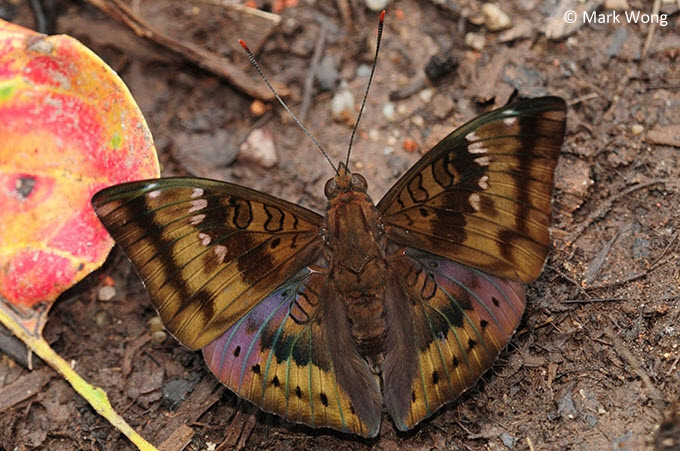
Our first stop was at along a river which is a popular spot for the local picnickers. As it was still early, we had the place to ourselves for some time as we searched for puddling butterflies. Amongst the notable species were the Grey Count, Doi Suthep Ace, several Polyura spp. Barons, Archdukes, Knights and so on.


A quick check on our little waterfall halfway up yielding species like the Blue Imperial, a couple of Lethe spp., the usual Logania that we saw on previous trips, and several others. Driving further up to the spot where the strange-looking Truncate Imperial was recently spotted, the group spent some time chasing this rarity and were rewarded with some shots of it.


The day's catch left everyone happy, as we made our way back to Chiangmai International Airport to pick up one more member - the rose amongst the thorns, who came one day later than the main group. Dinner was in Chiangmai as we compared notes on our day's "lifers".

Day 3


The famous Chiang Dao checkpoint and carpark which is a butterfly heaven according to some!

Early next day, the group was up and about, and we checked out of the Dome Hotel, and headed to Chiang Dao, a reputable 'hot-bed' of butterfly activity. The intention was also to stay at a "local" hotel in the vicinity of the famous Chiang Dao carpark, and then save on the typical hour's travelling time between Chiangmai and Chiang Dao.


The excitement rose as we neared the spot which many of us shot so many butterfly species on previous trips. There was also a slight apprehension as we noted the newly-tarmac'ed road leading to the checkpoint. If the authorities had, in their well-meaning intention of improving the roads and facilities, also "upgraded" the carpark at the checkpoint, then it will be the end of our favourite butterfly-shooting location!  Fortunately, it wasn't the case.


This must be the origin of why we are called ButterflyCircle?

From the word "go", the place was teeming with butterflies and there were hundreds of them puddling and flying around. The park rangers who manned the checkpoint must be quite used to crazy butterfly photographers at this location, but were still nevertheless amused at our group. One of them obliged by spraying water on the ground to attract the butterflies to puddle. This area is quite a butterfly gathering place, and to attract butterflies, "just add water" and they will flock to feed on the salts from the ground.


We spent a whole day shooting butterflies of all shapes and sizes, and the group, though many of us, walked around to several favoured spots so that we generally avoided getting into each others' way. Until when someone shouts in excitement at spotting a rarity, then the group will rush to see what caused the ruckus. When a rarity does show up, the more experienced members of the group generally practise photography etiquette so that as many members as possible are able to shoot the subject.


Dinner at the Nest2

When we were done for the day, the tired but happy gang of photographers headed to the nearby Nest 2 resort and checked in. We were pleasantly surprised at the nice accommodation and even more pleasantly surprised at the nice food available at the resort so that we didn't have to leave the premises to look for our dinner. Accommodation was in nice chalets and the environment was clean with all the luxuries that we would expect in the city.

Day 4


A typical chalet at the Nest2 with the scenic mountain view behind

The next morning, five of the group headed off north to the town of Fang, and to Doi Pha Hom Pok with the mission of nailing the elusive Kaiser I-Hind (Teinopalpus imperialis). The remaining group of five headed back to the carpark to continue our Chiang Dao butterfly-shooting adventure. It is always exciting to find that each day brings different species to the same location.


It was another hot and scorching day, and the butterflies were out in numbers as soon as the sun warmed up our shooting grounds. Due to the exceptionally large numbers of the Zebra Blue, it was always a challenge to look for small and rarer species - literally searching for needles in the haystack. But ever so often, a solitary rarity will appear out of nowhere to taunt us, and then magically disappear before we could get close for a good shot.


Highlights of the day were several Grey and Yellow Tinsels, a friendly Indian Red Admiral, a White Commodore, Indian Fritillary, several Skippers and many more. The group that went up north had a relatively quiet day, but managed to spot and shoot the rare Blue Peacock (Papilio arcturus) and Orange Freak up on the mountain.


Dinner was back at the Nest 2, and the usual after-dinner chats and sharing of the day's catch at one of the relaxing outdoor cabanas in the resort grounds. We packed our bags and got ready to check out the next day, but not before heading back to the Chiang Dao carpark for more shooting before taking the hour plus drive back to Chiangmai.

Day 5


The outdoor cabana at the Nest2 in the early morning hours

After breakfast, we checked out and bade farewell to the nice people at Nest 2, and dumped all our luggage into the cars. A quick 5-minute drive to the shooting location, did our usual setting up activities and it was back to our "back-breaking work" of shooting butterflies. I noticed that my camera body and lens were coated with dust after a few days of "puddling" with the butterflies in the dirt. This time around, our investment in getting knee and elbow guards helped minimise the abrasions and injuries when getting down to shoot puddling butterflies.


There were also a lot of bees and other biting insects amongst the butterflies, and always a source of irritation to us butterfly shooters. A few of us even got stung more than once, but fortunately, none of us were allegic to bee stings (perhaps with the exception of our English friend, Les, who somehow managed to get away unscathed).


A strange female form of the Courtesan

The rare Saffron that made Antonio's day!

It was another day of heavy shooting and we encountered several more new species that we did not see on the previous two days of shooting at Chiang Dao. Antonio had his "special" when he was able to shoot a species on his "hit list", the Saffron (Mota massyla). The rest of us continued to search for a more species, or to take a better shot of one that had been previously shot. Most of us managed to shoot a strange female form of the Courtesan (Euripus nyctelius) that appeared to be a hybrid of two other forms.


As we were about to leave, our sharp-eyed member spotted a Green Flash amongst the low shrubs and everyone scrambled to chase it down. But alas, this individual wasn't cooperative and after a few zips here and there amongst the green weeds, its undersides blended in well and camouflaged it from the group of frustrated photographers.


So off we headed onto the highway back to Chiangmai, checked in to the Dome again, and after a much needed shower and wash-up, we headed out for dinner. It was a relatively fruitful 3-day shooting outing in Chiang Dao, though some of the "locals" would say that it could be better!

To be continued...

Text by Khew SK : Photos by Sunny Chir, Chng CK, Les Day, Goh LC, Antonio Giudici, Huang CJ, Khew SK, Loke PF and Simon Sng.

04 April 2015

Life History of the Baron v2.0

Life History of the Baron (Euthalia aconthea gurda)


Butterfly Biodata:
Genus: Euthalia Hübner, 1819
Species: aconthea Cramer, 1777
Subspecies: gurda Fruhstorfer, 1906
Wingspan of Adult Butterfly: 50-70mm
Local Caterpillar Host Plant: Mangifera indica (Anacardiaceae, common name: Mango).


Physical Description of Adult Butterfly:
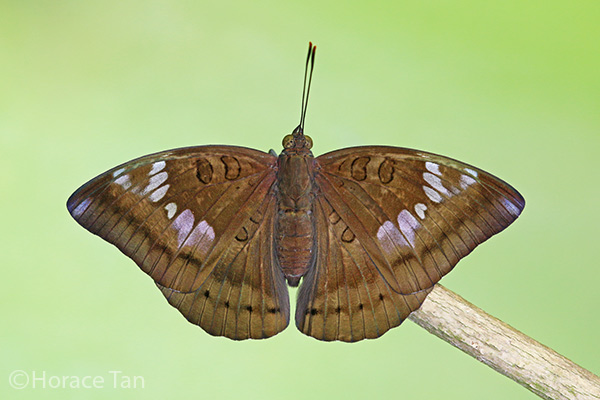
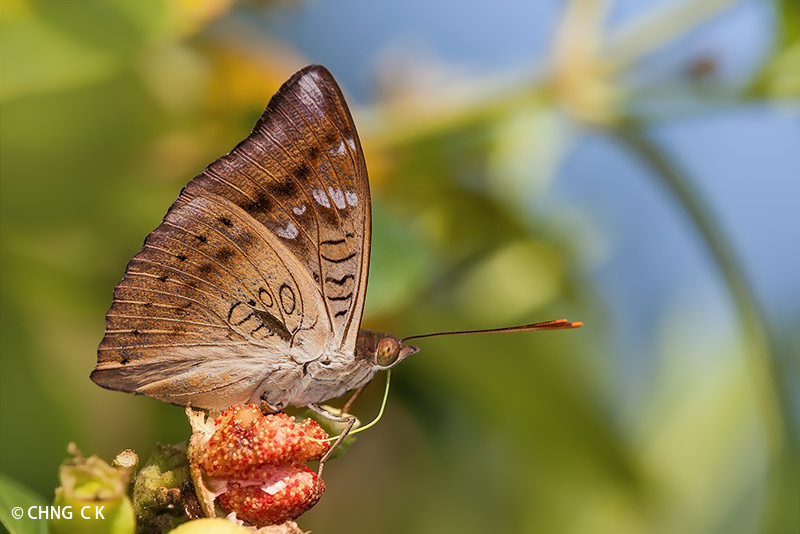
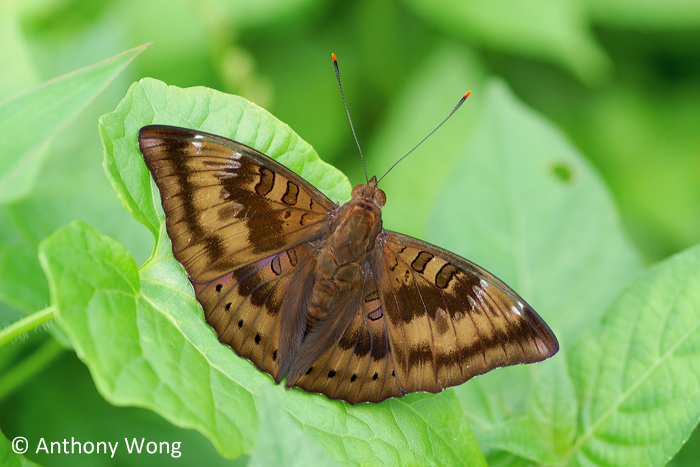
On the upperside, the male is dark brown with a broad obscure post-discal band on both wings. The inner edge of this band on the forewing bears several small whitish spots. The wings typically exudes a dark purplish tinge when viewed in sidelight. The female is larger and pale bluff brown, and the white spots on its forewing are larger and well defined. On the underside, the wings are paler and have a submarginal series of black spots on both fore- and hindwings. The proboscis is lime green.


28 March 2015

In Memory of Lee Kuan Yew (1923-2015)

In Memory of Lee Kuan Yew (1923-2015)
A Personal Tribute


Mr Lee Kuan Yew's portrait with the orchid named after him, Aranda Lee Kuan Yew at Singapore Botanic Gardens

For the first time since I penned my maiden article on this blog way back in Aug 2007, we are featuring all our butterfly photos in black-and-white in this weekend's article. It is a mark of respect for the founding Prime Minister of the Republic of Singapore, Mr Lee Kuan Yew (1923-2015). He passed away at the age of 91 on 23 Mar 2015.


Mr Lee was Singapore's longest serving Prime Minister, having been elected into office on 5 June 1959, in the same year that I was born, and stayed on as PM until 1990. My earliest memories of Singapore was when my dad was posted to Johor Bahru when I was just a year old, and for a period over 7 years (until we moved to another state in Malaysia), weekend trips across the Causeway to Singapore to visit my cousins were always looked forward to in anticipation.


Back in those days, we didn't need passports and there were no long queues at the checkpoints (because there were none!). My dad's Volkswagen Beetle just chugged across the Causeway, and we always recognised the landmarks like the old Yeo Hiap Seng factory in Bukit Timah Road and driving up to Newton Circus meant that we would soon be reaching my uncle's house at Norfolk Road. I had fond memories of Orchard Road, in particular, shopping at Fitzpatrick's Supermarket, CK Tang and of course, yummy ice cream were some of the simple pleasures that I always looked forward to on our family trips to Singapore.


Fitzpatrick's Supermarket in Singapore in the 1960's. Anyone remembers this building?

My early impression of Singapore was that it was more vibrant and exciting than where I lived in Johor Bahru, and the lights, glitzy buildings and modern supermarkets were always more attractive and something to look forward to. Then there was Mr Lee Kuan Yew, whom practically everyone in my era would know as the Prime Minister of Singapore, and who did good things for the common people.


After my family moved away from Johor Bahru, school took up most of my time, but like any school kid during the 60's and 70's, we fashioned our own entertainment by being outdoors, climbing trees, catching longkang fish, playing with fighting spiders and of course, in my case, chasing after and collecting butterflies, which started a lifelong hobby that lasted to this day.


Over two decades from 1960, and in particular after the separation from Malaysia in 1965, we watched Singapore from afar. Back home, tensions grew and came to a boil on 13 May 1969 with the racial riots in Malaysia. As a young 10 year old school-going boy living in Petaling Jaya, almost at the heart of the riots, it was traumatic and terrifying - listening to and reading reports of wanton killing between the Malays and Chinese in KL. The curfew kept our family at home, with doors locked and windows shut for nearly two weeks, as I saw the remaining food in the pantry dwindling and how my mom sacrificed her share of the food at each meal so that my brother and I could eat our fill.


Singapore's progress in the 70's was certainly the envy of its neighbours, and the media always attributed all these success stories to the visionary thinking of Mr Lee Kuan Yew. By the early 70's my dad was posted back to my birthplace of Penang, and I was doing my GCE O and A levels. After I received my results, I tried applying for both local and foreign universities. An offer of a scholarship from the Public Service Commission of Singapore came along, and I jumped at the chance of an opportunity to continue my tertiary education in Singapore. The sponsorship of promising students from all over Asia was a product of Mr Lee's vision and educational policy to recruit the best for Singapore.


What attracted me (and many of my friends too) most about Singapore, is its policy on meritocracy. If you did well in your studies, it doesn't matter what your skin colour is, which religion you embrace, or who your parents are. I was given an offer of a professional undergraduate course in the National University of Singapore. My applications to the local universities yielded courses like Applied Science and Arts, which I had absolutely no interest in. I recall leaving Penang in May 1979 via the Keretapi Tanah Melayu (KTM) train, choo-chooing all the way down to Tg Pagar Station in Singapore. My life in Singapore started with three weeks of orientation (called ragging in those days) in one of the University Halls of Residence.


Being active in the Dunearn Road Hostels and Sheares Hall at NUS meant contributing my time and energy. In my five years there, my stay in the hostels taught me independence, commitment, loyalty, leadership and perseverance through all sorts of adversity. The experience taught me how to work with my peers and motivate others towards a common goal - life skills that were to become very relevant in my working life.


Ironically, my first indirect encounter with Lee Kuan Yew, was during his official visit to the University in 1983. Apparently, whilst driving past my hostel, he observed and remarked that there was a tree that was planted too close to the building, and that its roots may damage the foundation. That tree happened to be outside my room's window, and whose shade and greenery I had enjoyed for a couple of years. Much to my dismay, that same tree was chopped down the very next day! I later found out that the University's Estate Office had an overzealous staff who interpreted Mr Lee's comment as an instruction to remove the tree! Such was the power of Lee Kuan Yew's words, and the actions that followed. I didn't think that he meant for the tree to be cut down, and he probably did not drive past my hostel again for some time to notice that his well-meaning comment meant the demise of a tree. What was amazing about this story? That tree was at least 50m away from the road, and he was driven past in a car, yet made that observation. Most of us would have just enjoyed the view from the car and not notice anything!


Serving an 8-year bond in the public sector after graduation gave me a first-person insight of the governance that the Lee Kuan Yew administration had designed for Singapore - clean, efficient and systematic. In the 80's, the nation-building machinery sped along at a frenetic pace. We were churning out schools at the average rate of one per month by the mid 80's. My fellow architects and I gained valuable professional experience at a rate of at least twice to thrice the speed of our contemporaries in neighbouring countries - we designed and implemented schools, hospitals, courthouses, museums, airports, bridges, prisons (!), parks, Ministry HQs, police and fire stations, universities, laboratories and many other institutional buildings too numerous to mention here. We were literally thrown into the deep end of our profession, and had to learn fast. But the Singapore spirit prevailed.


It was an exciting era, and as Singapore progressed, developed and improved its physical infrastructure, so did the economy and fortunes of its people. I could feel the pride and sense of achievement in the country, as we leapfrogged our neighbours in practically every aspect of growth and development. Less than 10 years after I stepped onto this little island in the sun, I decided that this would be home and where I would carve out my career and raise my family. I became a proud citizen in 1988. Making that decision meant a commitment and appreciation to the country that I had largely benefitted from.


Working in the Public Works Department, we had to also serve the Istana where Lee Kuan Yew spent his working hours. From my colleagues I learnt that he was a man with exacting standards and high expectations. He was also frugal, and in one example, rejected a proposal (in 1995) to change his working desk that he had used since he became PM in 1959! His comment? "What's wrong with this desk? It is still good and serves its function!"


The years went by, and like most ordinary Singaporeans, I just admired and respected Mr Lee from afar. There were a couple of times when I had the opportunity to be at the Istana, but was never courageous enough to approach him for a photograph. (We didn't have smartphones and selfies in those days)


ButterflyCircle members after a survey at Istana in 2006

The years sped past, and in 2006 I was invited to check out the Istana's butterfly biodiversity after the late Mrs Lee asked "where are the birds and butterflies at Istana grounds, despite the lush greenery?". Singapore's Garden City and City in a Garden reputation did not happen by chance. We are known as a “City in a Garden” due to Mr Lee Kuan Yew’s bold vision of greening Singapore. He saw this as a means of distinguishing Singapore from other cities, especially in the region. A green city would help convince potential investors that the place was well-run.


On 16 June 1963, Mr Lee Kuan Yew, who was then the Prime Minister, planted a tree at Farrer Circus to start Singapore on its greening journey. Mr Lee believed that introducing greenery would reduce the harshness of Singapore’s urbanisation, beautifying the city and making Singapore a more conducive environment to live in.

And thanks to Mr Lee's greening vision, we have a lot more biodiversity in Singapore than many would have expected in a city with such intensive development.  With ButterflyCircle members, we conducted a couple of surveys, and then advised the NParks curator on how to improve the butterfly diversity in Istana. It was during that period, when I also had the pleasure of meeting Mdm Ho Ching, the PM's wife, and that initial encounter culminated in the publication "A Field Guide to the Butterflies of Singapore" in 2010. Thank you, Ho Ching!


As we look at what Singapore is today, and during this week of mourning by all Singaporeans for Mr Lee Kuan Yew, each of us had, at one time or another, benefitted from his vision and leadership. Singapore is by no means perfect - and no country will ever be. But it is the vision, spirit, dedication and determination of its leaders and people that make the difference. I made my decision 27 years ago to make that commitment to Singapore - a country that helped me grow and succeed in an environment of meritocracy and equality - without racial prejudice or religious bias. I am proud to be a Singaporean and be a part of Singapore's progress and success story. Majulah Singapura!


Farewell and Rest in Peace, Mr Lee Kuan Yew. Thank you for Singapore. You are now reunited with the love of your life, Mdm Kwa Geok Choo in a better place. May the butterflies be with you! :)


Mr & Mrs Lee Kuan Yew, may your spirits soar above the clouds and watch over Singapore.  Rest in Peace.

Text and Photos by Khew SK

The Singapore Pledge
We, the citizens of Singapore,
pledge ourselves as one united people,
regardless of race, language or religion,
to build a democratic society
based on justice and equality
so as to achieve happiness, prosperity and
progress for our nation.

21 March 2015

Life History of the Ultra Snow Flat

Life History of the Ultra Snow Flat (Tagiades ultra)


Butterfly Biodata:
Genus: Tagiades Hübner, 1819
Species: ultra Evans, 1932
Wingspan of Adult Butterfly: 37-43mm
Caterpillar Local Host Plant: Dioscorea glabra (Dioscoreaceae).


Physical Description of Adult Butterfly:
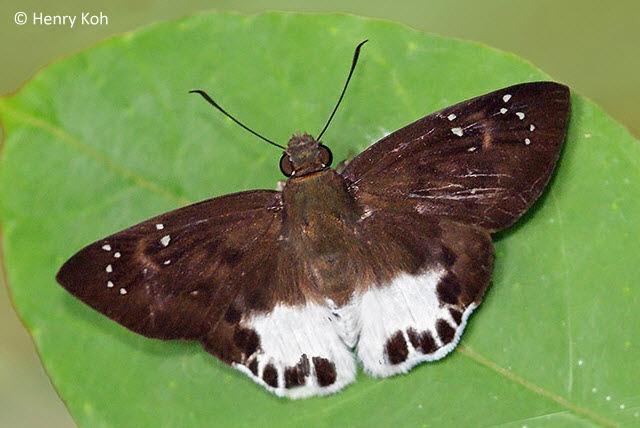
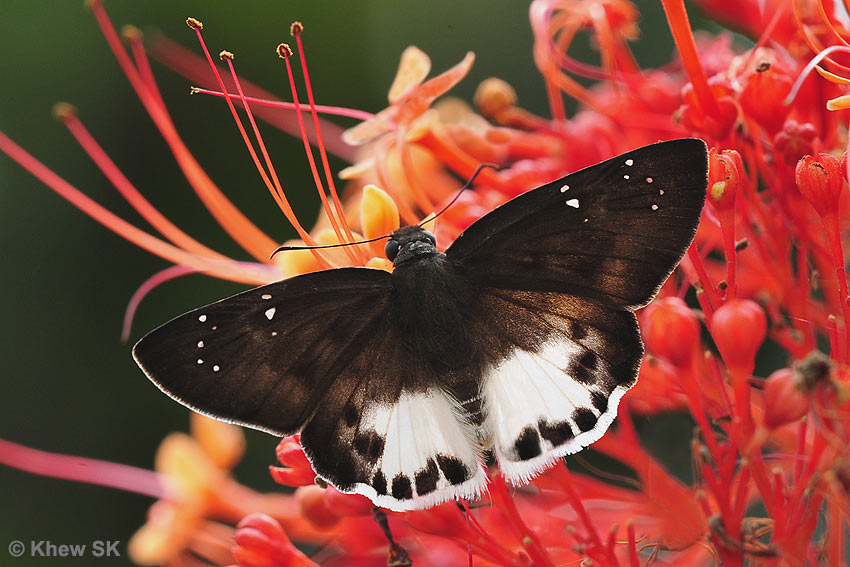
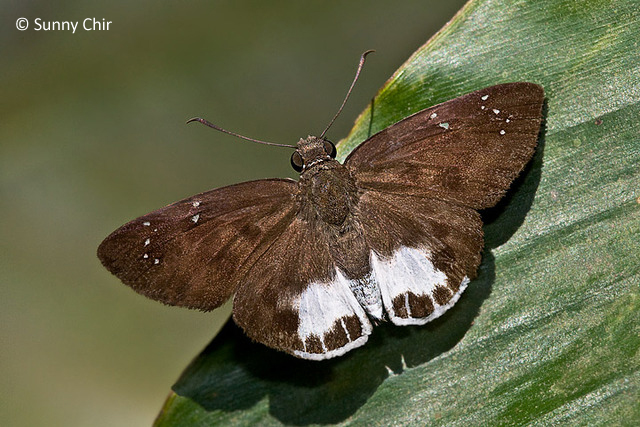
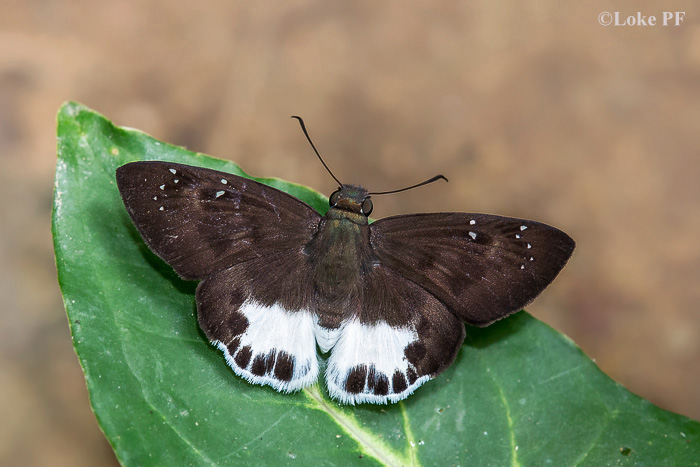
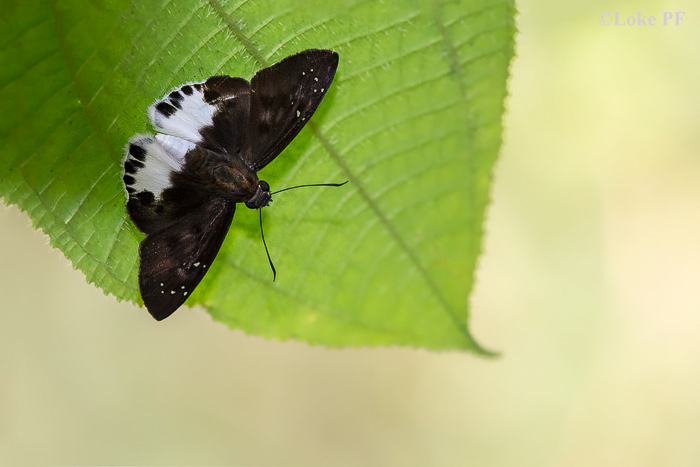
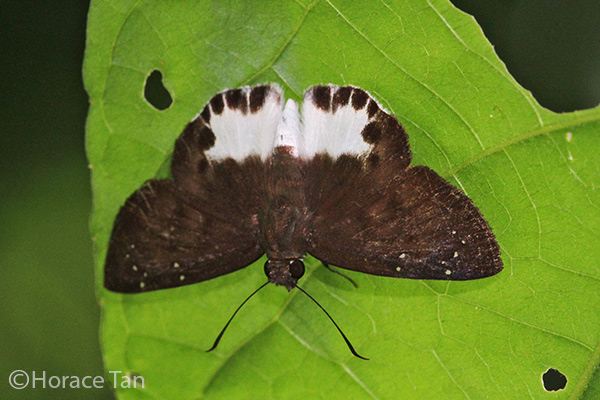
On the upperside, the wings are dark brown. On the forewing, there is a white hyaline spot in each of spaces 4,5,6,7,8 and 11.  The forewing cell features an upper spot, which usually accompanied with a smaller lower spot. On the hindwing, there is a large white tornal area with its inner edge reaching vein 6. In this whitened area,  there are black marginal spots at the end of veins 1b, 2 3 and 4. There are additional black post-discal spots in spaces 5 and 6, lying at the edge of the whitened area. Underneath, the wings are similarly marked as per above but with the whitened area on the hindwing   extended to the basal area.


A Ultra Snow Flat perching on the underside of a leaf.

Field Observations of Butterfly Behaviour:  
This species is moderately rare in Singapore and its distribution is restricted to forested areas of the catchment reserves and in western wastelands. The adults are strong flyers and are more active in the cooler hours of the day. As is the case for the other Tagiades species, the adults have the habit of perching on the underside of a leaf between flights, and with its wings opened flat.