Showing posts sorted by relevance for query Spalgis epius epius. Sort by date Show all posts

15 October 2011

Butterfly of the Month - October 2011

Butterfly of the Month - October 2011
The Apefly (Spalgis epius epius)


And here we are, halfway into the tenth month of 2011.  October is one of the long months of the year, with 31 days.  China celebrates its National Day, with extended long holidays and celebrations.  The country's development pace has been amazing, over the past two decades, and on its way to becoming an economic powerhouse to rival the traditional leaders of the western nations.  Even as the US and Europe struggle with their domestic financial woes, China and Asia grow from strength to strength.


A large part of October also belongs to the Librans - those born under the horoscope of the sign of the scales.  Placed as one of the air signs, Librans tend to be more compatible with those born under Gemini and Aquarius.


On Oct 5, the world lost a visionary, a tech genius and a pioneer - perhaps one of the foremost— in the field of business, innovation, and product design, and a man who had profoundly changed the face of the modern world - Steve Jobs.  The man who gave us the Mac, Apple, iPod, iPhone and iPad - devices that changed the way people communicated and revolutionalised the IT world and our lifestyle. 


The birthstone for October is the opal.  It is an amorphous form of silica, of which 3% to 21% its total weight is water.  The stone comes in a very wide range of colours, ranging from milky white to blues, greens and reds.  The opal is Australia's national stone, and from where nearly 97% of the world's supply of the stone comes. 


October's child is born for woe,
And life's vicissitudes must know,
But lay an opal on her breast,
And hope will lull those woes to rest.
- Gregorian Birthstone Poems


This month, we feature the diminutive Miletinae species, the Apefly (Spalgis epius epius).  This butterfly has a curious name, for the adult of the Apefly bears no simian resemblance whatsoever.  The common English name, however, probably comes from the pupa's resemblance to the face of an ape!  (Can you see the face of an ape in the photo of the pupa below?)

Copyright : Virenvaz via Wikipedia


The Apefly belongs to the family Lycaenidae, subfamily Miletinae, which is known by its collective name of the Harvesters.  The caterpillars of this subfamily are 'carnivorous' and feed on a variety of Homoptera like aphids, coccids and mealy bugs.  (See earlier blog article on Mergers, Partnerships & Betrayals)


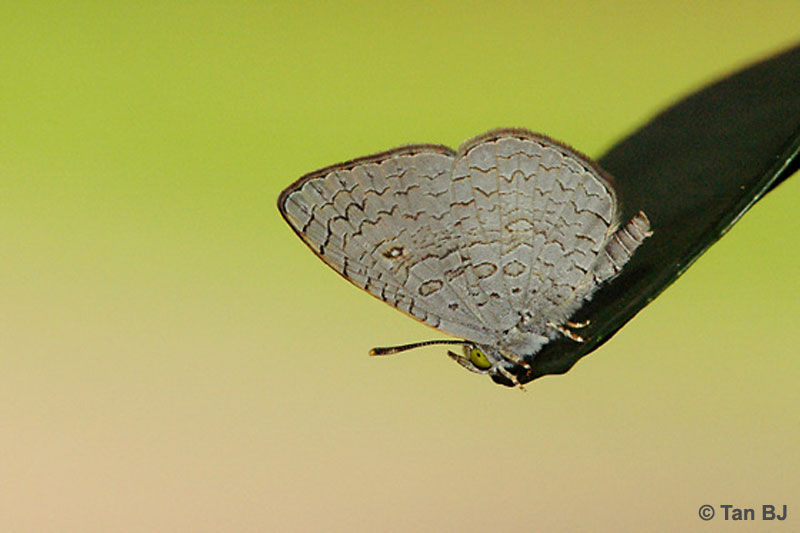
The Apefly has dark brown wings above and unmarked, except for a whitish discal patch, which is larger in the female. The underside is grayish buff, with numbers dark striations with a clearly defined brown-edged white spot at the cell end of the forewing. It has yellow-green eyes and long pointed palpi. Males have more pointed forewings than the females.

An amusing face shot of the Apefly showing its green eyes


It has a stronger flight than many of the other species in the subfamily, and on occasion, persistently returns to a few favoured perches despite being disturbed. 


At times, it flies erratically non-stop for long periods of time without stopping, a behaviour that is often observed in the other species of the Miletinae. 


The Apefly has red banded legs, and from field observations, although it has six fully-developed legs to stand on, it often perches with only four legs, preferring to fold up its front legs tightly against its body.  But there are definitely instances when all six legs are extended as it perches.


The antennae are short, robust and stubby, with a distinctly strong orange tip at the clubbed end.  The palpi are long and sharp and gives a distinct look to the Apefly.


And so, let's enjoy the remainder of the 10th month of 2011 with an interesting read about the diminutive and interesting Apefly, a species that is moderately common in Singapore, and that an observant naturalist is likely to encounter from time to time in the field. 

Text bt Khew SK ; Photos by James Chia, Khew SK, Loke PF, Nelson Ong, Tan CP, Tan BJ, Mark Wong & Benjamin Yam

01 November 2012

Random Gallery - Apefly

Random Butterfly Gallery
The Apefly (Spalgis epius epius)


This diminutive butterfly, the Apefly (Spalgis epius epius) belongs to the family Miletinae, collectively referred to as the 'Harvesters'. The caterpillars of the butterfiles of this family are typically carnivourous and feed on coccids, mealy bugs, aphids and even ant larvae. The Apefly is brown and usually unmarked on the upperside, whilst the underside is a greyish buff covered with striations

This Apefly resting on some young leaves, was photographed last weekend by ButterflyCircle member Loke PF at an urban hill park.  The rounded forewings indicate that this is a female of the species, where males typically have sharper wings, particularly a more angled apex on the forewings.

04 September 2014

Butterflies Galore! : Apefly

Butterflies Galore!
The Apefly (Spalgis epius epius)


In butterfly photography it is as important to get the subject (the butterfly) in focus and well-composed, as it is to get an uncluttered background so that the subject does not have to compete with too many elements in the photo for the viewer's attention. Many of ButterflyCircle members' shots depict creamy clean backgrounds, often green, that allow the subject butterfly to 'pop' out prominently in the photo.

In this shot, taken by ButterflyCircle member Loke PF, a different coloured background (from the usual green) does well in focusing the viewer's attention on the diminutive Apefly. In this case, the salmon coloured background helps to contrast well with the grey of the butterfly and the deep green on the leaf that it perches on.

29 October 2013

Butterflies Galore! : Apefly

Butterflies Galore!
The Apefly (Spalgis epius epius)


The common name for this species probably originated from its pupa which, when viewed from a certain angle, resembles the face of an ape. The species is quite widespread in Singapore, although it is by no means common. The caterpillars of the Apefly feed on coccids or mealy bugs, hence the butterfly appears where its caterpillar's food source is available. The species is therefore not dependent on any particular species of host plant.

This female Apefly was photographed by ButterflyCircle member Sunny Chir. The species usually flies around restlessly but occasionally stops to rest on the top surfaces of leaves with its wings folded upright. On rare occasions, it is observed to open its wings partially to show its uppersides when sunbathing.

21 March 2010

Mergers, Partnerships & Betrayals

Mergers, Partnerships and Betrayals
The Miletinae - The Harvesters


A multi-tasking pair of Bigg's Brownie (Miletus biggsii biggsii) - mating & feeding amongst their protector ants

In the real corporate world, the title of this blog would probably not elicit much interest and excitement, other than offering a good read about yet another unfortunate company being swallowed up, or employees being thrust into a chasm of anxiety about their future.


A Bigg's Brownie (Miletus biggsii biggsii) feeding off what appears to be a "herd" of mealy bugs that are tended by their protector ants

In the world of Lepidoptera, however, the partnership between butterfly and ants is already a well-studied topic by entomologists. Myrmecophily, or the positive interspecies association between ants and butterflies (or rather, their caterpillars) has been widely studied. This symbiotic association occurs with some Lycaenidae caterpillars evolving specialised organs that exude honeydew in return for protection by the ants. These caterpillars then go about their daily business of feeding on the leaves of their host plants, whilst enjoying 'armed' guards' protection from predators.


However, there exists a subfamily within the Lycaenidae family - the Miletinae, that is unique in the sense that their caterpillars are predatory or "carnivorous" in the butterfly world. Whilst it is generally well-known that most caterpillars are "herbivorous" and generally feed on leaves, buds and flowers of plants, the Miletinae (or commonly referred to as the Harvesters) species' caterpillars feed on a variety of Homoptera like aphids, coccids, mealy bugs and one species even feeds on ants' larvae!


In Singapore, the Miletinae is represented by five genera - Allotinus, Logania, Spalgis, Miletus and Liphyra. Other than Liphyra, the other genera have caterpillars that feed mainly on a variety of Homoptera.


The aphids, coccids and mealy bugs, which form the principal diet of the caterpillars of the four genera mentioned, tend to feed on young shoots of various plants. These insects have adapted piercing mouth parts that pierce and suck the sap of plants - usually soft-stemmed ones. The Homoptera must suck large amounts of sap from the plant to get their nutrients. Much of the sap is a sugary fluid that cannot be digested. This extra liquid is passed through their body and excreted as "honeydew." Ants and other insects "farm" the Homoptera and collect honeydew for their own food. In return for their food, ants will protect the Homoptera that provide their colony with a food source.


In the field, observations have been made of the Miletinae adults feeding off the secretions of the aphids, mealy bugs and coccids. The butterflies do this brazenly, without any fear of being attacked, in the presence of the protective ants that are also 'milking' the aphids or mealy bugs of their honeydew.

Walking gingerly in a minefield of ants!

Besides feeding off the honeydew, the Miletinae also lay their eggs where the aphids and mealy bugs are present, and the caterpillars of these species feed on the aphids and mealy bug community.

A Pale Mottle (Logania marmorata damis) amidst mealy bugs and their "farmers"

It is interesting to note that the ants neither extract honeydew from, nor tend to the caterpillars in this case. They go about their business of tending to the aphids or mealy bugs, but leave the caterpillars alone - despite the caterpillars devouring their "herd"! Why then, don't the normally ferocious ants attack and kill the predatory caterpillars?


Miletinae caterpillars amongst their "sheep" which provides food as they grow

Researchers have postulated that the caterpillars (and even adult butterflies) have some kind of chemo-mimicry that render themselves 'invisible' to the ants. In other words, as far as the ants are concerned, the Miletinae adults and caterpillars are perceived as just another ant in the colony.


Hello? Are you my brother? An ant checks out a Lesser Darkie (Allotinus unicolor unicolor).

Therefore, although the caterpillars and adult butterflies of the Miletinae derive 'protection' from the ants, they give nothing back in return. On top of that, the adult butterflies partake of the honeydew that are secreted by the aphids and mealy bugs, and their caterpillars feed on the ants' source of food. Hence the "betrayal" part of the whole situation, where the ants have been hoodwinked into a win-lose relationship with the Miletinae.

A Lesser Darkie feeds on honeydew produced by some aphids that are tended by their farmer ants

An even more extreme situation occurs with the Moth Butterfly (Liphyra brassolis abbreviata). The caterpillar of this species feeds on the larvae of the Weaver Ant (Oecophylla smaragdina). It is interesting to note that the caterpillar feeds and grows inside the nest of the ants, and has evolved a clever way to escape the wrath of the ants when it ecloses. Our earlier blog article describes the Moth Butterfly.

A newly-eclosed Moth Butterfly (Liphyra brassolis abbreviata) whose caterpillar feeds on ant grub

This unique characteristic of the sub-family Miletinae in the butterfly world is amazing, and runs contrary to the conventional belief that all caterpillars are herbivorous and feed only on plant material. The adult butterflies of the five genera of the Miletinae found in Singapore are therefore very widespread, having little dependence on the location of host plants, as their "host" food is actually other living insects! Hence wherever there is a colony of aphids, coccids or mealy bugs, the adult butterflies of this sub-family will seek them out, for food for themselves as well as their young.

An Apefly (Spalgis epius epius) one of the Miletenae whose caterpillars also feed on Homoptera

So do look out for these butterflies and special behaviour when you are out in the field!


Text by Khew SK ; Photos by Sunny Chir, James Foong, Federick Ho, Khew SK, Loke PF, Bobby Mun, Horace Tan & Tan Tze Siong

26 July 2020

Butterfly Photography at Our Local Parks - Kent Ridge Park

Butterfly Photography at Our Local Parks
Featuring : Kent Ridge Park


The Canopy Walk at Kent Ridge Park, surrounded by lush greenery at tree canopy level

On our rambles around Singapore's parks and gardens in search of butterflies, we explore the series of parks that make up the Southern Ridges. Starting from west and moving towards east, the Southern Ridges comprises Kent Ridge Park, Hort Park, Telok Blangah Hill Park and Mount Faber Park. All the four parks are connected via walkways and overhead bridges. In this blogpost, we visit the western-most entrance of the Southern Ridges, Kent Ridge Park.


A map of the Southern Ridges parks, comprising Kent Ridge Park, Hort Park, Telok Blangah Hill Park and Mount Faber Park.

A larger map of the 47 Ha Kent Ridge Park, stretching from Science Park to Pasir Panjang Road to the southwest boundary of the park

Kent Ridge Park is a wartime historical park, where one of the last battles for Singapore was fought during the Japanese Occupation. A war memorial plaque stands in Kent Ridge Park, erected to honour Lt Adnan Saidi, a lieutenant of the Malay Regiment's 1st Battalion, who died fighting the Japanese in one of the fiercest battles in Singapore in World War II. He led his men in the Battle of Opium Hill (Bukit Chandu), off Pasir Panjang, frustrating the Japanese efforts to take the ridge. He motivated his troops to try and fend off the Japanese, even though they were grossly outnumbered and undersupplied.


The main access road, Vigilante Drive, that leads up to Kent Ridge Park

The main carpark at Kent Ridge Park. Public amenities like rest rooms and drinking fountains are also located at this main area

A large shelter at Kent Ridge Park

Lush vegetation and towering trees are typical at Kent Ridge Park

Access to Kent Ridge Park on the eastern boundary, is via the winding South Buona Vista Road, turning left onto Vigilante Drive, up a steep incline to the ridge. There is a fairly large main carpark of about 40 lots and a smaller one near the entrance along Vigilante Drive. Parking is free. Covering a total area of 47 Ha, Kent Ridge Park features lush natural vegetation, tall mature trees and is rich in biodiversity.


Butterfly Row - a delightful row of butterfly-attracting nectaring plants to watch butterflies!

There are many trails starting from this point, leading in all directions around the ridge and enough biodiversity to satisfy the nature buff and those out for some fresh air and exercise. Just beyond the main carpark and a short walk along the ridge, is a row of butterfly-attracting nectaring plants like Shanghai Beauty (Jatropha integerrima), Snakeweed (Stachytarpheta indica), Red Tree Bush (Leea rubra) and many others.


Pansies and Skippers can be found feeding on the flowers

This "Butterfly Row" is a good place to visit to find butterflies fluttering around and feeding on the nectar from these flowering plants. In the morning hours, one can expect to find several species of skippers flitting from flower to flower, the sun-loving pansies, Chocolate Albatross, Lemon Emigrant and a variety of hill-topping Lycaenidae, if one is lucky.


A Bush Hopper that can be found amongst the grasses at the verge of the pond

A view of the pond at the eastern boundary of Kent Ridge Park

On the eastern side of Kent Ridge Park is a large pond abutting the boundary of Science Park. Starting from the low-point at this pond, there are many meandering footpaths that weave through the vegetation and rising in elevation towards the highest lookout points in the park. There are many dragonflies and damselflies around the pond, and amongst the grasses, species like the Bush Hopper and other skippers flit around.


Wide paths and lush greenery on both sides to cheer the nature lover and fitness enthusiast.  Compare the scale of the joggers with the heights of the trees flanking the path

Expect some steep climbs and lots of staircases! 

But don't worry if you run out of breath!  There are sturdy shelters and stone seats for you to take a break.

Expect lots of staircases and steep climbs as the paths lead from the pond upwards towards the ridge. The paths are either of tarmac or concrete, and are flanked by lush greenery and a variety of plants. Look out for the bird and insect life - there is always something to interest you.


The Scarce Silverstreak is sometimes seen ovipositing at the roadside hedge


The Transparent Sixline Blue can be encountered in the late afternoon, basking in the sun

The Ambon Onyx is occasionally encountered at Kent Ridge Park.  This individual was shot at the vegetation along the ridge

Back up at the main carpark, is a long hedge of Ficus microcarpa. This is the caterpillar host plant of the Scarce Silverstreak (Iraota rochana boswelliana), and if you are at the right place at the right time, you will be able to see the females of this species coming down to lay their eggs on this plant. Do keep a lookout for other Lycaenidae like the Transparent Sixline Blue (Nacaduba kurava nemana) and the occasional Ambon Onyx (Horaga syrinx maenala) amongst the vegetation in this area.


Views of the Pasir Panjang Container Port through the tall vegetation at Kent Ridge Park

Do take in the views of the southern waterfront from the Lookout Points along the ridge. At this point in time, the Pasir Panjang Container Port is still in operation the the views may be marred by these unsightly industrial equipment. In the near future, there are plans to transform this industrial area into the Greater Southern Waterfront with housing, parks, entertainment and commercial areas!


Forest bathing anyone?

Continue your walk westwards towards the Canopy Walk. Along the way, marvel at the towering Tembusu and Casuarina trees flanking the path. It is a tranquil walk and one can truly experience the therapeutic effects of "forest bathing" along this route. Do look out for the Miletinae amongst the shrubbery. Species like the Apefly (Spalgis epius epius) and Pale Mottle (Logania marmorata damis) are sometimes encountered here.


A mating pair of Pale Mottle

At the western end of Kent Ridge Park is the 280m long Canopy Walk - an elevated walkway that was designed to avoid felling any of the mature trees in the area, weaving amongst the tree canopies. The Canopy Walk ends at the wartime museum, Reflections At Bukit Chandu. This area before reaching the Canopy Walk is lined with tall Tembusu trees, offering shade from the hot sun and shelter for birds, butterflies, and a myriad of Mother Nature's creations.


The elevated Canopy Walk, which is one of the key attractions of Kent Ridge Park


The shelter at the mid-point of the Canopy Walk

A view from the Canopy Walk towards the Pasir Panjang Nursery and the city skyline beyond

Looking down at the tree canopies below

Along the Canopy Walk, the visitor can take in breath-taking views of NParks' Pasir Panjang Nursery and the city skyline beyond. From this elevated vantage point, one can look down at the tree canopies below, and also be at eye-level with the treetops of some of the tallest trees in the area. There is also a small shelter mid-way along this elevated walkway to take cover from the hot afternoon sun to enjoy the scenic view.


Some butterfly species that can be found at Kent Ridge Park - Malayan Plum Judy, Dark Brand Bush Brown and Plain Nawab.  

Down below the Canopy Walk, there is also a shaded forested path, where sometimes the Malayan Plum Judy (Abisara saturata kausambioides) can be spotted amongst the low shrubbery. This Riodinidae species usually displays its twist-and-turn behaviour and stops on the uppersurfaces of the vegetation with half-opened wings. Other species like the Dark Brand Bush Brown (Mycalesis mineus macromalayana) and the Plain Nawab (Polyura hebe plautus) may also be spotted here (the last named so, because its caterpillar host plant, the Red Saga, is common at Kent Ridge Park)

How to Get There :

By bus: 92, 92A along Science Park Drive
Alight opposite the Rutherford (Bus Stop ID : 18289) and access Kent Ridge Park via the pond area

Or 200
Alight outside National Leadership Institute, (Bus stop ID: 15099) walk northwards along South Buona Vista Road until Vigilante Drive)

By Car : From South Buona Vista Road. Turn into Vigilante Drive and up the slope to Kent Ridge Park. Parking is free.

Text by Khew SK : Photos by Khew SK, Lim CA and Loh MY