Showing posts sorted by relevance for query Pratapa deva relata. Sort by date Show all posts

29 February 2024

Butterfly of the Month - February 2024

Butterfly of the Month - February 2024
The White Royal (Pratapa deva relata)


On this special once-every-four-years day of 29 Feb, we feature one of our "royal" butterflies from the Lycaenidae family. The Lycaenidae, often referred to as the Blues and Hairstreaks, is represented by the largest number of species in Singapore. As many of the species are cryptic and superficially very similar-looking, more species are being added to the Singapore checklist as new information becomes available, or observations of species which were previously missed are included to the list.


Our Butterfly of the Month for February 2024 is the moderately rare White Royal (Pratapa deva relata). This species was a recent re-discovery back in 2007 when it was first photographed at an urban area near Telok Blangah Hills Park. It was subsequently observed that the caterpillars of this species depends on the parasitic mistletoe, Rusty Mistletoe (Scurrula ferruginea) as its host plant. With a more targeted observation of habitats where this parasitic plant grows, it was observed that the species is often present in the vicinity of the host plant.


The White Royal is widely distributed across Singapore and found in urban parks and gardens, as well as the nature reserves and areas where the caterpillar host plant can be found. The distinctive parasitic plant can often be spotted growing on other plants where its "rusty" undersides of its leaves stand out. The adult butterflies are often spotted singly where they occur, but females have been seen in small numbers, ovipositing on its host plants.

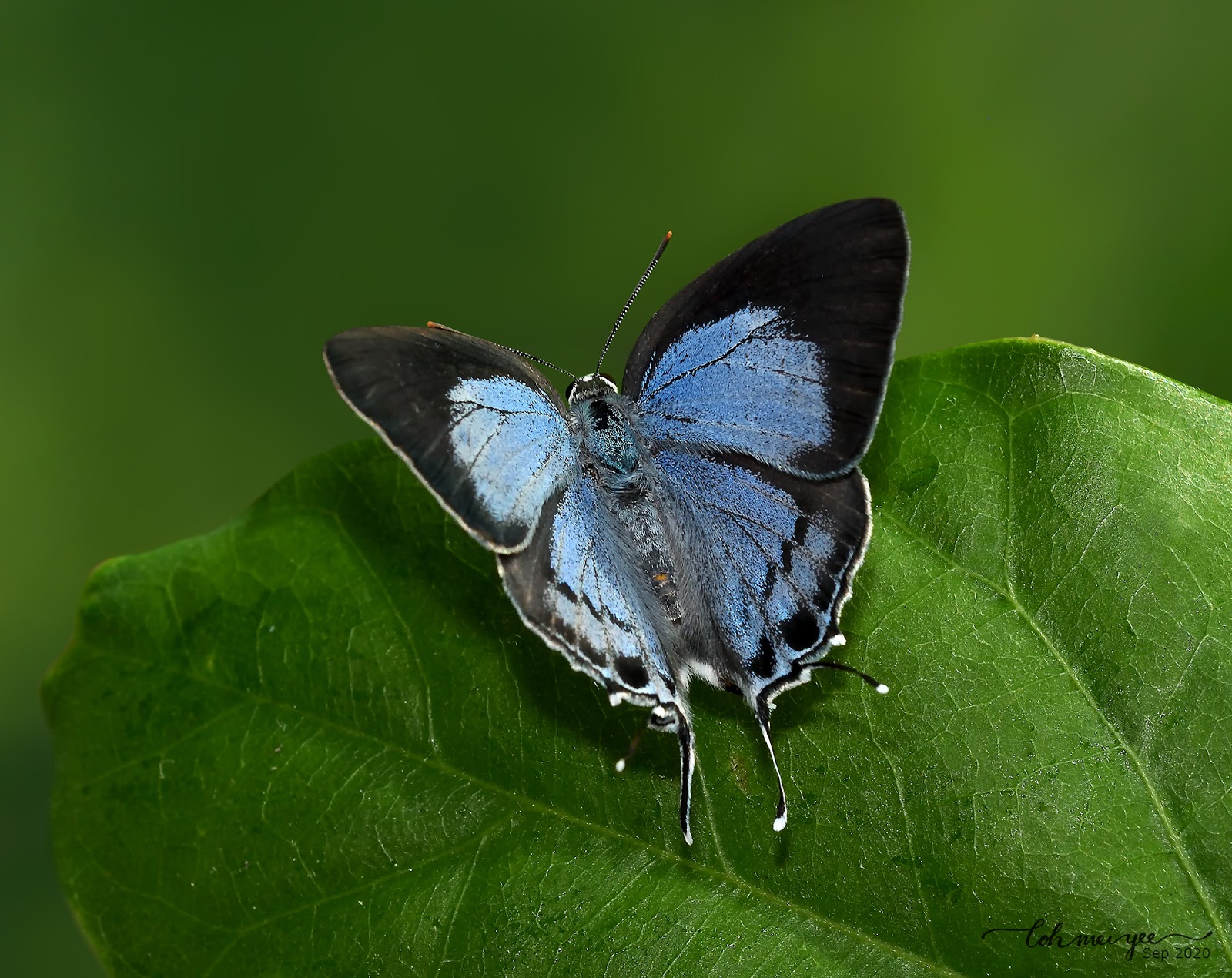
Male (top) and Female (bottom) White Royal showing their upperwings

The upperside of the male White Royal is a deep lustrous blue with broad black borders, particularly at the apical area, on the upperside of the forewings and a series of black marginal spots on the hindwings. The females feature paler blue uppersides, also with broad black apical borders on the forewings.

A female White Royal sunbathing with open wings
A "rear view" of the White Royal showing its tornal lobe

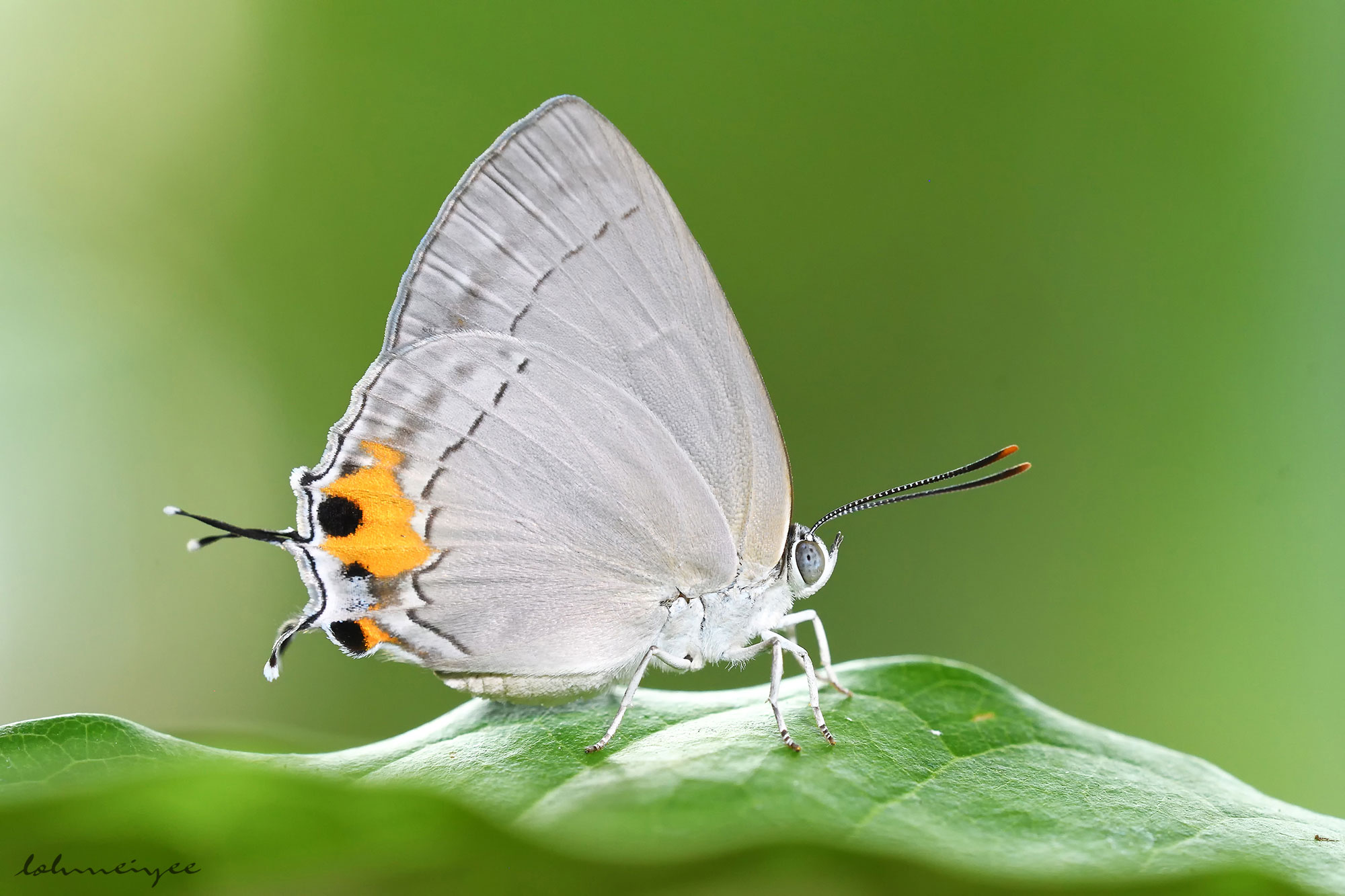
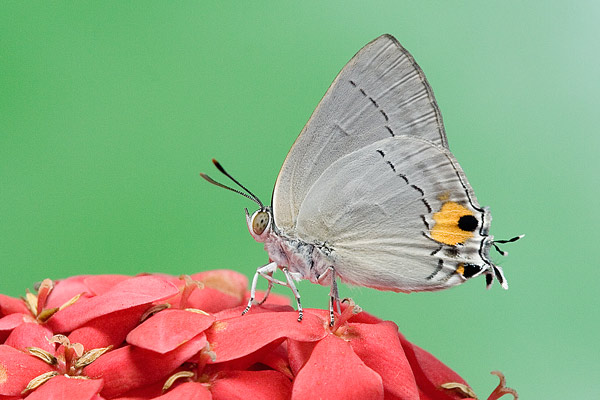
The underside of both sexes is greyish white with a series of post-discal narrow black streaks. The underside of the hindwing has a prominent orange-crowned black marginal spot in space 2. There is a pair of white-tipped tails at the ends of veins 1b and 2. The tornal lobe on the hindwing is black and orange with white cilia on pristine individuals.


The eyes of the White Royal are transparent instead of jet black, as in the case with many of the related species. The legs are greyish-white throughout. The antennae are black-and-white banded, and orange tipped at the club.

A female White Royal resting on the leaf of the Rusty Mistletoe after ovipositing

The complete life history of the White Royal has been successfully recorded in Singapore on its single caterpillar host plant, the Rusty Mistletoe (Scurrula ferruginea). This host plant, one of only a few parasitic and hemi-parasitic plants found in Singapore, is featured in an earlier blogpost about Mistletoes and their importance to the butterfly fauna in Singapore. At least 4 species of Lycaenidae caterpillars depends on the Rusty Mistletoe for survival and continued existence in Singapore.

Text by Khew SK : Photos by Khew SK, Loh MY, Richard Ong, Horace Tan, May Yap and Yip Jen Wei

01 March 2008

Life History of the White Royal

Life History of the White Royal (Pratapa deva relata)


Butterfly Biodata:
Genus : Pratapa Moore, 1881
Species : deva Moore, 1858
Subspecies : relata Distant, 1884
Wingspan of Adult Butterfly : 38mm
Caterpillar Host Plant : Scurrula ferruginea

Physical Description of Adult Butterfly:
The upperside is deep lustrous blue for the male and paler blue for the female, and both sexes have black borders on both wings with the one on the forewings being very broad at the apex. The underside for both sexes is greyish white with a post-discal series of narrow black streaks. The hindwing underside has a orange-crowned black tornal lobe and a black marginal spot in space 2 broadly crowned in orange. There are two pairs of white-tipped tails at the end of veins 1b and 2.

Field Observations of Butterfly Behaviour:
The adults are rarely observed in the field. In the few field sightings in Pulau Ubin and an urban bushland, the adults were mostly found near its host plant either as newly eclosed specimens or females on ovipositing visits. They fly with swift but short flights. Some adults have also been observed to be flying at tree-top level in sunny weather.

Scurrula ferruginea, a wide-angle view (left), close-up on young leaves (right)

The adult female lays eggs on the underside of a mature leaf. Freshly laid eggs are white with a light green tinge but this disappears within hours. Each egg is about 0.7mm in diameter, and has a reticulated pattern of ridges and pits on its surface. After three days of development within the egg shell, the caterpillar emerges by eating the top portion of the egg shell, and exits through the resultant hole.

Freshly laid egg (top), mature egg (bottom)

The newly hatched caterpillar is about 1mm long, light brown in color and has rather long dorsolateral hairs. Both young and old leaves of the host plant are covered with a tawny tomentum, and the newly hatched caterpillar has to push aside these fine and vertillate hairs before skimming the lamina from one side of the leaf. The feeding is observed to take place on both young and old leaves. On mature leaves, the caterpillar has a preference for the underside where the light brown surface offers a better camouflage. Up to the third instar, the feeding caterpillar resembles a ploughing machine in action, with a winding furrow in its wake, and piles of fine hairs pushed to the sides and ahead of it.

A newly hatched caterpillar leaving the site of its first meal.
One-day old 1st instar caterpillar

As it grows, a number of small and short reddish brown markings appears on its body. After four days of feeding and growing to a length of about 2mm, the caterpillar comes to rest for a period of about one day for the moult to the 2nd instar. In the new instar, the caterpillar assumes a more woodlouse shape with shorter dorsolateral hairs in proportion to its body size. There is a diamond-shaped prothoracic shield on the first thoracic segment and the dorsal nectary organ on the 7th segment. The neatly arranged reddish brown markings on its body has become very prominent.

2nd instar caterpillar of White Royal

After another four days of feeding in the same ploughing manner, the caterpillar reaches a length of 4.5mm, and it goes on to stay dormant for about one day for the moult to 3rd instar. The 3rd instar caterpillar loses most of the reddish brown markings from its body which now has a a light green undertone. The tentacular organs on the 8th body segment are also observable as they are everted from time to time. Feeding is still done by skimming the leaf surface, but on rare occasions, some 3rd instar caterpillars were also observed to eat from the edge of the leaf.
3rd instar caterpillar of White Royal
Feeding activity in 3rd instar lasts four days, with body length reaches 8.5mm-9mm. Another day is spent for moulting to the 4th and final instar. The final instar caterpillar has become more stout with a raised dorsal ridge marked with a whitish undertone. It exclusively eats from the edge of the leaf. As it feeds, the caterpillar wraps its sub-spiracular part of its first few body segments around the leaf edge.
A newly moulted 4th instar caterpillar eating its excuviae
A 4th instar caterpillar eating at the leaf edge
The 4th instar caterpillar spends five days feeding, reaching a length of 12-13mm before entering the prep-pupal stage. The caterpillar moves to a branch of the host plant, and comes to rest in a head-up position. After about half a day in its position, the prep-pupa turns around to assume a head-down position. Pupation finally takes places after another half-day. Total number of days of larval growth inclusive of pre-pupuation is 21.
Pre-pupation stage in left and middle panels showing the reversal of head position. The resultant pupa is shown in the right panel.
The pupa is held firmly by the tail in a head down position. It has a white base color with bold dark band on its upper half and dark yellowish diffuse patches along the dorsal line. When disturbed, the pupa could jerk up and down at a fast pace.
Two views of a fresh pupa
After 7 days, the pupa case becomes transparent and features such as the forewing upperside, eyes and antennae of the adult are visible. The next day, eclosion takes place in the mid-morning from 7am to 10am. The emerged adult stays on the split pupal case to expand and dry its wings before moving on to begin another cycle of this species. From egg to eclosion, the cycle length recorded is about 32 days.
A mature pupa with the forewing upperside visible.
Part 1 of 2 of an eclosion sequence (left to right order).
Part 2 of 2 of an eclosion sequence (left to right order).
A newly emerged White Royal.
Another newly emerged White Royal.
Text and Photos by Horace Tan

22 September 2019

Singapore's Royalty - Part 1

Singapore's Royalty - Part 1
Featuring the Royal Butterflies of Singapore


A Chocolate Royal basks in the sun with its wings opened to show the majestic purple uppersides

This weekend's blogpost takes a look at the various butterfly species found in Singapore that bear the English common name "Royal". The word royal is often defined as "used to indicate that something is connected with a king, queen, or emperor, or their family." In describing something as royal gives it a complimentary stature of being beautiful, majestic or an object of exceedingly high recognition.


In our butterfly world, quite a few species have been christened with the "royal" title. In most of them, the name is certainly befitting of their beauty and awe-inspiring colours. The Singapore species that bear the name "Royal" are largely from the sub-family Theclinae of the family Lycaenidae. Part 1 of this blogpost introduces four of the more frequently encountered species in Singapore.

1. Peacock Royal (Tajuria cippus maxentius)


A Peacock Royal perches on a bed of red Ixora flowers

The Peacock Royal is the commonest of the "Royals" and is widely distributed in Singapore. It can regularly be found in urban parks and gardens but is sometimes seen in the forest edges of the nature reserves of Singapore. Both males and females are observed with regularity, especially when feeding on the red flowers of the Javanese Ixora.


Upperside of a male (top) and female (bottom) Peacock Royal

The upperside of the male Peacock Royal is a beautiful royal blue with a broad black apical border on the forewing. The female is pale blue with broad black apical borders on the forewing and a series of black squiggly post-discal striae on the hindwing. The underside of both sexes is greyish-white with post discal striae and series of marginal and sub-marginal spots. The large black tornal spots on the hindwing are orange-crowned. The hindwing features a pair of white-tipped tails at veins 1a and 2.


The Peacock Royal is skittish and a fast flyer. It has jet-black eyes which can immediately distinguish it from its other related cousins in the genus. The caterpillar of this species feeds on parasitic plants like Dendropththoe pentandra and Macrosolen cochinchinensis,both of which are common in urban gardens.

2. Felder's Royal (Tajuria mantra mantra)


Our next royal is the Felder's Royal. This species comes from the same genus as the Peacock Royal and is a moderately rare species. It is widely distributed across the island and shares the same caterpillar host plant as the Peacock Royal. Individuals of the Felder's Royal are typically larger than the related species in the genus.


The upperside of the male is a shining greenish blue whilst the female is a pale purplish blue. Both sexes have a broad black apical border on the upperside of the forewing. The underside is a drab greyish brown and are whitened at the dorsum. Each hindwing has a pair of white-tipped tails at veins 1b and 2. The tornal area has iridescent blue scales flanked by two orange-crowned black spots.


Also a skittish flyer, the Felder's Royal has a habit of perching on the underside of a leaf to rest or hide itself. The compound eyes are transparent and silvery grey. It has been successfully bred in Singapore on the parasitic plant Macrosolen cochinchinensis.

3. Chocolate Royal (Remelana jangala travana)


The Chocolate Royal is another moderately rare species in Singapore. It makes an appearance during certain months of the year, but then may be absent for many months of the year. Its host plants are Eurya acuminata and the common Ixora javanensis. Hence it is curious that it is not as common as it should be, given the abundance of its host plants.


The upperside of the male Chocolate Royal is a majestic deep purple, with broad black borders on both wings. The female is paler with the basal portions of the forewing entirely purple. The underside is a dark chocolate brown with darker narrow post-discal lines on both wings. The black tornal spots on the hindwing are crowned with metallic green scaling without any orange crowning as in the preceding two species. There are two white-tipped tails at veins 1b and 2 on the hindwing.


A Chocolate Royal puddling at a damp footpath

The Chocolate Royal is often seen flying rapidly amongst low shrubbery and feeding on the flowers of various Ixora hybrids. Occasionally, males are seen to sunbathe with its wings opened flat. The species has also been encountered puddling at muddy streambanks and damp footpaths in the forested areas.

4. White Royal (Pratapa deva relata)


The White Royal was a recent re-discovery in 2007 when it was spotted at an urban park in Singapore. The species was subsequently observed at various locations across the island, particularly in the vicinity of its caterpillar host plant, the parasitic Scurrula ferruginea.


The upperside of a female White Royal

The upperside of the male White Royal is a deep lustrous blue whilst the female is a paler sky blue. Both sexes have a broad black apical border on the upperside of the forewing. The underside is greyish white with post-discal black streaks. The hindwing tornal area has the usual orange-crowned black spots. There is a pair of white-tipped tails at veins 1b and 2 of the hindwing.


A female White Royal perches on the edge of its caterpillar host plant.  Note transparent eyes

The White Royal is skittish and fast flying, and often stays in the vicinity of its caterpillar host plant. It is considered moderately rare but when a colony is located, there are usually several individuals flying around. However, in recent years, the species has been absent and sightings have been few and far in between.

And there you have it, the more regularly seen Royals in Singapore, although none of them can be considered common. In the next part of this article, we take a look at the rarer species of Royals that have been recorded in Singapore over the past two decades.

Text by Khew SK : Photos by Khew SK, Koh CH, Loh MY, Simon Sng, Jonathan Soong and Horace Tan.

13 September 2020

Mistletoes and Butterflies

Mistletoes and Butterflies
Ecological importance of Parasitic Plants


A female Banded Royal opens its wings to sunbathe. A recent addition to the number of butterfly species whose caterpillars feed on mistletoe

A parasitic plant is a plant that derives some or all of its nutritional requirement from another living plant. All parasitic plants have modified roots, called haustoria, which penetrate the host plant, connecting them to the conductive system – either the xylem, the phloem, or both. This provides them with the ability to extract water and nutrients from the host. Parasitic plants which derive water/nutrients from the hosts and are photosynthetic are known as "hemiparasites".


The large leaves of the Malayan Mistletoe are able to support the big numbers of the common urban species like the Painted Jezebel.

There are currently 10 known species of parasitic plants extant in Singapore. Quite a few of these species, commonly referred to as "mistletoes", can be seen attached to a variety of host plants - from shrubs to large trees all around Singapore. Mistletoes are believed to have medicinal properties and used in traditional medicine to cure a variety of ailments like cough, diabetes, hypertension, cancer and as a diuretic.


In the popular Asterix and Obelix comics, the druid Getafix adds mistletoe as a key ingredient in his magic potion 

In the popular comic series Asterix and Obelix, the mistletoe is a key ingredient in the magic potion that endows our two heroes with superhuman strength. The druid Getafix, who makes the concoction, is often depicted in the comics cutting mistletoe, hidden amongst the lush treetops with a golden sickle that preserves the magical properties of the mistletoe.


The hemiparasitic Chinese Mistletoe attached to the host

Parasitic plants are not the most welcomed plants amongst arborists, tree maintenance personnel and gardeners. This is because, by virtue of the parasitic nature of these plants, they anchor themselves to a host shrub or tree and extract nutrients from the host. In very severe infestations, the parasitic plants may stunt the growth of the host or even kill it. However, in most cases, a host can support these parasitic plants for decades without significant adverse effect on the host. Nevertheless, these under-appreciated and misunderstood parasitic plants are often pruned and removed from the host.


The shiny leaves of the Rusty Mistletoe are reddish brown when young, but turn a deep green when mature

What then, are the ecological functions of these "parasites" of other plants? Plants research has shown that mistletoes are keystone species in forests and woodlands. A keystone species is one which has a very significant influence in an ecosystem, and if removed may cause undesirable impact to the ecology. Many birds, insects and aboreal mammals build their nests among mistletoes. A wide variety of animals and insects feed on the leaves, shoots, fruits, flowers and nectar of mistletoes.


The Singapore Mistletoe Story by Francis Lim - a book about the parasitic plants in Singapore

Amongst the species of mistletoes in Singapore, three are of particular importance to butterflies. They are host plants to a variety of common to very rare species of butterflies. This article explores these species of mistletoes which are hosts to the caterpillars of these butterflies. It is also likely that the remaining 7 species of mistletoes may be caterpillar host plants for other species of butterflies, but this has yet to be discovered and hopefully recorded in time to come.

1. Malayan Mistletoe (Dendrophthoe pentandra)


The lush green leaves of the Malayan Mistletoe with flowers on its stem

The Malayan Mistletoe is by far the most common mistletoe in Singapore. It is a familiar site on roadside trees and in urban gardens, especially where plants are neglected or unkempt. It is quite often seen on plants like the Shui Mei (Wrightia religiosa) in private gardens, as well as any urban trees where birds spread the seeds of this parasitic plant, ranging from fruit trees like mango and chiku, to a wide variety of other roadside trees.


This common parasitic plant is a caterpillar host plant to at least five different species of butterflies across three families. These are :
  1. Painted Jezebel (Delias hyparete metarete)
  2. Green Baron (Euthalia adonia pinwilli)
  3. (Tajuria dominus dominus)
  4. Peacock Royal (Tajuria cippus maxentius)
  5. Great Imperial (Jacoona anasuja anasuja)

The distasteful Painted Jezebel's caterpillars have somehow managed to sequester the chemicals from the Malayan Mistletoe to make itself unattractive to predators

Amongst these species, it is interesting to note that the aposematic Painted Jezebel is believed to be distasteful to birds and has somehow managed to sequester the chemicals in the Malayan Mistletoe as a protection against predators. This is something that the other 3 species that feed on the same host plant are not able to do so, or at least the adult butterflies are not known to be distasteful to predators.


The flowers of the Malayan Mistletoe

The Malayan Mistletoe is most likely dispersed mainly by the birds that feed on its fruits, and then transporting the seeds to other trees where the bird droppings, which contain the seeds, are deposited on the branches of other plants. As the seeds ripen, it will extend its haustoria (specialised roots) and penetrate into the host as it takes grip and grows. The haustoria of the Malayan Mistletoe tends to grow into a ball-like form as the plant matures.

2. Chinese Mistletoe (Macrosolen cochinchinensis)


A healthy growth of the Chinese Mistletoe

The next most common species of our local parasitic plants, is the Chinese Mistletoe, which, like the previous mistletoe, is also a stem hemiparasite. It attaches itself to the branches of its host and grows into a large bush that can span 1m-2m across. Depending on the size of the host, the growth of the Chinese Mistletoe can sometimes overwhelm and smother the entire host.


The Chinese Mistletoe is a caterpillar host plant to an even wider variety of butterfly species (some of which also feeds on the Malayan Mistletoe). These are :
  1. Green Baron (Euthalia adonia pinwilli)
  2. Centaur Oakblue (Arhopala centaurus nakula)
  3. Peacock Royal (Tajuria cippus maxentius)
  4. Banded Royal (Rachana jalindra burbona)
  5. Felder's Royal (Tajuria mantra mantra)
  6. Green Imperial (Manto hypoleuca terana)
  7. Great Imperial (Jacoona anasuja anasuja)
  8. Semanga superba deliciosa.


The flowers and fruits of the Chinese Mistletoe, on which the caterpillars of the Green Imperial and Banded Royal feed

The leaves of the Chinese Mistletoe are pinkish to red when young, turning light green and finally dark green as they mature. The mature leaves are stiff and slightly waxy. It should be noted, however, that several of the butterfly species' caterpillars actually feed on the flower buds and fruits of the Chinese Mistletoe, rather than the leaves.


A young shoot of the Chinese Mistletoe attached to its host via its specialised roots called haustoria

Like the Malayan Mistletoe, the Chinese Mistletoe is also mainly propagated by birds. Birds feed on the ripened globular fruits of the Chinese Mistletoe and once digested, the bird droppings are deposited on other plants as the bird moves in search for food. This gives a chance for the seeds to germinate and grow if a suitable host is found.

3. Rusty Mistletoe (Scurrula ferruginea)


The Rusty Mistletoe has a layer of fine brown hairs on the undersides of its leaves - giving it a "rusty" look

The last and slightly rarer species of mistletoe that plays host to butterfly caterpillars, is the Rusty Mistletoe. The leaves of this parasitic plant are green on top, but covered with a layer of fine brown hairs on the underside of the leaves, giving it a "rusty" appearance. As it grows, the main stem of the Rusty Mistletoe attaches to the host rather seamlessly, with a few side roots extending along the sides of the branch, growing the many little haustoria into the host.


The White Royal's caterpillars feed on the young shoots and leaves of the Rusty Mistletoe

This species of mistletoe is the caterpillar host plant for at least two species of Lycaenidae. These are:
  1. Great Imperial (Jacoona anasuja anasuja)
  2. White Royal (Pratapa deva relata
Both are rare species in Singapore. The White Royal was only recently re-discovered in 2007 but subsequently successfully bred on the Rusty Mistletoe.  The Great Imperial, which has been bred on all three mistletoes mentioned in this article, is the most versatile and its caterpillar accepts all three host plants.


A female White Royal perched on a leaf of the Rusty Mistletoe after ovipositing on the young shoots of the plant

Where it grows, the Rusty Mistletoe is not difficult to spot, as the brownish red appearance of its foliage sets it apart from its host. It grows into a relatively large bush that can measure 1-2m across. The flower of the Rusty Mistletoe has an interesting appearance of a brownish coloured hairy paw, whilst the fruit is a small hairy pseudo berry of about 1cm long.


Again, like the other mistletoes mentioned here, the Rusty Mistletoe is probably dispersed by birds that eat the fruits and then propagated by the bird droppings as the birds forage for food around the area. The seeds are also likely to stick onto branches of the host and then the haustoria anchoring the the plant to the host after the seed germinates, typical of the like the other species of stem hemiparasites.


In closing, we have taken a look at the more common mistletoes found in Singapore, and it is through keen observations with a dose of luck that we have discovered the range of species of butterflies that are dependent on these specific mistletoes for survival. If there is overzealous management of these "parasites" and their removal from their hosts, then it will critically threaten the existence of these species of butterflies (many of them rare) in Singapore. So the next time you see these parasitic plants around, leave them alone. The butterflies will thank you for that!

Text by Khew SK : Photos by Huang CJ, Khew SK, LohMY, Jonathan Soong and Horace Tan

References and Further Reading :