Showing posts sorted by relevance for query Miletus biggsii. Sort by date Show all posts

21 March 2010

Mergers, Partnerships & Betrayals

Mergers, Partnerships and Betrayals
The Miletinae - The Harvesters


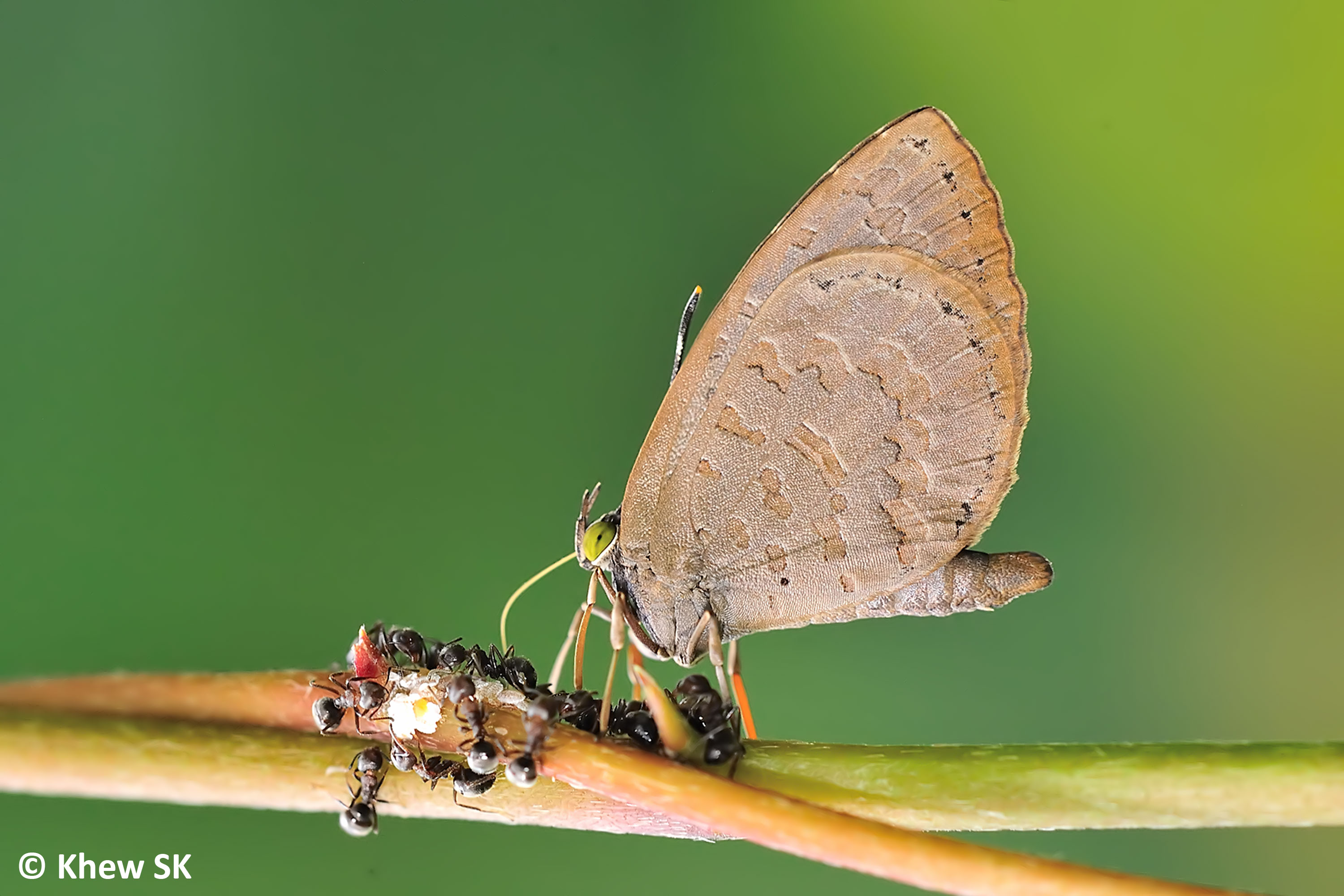
A multi-tasking pair of Bigg's Brownie (Miletus biggsii biggsii) - mating & feeding amongst their protector ants

In the real corporate world, the title of this blog would probably not elicit much interest and excitement, other than offering a good read about yet another unfortunate company being swallowed up, or employees being thrust into a chasm of anxiety about their future.


A Bigg's Brownie (Miletus biggsii biggsii) feeding off what appears to be a "herd" of mealy bugs that are tended by their protector ants

In the world of Lepidoptera, however, the partnership between butterfly and ants is already a well-studied topic by entomologists. Myrmecophily, or the positive interspecies association between ants and butterflies (or rather, their caterpillars) has been widely studied. This symbiotic association occurs with some Lycaenidae caterpillars evolving specialised organs that exude honeydew in return for protection by the ants. These caterpillars then go about their daily business of feeding on the leaves of their host plants, whilst enjoying 'armed' guards' protection from predators.


However, there exists a subfamily within the Lycaenidae family - the Miletinae, that is unique in the sense that their caterpillars are predatory or "carnivorous" in the butterfly world. Whilst it is generally well-known that most caterpillars are "herbivorous" and generally feed on leaves, buds and flowers of plants, the Miletinae (or commonly referred to as the Harvesters) species' caterpillars feed on a variety of Homoptera like aphids, coccids, mealy bugs and one species even feeds on ants' larvae!


In Singapore, the Miletinae is represented by five genera - Allotinus, Logania, Spalgis, Miletus and Liphyra. Other than Liphyra, the other genera have caterpillars that feed mainly on a variety of Homoptera.


The aphids, coccids and mealy bugs, which form the principal diet of the caterpillars of the four genera mentioned, tend to feed on young shoots of various plants. These insects have adapted piercing mouth parts that pierce and suck the sap of plants - usually soft-stemmed ones. The Homoptera must suck large amounts of sap from the plant to get their nutrients. Much of the sap is a sugary fluid that cannot be digested. This extra liquid is passed through their body and excreted as "honeydew." Ants and other insects "farm" the Homoptera and collect honeydew for their own food. In return for their food, ants will protect the Homoptera that provide their colony with a food source.


In the field, observations have been made of the Miletinae adults feeding off the secretions of the aphids, mealy bugs and coccids. The butterflies do this brazenly, without any fear of being attacked, in the presence of the protective ants that are also 'milking' the aphids or mealy bugs of their honeydew.

Walking gingerly in a minefield of ants!

Besides feeding off the honeydew, the Miletinae also lay their eggs where the aphids and mealy bugs are present, and the caterpillars of these species feed on the aphids and mealy bug community.

A Pale Mottle (Logania marmorata damis) amidst mealy bugs and their "farmers"

It is interesting to note that the ants neither extract honeydew from, nor tend to the caterpillars in this case. They go about their business of tending to the aphids or mealy bugs, but leave the caterpillars alone - despite the caterpillars devouring their "herd"! Why then, don't the normally ferocious ants attack and kill the predatory caterpillars?


Miletinae caterpillars amongst their "sheep" which provides food as they grow

Researchers have postulated that the caterpillars (and even adult butterflies) have some kind of chemo-mimicry that render themselves 'invisible' to the ants. In other words, as far as the ants are concerned, the Miletinae adults and caterpillars are perceived as just another ant in the colony.


Hello? Are you my brother? An ant checks out a Lesser Darkie (Allotinus unicolor unicolor).

Therefore, although the caterpillars and adult butterflies of the Miletinae derive 'protection' from the ants, they give nothing back in return. On top of that, the adult butterflies partake of the honeydew that are secreted by the aphids and mealy bugs, and their caterpillars feed on the ants' source of food. Hence the "betrayal" part of the whole situation, where the ants have been hoodwinked into a win-lose relationship with the Miletinae.

A Lesser Darkie feeds on honeydew produced by some aphids that are tended by their farmer ants

An even more extreme situation occurs with the Moth Butterfly (Liphyra brassolis abbreviata). The caterpillar of this species feeds on the larvae of the Weaver Ant (Oecophylla smaragdina). It is interesting to note that the caterpillar feeds and grows inside the nest of the ants, and has evolved a clever way to escape the wrath of the ants when it ecloses. Our earlier blog article describes the Moth Butterfly.

A newly-eclosed Moth Butterfly (Liphyra brassolis abbreviata) whose caterpillar feeds on ant grub

This unique characteristic of the sub-family Miletinae in the butterfly world is amazing, and runs contrary to the conventional belief that all caterpillars are herbivorous and feed only on plant material. The adult butterflies of the five genera of the Miletinae found in Singapore are therefore very widespread, having little dependence on the location of host plants, as their "host" food is actually other living insects! Hence wherever there is a colony of aphids, coccids or mealy bugs, the adult butterflies of this sub-family will seek them out, for food for themselves as well as their young.

An Apefly (Spalgis epius epius) one of the Miletenae whose caterpillars also feed on Homoptera

So do look out for these butterflies and special behaviour when you are out in the field!


Text by Khew SK ; Photos by Sunny Chir, James Foong, Federick Ho, Khew SK, Loke PF, Bobby Mun, Horace Tan & Tan Tze Siong

29 September 2024

Butterfly of the Month - September 2024

Butterfly of the Month - September 2024
The Bigg's Brownwing (Miletus biggsii biggsii)

A mating pair of Bigg's Brownwings amongst ants and coccids

The month of September usually brings on the Southwest monsoon squalls - strong winds blowing from the southwest of Singapore.  These winds are also often called the "Sumatras". A Sumatra squall has characteristics that are specific to this region - it is a line of thunderstorms that develops over Indonesia's Sumatra island or the Strait of Malacca, then moves eastwards to affect Singapore and Peninsula Malaysia. On 17 September, such a squall hit Singapore island with enough severity to topple large trees and break branches. Over 300 trees were affected in Singapore, caused by strong winds that exceeded 80km/h.


Over in West Malaysia, which shares similar weather conditions of the Southwesterly monsoon winds, some fatalities were reported. In Penang, two unfortunate Chinese tourists were tragically killed when the winds blew down a tree that crushed the car that they were seated in. Elsewhere, in Pahang, a tree crushed an elderly man and injured his grand daughter at a site where they were camping. Another signal of climate change around the world where weather conditions exhibit more extreme outcomes?


September is also known for the celebration of the Mid-Autumn Festival that falls on the 15th day of the eighth lunar month. The full moon is considered a symbol of reunion, and is shining its brightest during this time. It is a month of delicious mooncakes and lantern parties where families delight in carrying lanterns at night, from traditional paper ones with wax candles to modern, battery-operated versions.


Our Butterfly of the Month for September 2024 is a representative of the sub-family Miletinae, often referred to as the "Harvesters". Our feature butterfly is the Bigg's Brownwing (Miletus biggsii biggsii). The common name of this species was Bigg's Brownie according to past literature, but has recently been changed to Brownwing to avoid the racially-sensitive word Brownie, sometimes misconstrued as a derogatory reference to dark-skinned people of certain races.

A Bigg's Brownwing in a sea of ants and not fearing for its life!

The Bigg's Brownwing usually flies in the shaded understorey of forested areas and patches of greenery around Singapore. They can be found in the nature reserves as well as urban parks and gardens. In particular the adult butterflies are often seen where their primary food source - several species of aphids and coccids are found. These insects are often "farmed" by ants.


The butterfly have a weak erratic flight and often remain in flight for long periods of time without taking a rest.  Occasionally, they are spotted feeding on the sugary excretions of the aphids and coccids in the company of the ant farmers. Despite the ferocious ants guarding their source of food, the Bigg's Brownwing can alight on a group of ants and yet remain "invisible" to the ants such that the ants leave the butterfly unharmed.

A fluttering Bigg's Brownwing showing a glimpse of its upperside

The Bigg's Brownwing is light brown above with an oblique white band across the forewing - wider in the female than the male. Very often, this white band is reduced and obscure, and in some individuals, absent altogether. The underside of the butterfly is light-greyish brown with dark markings that gives the flat wings a 3-dimensional effect. There is a series of black submarginal spots on both wings and where the marginal edges of the wings take on a deeper orange shading.


Many photos of this species depict the butterfly in a sea of ants. Whereas other species of butterflies daring enough to do this would be torn to pieces by the ants and eaten, the Bigg's Brownwing somehow always remains unmolested and where the ants do not percieve it as a threat nor as food! The butterfly lays its eggs amongst the aphids or coccids and the caterpillars that hatch eat these insects as its source of food, making the species in the sub-family Miletinae "carnivorous".

Text by Khew SK : Photos by David Chan, Ash Foo, Khew SK, Michael Khor, Koh CH, Loke PF, Bene Tay and Mark Wong

27 December 2013

Butterflies Galore! : Bigg's Brownie

Butterflies Galore!
The Bigg's Brownie (Miletus biggsii biggsii)


This interesting shot by ButterflyCircle member shows the relationship between what would normally be considered predator and prey. However, for the butterflies that belong to the family Miletinae, there is a symbiotic relationship amongst the butterfly, its caterpillar and the ants and in this case, the scale insects (Coccids) that the ants are 'farming'. In an earlier article on myrmecophily on this blog, more details are discussed.

The Bigg's Brownie (Miletus biggsii biggsii) shown here, appears to be "invisible" to the ants, which are busy "farming" the coccids for their honeydew secretions. The caterpillars of the Biggs Brownie also invade the ant-coccid association, by feeding on the coccids. Some other species of the family also feed on the ant larvae as their primary source of food.

10 May 2014

Revision to the Common Names of Butterflies

A Revision to the Common Names of Butterflies
Part 1 : Changes Due to Socially Unacceptable Reasons


A pair of mating Niggers (!!)

After the excitement and fanfare of our most recent butterfly book, featuring butterflies from the South East Asian countries of Peninsular Malaysia, Singapore and Thailand died down, I managed to find some time to read the book in greater detail. Also, remembering some of the principles elaborated by Dr Kirton at his talk during the launch, I went about analysing some of the background behind the English Common name updates in the book.


Dr Laurence Kirton speaks at his book launch in Singapore

At Dr Kirton's talk, he outlined the basic rationale behind what caused him to change some of the more widely used English common names in the region. Whether these name changes would cause further confusion amongst the butterfly enthusiasts or not, or will become standard usage in time to come, would depend on the general acceptance amongst the stakeholders.


As English common names are certainly not within the exclusive domain of scientists, taxonomists or academics, these names can be coined by practically anyone who has more than a fleeting interest in butterflies. Naming conventions and fundamental rationale can sometimes be illogical and often defy common comprehension. Some names appear logical and obvious - dependent on the physical attributes of the butterfly species concerned, whilst others have dubious associations at best, or even appear questionable.


A Lesser Darkie perches on a leaf

Through common usage, some of these names have spread across the region amongst butterfly enthusiasts - some have stuck through their popularity, whilst others vary depending on the country of origin, and the 'authorities' who have named them. It is often confusing, when a particular species carries different English names in different countries. I will not go into the Chinese common names in this article, though I was told that in certain cases, a single species can have up to 6 or 7 Chinese common names across the Chinese-speaking countries!


© Dr Laurence Kirton, Forest Research Institute of Malaysia (FRIM)

Dr Kirton outlined the following basic principles that he adopted in his latest book, which determined whether he made changes (or not) to the English common names of butterflies in the region :
  1. Where the original name is socially unacceptable / derogatory
  2. Where the name has incorrect syntax or grammar
  3. Where the original name refers to a people group
  4. Where the same name is used for different species
  5. Where multiple names are used for the same species
  6. Where different regions use different names
He went on to clarify that "Common names usually follow as closely as possible to WA Evans' (1927) "The Identification of Indian Butterflies" : Bombay Natural History Society, Madras 302 pp.


Whilst most of us would not have any issue with the principles above, the devil would be in the details and the rationale for the continued adoption of the 'common usage' names or not, would have to be evaluated and discussed from various alternative perspectives and points of view.


For a start, I will discuss the name change for four species of butterflies which I would deem as necessary. The rationale behind the name change would be that the original names in today's politically-sensitive environment, would fall under the category of being "socially unacceptable and/or derogatory". I had, some years back, written a piece on a butterfly that was unfortunate enough to be called a Nigger. Perhaps in an era when life was more simple and straightforward, such names would not offend anyone, but today, such a name would be considered derogatory to certain ethnic groups, and deemed unacceptable.


© Dr Laurence Kirton, FRIM

In Dr Kirton's detailed explanations during his talk about the Nigger made a lot of sense. We support the new name coined for the species Orsotriaena medus cinerea and it will henceforth be called Dark Grass Brown. Other names suggested earlier, either already in print or on the internet are :
  • "Blackie" - by Kazuhisa Otsuka in Butterflies of Borneo and South East Asia, 2001
  • "Jungle Brown" - by Smith, 1989
  • "Dusky Bush Brown" and "Smooth Eyed Bush Brown" by Braby 1997 and 2010
  • "Medus Bush Brown" - by Kunte et al, 2014


Three other species found in Singapore, also having names which are considered derogatory and have been changed in Dr Kirton's book, belong to the Miletinae subfamily. The earlier innocuous names are now considered ethnic slurs - labels used used as insinuations or allegations about members of a given ethnicity or to refer to them in a derogatory (critical or disrespectful), pejorative (disapproving or contemptuous), or insulting manner in the English-speaking world.


From Darkie to Darlie - the evolution of a name and logo of a popular toothpaste brand in Asia

The first of the common names is "Darkie". In the list of ethnic slurs, the word "darkie" refers to a black person (similar to Nigger) and is highly likely to cause offense to certain ethnic groups. In the consumer product world, a toothpaste company, Hawley & Hazel, used to market a popular brand of toothpaste called "Darkie". The brand well-known in Asia and Australasia, was subsequently rebranded as "Darlie" some time in 1989 to avoid the politically-incorrect and potentially derogatory reference to Afro-Americans.


Lesser Darkie will now be called Lesser Darkwing

In our butterfly world, there is a species known as the Lesser Darkie (Allotinus unicolor unicolor). The English common name is a bit of a mystery, as the butterfly neither black or has any features that suggest the name. Dr Kirton has renamed this species as the Lesser Darkwing. It is a name that avoids the controversy of an ethnic slur and appears to be safe for use without offending anyone. So Lesser Darkwing it will be!


Bigg's Brownie will now be called Bigg's Brownwing

A third generic common name, which also has ethnically derogatory connotations, particular in common usage in the United States, is the "Brownie". Whilst less well-known than Nigger and Darkie, the word Brownie is generally used as a derogatory slur to refer to a :
a. (US) a person of mixed white and black ancestry; a mulatto.
b. (US) a young, brown-skinned person 1940s–1950s.
c. (US) derogatory name to refer to brown Mexican people.


Blue Brownwing, underside and (inset) upperside of the wings

There was even a recent article that highlights the use of the word "Brownie" (in a non-complimentary way) to refer to US President Barack Obama! Hence, the avoidance of the potentially controversial word "Brownie" is timely and should be removed from our butterflies' names as well.  Having said that, however, I wonder when someone will change the name of my favourite chocolate "brownie" dessert! But that is certainly another debate for another forum.


Blue Brownie will now be called Blue Brownwing

In Singapore, we have the Blue Brownie (Miletus symethus petronius) and the Bigg's Brownie (Miletus biggsii biggsii). Along the same logical lines of naming the Darkwings, Dr Kirton also suggests a name change from Brownie to Brownwing.  So Miletus symethus will now be called Blue Brownwing, whilst Miletus biggsii will be renamed as Bigg's Brownwing.


Bigg's Brownie will now be called Bigg's Brownwing

In summary, these are the four species relevant to the Singapore butterfly fauna that ButterflyCircle will be making changes to - from Nigger to Dark Grass Brown; from Lesser Darkie to Lesser Darkwing; from Blue Brownie to Blue Brownwing and from Bigg's Brownie to Bigg's Brownwing.  We accept these changes due to the rationale that Dr Kirton has articulated in his presentation, and we see no reason to disagree with the reasons behind the change.  However, there is still room for debate, and the changes to the English common names, like the regular taxonomic revisions to species' scientific names, will probably not be cast in stone!


Blue Brownie will now be called Blue Brownwing

Whilst our hardcopy Field Guide to the Butterflies of Singapore 2010 has used these original names and no amendments can be made at this point in time, any future editions will make these changes accordingly. Our online collaterals will make the changes henceforth. All the four species' names fall under the collective category of "socially unacceptable" or "derogatory" in terms of negative ethnic slurs.


We will evaluate other name changes as proposed by Dr Kirton in our forthcoming blog articles, where various ButterflyCircle members have given their opinions which may not necessarily concur with Dr Kirton's proposed name changes. These will be dealt with eventually, and discussions will be made regarding our opinions which offer contrarian and alternative viewpoints to those raised by Dr Kirton.


Farewell Nigger, Hello Dark Grass Brown!

In the meantime, we will take our time to digest and try to understand the backgrounds behind some of these name changes and we will not rush to make any hasty changes. Some of these original names have sentimental, emotional, historical or even nationalistic (!) connotations, and even if the names are changed, it may take a long time before they become widely accepted for daily usage amongst butterfly enthusiasts.

Text by Khew SK : Photos by Sunny Chir, Khew SK, Koh CH, Loke PF,  Tan BJ, Benedict Tay & Mark Wong

References : 

  • List of Ethnic Slurs - Source - Wikipedia
  • List of Ethnic Slurs by Ethnicity - Source : FileSharingTalk
  • A Naturalist's Guide to the Butterflies of P. Malaysia, Singapore & Thailand, Laurence G Kirton : John Beaufoy Publishing 2014
  • [C&P1] The Butterflies of The Malay Peninsula, A.S. Corbet and H.M. Pendlebury, 1st Edition, Kyle & Palmer, 1934.

16 July 2013

Butterflies Galore! : Bigg's Brownie

Butterflies Galore!
The Bigg's Brownie (Miletus biggsii biggsii)


The Bigg's Brownie is a species of butterfly that belong to the subfamily Miletinae. The caterpillars are considered "carnivorous" as they feed on other insects - primarily coccids, mealy bugs, aphids or ant larvae. The early stages of this butterfly also have a symbiotic relationship with ants. The caterpillars get protection from the ants in return for sweet secretions often referred to as "honeydew" from their bodies.

The Bigg's Brownie is often seen in the vicinity of ants like shown in this shot. As the ants are known to "farm" the aphids, mealy bugs and coccids for their secretions, the butterfly seeks out these locations to lay her eggs so that the caterpillars can feed on the aphids. This shot was taken by ButterflyCircle member Mark Wong in the forested nature reserves recently.

Also see related article : Mergers, Partnerships & Betrayals


15 November 2012

Random Gallery - Bigg's Brownie

Random Butterfly Gallery
Bigg's Brownie (Miletus biggsii biggsii)


The Bigg's Brownie is a relatively common species in Singapore.  It is most often seen fluttering restlessly in well-shaded areas at the fringes of the nature reserves as well as in various urban parks.  The species is associated with mealy bugs, aphids and coccids, on which their caterpillars feed.  The adult butterflies are observed flying around ant-infested young shoots of various plants.  The ants "farm" the mealy bugs for their sugary discharge, and do not seem to attack the intruding butterflies.

The species is light brown on the upperside, with an oblique white band on the forewings, which can vary across different individuals.  The underside is light greyish brown with dark markings outlined in white.  This individual was shot by ButterflyCircle member Koh Cher Hern recently. 

05 September 2020

Butterfly Photography at Our Local Parks - Telok Blangah Hill Park

Butterfly Photography at Our Local Parks
Featuring : Telok Blangah Hill Park


The Terrace Garden which leads up to the highest point of Telok Blangah Hill Park

In our earlier blogpost on the Southern Ridges Parks, we explored the 47 Ha Kent Ridge Park. Starting from west and moving towards east, the Southern Ridges comprises Kent Ridge Park, Hort Park, Telok Blangah Hill Park and Mount Faber Park. All the four parks are interconnected via walkways and overhead bridges. This weekend, we take a look at the next elevated park, Telok Blangah Hill Park.


An overview of Telok Blangah Hill Park which is connected to Hort Park at the western end at Alexandra Road, and to Mount Faber at the eastern end at Henderson Road

A view along the elevated Forest Walk, which connects Alexandra Arch to Telok Blangah Hill Park.

Telok Blangah Hill Park is bounded by Alexandra Road on its western boundary, and Henderson Road on its eastern boundary. This elongated park is about 34 Hectares in area, and covered with lush greenery over most of its area. It is connected to the Hort Park via the Alexandra Arch overhead bridge at its western boundary. A visitor entering from this end of the Park will trek the Forest Walk – a 1.3-kilometre-long elevated metal walkway that links Hort Park to Telok Blangah Hill Park.


Below the elevated Forest Walk is the Earth Trail.

A certain locations, the Earth Trail is connected to the elevated Forest Walk via staircases

Both the Earth Trail and Forest Walk end at the little metal shelter which then leads you onto Telok Blangah Green road

An alternative route along the same direction is the Earth Trail that brings you closer to the forest understorey. The Earth Trail is below the elevated Forest Walk and connects to the elevated walk at certain places via staircases. Both trails will lead a visitor to Telok Blangah Green. At the start of the Forest Walk is a shelter at which you can take a quick rest before proceeding to the other parts of this hill park.


A the top of Telok Blangah Hill Park, where a visitor gets a 360deg view of the surroundings


A view across the horizon of the Singapore skyline

A view downwards from the top at the Terrace Garden

Be prepared for lots of staircases and steps at Telok Blangah Hill Park!

The entrance to the Terrace Garden

Telok Blangah Green winds around the hillock which overlooks the Terrace Garden. The Terrace Garden consists of a series of semi-circular terraces situated at the top of the park. The top of this hillock is the highest point of the park and from here, you will be able to enjoy a breath-taking 360-degree view of Singapore.


Alkaff Mansion with its commanding view of the surroundings

Alkaff Mansion and more steps!

The forecourt at Alkaff Mansion

Walking along Telok Blangah Green will take you past the historic Alkaff Mansion, an elegant colonial bungalow built by a family of Arab Traders, which used to host grand parties for the social elite and who's who in 19th century Singapore. Situated on top of a knoll with a commanding view of the lush greenery around, Alkaff Mansion is now an F&B outlet today.


Some of the red-brick paths winding through the forested areas in the park

Brick path in the forested area.  There are stone tables/seats where one can take a good rest or even have a picnic under the shaded understorey.

As you continue to walk towards the east, you will pass a public rest room on the left, and the Therapeutic Garden on the right. The lush greenery all around the garden creates a restorative environment to engage the senses and to uplift both mental and emotional well-being while serving as complementary habitat for native biodiversity. Walk towards the Therapeutic Garden and take a short detour downhill towards the Stream Garden which brings you to the foot of the hill and the main road Telok Blangah Heights.


A pavilion to take shelter from the hot sun or pouring rain

And more steps!

Back up at the Therapeutic Garden, and on the left of Telok Blangah Green is a hilly patch of lush forested area with a network of quiet paths complete with stone tables and seats and a shelter from the elements. There are the occasional butterfly surprises around this area, and one should look carefully at the shrubbery that may attract some rarities.


Paved road leading towards the Henderson Waves

If you stay on the main trails, there are ample signages

One of the older trails that lead you to the hillock that connects to Mount Faber Park.

On the right side is Car Park 1, and another network of paths winding around the greenery, leading to another knoll which is connected to the Henderson Bridge. There is a shelter and seats at this hilltop area where one can take a short rest and a cold drink from the vending machine before crossing the distinctive Henderson Waves overhead bridge to Mount Faber Park.  This forested hillock was also the location where the body of Huang Na was found after her tragic murder back in 2004.


Butterflies of Telok Blangah Hill Park

As far as butterflies are concerned, the Southern Ridges is a location where occasional rare species may appear. This is related to one of the habits of "hill topping" by butterflies - whereby many species, particularly the males, indulge in the activity of choosing their favourite perches and patrol the area for eligible females.  The list of butterflies featured here is not exhaustive.


Two examples of butterflies that are normally found in the forested nature reserves, but can be spotted at Telok Blangah Hill Park.

Over the years, some of the species that have been observed at Telok Blangah Hill Park include some of the rarest Lycaenidae species that have been observed in Singapore. As some of the vegetation have evolved over the years, certain species that have been spotted between 2000 and 2010 are no longer seen today. Interestingly, some forest-dependent species like the Branded Imperial and Malayan Lascar were "regulars" at TBHP in the past.


The Colour Sergeant was once found quite commonly at the grounds of Alkaff Mansion.  It is no longer seen there today.

At the grounds of the Alkaff Mansion, there once were a few host plants of the Colour Sergeant growing at the periphery of the forecourt. I recall that we often found the caterpillars of the Colour Sergeant on this host. Today, these plants have not survived and the species is rarely seen at this location.


Three Spot Grass Yellows eclosing on their host plant, Albizia

The common urban species are found at TBHP, and interestingly, three species of the Eurema or Grass Yellows, have been observed around the park. There was a time when the Albizia trees (Paraserianthes moluccana) had large congregations of the Three Spot Grass Yellow (Eurema blanda snelleni) breeding on them. The Common Grass Yellow (E. hecabe contubernalis) and the Chocolate Grass Yellow (E. sari sodalis) are also spotted here.


Look out for the distinctive dragon-headed Plain Nawab caterpillars on the Red Saga shrubs

If you look amongst the low shrubs of the Red Saga, there are often caterpillars of the Plain Nawab (Polyura hebe plautus) feeding on the leaflets of this common tree. The adults are often frolicking at tree top level, flying rapidly from one perch to another, and returning repeatedly to their favourite perches.


The Malayan Plum Judy was first recorded from the Southern Ridges


Examples of the Miletinae found at Telok Blangah Hill Park

This park was one of the first places where the Malayan Plum Judy (Abisara saturata kausambioides) was spotted. It can still be observed hopping from leaf to leaf in recent years. At least four species of the Miletinae are regularly observed at TBHP, the most often seen is the Biggs Brownwing (Miletus biggsii biggsii) flying restlessly amongst the shrubbery. The Apefly, Blue Brownwing and Pale Mottle have also been spotted here.


The rare Silver Royal was feeding at the flower of Syzygium sp. at Telok Blangah Hill Park when it was sighted in 2005


The very rare White Fourline Blue was observed at Telok Blangah Hill Park for a period of about a month in 2009.  It can no longer be found there and has not been seen since.

Amongst the Lycaenidae recorded here is the very rare Silver Royal, which was photographed whilst feeding on the flowers of a Syzygium tree where it was first recorded as a re-discovery in 2005. Another very rare Lycaenidae, the White Fourline Blue (Nacaduba angusta kerriana) was first observed at TBHP. Subsequent to that sighting in 2009, where it was documented as a re-discovery, a female was observed ovipositing and its life history successfully recorded on the host plant Entada spiralis. However, it has not been seen since that short period in 2009.


Various other Line Blues from the genus Nacaduba are often sighted at Telok Blangah Hill Park

The other confusing lookalike Sixline and Fourline Blues can also be found here, usually frolicking on bright sunny days. They fly rapidly, and then select a perch onto which to land and they have a unique habit of flattening themselves to the angle of the sun to maximise their exposure to the warm sunshine.


A variety of skippers observed at Telok Blangah Hill Park

Amongst the Hesperiidae found at TBHP are the various Palm Darts, Common Redeye, Chequered Lancer, Plain Banded Awl and the Orange Awlet (where its caterpillar host plant, Arthrophyllum diversifolium, is commonly found at TBHP). The variety of caterpillar host plants that can be found at TBHP supports these species. Some examples are Spatholobus ferrugineus, Caryota mitis, Cocos nucifera and various grasses and bamboos.


A Copper Flash feeding at the flowers of the Mile-A-Minute at Telok Blangah Hill Park

All in all, the butterfly diversity at TBHP is above average. However, the park cannot be considered as an ideal butterfly-shooting location for beginners due to its topography and vegetation - some areas of which are not easily accessible. As nectaring plants are not as widespread, it is challenging to photograph butterflies that are actively flying about. Nevertheless, it is a good place to do butterfly-watching, due to its variety of habitats and environments.


A map of Telok Blangah Hill Park

How to Get There :

By bus :

(57, 145, 175, 176, 195, 195a, 272, 273) stop at Bus stop 14241, along Henderson Road and walk up along Telok Blangah Green.

(120, 124) stop at Bus stop 14331, along Telok Blangah Heights.

By car :

Drive along Henderson Green and turn into Telok Blangah Green. There are three carparks 1, 2 and 3, but on weekends, it may be challenging to find carpark lots during the peak hours. Parking is free.

Note that, due to the terrain, accessibility is challenging and there is no wheelchair access to many of the attractions mentioned above.

Text and Photos by Khew SK

References : NParks Website : Telok Blangah Hill Park