Showing posts sorted by relevance for query Manto hypoleuca terana. Sort by date Show all posts

01 June 2008

Plus Two makes 284

Re-discovery of two more species of Lycaenidae brings the Singapore Checklist to 284 species.


The recent re-discovery of two more species of Lycaenidae - one from the genus Nacaduba and the other from the genus Manto brings the total number of species in the Singapore Checklist to 284 species.

The Jewel Four-Line Blue (Nacaduba sanaya elioti)

The first species is the Jewel Four-Line Blue (Nacaduba sanaya elioti ). The genus Nacaduba comprise many species which look very similar to each other and are not easy to identify in the field. However, our ButterflyCircle member, Horace Tan, who specialises in the early stages of butterflies, managed to observe this species over a few months and managed to breed the species from egg to adulthood.


The pristine adult specimens were then compared with the reference books and it was discovered that this specimen was not similar to the other species already recorded in the Singapore checklist. This species, obviously belonging to the pavana group (the 4-line Blues) is also without a basal pair of lines in the forewing cell beneath.


A female Jewel Four-Line Blue oviposting on its host plant, and the leaves of the host plant of this species.

After careful investigations and seeking advice from our foreign expert, Prof Konrad Fiedler, a renowned expert in tropical Lycaenidae, it was confirmed that this species is indeed the Jewel Four-Line Blue (Nacaduba sanaya elioti). It is now re-instated into the Singapore Checklist, where it was originally recorded as extant by Corbet & Pendlebury as well as W. A. Fleming.

The Green Imperial (Manto hypoleuca terana)

The second species is the Green Imperial (Manto hypoleuca terana). Described as "rather rare and is more often taken in the forest at low to moderate elevations than on the hill tops", the species has been earlier observed, but only on this opportune occasion where a pristine male was observed with its characteristic green upperside, when the species could finally be positively identified.


This species appears superficially similar to the Grand Imperial (Neocheritra amrita amrita) and the Great Imperial (Jacoona anasuja anasuja). However, the Green Imperial has a wider suffusion of orange on the hindwing below, almost reaching the dorsal margin of the hindwing below, unlike the other two species, particularly in the males. That the post-discal striae reach vein 6 on the hindwings also reaffirms this species identification.


Photographed at the edge of the nature reserves feeding on the flowers of the Yellow Cane Palm (Dypsis lutescens), the fortunate encounter has confirmed the existence of this rare Lycaenid in Singapore, and the species Green Imperial (Manto hypoleuca terana) has been reinstated to the Singapore Butterfly checklist as species # 284.


Text by Khew SK : Photos by Khew SK & Horace Tan

14 May 2011

Butterfly of the Month - May 2011

Butterfly of the Month - May 2011
The Green Imperial (Manto hypoleuca terana)


A male Green Imperial showing its emerald green upperside

The month of May proved to be an interesting month for Singaporeans. Often described as a politically-apathetic bunch of people, the 2011 General Elections proved that Singaporeans have indeed matured politically. A colleague who is from another country said that it was quite amazing that the Singapore GE was so well organised, peaceful and efficient, unlike elections in his home country.


A male Green Imperial feeds on the inflorescence of a Yellow Cane Palm

Indeed, as the dust settles down on the political battlefield and everyone goes back to their own lives, a few key messages left a lot of food for thought. The first is that of the electorate's resolve for an alternative voice in Parliament. Next is the increasing use of social media and the cyberspace to launch campaigns and communication amongst the net-savvy. This media is something of a phenomenon that both the ruling party and the alternative parties had not fully exploited, and it will be a platform on which future elections will be fought. That the alternative parties have secured 6 seats out of a total of 87 in Parliament is in itself a historical moment for Singapore politics. But for the ruling party, the Peoples Action Party, the results of the elections 2011 would be something that the incumbents of any other independent democratic country would die for... perhaps even literally!


The month of May in Singapore has seen relatively decent weather, although there have been days of thundery showers that have kept butterfly shooters cooped up and moping at home. The month is traditionally associated with the gemstone Emerald. The stone is of the mineral beryl, and usually coloured green by trace deposits of chromium or vanadium.


Who first beholds the light of day
In spring's sweet flowery month of May
And wears an emerald all her life
Shall be a loved and happy wife.
-Gregorian Birthstone Poems


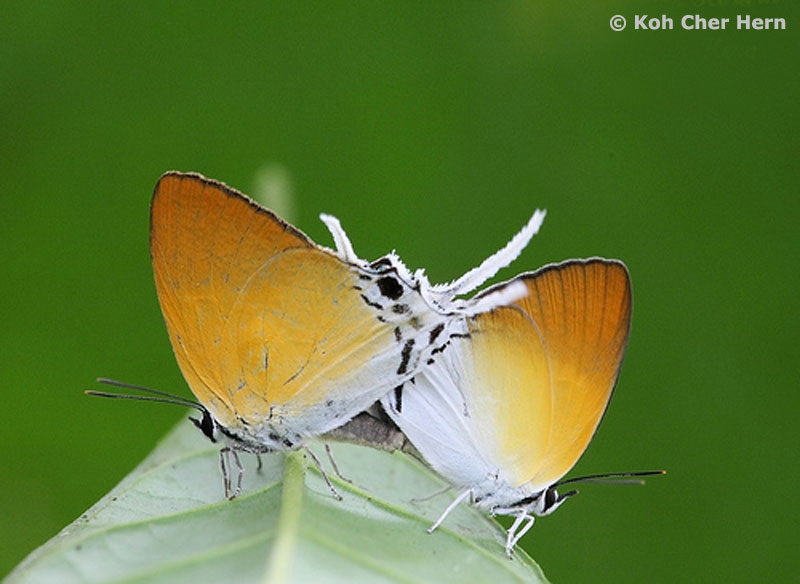
A pair of Green Imperials - male (right) and female (left)

For May 2011, we feature a little green gem of a butterfly, the Green Imperial (Manto hypoleuca terana). The species is one of the long-tailed Lycaenids of Singapore's butterfly fauna. It is a rare forest-dependent species that is not often observed, and probably frequent tree-tops rather than visiting lower level plants.


The male of the Green Imperial is a shining bluish-green at the wing bases of the forewings and on the hindwings, probably giving it its common English name with its emerald green appearance. The broad black apical area of the forewings contrasts strongly with the green.


A female Green Imperial showing its upperside

The female is a drab brown above with black and white markings on the tornal area of the hindwings. Both sexes feature a long pure white tail at vein 2 of the hindwing and a shorter stubby tail at the adjacent vein 3.


A male Green Imperial feeding on a young fern

The underside is dark orange and unmarked on the forewing, although the apical area of the forewing tends to appear darker in colour than the rest of the wings. The hindwing has black sub-marginal and marginal spot and stripes. The hindwing of the male is almost totally orange, whilst the female has a whitened dorsum.


The Green Imperial flies rapidly and is usually quite skittish. It also has a habit of perching on the underside of a leaf at times. It has been successfully bred on the parasitic plant, Macrosolen cochinchinensis that is not uncommonly found on many mature trees.


A mating pair of Green Imperial - male (left), female (right)

This emerald beauty depends very much on the survival and conservation of its parasitic host plant, and it is hoped that with proper management and conservation of the host plant, the Green Imperial will survive as part of Singapore's butterfly fauna for a long time to come.


Text by Khew SK : Photos by Sunny Chir, Federick Ho, Khew SK, Koh Cher Hern, Horace Tan & Tan BJ

18 April 2009

Life History of the Green Imperial

Life History of the Green Imperial (Manto hypoleuca terana)


Butterfly Biodata:
Genus: Manto de Nicéville, 1895
Species: hypoleuca Hewitson, 1865
Subspecies: terana
Seitz, 1926
Wingspan of Adult Butterfly: 36mm
Caterpillar Host Plants:
Macrosolen cochinchinensis (Loranthaceae)

Physical Description of Adult Butterfly:
Above, the male is shining bluish green, with the apical two-thirds of the forewing, cell and termen border of the hindwing black; tornal margin white and crossed by submarginal spots.
The female is dark brown and has white tornal area in the hindwing crossed by conjoined quadrate black spots in spaces 1b and 2. Beneath, both sexes are yellowish orange on the forewing, much paler at dorsum and darker towards the apex. The extent of the yellowish orange coloration on the hindwing differs in the two sexes, with the male having almost complete coverage and that of the female being restricted to the costal area and white elsewhere. The white tornal area contains prominent subtornal markings, with a series of post-discal striae usually reaching vein 6. Each hindwing has a pair of white-tipped tails at ends of veins 1b and 2, with the ones at vein 1b much longer, and the ones at vein 2 about one-third as long.


A male Green Imperial


The upperside of a male Green Imperial


A female Green Imperial


The upperside of a female Green Imperial

Field Observations of Butterfly Behaviour:
This species was confirmed to be still extant in Singapore after a fortunate encounter with a male specimen at the edge of the nature reserve in 2008. It is rare locally as well as in the Malayan Peninsula. Sightings of this species have so far been confined to a few locations within the Central Catchment Nature Reserve, and typically only a single individual appears each time. The fast-flying adults have been sighted taking nectar at flowering plants in the reserves, and perching high near its host plants. An active ButterflyCircle member, Ben Jin, had the good fortune of locating the eggs and caterpillars on the host plant recently. Credit is thus due to him for the discovery of early stages of this stealthy species and making it possible for the life history to be featured in this article.

Early Stages:
The host plant,
Macrosolen cochinchinensis, is a parasitic shrub with all parts of the plants glabrous (having no hairs, smooth). The leaves are leathery, opposite, ovate or lanceolate. The early stages of the Green Imperial feed on the young to mid-aged leaves of this parasitic host, with the 1st instar initially skimming the leaf surface and the later instars eating the leaf along the edges.


Host plant : Macroseolen cochinchinensis

Eggs are laid singly on the stem or petiole of a young shoot, or the pedicel in the vicinity of the flower buds of the host plant. The egg is hemi-spherical with a raised dome, the very top of which is the micropylar. Each egg is white and covered with rather large hexagonal pits. The diameter of the circular base is about 1mm.


Two views of an egg of the Green Imperial


Two vlews of an empty egg shell where the raised dome was mostly eaten by the newly
hatched as it made its way out.

It takes about 3 days for the collected egg to hatch. The young caterpillar consumes just enough of the egg shell to emerge. It is pale yellow in coloration, and has a length of about 1.5mm. Long setae (hairs) run along the length of the body dorsally as well as sub-spiracularly. Raised dorsal tubercles are transparent. A large prothoracic shield, in darker shade of brown, can be observed. The newly hatched feeds on the flower parts or the young leaves nearby by skimming the surface.
Later instars will feed on the leaf lamina, working their ways along the edges.


Two views of a newly hatched caterpillar, length: 1.5mm.


1st instar caterpillar, length: 2mm.

As it grows in this instar, the caterpillar assumes a greenish (yellowish green form) or a reddish coloration (red form). The 1st instar lasts about 3 days and sees the body length increased to about 3mm.


A 1st instar caterpillar of the yellowish green form, in the vicinity of an egg.


A 1st instar caterpillar of the red form.

In the 2nd instar caterpillar, the dorsal tubercles are reduced in size, and the long dorsal setae seen in the 1st instar are now absent. Its diamond-shaped prothoracic shield is very dark in color. The posterior segments from the 7th abdominal segment onwards are fused together and taper downward to the last segment. Pale brown patches decorates the sides of the body, as well as the anterior and posterior segments.


A newly moulted 2nd instar caterpillar (yellowish green form), eating its old skin.


A red form caterpillar seen just after its moult to 2nd instar.


Two views of 2nd instar caterpillar (yellowish green form), early in this stage, length:4.5mm.

These patches become darker in coloration as the caterpillar grows in this instar. A much darker marking is also present between abdominal segments 4 and 5. It is possible to observe the dorsal nectary organ at this stage, though it is still inconspicuous to the naked eye. The 2nd instar lasts for 3 days with the body length reaches about 6-7mm.


Two views of a 2nd instar caterpillar, later in this stage, length:6mm.


A 2nd instar caterpillar committing a carnivorous act.
The victim is a young caterpillar (late 2nd instar) of Tajuria mantra mantra.

In the 3rd instar caterpillar, the lateral body markings, pale brown to dark brown in cryptic pattern, now dominate the general appearance. In the red form, these lateral body markings have a reddish undertone. The lateral body markings are broken between the 4th and 5th abdominal segments by a black triangular marking. The contrasting green coloration is restricted to the dorsal ridge and subspiracular rim of the body.


3rd instar caterpillar, length: 9.5mm.

As the body grows in size to a length of around 11-12mm, the color of shading on the body darkens. The dorsal nectary organ and the tentacular organs are now easily observed on the fused posterior segments. After 3-4 days in the 3rd instar, the moult to the 4th and final instar takes place.


3rd instar caterpillar, length: 12mm, resting for the moult to next instar.

The 4th instar caterpillar is dark brown in color, with pale brown lateral patches and very wrinkled body surface. Both yellowish green and red forms now have the same appearance in this final instar. The prothoracic shield is initially purplish in color in the early hours of the moult, but turning black soon after.


Three shots of the moutling event from the 3rd to the 4th instar,
ending with the new 4th instar eating its old skin.


Prothoracc shield of the 4th instar caterpilar, initially purple (top) and turning black hours later (bottom)


4th instar caterpillar, length: 12.5mm

The 4th instar lasts for 4-6 days and the body reaches a length of about 21-23mm. Nearing the end of this instar, the caterpillar ceases feeding, and its body shrinks in length. Soon it comes to rest on a spot on the surface of a leaf or a stem, and begins the pre-pupatory phase of its life cycle.


4th instar caterpillar, late in this stage, 21mm


A sequence of shots showing the eversion of the tentacular organs.


The pre-pupatory caterpillar prepares for pupation by spinning a silk pad to which it attaches itself via claspers at the posterior end. Even during this pre-pupal stage, color changes continue to take place with silver replacing the pale brown coloration during the 1.5-2 days of the pre-pupatory period.


A pupation sequence for a Green Imperial caterpillar.


Finally after 16-18 days of larval growth, pupation takes place. The pupa is held firmly via its cremaster to the silk pad on the stem or leaf surface. It is 15-16mm in length, brown to reddish brown in base color with large pale green patches. The pupa was observed to react to an external disturbance by jerking up and down.


Two views of a fresh pupa of Green Imperial

Eleven days later, the pupa becomes darkened in color signaling the imminent emergence of the adult. The next day the adult butterfly emerges from the mature pupa.


Two views of a mature pupa (female)


A newly eclosed male Green Imperial drying its wings on its pupal case.


A newly eclosed male Green Imperial.


A female Green Imperial

References:

  • The Butterflies of The Malay Peninsula, A.S. Corbet and H.M. Pendlebury, 4th Edition, Malayan Nature Society.

  • Butterflies of Thailand, Pisuth Ek-Amnuay, 1st Edition, 2006


Text by Horace Tan, photos by Mark Wong, Tan Ben Jin, Khew SK and Horace Tan