Travelogue - Mahua 2020 : Part 2
Back to Mahua Waterfall in Sabah
 The pretty Kinabalu Lass perching on a leaf. This species is endemic to Borneo and one of our favourite butterflies of this trip
Day 4 (12 Feb 2020) : Mahua Waterfall
The pretty Kinabalu Lass perching on a leaf. This species is endemic to Borneo and one of our favourite butterflies of this trip
Day 4 (12 Feb 2020) : Mahua Waterfall
 The scenery from the back entrance of our dormitory that greeted us every morning
Everyone was up and about just after 7am. The problem with the dormitory's wooden plank flooring was that whoever wakes up early and walks around the dormitory, the footsteps resonating on the wooden floor is likely to wake everyone, except the deepest sleeper, up! A quick breakfast of coffee, buns, cup noodles and hard-boiled eggs, we were ready to go!
 The signature Mahua waterfall view that must have been taken thousands of times by visitors
As David had not had his chance at shooting the Kinabalu Swordtail, we decided to stay at the Mahua Waterfall again, and not explore further afield in the Tambunan area. By this time, we were all very familiar with the routine, and off we went to the area near the Ranger Post, looking for the early morning Swallowtails and Skippers. It was only about 8:15am when Cheng Ai spotted the Silky Owl floating about at the treetops, but it stayed out of reach.
 A White Banded Awl that came down to puddle for us
At the dining shed, we spotted a bluish skipper that was puddling on a damp patch on the floor. It was a White Banded Awl (Hasora taminatus malayana) that was cooperative enough to allow us to take multiple shots of it as it fed on the moisture. It was a relatively pristine individual, and the pretty iridescent blue-purple sheen of the wings was a sight to behold.

 Two common morning skippers that are found in the garden around the Admin Building
Out in the undergrowth area in the garden surrounding the Admin Building, a Banded Demon and a Bright Red Velvet Bob frolicked amongst the Asystasia flowers, flying rapidly from flower to flower to feed on the early morning nectar, and then stopping to sunbathe in the sunshine. The skies were generally clear, compared to the previous day, but still cloudy. The weather looked more promising than the previous day, and we headed for the Mahua Waterfall in anticipation of more species to shoot today.
 The underside of a male Black Prince that was commonly seen around the Mahua Waterfall
 The Malayan Oakleaf was regularly seen at the Changing Rooms/Toilets area near the waterfall
As the trail to the waterfall was largely in the shade where the sunshine had not penetrated yet, there was little activity other than the usual species that we encountered the previous days. When we reached the Changing Rooms/Toilets just before the waterfall, the Black Princes, Malayan Oakleaf and Dark Archdukes were up and about.
 A Quaker feeding on a wildflower
A number of Quakers were flying around the wildflowers, and presented good photography opportunities as they were still lethargic in the cool early morning air and the flowers provided their source of nectar for the day.

 A record shot of the Bornean Birdwing ovipositing and the caterpillar host plant, an Aristolochia sp.
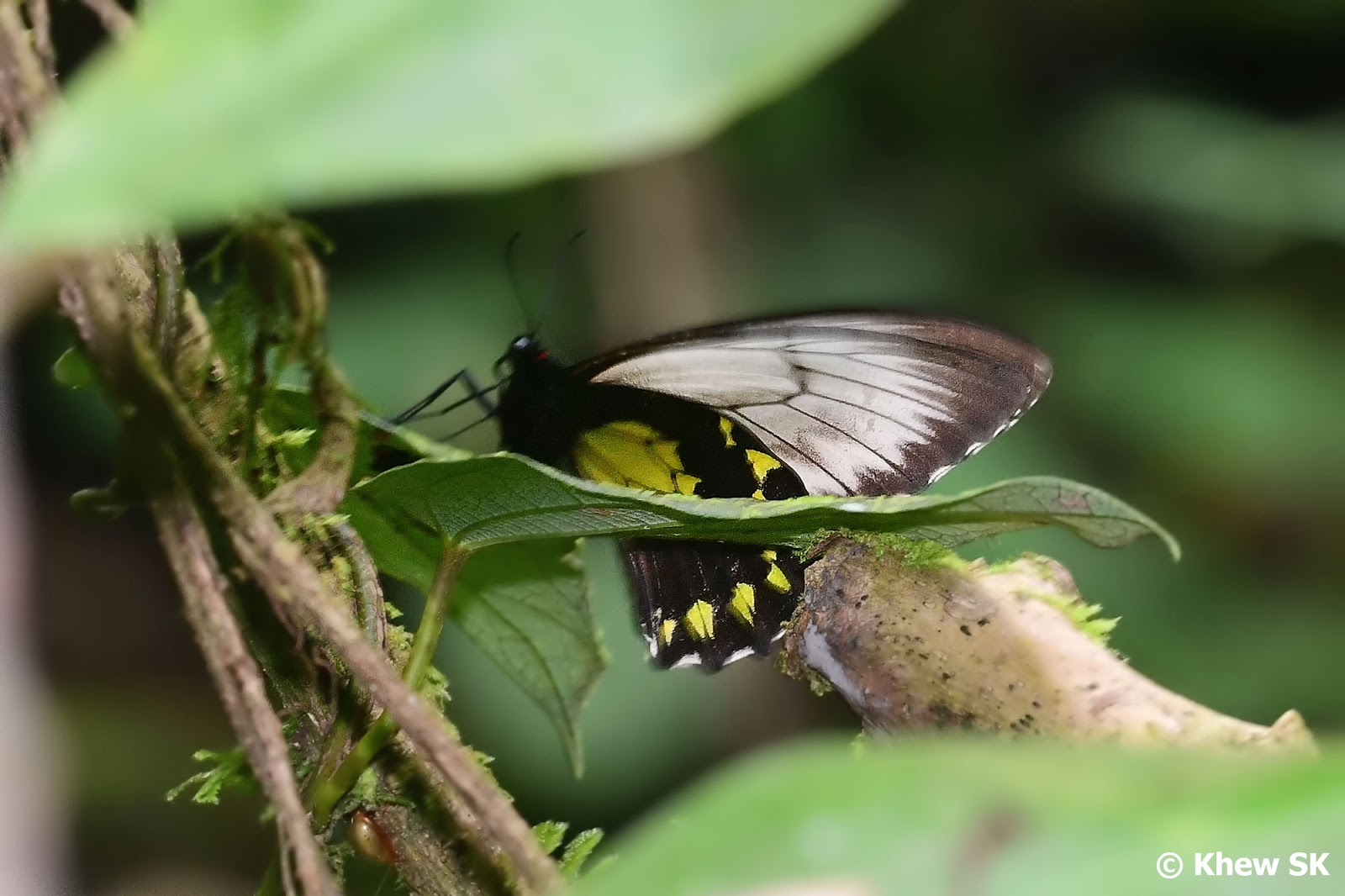
As the sun rose and many areas in the forest understorey began to be illuminated by the warm sunshine, more butterflies stirred. A lone female endemic Troides andromache andromache fluttered across the stream and kept returning to a particular tree. Although it did not stop for a good shot, it fluttered higher up and suddenly adopted the usual ovipositing pose. It was then I realised that I was just standing next to its caterpillar host plant, an Aristolochia vine. It was just awesome to watch this magnificently large Birdwing that can be found only in Borneo.

 The Bornean Mormon (top) and Kinabalu Bluebottle (bottom) are endemic to Borneo
As the sun shone brightly overhead, the Mahua Waterfall area became busy with puddling Papilionidae. The endemic Kinabalu Bluebottle (Graphium procles) were the first to appear, and two of them puddled long enough to keep all of us busy. They were joined by yet another endemic, the Bornean Mormon (Papilio acheron), puddling alongside other Papilionidae and Pieridae species.
 A group of four Dark Mapwings puddling

 The Great Sergeant was seen many times on our trip
The Dark Mapwings (Cyrestis maenalis) that were elusive in the previous days, came out in numbers to puddle at the damp area near the waterfall. After awhile, they were so friendly that they grouped together and puddled for a "family shot". They were joined by another Great Sergeant and the Kinabalu Swordtails.
 A Yellow Puffin puddling near the waterfall
A Yellow Puffin (Appias cardena cardena), initially very active and skittish, finally settled down to puddle and allowed us to take shots of it at close range. A couple of other Appias were flying around, but none as cooperative as this Yellow Puffin. A less-than-perfect Kinabalu Swordtail joined in the fun, but by this time, we were more choosy and looked for more pristine butterflies.
 Tawny Rajah puddling
Meanwhile along the trail back to the Ranger Post, a lone Tawny Rajah (Charaxes bernardus cybistia) was puddling on the wet ground. There were quite a few on our previous trip, but this time around, there appeared to be fewer.

 A Great Mormon and Common Bluebottle puddling at the carpark area
And out at the carpark puddling area, a Great Mormon was helping itself to the liquid nutrients, and a Malayan Crow just scooted off as we approached it. A Common Bluebottle also came down to puddle.

It was late afternoon as the clouds starting coming in again and the environment was cooler, and a couple of Red Helens and a male Wanderer stayed to feed on the Impatiens flowers. We went back to the dormitory and headed back to town for dinner. Interestingly, we could buy fresh vegetables from the 'pasar malam' nearby and then pass it to the cook to prepare our "customised" dinner!
Day 5 (13 Feb 2020) : Exploring Trus Madi Forest Reserve and Molunggung Post Control

The final stretch of road leading to the Trus Madi base camp and to the forest reserve and the mountain peak beyond
We decided to take a break from Mahua on this day, and explore further afield to see if there are other locations where we can find more species of butterflies of Borneo. I recalled that in Tambunan town, there was a sign that pointed to a "forest reserve" somewhere. So after our usual breakfast, we set off and headed towards Tambunan to look for this forest reserve.
 At the roundabout at Tambunan Town, look for the TrusMadi Forest Reserve sign
At the roundabout at Pekan Tambunan, we found the signboard that pointed to TrusMadi Forest Reserve, so we headed in that direction. We had never been in this area before, and there were very few vehicles heading in that direction. Perhaps it was a weekday. We followed the road signs until we reached an area where the paved road stopped and the road ahead was covered with gravel. We assumed it was the end of the road but there was no forest reserve to be found.
 A Malayan Crow, a species that was common at the Trusmadi access road
Cheng Ai asked a contractor working at the area for directions and we found out that the TrusMadi Forest reserve was indeed in that direction, along about 6km of gravel road. So we decided to see what this place looked like. There were no regrets hiring the Nissan X-Trail, as the SUV was able to move on the loose gravel road with relative ease. Along the way, we spotted some "Crows (Euploea spp) puddling so we stopped to investigate.
 Upperside of a Three Ring, a species that was common along the road edges and often ignored by our photographers
We spotted what appeared to be several individuals of the Malayan Crow (Euploea camaralzeman) and took some time to chase and shoot them amongst the roadside shrubbery. A small side trail also yielded a couple of shots of a Three Ring (probably Ypthima pandocus sertorius). We then continued our drive along the gravel road.
 A Malayan Crow with open wings as it puddled
It ended at a closed gate indicating that it was the end of the road for us. After parking our car at the roadside, we went to the guard post and spoke to the person. We were told that the park was under "repairs and renovations" and he wasn't sure for how long. However, he told us that there was a waterfall some 3 km from this checkpoint and Trus Madi was popular with nature trekkers and hikers.
 A Parantica luzonensis praemacaristus puddling at the concrete and gravel area leading to the Trusmadi base camp
Mount Trusmadi or Trus Madi (Malay: Gunung Trusmadi) is a mountain located at the Interior Division of Sabah, Malaysia. It is considered as the second highest mountain in both Sabah and Malaysia at 2,642 metres (8,668 ft), after Mount Kinabalu with Mount Trusmadi offering a tougher climbing challenge than the latter.

As we could not proceed further, we just scouted around the guard post and noticed that the area around the access road that was recently concreted attracted a number of Danainae, which kept us busy for a while. We saw the Malayan Crow, Dark Blue Tiger, Striped Blue Crow, Yellow Glassy Tiger and one of the local Parantica.


 The Molunggung Ranger Post and some facilities
After shooting our fill of the Crows and Tigers, we headed off the mountain trail and went to look for another location which the rangers at Mahua described to David. After about an hour's drive, we found the junction to Jalan Kg Tikolod and took a 10 km drive from the junction to another ranger post called Molunggung Post. It was a series of huts that were quite similar to the ranger post at Mahua. After speaking to the staff there, we were told that this ranger post was the start of a long forest trek called Jalan Garam (or Salt Road) that will take 2-3 days to complete.
 David balances on the the rock "bridge" to cross the wide stream

 The Salt Road or Jalan Garam map. The entire route will take 2-3 days of trekking according to the staff whom we spoke to
We crossed the stream to the start of the Jalan Garam trail and started walking. It was a narrow trail and heavily shaded - not the best of conditions for butterfly shooting. The trail appeared to be very damp, probably from the rain the previous day, and there was not a single butterfly spotted as we walked in further. The trail has good potential if it was a hot sunny day, especially if there is a good clearing further along. We bookmarked this trail for a future expedition.
 At the Jalan Garam, the trail is narrow and sometimes slippery
As it stayed overcast, the potential of encountering butterflies was low along Jalan Garam, and we backtracked to the ranger post after about 30 minutes. As we reached the clearing next to the Ranger Post, the sun broke through for a while and there was some butterfly activity around the area.


 Different views of the endemic Kinabalu Lass (or Bornean Sapphire) at the Molunggung Post
We saw some Cruisers, Great Mormons, Red Helens (one of which oviposited on a lime tree), and some common species. But what kept us busy for nearly most of our visit here was a single endemic Kinabalu Lass (Heliophorus kiana). It kept returning time and again to a few favourite perches and posed to allow us to shoot its underside and upperside as it opened its wings to sunbathe.
 A group shot before we left the Molunggung Post
 A shot of the Restoran Tambunan where we had dinner for 4 consecutive nights
The sky was cloudy and we decided to head back to Mahua. A quick walk into the Mahua forest trail didn't yield anything of interest, and we washed up and headed back into Tambunan for our dinner at our regular kopitiam, having made a special reservation for the dishes the previous night.
Day 6 (14 Feb 2020) - Mahua Waterfall

 Glorious blue skies greeted us on our final day at Mahua!
After our adventure yesterday, we decided to spend our final day of this trip at Mahua Waterfall. After our usual breakfast, we suited up and got ready to head out to our very familiar hunting grounds for the past week. The weather gods must have taken pity on us and rewarded us with glorious blue skies and strong sunshine. The Plain Banded Awls were back at the dormitory and flying actively around, and they were our first 'targets' for the day.
 A sunbathing tattered female Great Mormon
At the carpark, a tattered female Great Mormon flew past and settled with open wings to catch the sun's warmth before fluttering off. A Malay Baron perched on a high leaf on a nearby tree and took off as soon as I tried to get near. It was a glorious day (finally!) and we looked forward to more activity at the waterfall area.

 The sunshine warmed up the trails to the Mahua Waterfall
We quickly made our way into the forest trail and up to the Mahua Waterfall. As the sunshine broke through the thick canopy, butterflies started stirring out of their cool slumber and flutter around to sunbathe on the sunlit spots amongst the leafy foliage in the forest.

A male Rajah Brooke's Birdwing (Trogonoptera brookiana brookiana) glided past, displaying its resplendent black and iridescent green wings that never fail to impress. This species doesn't appear to puddle in congregations over here in Sabah, unlike its cousin, subspecies albescens over in West Malaysia. A Cruiser puddled along the trail, and the males were relatively common throughout our stay at Mahua.

 Upper (top) and underside (bottom) of the Club Beak
I spotted a Club Beak (Libythea myrrha borneensis) foraging amongst some rocks, but it was doing so with half-opened wings. Normally, this species stops with its wings folded upright, and getting a glimpse of its uppersides is only when it flies. This one stopped to puddle with its wings slightly opened, showing a more attractive side to it compared to its striated and rather unattractive undersides.
 Shooting the puddling butterflies at the waterfall area!
 A Kinabalu Swordtail pudding on a mossy rock
As the environment in the humid forest became warmer, butterfly activity increased. Our favourite Papilionidae, the Kinabalu Swordtail showed up time and again to tease us, and at times, stopped long enough for everyone to have our fill of shots of this beauty. The Red Helens were so common that they became sort of an irritation when we were trying to isolate our target butterfly species (that didn't include them!)


 More photos of the endemic Bornean Mormon and Kinabalu Bluebottles
The Bornean Mormons (Papilio acheron), endemic to Borneo, proved to be as common as our previous trip. Occasionally, 5-6 individuals puddled together. Here, Cheng Ai managed to shoot a trio puddling together. The Kinabalu Bluebottles also joined in the puddling, giving the Papilionidaes the lion's share of the puddling grounds.

 Classic shots of the Green Dragontail at Mahua Waterfall
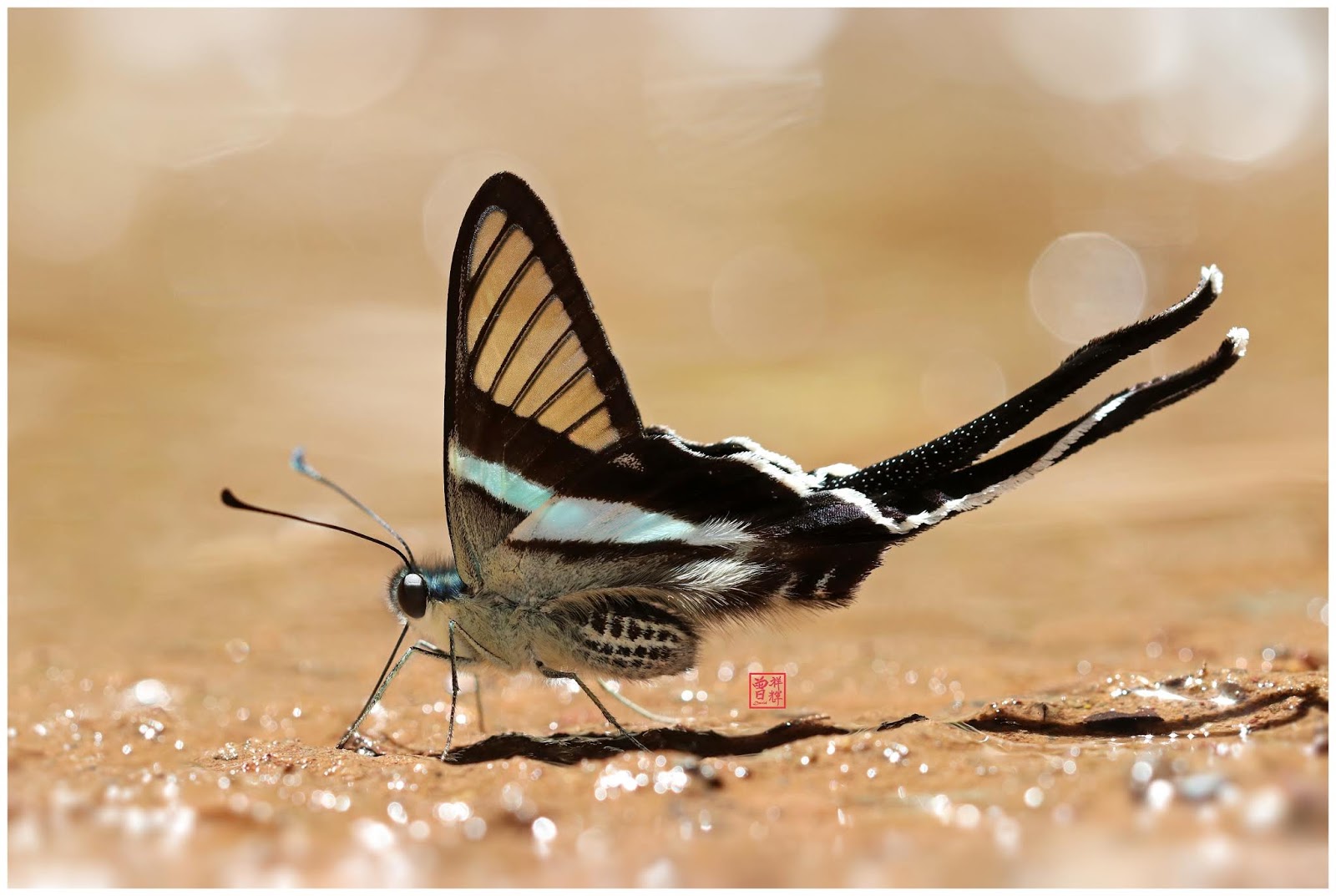
Just past noon, we spotted a familiar dragonfly-like movement zipping around the other larger butterflies. A Green Dragontail (Lamproptera meges meges) appeared. After its initial skittishness, it finally settled down for a good long drink, and as the sun shone strongly above, it opened its wings to show off its upperside and distinctly green band which distinguishes it from its close cousin, the White Dragontail.


 The Himalayan Jester puddling

There were several Sergeant species (Athyma spp) around, and this cooperative Colour Sergeant stayed long enough for us to get some shots of it. Several Great Sergeants also came down to puddle, but most of us had enough shots of this species on this trip, and they were very much ignored. A Himalayan Jester (Symbrenthia hypselis balunda) kept our photographers busy trying to get shots of its pretty underside patterns. David also spotted a Yellow Flat (Mooreana trichoneura trichoneura) puddling on a patch of green moss.
 The endemic Bornean Sawtooth was spotted on 3 of the 5 days we were at Mahua
Out at the carpark puddling ground, we spotted the Bornean Sawtooth again. As usual, it was skittish and flew strongly around the puddling area, finally stopping long enough for more shots of this endemic species. The afternoon sun sapped our energy, as we took a quick break and lunch. As it was too hot out in the open, we made a final trip into the forested trail and waterfall.
 A male Rajah Brooke's Birdwing showing off its black and green wings as it puddles
The same species were still around and we stayed to take more shots of them. A male Rajah Brooke's Birdwing finally stopped long enough to puddle and posed a challenge to us to get this large butterfly all in focus as it flapped its wings almost non-stop.
 Our delicious dinner at the Mahua Rainforest Paradise on our final night of our stay at Mahua
The afternoon wore on, and it was time to call it a day. This was our fifth full day on this outing, and hopefully, everyone got their fill of butterflies and enjoyed the trip. After washing up, we stayed at the Mahua Rainforest Paradise for dinner. We decided to have an easy evening as we prepared for our departure the next day.
 A group shot at the dinner table at Mahua Rainforest Paradise's dining hall
The food prepared by our hosts was quite good, and for the first time, we had a non-Chinese meal after five evenings at Tambunan town. Dinner was wolfed down in record time, and we went back to the dormitory to start packing for our trip home tomorrow.
Day 7 (15 Feb 2020) - Mahua Waterfall to Kota Kinabalu to Singapore
 A final look at the Admin Building of the Mahua Rainforest Paradise and our Nissan X-Trail, all packed and ready to go!
We were up bright and early, and most of us were already packed and ready to go. Reality began to hit again, as we read news of the COVID-19 spread in Singapore, and the number of cases in recent days. We had a quick breakfast, and checked our rooms to ensure that we have not left anything behind.
 Our friendly companion dog came out to bid us farewell
Walking around the garden, it was photographs time as we took selfies, wefies and group photos. We bade farewell to the hospitable staff at Mahua and our friendly 'guardian' dog that kept us company through our stay (in exchange for some yummy food scraps, including a can of premium dog food). After piling our luggage into the X-Trail, we set off on the journey back to Kota Kinabalu.
 The final group shot at the entrance to the trail to the Mahua Waterfall
Our flight back to Singapore was as uneventful as before, although all of us wore surgical masks at the airport and on the flight (just in case). As the plane took off, I took a glimpse of Mt Kinabalu and the Crocker Range, and fond memories of our week in the forests around Mahua and how we enjoyed Sabah's Flying Jewels. I'm sure that we will be back here again someday not too far in the future.
Text by Khew SK : Photos by David Chan, Khew SK, Lim CA and Loh MY