Showing posts sorted by relevance for query Hasora chromus. Sort by date Show all posts

16 October 2010

Life History of the Common Banded Awl

Life History of the Common Banded Awl (Hasora chromus chromus)


Butterfly Biodata:
Genus: Hasora Moore, 1881
Species: chromus Cramer, 1780
Subspecies: chromus Cramer, 1780
Wingspan of Adult Butterfly: 45mm
Caterpillar Host Plants: Pongamia pinnata (Leguminosae).


A male Common Banded Awl perching on a leaf.


A male Common Banded Awl perching on the underside of a branch.

Physical Description of Adult Butterfly:
Adults are rather large in size with pointed forewing apex and markedly lobate hindwings. Above, the wings are dark brown. In the male, the wings are unmarked while the female has two pale yellowish crescentic spots in spaces 2 and 3 on the forewing. The male has a discal stigma on the forewing. Below, both sexes are pale purplish brown. On the hindwing, there is a prominent and narrow white to bluish white discal band partitioning the wing into an inner and an outer half. The inner edge of the band is more sharply defined compared to the outer edge. In contrast, the discal band on the forewing is faint and extends only over the upper portion of the wing. The female has two apical spots in spaces 6 and 7 of the forewing with the one in space 7 absent from some specimens.


Close-up views of the light brown and purplish scales of a female Common Banded Awl.


A male Common Banded Awl perching on the underside of a leaf.


A male Common Banded Awl perching on the underside of a grass blade.

Field Observations of Butterfly Behaviour:
This species is uncommon in Singapore. There is a better chance of finding larval stages of this species on its host plant, Pongamia pinnata, than seeing the adults up close. The fast flying adults have been observed to visit flowers for nectar. When resting, the adults typically do so on the underside of a leaf or other plant parts.


A female Common Banded Awl visiting flowers.


A female Common Banded Awl perching on a stem.

Early Stages:
The local host plant, Pongamia pinnata, is a tree which can grow up to 6-15m tall. Its compound leaf has 5-7 leaflets in a pinna. Each leaflet is thin leathery, shiny reddish brown when young, and turn darker green when matured. It is listed as "Endangered" in the latest Singapore Red Data book, and at present can be found locally in small numbers in parks and along side walks in certain built-up areas. The caterpillars of the Common Banded Awl feed on young to middle-aged leaves of this plant.


Host plant : Pongamia pinnata. Relatively young leaves are shown.

The eggs are laid singly or in small groups of 2-3 on young shoots of the host plants. Each egg is initially white and shaped like a bun with a flattened base (diameter: 0.4-0.5mm). Prominent ridges running from the pole to the base. The micropylar sits atop at the pole. The entire egg turns pinky red as it develops, and then decolorizes again when the caterpillar is ready to emerge.


Two views of a `fresh' egg of the Common Banded Awl.


Two views of a maturing egg of the Common Banded Awl.


Two views of a mature egg of the Common Banded Awl with the larval head vaguely visible.


Two views of empty egg shells of the Common Banded Awl.

It takes 2-3 days for the collected egg to hatch. The young caterpillar eats just enough of the shell to emerge, and has a length of about 2mm. It has the typical cylindrical shape for skipper caterpillars, and the yellowish brown body has a number of short setae. The large head is black, slightly bi-lobed and lightly hairy. The dorsum of the prothorax carries a dark-colored patch/shield.


Two views of a 1st instar caterpillar, early in this stage, length: 1.8mm.


Two views of a 1st instar caterpillar, late in this stage, length: 2.6mm.

The young caterpillar constructs its first leaf shelter by bringing two halves of a small young leaf together with silk threads. It rests within the flap and ventures out to eat on nearby leaf surface. In later instars, the Common Banded Awl caterpillars also construct leaf shelters in a similar fashion but do so with larger and older leaves. The larval growth of the Common Banded Awl is rapid in pace for all five of its instars, with all but the final instar lasting only 1-1.5 days.


1st instar caterpillar, late in this stage, dormant before its moult, length: 3.2mm.

After reaching a length of about 3.2mm in the 1st instar, the caterpillar moults to the next instar after a short dormant period. The 2nd instar caterpillar has four faint whitish narrow dorsal bands and one lateral band which are barely visible against the pale yellowish body ground color. These bands become more prominent as the body ground colour turn pale brownish towards the end of this instar. The body and the head capsule are also covered in short fine setae.


Two views of a 2nd instar caterpillar, early in this stage, length: 3.3mm.


2nd instar caterpillar, late in this stage, length: 5mm.


2nd instar caterpillar, late L2, dormant before its moult, length:5.5mm.

The 2nd instar caterpillar reaches a length of about 5.5mm, and after 2 days in this stage, it moults again. The 3rd instar caterpillar resembles the 2nd instar caterpillar but with more prominent dorsal and lateral whitish bands due to the much darker brown in its ground colour. Overall the body takes on a freckled appearance with numerous tiny lighter patches dotting the dark brown surface. A narrow anal plate dark brown to black in color, can now be seen on the posterior end. This instar lasts another 1-1.5 days with the length reaching 9mm.


Two views of a 3rd instar caterpillar, early in this stage, length: 6.5mm.


Two views of a 3rd instar caterpillar, prior to its moult, length: 9mm.


The 4th instar caterpillar resembles the 3rd instar caterpillar closely, but with its body ground colour in darker brown. The whitish setae on the head capsule are proportionately much longer than in earlier instars. This stage takes about 1-1.5 days to complete with the body length reaching 19mm.


Two views of a 4th instar caterpillar, early in this stage, length: 12.3mm.


Two views of a 4th instar caterpillar, late in this stage, length: 19mm.

The final and 5th instar caterpillar has similar body markings as the 4th instar caterpillar, though the ground colour has changed to a dark shade of purplish brown or even pinky brown above the lateral band. Several large dorso-lateral spots are also present here. Below the narrow lateral band, the body is in a contrasting yellowish brown. One unmistaken change is in the head capsule which has now become pale orangy brown. Moderately long white setae are found over the whole body and the head capsule. This stage takes about 3 days to complete with body length reaching up to 36mm.


A newly moulted 5th instar caterpillar eating its `old' larval skin.


Two views of a 5th instar caterpillar, early in this stage, length: 19mm.


Two views of a 5th instar caterpillar, length: 26mm.

Towards the end of 5th instar, the body of the caterpillar gradually shrinks in length and decolorises. Some caterpillars would turn completely pale greenish whilst others retains several lateral dark spots. The fully grown caterpillar ceases feeding and stations itself in its leaf shelter and enters the preparatory pupa phase. During the early part of this stage, the caterpillar spins large quantity of silk threads to seal the pupation shelter, and in particular, constructs a silk girdle at its 2nd/3rd abdominal segment and a short transverse silk band near its posterior end. Both the dorsal point of the girdle and the transverse band are also secured by vertical/oblique threads to the inner wall of the shelter.


Two views of a 5th instar caterpillar, late in this stage, length:36mm.


Two views of a pre-pupa of the Common Banded Awl secured via silk girdle and anchor in its shelter.

After about 0.5-1 day of the pre-pupal phase, pupation takes place within the pupation shelter. The pupa secures itself with its cremaster attached to the transverse band. The pupa has a short thorax, a rather long abdomen and a short and pointed rostrum. Fresh after the pupation event, the body is greenish, but after 0.5 to 1 day, the body surface becomes mostly covered in a white substance. Length of pupae: 23-24mm.


Two views of a pupa of the Common Banded Awl with a coating of whitish powdery substance.

After 5-5.5 days, the pupa becomes darkened in color signaling the imminent emergence of the adult. The next day the adult butterfly emerges from the mature pupa.
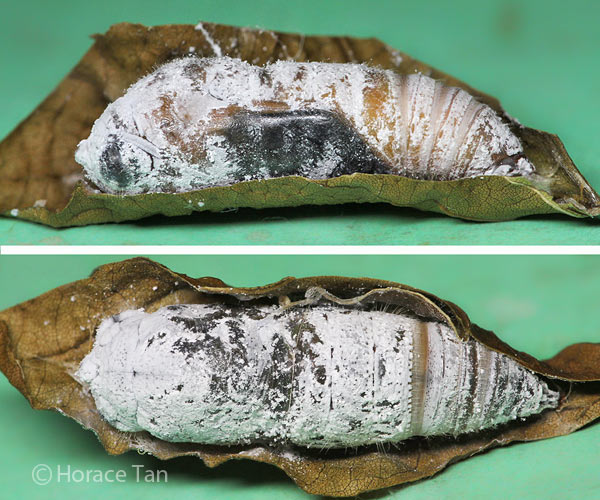

Two views of a mature pupa of the Common Banded Awl


A newly eclosed male Common Banded Awl.

References:

  • The Butterflies of The Malay Peninsula, A.S. Corbet and H.M. Pendlebury, 4th Edition, The Malayan Nature Society.
  • Butterflies of Thailand, Pisuth Ek-Amnuay, 1st Edition, 2006
  • The Butterflies of Hong Kong, M. Bascombe, G. Johnston, F. Bascombe, Princeton University Pres 1999
Text by Horace Tan, Photos by Khew S K and Horace Tan

18 May 2019

Awls of Singapore : Part 2

Awls of Singapore : Part 2
Featuring the Awl skippers in Singapore


A Plain Banded Awl puddles on a terracotta tile floor

In Part 2 of the Awls of Singapore, we take a look at the remaining four species of skippers bearing the name "Awl" in their English Common names. As mentioned in Part 1 last week, the use of an everyday object (at least in the past) for the name of a butterfly is uncommon. The awl is, after all, a tool with a pointed tip used to make holes in leather or thick fabrics.


A White Banded Awl puddling at a concrete table

We now feature the four remaining species of the extant Awls found in Singapore - all of which belong to the genus Hasora. These are robust-bodied skippers that prefer the shaded forested areas and are usually more active in the early morning and late dusk hours of the day. They can also be found feeding on flowering plants or puddling on bird droppings and damp forest logs, footpaths and brick walls of buildings within the forested areas.

4) The Common Banded Awl (Hasora chromus chromus)


The Common Banded Awl is a relatively rare species but is widely distributed across Singapore, from the nature reserves to urban parks and gardens. It is a rapid flyer and more active in the early hours of the morning, where it zips across heavily shaded habitats, sometimes on tree trunks, feeding on the moisture of the morning dew. It can sometimes be found puddling on bird droppings, or feeding on flowers of trees like the Spicate Eugenia (Eugenia zeylanicum).


Typical behaviour of the Awls - hiding under a leaf

The upperside of the Common Banded Awl is dark brown in the male and unmarked, whilst the female has two crescentic spots on the forewings. On the underside, the base colour is a dull purple-brown with the white discal band usually narrow and outwardly diffused. The underside of the basal area of both wings is washed with a dull purple-blue sheen under certain lighting conditions. Forewing typically without an apical spot in space 6 of the forewing in the male, but in the female, there may be apical spots in spaces 6 and 7 on the forewing. The hindwing marginal white line extends indistinctly to the apex. The caterpillars have been successfully bred in Singapore on Pongamia pinnata.

5) The Plain Banded Awl (Hasora vitta vitta)


A Plain Banded Awl perched on a coconut tree trunk

The Plain Banded Awl appears very similar to the Common Banded Awl, and identification is often difficult in the field. It shares the same habits as its other cousins in that, when disturbed, it hides under a leaf with its wings folded upright. She species has been spotted at urban parks as well as in shady forested areas. A swift flyer, the Plain Banded Awl also displays crepuscular habits and regularly observed feeding at flowering trees and puddling.


Plain Banded Awls feeding on flowering plants

The Plain Banded Awl is dark brown above with a single prominent pale yellow sub-apical spot on the forewing of the male, whilst the female has additional large hyaline spots on the forewing. The underside is pale brown with the inner half of the hindwing having a bluish-grey glaze. The white post-discal band is usually broader than the Common Banded Awl. The hindwing marginal white line starts at the tornal area and generally ends at vein 3. The caterpillars have been successfully bred in Singapore on Spatholobus ferrugineus.

6) The White Banded Awl (Hasora taminatus malayana)


Like its other relatives, the White Banded Awl is mainly found in shady forested areas in the nature reserves. It also displays the habit of hiding under a leaf with its wings folded upright. Once disturbed it takes off at high speed to search for another hiding place. It is also found puddling on damp footpaths and walls of buildings in the vicinity of the nature reserves.


The male White Banded Awl is dark brown above and unmarked, whilst the female has small pale yellow post-discal spots on the forewing. The underside is pale brown with the wing bases strongly suffused with a bluish-green sheen. The white post-discal band is always narrow. The caterpillars of the White Banded Awl have been successfully bred on Derris trifoliata.

7) The Yellow Banded Awl (Hasora schoenherr chuza)


Yellow Banded Awl hiding under leaf (top) and puddling at a clay brick wall (bottom)

The Yellow Banded Awl is considered rare and usually encountered singly in the forested nature reserves of Singapore. It has the same habit of the other Hasoras of flying rapidly and then settling on the underside of a leaf to hide. It is often observed to puddle on bird droppings and other animal excretions and also fond of damp walls and tree trunks.


The Yellow Banded Awl is dark brown above with four sub-apical pale yellow spots, together with hyaline spots to form a confluent band. The hindwing has a broad yellow discal band. The underside is similarly marked but with lighter wing bases. In certain side lights, the apical and marginal areas on the underside of the wings may appear deep purple. The caterpillars of this species have been bred on Spatholobus ridleyi and Kunstleria ridleyi.

Text by Khew SK : Photos by Khew SK, Loke PF, Nelson Ong and Horace Tan.

25 June 2016

Butterfly Photography at Our Local Parks - Fusionopolis North

Butterfly Photography at Our Local Parks
Featuring : Fusionopolis North @ One North Park


Another Butterfly Garden in Singapore has recently been completed by NParks and opened to the public on the western part of Singapore. A 5,800 sqm Butterfly Garden referred to as Fusionopolis North, it features a rain garden with bioswales, is cultivated with butterfly-attracting host and nectaring plants.


One-north Park is a 16-ha park consisting of 13 land parcels spanning across the entire length of JTC’s masterplan for one-north to create a work-live-play-learn environment. The park, when fully completed, serves as an integrated green corridor to link key developments such as Biopolis, Fusionopolis, Mediapolis and the one-north MRT station.


Last week, two of the parcels were completed - Fusionopolis North (flanked by Central Exchange Green, One North Link and Portsdown Road) and Fusionopolis South (flanked by One North Crescent, Portsdown Road and Central Exchange Green). The two adjacent parcels are rich with local biodiversity like birds, butterflies, dragonflies and even a snake or two.


I visited to the Fusionopolis North's Butterfly Garden during its opening ceremony last Saturday at around 4:00pm on a drizzly evening. Surprisingly, there were still quite a number of butterflies fluttering around, feeding on the flowering plants. In a short 30 minute survey, a total of 11 species of butterflies were spotted. Not bad, considering the time of the day and the weather.


Two more follow-up observation surveys were made over the weekends and the tally is now 26 species and counting! The Butterfly Garden was active with free-ranging butterflies on both the days that I visited. The most common species was the Lemon Emigrant (Catopsilia pomona pomona) and Tawny Coster (Acraea terpsicore). There were at least 20 individuals of both species fluttering amongst the flowering plants.


Top : Female Blue Pansy ovipositing on the leaves of the variegated Asystasia gangetica

Large numbers of butterfly-attracting plants have been cultivated on the 0.58Ha plot. The main concrete path winds around the patches of host and nectaring plants, with secondary paths of gravel providing alternative routes around the greenery. Look for the Tawny Coster caterpillars on the Yellow Alder (Tunera ulmifolia) plants. The low-lying Asystasia gangetica "Ivory Ribbons" plants attract the Blue Pansy to lay eggs on them, and their caterpillars can be found on these plants, if you look hard enough.


Common Mime feeding on the purple flower of the Golden Dewdrop

The other host plants like the Lime Bush (Citrus sp) and Indian Curry Leaf (Murraya koenigii) around the periphery of the Butterfly Garden are sure attractants to the females of the Common Mormon and Lime Butterfly to lay eggs on their favourite caterpillar host plants. There are also many other host plants like Asystasia, Ixora, Cratoxylum cochinchinense and Caesalpinia pulcherrima to attract their respective butterfly species.


Amongst the nectaring plants are the Yellow Alder (which attracts butterflies to feed on them in the early morning hours when their yellow flowers are open fully), Lantana, Ixora, and the Golden Dewdrop (Duranta erecta). The last-named plant, with its pretty purple flowers, seems to be the all-time favourite with the butterflies at this Butterfly Garden.


Female Blue Pansy feeding on the yellow variety of Lantana camara

The success of this small patch of greenery is dependent on its catchment area surrounding the park. Adjacent to the cultivated patches, large areas of greenery are left in their undisturbed natural state. These green 'backdrops' are functionally critical as buffer areas which also host rich biodiversity in the area. The network of Park Connectors (PCNs) then link up the larger parks like the Southern Ridges, Botanic Gardens, West Coast Park and Bukit Timah to this area.


Overview map of the Fusionopolis North Butterfly Garden

As the Butterfly Garden at Fusionopolis North is newly completed, it appears rather open and hot. When the vegetation is more mature, there may be patches of shadier habitats that may attract other species of butterflies besides those that prefer open and bright sunshine environments. Do take a walk to the adjacent Fusionopolis South, as there are also areas that are attractive to butterflies as well.


Signages and seating at Fusionopolis North Butterfly Garden

There are some interpretative signs to help introduce the types of plants that are cultivated at the Butterfly Garden. On a cloudy day or in the evenings, a visitor may be tempted to just take a seat at several seating areas along the walkways, just to enjoy the breeze and watch the butterflies flutter by.


Whilst nature enthusiasts often lament the loss of our natural urban greenery, the juxtaposition of cultivated plots with existing natural plots like what has been done at One-North Park, often offers a good conservation balance that may be just right for our biodiversity to thrive within our built environment. NParks and other government agencies like the JTC and URA have been making great strides in helping to maximise the potential of our urban greenery to attract and enhance our biodiversity despite the continuous need to develop our scarce land resources.


Fusionopolis North Butterfly Garden with the high-tech industrial buildings in the background

If you are a resident living in the south-western part of Singapore, pay a visit to this new Butterfly Garden at Fusionopolis North on a sunny day, and you will not be disappointed at the variety of butterflies that can be spotted at this small plot of greenery.


How to Get There :
By MRT : Fusionopolis North Butterfly Garden is about a 5-minute walk from the One-North MRT station, or about a 10-minute walk from the Buona Vista MRT station.

By Car : See map for details. Park at the various buildings opposite the park. The basement carpark at One-North Residences is the nearest carpark. Note that prevailing parking charges apply.

Text by Khew SK : Photos by Khew SK and Huang CJ

Checklist of Butterflies Observed at Fusionopolis North Butterfly Garden :
  1. Papilio clytia clytia (Common Mime)
  2. Papilio demoleus malayana (Lime Butterfly)
  3. Papilio polytes romulus (Common Mormon)
  4. Delias hyparete metarete (Painted Jezebel)
  5. Appias libythea olferna (Striped Albatross)
  6. Catopsilia pomona pomona (Lemon Emigrant)
  7. Catopsilia scylla cornelia (Orange Emigrant)
  8. Eurema hecabe contubernalis (Common Grass Yellow)
  9. Danaus chrysippus chrysippus (Plain Tiger)
  10. Ideopsis vulgaris macrina (Blue Glassy Tiger)
  11. Elymnias hypermnestra agina (Common Palmfly)
  12. Mycalesis mineus macromalayana (Dark Brand Bush Brown)
  13. Doleschallia bisaltide bisaltide (Autumn Leaf)
  14. Junonia hedonia ida (Chocolate Pansy)
  15. Junonia almana javana (Peacock Pansy)
  16. Junonia orithya wallacei (Blue Pansy)
  17. Acraea terpsicore (Tawny Coster)
  18. Phalanta phalantha phalantha (Leopard)
  19. Phaedyma columella singa (Short Banded Sailor)
  20. Euchrysops cnejus cnejus (Gram Blue)
  21. Zizula hylax pygmaea (Pygmy Grass Blue)
  22. Zizina otis lampa (Lesser Grass Blue)
  23. Hasora chromus chromus (Common Banded Awl)
  24. Potanthus omaha omaha (Lesser Dart)
  25. Polytremis lubricans lubricans (Small Branded Swift)
  26. Suastus gremius gremius (Palm Bob)
Further Reading and References :

NParks Website : One North Park : Fusionopolis North Butterfly Garden