Showing posts sorted by relevance for query Ancistroides nigrita. Sort by date Show all posts

08 September 2018

Butterfly of the Month - September 2018

Butterfly of the Month - September 2018
The Chocolate Demon (Ancistroides nigrita maura)


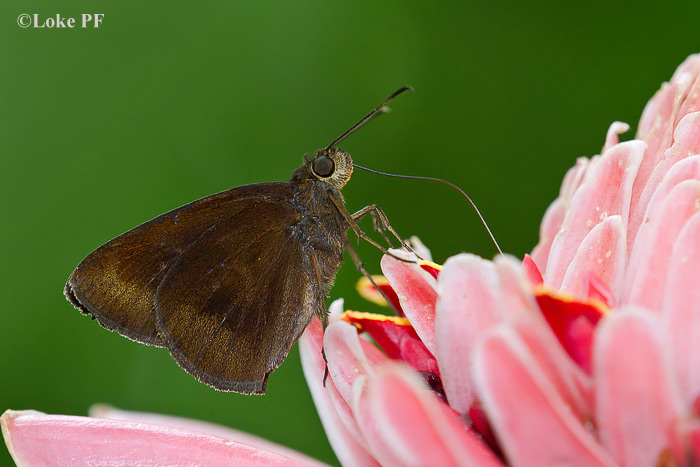
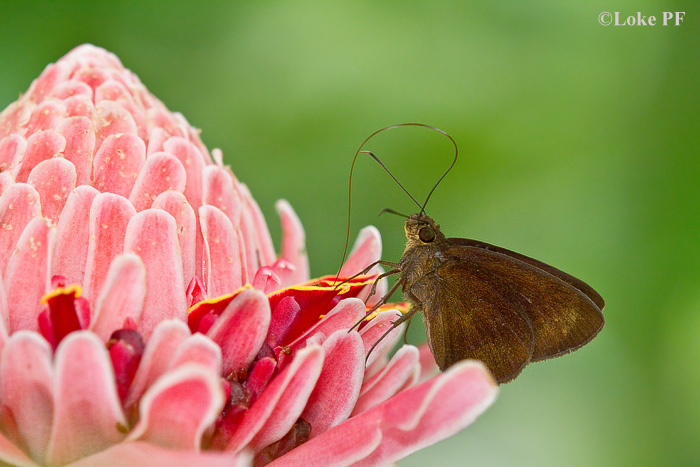
A Chocolate Demon sends its exceedingly long proboscis deep into the flower of the Torch Ginger for nectar

Just into the ninth month of 2018, Chinese communities prepare for the Mid-Autumn or Mooncake Festival towards the end of September. Many Chinese/Asians all over the world - crazy, rich or otherwise, look forward to the sweet treats in the form of mooncakes. Even in early September, I have already had my first taste of mooncakes sold by ever-enterprising retailers who start selling these diabetes-inducing desserts way ahead of the Mooncake Festival.


Over in Jakarta and Palembang, the 18th Asian Games drew to a close on 2 Sep, with just over two weeks of competitions amongst the best athletes in Asia. The Games closed without any major hitches or security issues, as Indonesia showed its proficiency and confidence to host a major sports event and could be a contender for the Summer Olympics some time in the future. Little Singapore ended the games in 14th spot (out of 46 participating asian countries) securing 22 medals with 4 golds coming from swimming, sailing and contract bridge.


Over in Japan, Mother Nature's wrath came in the form of typhoon Jebi, the strongest winds to hit Japan in 25 years. Before it made landfall, the storm had sustained winds of 140 kilometers per hour and gusts of 165 kmh, the equivalent of a Category 1 Atlantic hurricane. And as the Japanese were recovering from Jebi, a 6.7 magnitude earthquake struck the island of Hokkaido. It is just the latest of a number of natural disasters to hit the country, continuing a summer of chaos that has seen deadly floods, typhoons, earthquakes and heatwaves. Not a good year for Japan.
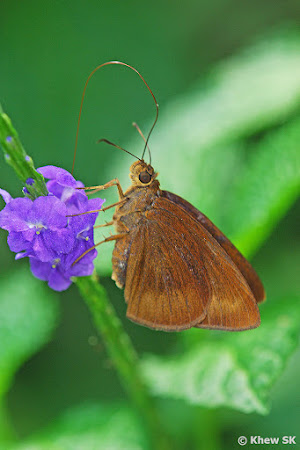

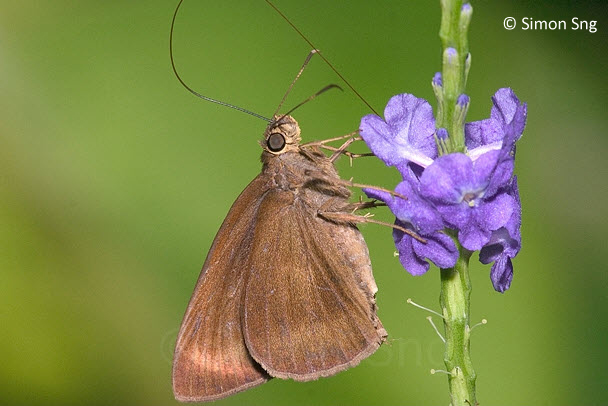
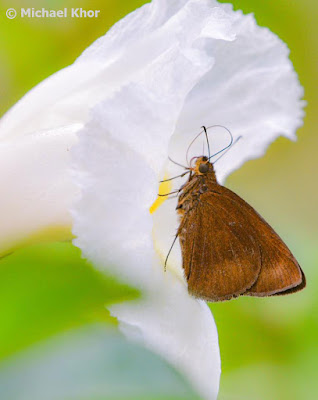
A Chocolate Demon feeding on the flower of the Snakeweed

Back home in quiet, 'boring' but safe Singapore, the government had to settle for a deferment of the High Speed Rail (HSR) project that was originally touted to start operations in 2026. However, the deferment would mean that if the project will eventually happen, it would only start running in 2031. The new Malaysian government has also thrown a number of controversial bilateral proposals our way, one of which stirred the environmentalists' hornet's nest. The proposal of a 3rd terrestrial link via Pulau Ubin irked the nature community. Let us hope that this is just another 'distraction' thrown our way to mask the 'real' agenda that is yet to come.
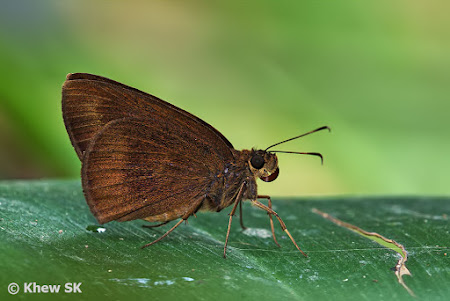

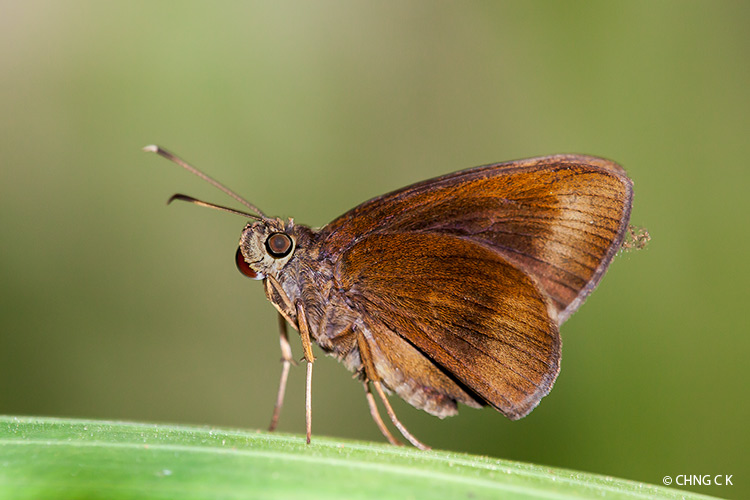
A Chocolate Demon perches on a leaf under the shade with its wings folded upright

Let us turn to our Butterfly of the Month for September 2018. In our butterfly world, not every species is endowed with awe-inspiring beauty, colour, size or shape. Some butterfly species can appear drab and uninteresting to many observers. Our feature butterfly this month is one of them - the Chocolate Demon (Ancistroides nigrita maura).
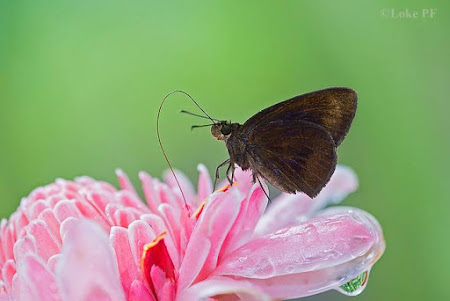
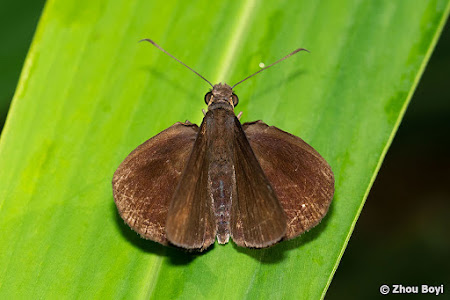
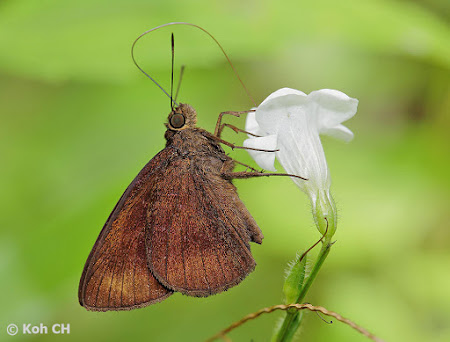

One of the remarkable features of the Chocolate Demon is its very long proboscis

The Chocolate Demon is a relatively common species, often found in urban parks and gardens where its preferred caterpillar host plant, the Torch Ginger (Etlinger elatior) is cultivated. Several other of its caterpillar host plants are cultivated as garnishing or ingredients for our local cuisine, and hence found in urban areas.

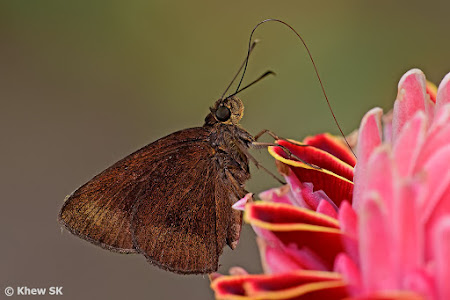
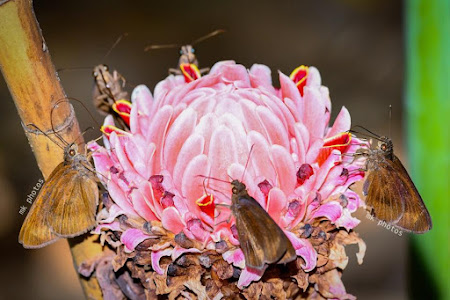
The Chocolate Demon butterflies are often found in the vicinity of its host plant, the Torch Ginger.  They feed on the flower of this ginger, and sometimes many individuals are seen feeding together  How many Chocolate Demons can you count in the last photo?

It is a large skipper of the Hesperiidae family, and flies with an erratic and hopping flight amongst low shrubbery. It can often be observed to be feeding on various nectaring plants, and stops with its wings half-opened in a typical Hesperiidae fashion. Adults are also regularly seen in the vicinity of Torch Ginger groves, feeding on the large pink flowers of the plant. Sometimes up to half a dozen individuals can be seen together.
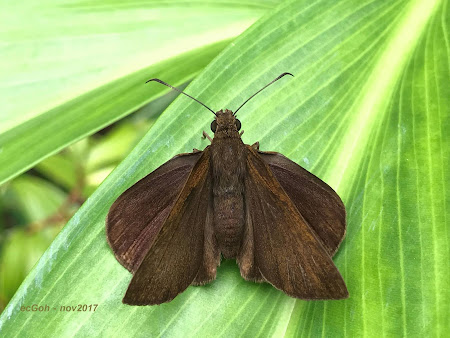
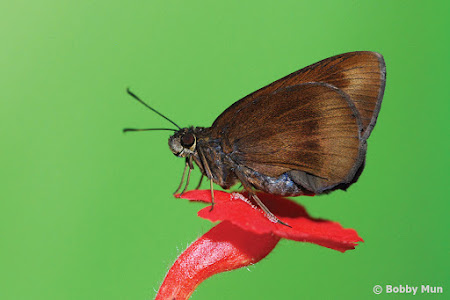


The Chocolate Demon is dark chocolate brown on the upperside and unmarked. On the underside, the marginal areas of both wings appear paler than the ground colour. A remarkable feature of this species is the extreme length of its proboscis, with which it uses to probe deep into flowers for nectar. The proboscis is more than twice as long as the butterfly's body.
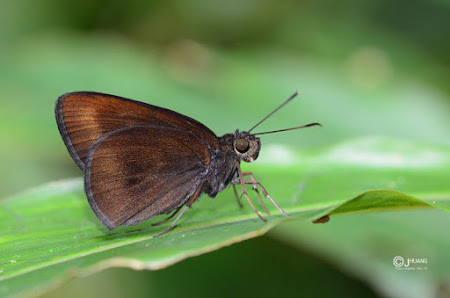


Besides feeding on flowers for nectar, the Chocolate Demon can sometimes be seen to feed on bird droppings and other animal excretions, although it is rarely seen to puddle at damp forest paths. It can be skittish at times and sometimes 'jump' at the flash when photographed.


Caterpillars are usually found in leaf shelters on the preferred host plant, Torch Ginger. Other known host plants on which the caterpillars have been successfully bred in Singapore are Hedychium coronarium (White Ginger Lily, Butterfly Ginger), Zingiber officinale (Ginger) and Alpinia aquatica (Aquatic Ginger).

Text by Khew SK : Photos by Alan Ang, Goh EC, Federick Ho, Huang CJ, Khew SK, Michael Khor, Koh CH, Loke PF, Bobby Mun and Zhou Boyi

19 February 2013

Random Gallery - Chocolate Demon

Random Butterfly Gallery
The Chocolate Demon (Ancistroides nigrita maura)


Drab chocolate brown and generally unmarked, the Chocolate Demon (Ancistroides nigrita maura) is not your typical pretty butterfly that would attract much attention from the casual observer. It is one of several species of Skippers (family : Hesperiidae) to have the common name "Demon". The caterpillar host plants in Singapore are the Torch Ginger (Nicolaia elatior) and Pandan (Pandanus amarilyfolius).

In this shot, the adult Chocolate Demon was photographed feeding on the flower of the Torch Ginger by ButterflyCircle member Loke PF. So the Torch Ginger is a source of food for the Chocolate Demon's early stages as well as the adult butterfly. Of noteworthy mention, is the butterfly's extremely long proboscis, (which is typical of many of the species in the family) giving an impression that the butterfly is 'fly-fishing' when it unfurls its proboscis to feed on nectar from flowers. 

18 January 2014

Life History of the Chocolate Demon

Life History of the Chocolate Demon (Ancistroides nigrita maura)


Butterfly Biodata:
Genus: Ancistroides Butler, 1874
Species: nigrita Latreille, 1824
Sub-species: maura Snellen, 1880
Wingspan of Adult Butterfly: 42-50mm
Caterpillar Local Host Plants: Etlingera elatior (Zingiberaceae, common name: Torch Ginger), Hedychium coronarium  (Zingiberaceae, common name: White Ginger Lily, Butterfly Ginger), Zingiber officinale (Zingiberaceae, common name: Ginger), Alpinia aquatica (Zingiberaceae).


Physical Description of Adult Butterfly:
Chocolate Demon is a relatively large skipper. On the upperside, the wings are dark brown and unmarked. On the underside, the wings are brown with marginal areas of both wings paler than the ground colour. The proboscis is particularly long compared to other skipper species.


Field Observations of Butterfly Behaviour:
Chocolate Demon is moderately common in Singapore. The adults are typically found in parks, park connectors and gardens where one of its host plants in the Zingiberaceae is cultivated. The adults fly in an erratic and hopping manner amongst low shrubbery. They visit flowers for nectar, and puddle on birding droppings and other animal excretions.


04 August 2019

Demons of Singapore

Demons of Singapore
Featuring Demon Butterflies in Singapore


A Chocolate Demon feeding on the flower of the Torch Ginger. whose leaves also happen to be its caterpillar host plant

Since the beginning of August 2019, one can almost encounter the burning of joss paper, joss sticks, candles and food offerings in most housing estates. The Hungry Ghost Festival, which falls on the 7th month of the Chinese calendar, started on 1 Aug and will continue for a month. The Festival, where Buddhists and Taoists believe that the Gates of Hell opens for a month, to allow spirits and souls from the netherworld to roam freely on Earth, seeking food and other offerings.


The Chinese believe that demons guard the Gates of Hell that are opened during the Hungry Ghost Festival to allow spirits of the departed to roam freely for a month.

A traditional stage set-up during the Hungry Ghost Festival

Other than burning paper offerings, raucous and loud musical and Chinese traditional performances will also liven up heartlands areas as tents are set up to house massive dinners, auctions, operas and, of course, getai­ (“song stage” in Chinese) shows. The last named shows often feature scantily-clad girls who sing a variety of songs in local dialects and Mandarin. If you are planning to catch any of these shows, just be sure to leave the front row seats empty for the “spirits” and demons who supposedly crave such entertainment too!


There are also many superstitions that are followed during this season include refraining from leaving umbrellas open inside the home, as that is believed to invite homeless spirits. Some avoid killing insects (butterflies too!) as they could be deceased ancestors who have been reincarnated. Other no-nos include walking around in dark lonely places like cemeteries or forests, especially at night.


So whilst the spirits, demons and other denizens of the netherworld roam around and seek their freedom for the next 25 days before the Gates of Hell close again for another year, let us take a look at our local demons flying around in Singapore. Our butterfly Demons that is...

1) The Chocolate Demon (Ancistroides nigrita maura)


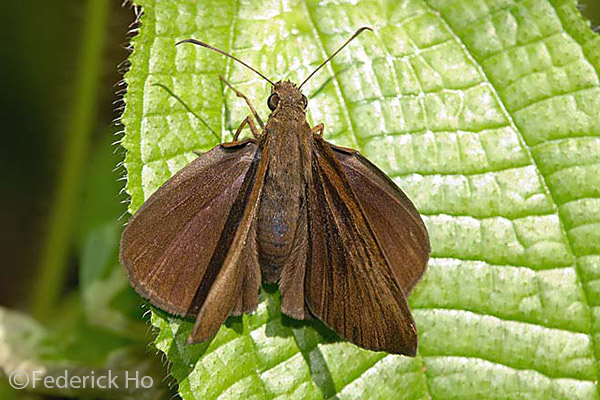
A pristine Chocolate Demon perches on a leaf in the shade

This urban Hesperiidae (skipper) can usually be found in the vicinity of its caterpillar host plant, the Torch Ginger (Etlingera elatior) and other ginger-type plants. It is relatively common and is well distributed across the island. The Chocolate Demon is a large skipper and flies with an erratic and bobbing flight amongst low shrubbery.


The Chocolate Demon has one of the longest proboscis amongst the butterflies found in Singapore

The Chocolate Demon is dark brown above and unmarked. On the underside, however, the marginal areas of both wings appear paler than the ground colour. A unique feature of this butterfly is its long proboscis with which is uses to probe deep into flowers for nectar.


A Chocolate Demon sunbathes in a typical skipper fashion

The species often stops to sunbathe in a typical skipper pose - with its hindwings opened flat whilst its forewings are opened at a 45deg angle to the body. It is often observed to feed on bird droppings and other animal excretions, but is also equally regularly encountered feeding on a variety of flowers, one of which is the Torch Ginger's attractive pink flowers.

2) The Banded Demon (Notocrypta paralysos varians)


A mating pair of Banded Demon

The Banded Demon is another skipper that often stays in the vicinity of its host plant, Costus lucanusianus a species of ginger that grows in the shady understorey in Singapore's nature reserves and other forested areas. It is a rapid flyer and can be skittish as it zips around low amongst the shrubbery. It can also be found in urban parks and gardens, besides the nature reserves.


The Banded Demon is a deep brown above with a distinct white discal band composed of large rounded contiguous spots on the forewing. There is usually a white hyaline spot in space 4 of the forewing, but this spot can be absent in some individuals. The underside, which is a paler purplish-brown is distinctly paler along the wing margins.


The butterfly is usually encountered in the early morning hours of the day, sunbathing with its wings in the usual skipper fashion. It likes to feed on the flowers of the Chinese Violet (Asystasia gangetica), and flies rapidly from flower to flower, using its long proboscis to reach inside the flower for nectar.

3) The Grass Demon (Udaspes folus)


A Grass Demon feeding on the flower of Mussaenda

The last Demon extant in Singapore occurs mainly in urban parks and gardens in the vicinity of its preferred host plant, Turmeric (Cucurma longa), and other gingers. It is regularly found in herb and spice gardens in Singapore, where ginger and turmeric are cultivated. It is a fast-flyer but usually zips around at a low level.


The Grass Demon is dark brown above, with the forewing featuring a white discal fascia comprised of several large white spots. The hindwing has a large white discal patch on the upperside. The underside is paler and appears reddish brown in pristine individuals. The hindwing cilia is chequered in freshly eclosed individuals. The antenna has a whitish band just below the club.


A Grass Demon sunbathes in typical skipper fashion

The butterfly is observed to feed on flowers in the early morning hours. It also likes to puddle on bird droppings and other animal excretions. An often-observed behaviour of the Grass Demon is that when it perches on a top surface of a leaf to sunbathe, it opens and closes its wings rhythmically.

And so we are introduced to the three Demons in Singapore that are not part of the Festival of Hungry Ghosts, but are part of Singapore's butterfly diversity.

Text by Khew SK : Photos by Khew SK, Koh CH, Loke PF, Tan CP and Anthony Wong

04 September 2010

Observation Notes on Forest Hopper / Coon

Observation Notes on the Forest Hopper & Coon
Updating the Butterflies of Singapore Checklist


A shot of the Coon taken at Endau Rompin Forest Reserve in Malaysia

The family Hesperiidae (or commonly known as Skippers) feature rather unattractive butterflies. They are fast flying, with big eyes and many of them perch with their wings opened in a unique fashion, known only to the Hesperiidae - with their forewings held out at a 45 deg angle, whilst the hindwings are opened flat.


A shot of the Forest Hopper taken in Singapore

Many skippers are brown, unmarked and not typical of what enthusiasts, hobbyists and nature photographers would find particularly beautiful in a butterfly. Hence it is not surprising that many of these ubiquitous butterflies go about their daily lives, flitting amongst flowers in the early morning hours and later hours of the day largely unnoticed.


A Forest Hopper perches on a blade of grass

Of particular interest would be the many lookalikes which are difficult to identify with a high level of confidence from just field shots. To add to this difficulty, the large variations in the physical characteristics like their hyaline spots, markings and colours in both the males and females make it extremely challenging to distinguish between certain species without examining them scientifically - i.e. dead in a collection or via dissection of the genitalia.


Another Forest Hopper on a leaf

Early in the compilation of the Butterflies of Singapore checklist, I had inadvertently classified a predominantly brown and unattractive skipper as the Coon (Psolos fuligo fuligo). For a long time, we had assumed that this was the species flying around the grasslands in Singapore.

Recently, one of ButterflyCircle members, Dr S. Kalesh, who hails from Trivandrum (or Thiruvananthapuram) in India, and who is a specialist in Hesperiidae, corrected this mistake. The Singapore Checklist has been updated accordingly, as after examining the repository of photographs and also voucher specimens amongst ButterflyCircle members and my own collection, the Coon (Psolos fuligo fuligo) is unfortunately no longer extant in the Singapore environment. Although it is listed in the Checklists of Butterflies of the Malay Peninsula (C&P4), there has be no reliable evidence that this species still exists in Singapore and therefore removed from the Checklist until such time any evidence of its presence can be validated.


A shot of the Coon taken in India

The butterfly that had earlier been mis-identified as the Coon, has now been confirmed to be the Forest Hopper (Astictopterus jama jama) and reinstated to the Singapore Checklist. This predominantly brown skipper is described as "above and below the butterfly is dark brown and is usually unmarked although there may be two or three white hyaline subapical dots on the forewing.


A Forest Hopper feeds on a yellow flower

In C&P4, page 351, the authors continued to mention that "The unicolourous underside and porrect palpi differentiate this species from the superficially similar Psolos fuligo (Coon)". The Coon, on the other hand, is described to have a few small and rather obscure ferruginous spots on the forewing and hindwing.

Dr S Kalesh further added that,

Note the 'hunchbacked' appearance of the Coon and also the obscure spots

In the Coon : The forewing tips diverge from each other and the wings are more produced in coon. Underside hue is brown with a violetish tinge with some pale brown areas. The forewings also curve in a convex manner, giving the butterfly a "hunchbacked" look.


The unicolourous underside of the Forest Hopper and the three subapical hyaline spots on the forewing

In the Forest Hopper : The underside is blackish brown with grey scales occationally also with 3 apical spots and the wingtips dont diverge from each other.


Another Forest Hopper perched on a blade of grass

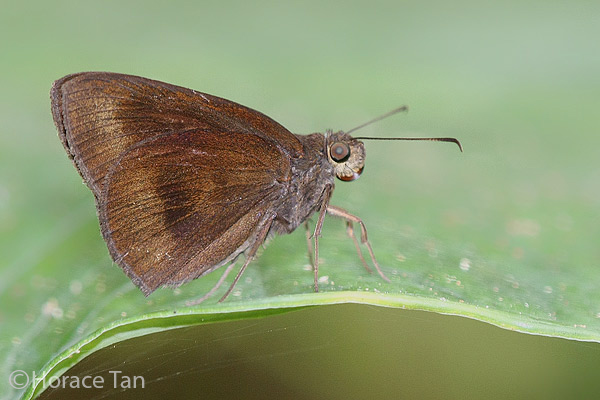
The shots in this blog article show the differences between the Coon and the Forest Hopper. The other species that are extant in Singapore and that may be confused with these two species would be the Chocolate Demon (Ancistroides nigrita maura) and the all-brown male of the rare skipper Quedara monteithii monteithii.

Text by Khew SK ; Photos by Federick Ho, Dr S Kalesh, Khew SK, Horace Tan & Wong CM
Special thanks to Dr S Kalesh. His blog : The Skippers of Kerala