30 October 2022

Butterfly of the Month - October 2022

Butterfly of the Month - October 2022
The Dark Banded Ace (Halpe ormenes vilasina)

A Dark Banded Ace feeding on the flower of the Spanish Needle (Bidens alba)

October 2022 has come and almost gone. Another month has slipped past and the world chugs on. It has been a rather wet year, driven largely by the La Niña weather effect, where a drop in sea surface temperatures create low pressure areas causing heavy storms and heavier rains. There is a strong correlation between the strength of La Niña and rainfall - the greater the sea surface temperature and Southern Oscillation difference from normal, the larger the rainfall change.


And so it has been for the southeast asian region where wetter months have been the norm. The negative effects of climate change have been more pronounced in recent years where the built environment that has been effective in mitigating adverse weather in the past have come under strain. Drains that have served well in the past are now in critical need of widening and upgrading to take on the abnormal and intense rainfall not previously experienced.

A mating pair of Dark Banded Ace

Sea level rises have been modelled and predicted by scientists and engineers. It is not a matter of when, but by how much. Governments are painfully aware of the potential damage of just a few centimeters of sea level rise per annum and the cost of damage to infrastructure in the future. Singapore has embarked on studies towards solutions for the coastal protection of our tiny island-state and this forward planning will benefit future generations.

A Dark Banded Ace feeding on the flower of Syzygium zeylanicum

2022 will also be remembered as an economically watershed year in Singapore as home prices and rentals soar in tandem with bank interest rates that have not been seen in the past 3 decades. However, the strengthening of the Singapore dollar makes it cheaper to satisfy Singaporeans' retail therapy appetites and also enjoy holidays abroad.
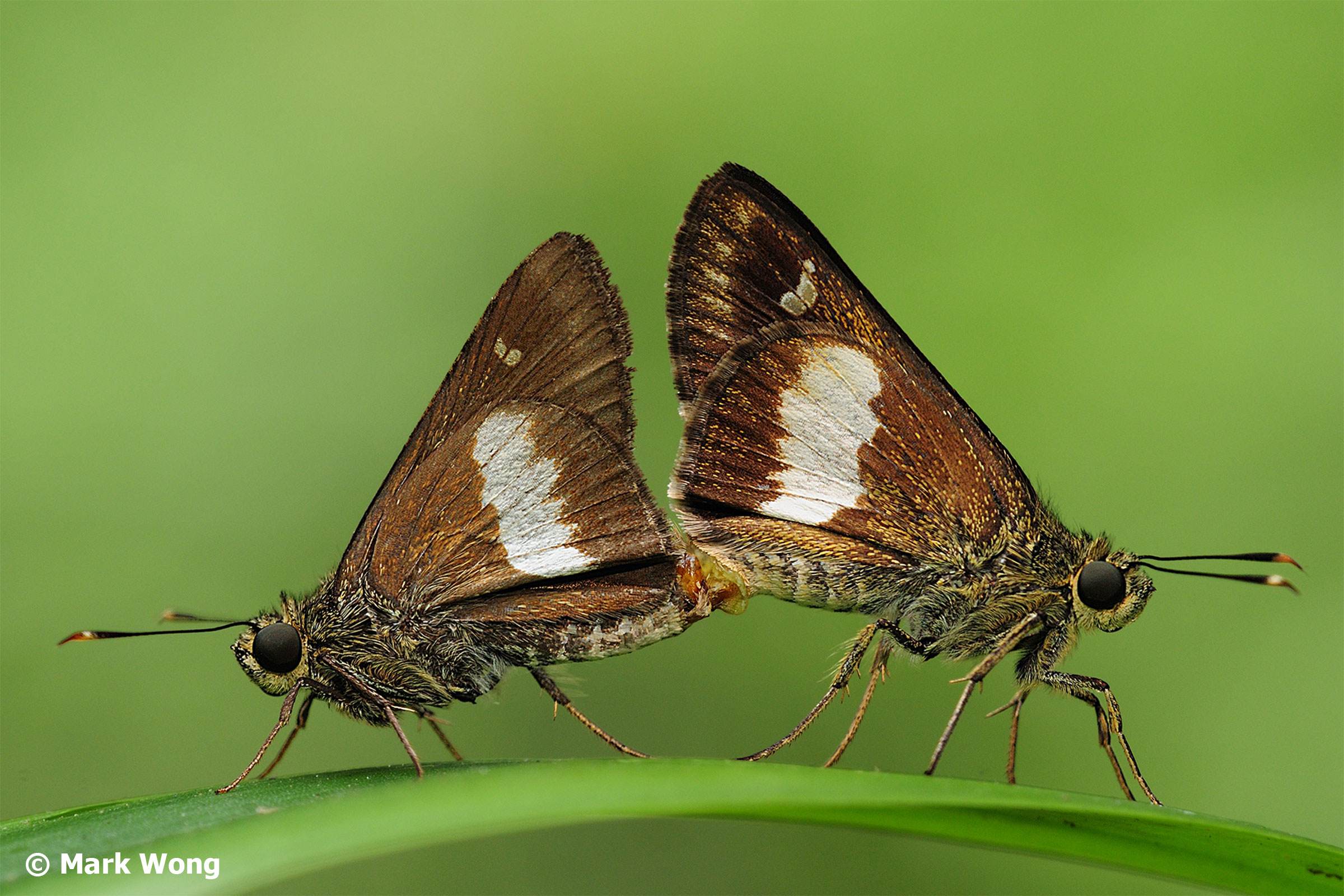

We feature another skipper as our Butterfly of the Month for October 2022 - The Dark Banded Ace (Halpe ormenes vilasina). This species belongs to the genus Halpe which comprises no fewer than 16 very similar-looking species in Malaysia and Singapore. It was the only representative of the genus in Singapore until 2022 when another species - Halpe porus (Moore's Ace) was spotted and recorded as a new discovery for Singapore.

Upperside shot of a Dark Banded Ace showing the forewing spots

The Dark Banded Ace is brown on the upperside with the usual Halpe pattern of small white hyaline spots on the forewing. On the underside of the hindwing, is a prominent white post-discal band extending from space 1b to the apex. The basal area of the wings is speckled with golden-yellow. The white post-discal band on the underside of the hindwing is outwardly jagged. The antennae are yellow banded just below the apiculus.


The Dark Banded Ace is relatively uncommon, and not often observed, although it makes regular appearances over the years.  It usually frequents forested areas where its caterpillar host plant, bamboo can be found. Occasionally, it can be observed feeding on flowering plants and on bird droppings. The species is skittish and flies rapidly in the usual skipper fashion.

Caterpillar of the Dark Banded Ace on bamboo sp.  Inset : Head of the caterpillar with "false eyes"

The caterpillar can be found on some species of bamboo and builds a leaf shelter to hide from predators. It moves away from the leaf shelter to feed on other leaves and then returns to the shelter to rest.  The face of the caterpillar is unique in that it appears to display a set of prominent black "eyes" on its head.

Text by Khew SK : Photos by Khew SK, Koh CH, Loh MY, Jonathan Soong. Horace Tan and Mark Wong

30 September 2022

Butterfly of the Month - September 2022

Butterfly of the Month - September 2022
The Metallic Caerulean (Jamides alecto ageladas)

A Metallic Caerulean feeding on the flower of the Red Tree Bush.  Note its raised hindwing showing the bright metallic blue upperside

The ninth month of 2022 whizzes past and very soon we will be in the final quarter of the year. Over in the United Kingdom, the longest serving monarch, Queen Elizabeth II, passes away. For as long as us baby boomers can remember, England always had a queen and the image of her appeared from commemorative stamps to the British currency notes and coins. Crowned the Queen in 1952, she ruled the United Kingdom until her death in 2022, setting a historical record as the UK's longest serving monarch.


The world waits with bated breath as China prepares itself for its 20th National Congress next month. China’s ruling Communist Party will hold its five-yearly congress beginning on October 16, with President Xi Jinping poised to secure a historic third leadership term and cement his place as the country’s most powerful leader since Mao Zedong.


With an economy battered by its unique zero-Covid policy characterised by lockdowns and quarantines, will China start accepting the virus as endemic and deal with it like most countries around the world are already doing? Or will it continue to exercise its own brand of managing Covid19 and continue on its track of controlling the spread by isolating entire cities? It is expected that the directives set at the National Congress will shed some light on the way forward.


Over to our closest neighbour Malaysia in the north, the prediction that former Prime Minister Najib Razak will be released from jail in September did not quite materialise. He has remained in jail after being sentenced to 12 years imprisonment and fined RM210M by the apex court in Malaysia. Behind bars but not forgotten, will the former Prime Minister and son of the 2nd Prime Minister of Malaysia, Tun Abdul Razak, be back in politics again one day soon? In Malaysia, anything is possible.


Leaving the current affairs of the human world behind, let us turn to our Butterfly of the Month for September 2022, the Metallic Caerulean (Jamides alecto ageladas). Re-discovered in 2008 at the now-demolished Mandai Orchid Garden, the species is relatively widespread and is probably the 2nd most common species in the genus after the Common Caerulean (Jamides celeno aelianus).

A Metallic Caerulean showing a glimpse of its metallic blue upperside
A mating pair of Metallic Caeruleans

The Metallic Caerulean is described as the largest species in the elpis subgroup, which is characterized by the post-discal band on the underside of the forewing being completely dislocated at vein 3. The male of the species has a black diffuse border on the forewing, expanding to about 1mm at the apex and a series of black marginal spots on the hindwing. The female has the forewing border extending narrowly along the costa to the base.

A Metallic Caerulean feeding on the flower of the Red Tree Bush

The Metallic Caerulean has bright metallic blue uppersides, and grey ground colour on the undersides with the usual white banding. On the hindwing, there is a black-centred orange-crowned eyespot at the tornal area, with some additional submarginal orange markings along veins 1b and 4. There is a white-tipped filamentous tail at vein 2 of the hindwing.

A Metallic Caerulean ovipositing on the flower of its caterpillar host plant, Torch Ginger

The species is an erratic and active flyer, often flying restlessly on bright sunny days and frolicking amongst the shrubbery. It is often found in the vicinity of the Torch Ginger plants and the flowers, on which the caterpillars of the Metallic Caerulean feed. At certain times of the day, it will perch with its wings folded upright, on the uppersides of leaves to rest in the shaded understorey.

A Metallic Caerulean puddling on bird dropping
A Metallic Caerulean feeding on the flower of the False Heather (Cuphea hyssopifolia)

Both sexes are regularly seen feeding on a variety of flowering plants, like the Red Tree Bush, Bandicoot Berry, False Heather and others. Males have been observed puddling on bird droppings and other decomposing organic material. The species has been successfully bred in Singapore on the Torch Ginger and Yellow Saraca.

Text by Khew SK : Photos by Khew SK, Henry Koh, Loh MY, Horace Tan, Anthony Wong and Mark Wong


28 August 2022

Butterfly of the Month - August 2022

Butterfly of the Month - August 2022
The Tree Flitter (Hyarotis adrastus praba)

A Tree Flitter feeding on the flower of Ixora javanica

The last weekend of the month of August 2022 brings some good cheer and optimism in Singapore's handling of the Covid19 pandemic. Over a period of more than 2 years, our island nation has been facing ups and downs of handling a historically unprecedented viral pandemic that turned lives upside down and handed the economy a knockout punch. But in his National Day Rally, the Prime Minister announced that wearing of face masks in the majority of situations will soon be optional as Singapore deals with Covid in its own way of co-existing with the disease in our midst.


August is also known as the Hungry Ghost month in most Asian nations where the the souls of the dead are believed to roam the earth during the festival, and these ghosts can get up to mischief if ignored. Just as the Americans have Halloween, the Chinese have the Hungry Ghost Festival (also known as Zhong Yuan Jie in Chinese), a festival held in honour of the dearly departed. According to traditional customs, all sorts of offerings are made during this period, which is the seventh month in the lunar calendar.


August is also the month when Singapore celebrates its National Day every year.  This year, we celebrated our 57th year of independence. This little island nation has come a long way from its early years of uncertainty and struggle. Today, it is a bustling and successful metropolis that many other countries use as a benchmark to match up to - in areas ranging from public housing, security, urban planning, low corruption and systems that work efficiently.


Globally, the war in eastern Europe continues to rage on, affecting other countries economically as the spectre of food shortages and energy loom ahead of the winter months of 2022. Closer to Asia, the US-China spats have continued and slowly reaching levels that have not been seen for many decades. A China that is growing in confidence, economically and militarily, is beginning to challenge the US position as the world leader and this does not bode well for world peace in the coming years.


Our Butterfly of the Month for August 2022 is a skipper, the Tree Flitter (Hyarotis adrastus praba). The Tree Flitter is moderately rare, but is regularly found at the forest edges of the nature reserves. It is rather widely distributed. It can sometimes be spotted in urban parks and gardens as well as in coastal forests in back-mangrove habitats.

A Tree Flitter sunbathing on the top surface of a leaf with its wings partially opened in the typical skipper fashion

It is a fast flyer, zipping from flower to flower as it feeds on nectar. It is often seen sunbathing with half-open wings in the skipper fashion, or lurking in shady spots with its wings folded upright. It forages amongst low shrubbery and flowering bushes but is alert and often takes off to the sanctuary of the treetops if alarmed.


The Tree Flitter is dark brown above with large hyaline and subapical spots on the forewing.  The underside of the hindwing is crossed by an irregular white discal band from mid-costa to mid-dorsum. The hindwing cilia is chequered and this is more obvious in pristine individuals. The antennae are white banded just below the elbow of the apiculus.

A Tree Flitter feeding on bird dropping on a leaf
Tree Flitters feeding on nectar from a variety of flowers

The species is often seen feeding at flowering Ixora bushes, flowers of the Chinese Violet, and flowering trees like Syzygium spp. It also feeds on bird droppings and can occasionally be seen pudding at muddy footpaths which have been contaminated with animal excretions. The Tree Flitter has been successfully bred on the common rattan, Daemonorops augustifolia.

Text by Khew SK : Photos by Gavin Chan, Chng CK, Khew SK, Loh MY, Loke PF, Bobby Mun, Horace Tan and Anthony Wong

31 July 2022

Butterfly of the Month - July 2022

Butterfly of the Month - July 2022
The Julia Heliconian (Dryas iulia)

A male Julia Heliconian sunbathes with open wings on a leaf

We are well into the 2nd half of 2022 with a greater optimism towards the rest of the year. As with anything in life, there are always challenges and risks in our way, as the world continues to evolve in ways that would not have been imagined a decade ago. For example, in the workplace, one would not have anticipated a situation where employees can work from home and not be branded a "skiver"!

A female Julia Heliconian feeding on the flowers of Lantana camara at Tampines Eco Green

Indeed, the "Great Resignation" appears to be a disruption that has affected nearly every industry as staff leave for greener pastures - even in unfamiliar or unrelated industries. Did the pandemic disruption give employees the time and space to re-evaluate their lives and choose paths less trodden? Or was it a simple case of economics that rising costs and inflation caused the working person to take a more practical approach to better manage their daily expenses?

Underside of the Julia Heliconian : Top : Female Bottom : Male

The answer may be "all of the above" as everyone would have heard of examples where staff made the  decision to exit their companies for various reasons ranging from salary, work-life balance, upward mobility, meaningful work, family issues, change of environment and a whole host of other requirements. For companies, particularly in Singapore, the sudden increase in manpower costs have cut bottom lines and profits as each organisation struggles with the prospects of a global talent competition that has not been experienced for many years.


The opening up of the global workforce economy has yet to reach a level comparable to pre-covid times, as potential employees are still reticent to move out of their homelands and comfort zone. Whilst this should normalise in the months to come, the numbers of foreign employees available appear to be still relatively low. This may have added to the woes of companies looking to recruit foreign talent to replace existing employees who are part of the resignation exodus.


Speaking of foreign talents and immigrants, we turn to our Butterfly of the Month for July 2022, the Julia Heliconian (Dryas iulia). A native of the tropical and sub-tropical areas of South America, particularly in Brazil, Peru, Ecuador and other countries in that region, it can also be found in the southern states of the US. The species was unknown to this part of tropical Asia until the late 90's when a butterfly farm in Phuket, Thailand imported the species as part of its exhibits for its butterfly aviary.


It was also later discovered that the Julia Heliconian was bred and released during religious ceremonies and weddings. For a species that breeds easily and where large clutches of eggs are laid by the females, the Julia Heliconian began to spread widely in Southern Thailand. That its caterpillar host plants are considered "weeds" - Passiflora suberosa and less often, Passiflora foetida, the species began colonising southwards into Malaysia where it was first spotted on Pulau Langkawi in Sep 2009. Its spread southwards is probably also helped by the fact that it displays aposematic colouration as it is distasteful to predators. 


There were no further observations of this species in Malaysia, until some time six years later when it was spotted breeding at an urban garden in the state of Selangor in May 2015. Whilst it may have already been present in several of the northern states of West Malaysia, there were no reliable sighting reports until 2015. Both adult and early stages of the species were observed.

A mating pair of Julia Heliconian. Left : Male, Right : Female

It was a matter of time before the southward invasion of the Julia Heliconian would end in Singapore. And the theory was proven to be correct when an individual was spotted at Hort Park in the southern part of Singapore in June 2021. A colony emerged at St John's Island thereafter, and more individuals were observed all over Singapore island in 2021 and this year. It became more common and very often several individuals were spotted together, usually flying rapidly around, or feeding on flowers.

A male Julia Heliconian feeding on Lantana camara flowers at St John's Island

The Julia Heliconian is a narrow-winged butterfly with elongated forewings, usually with a wingspan of 82-92 mm. On the upperside, the wings are bright orange in the male and duller orange in the female. There are black borders along the wing margin, with those in the female broader and more extensive. The eyes are translucent and the compound eye details can be seen.


On the underside, the wings for both sexes are paler compared to the upperside, and are adorned with brown markings in the cell, in post-discal area as well as along the wing margins. A small pink red patch occurs in the basal area of both wings.


The butterfly is active and a relatively strong flyer. Even when it is feeding, it tends to move a lot and is not easy to photograph. The caterpillars appear spiky, and are somewhat similar to some of the species in the Nymphalidae family. The life history has been successfully documented on the invasive weed, Passiflora suberosa in Singapore.

Text by Khew SK : Photos by Gavin Chan, Khew SK, Loh MY and Horace Tan.

References and Additional Reading :