04 June 2016

Ubin Day 2016

Ubin Day 2016
ButterflyCircle at Pesta Ubin 2016


Our traditional group mugshot at Butterfly Hill with our visiting VVIPs

The annual celebration at Pulau Ubin for the fifth time since its inaugural start back in 2002 took place on 4 Jun this year. What is special this year, was that the celebration of all things Ubin expanded to a whole month! Pesta Ubin as it is called, featured many activities by various groups of volunteers from 14 May to 12 Jun. Pesta Ubin (roughly translated from Malay, means Ubin Carnival) showcased many activities from painting, coastal cleanups, night macro sessions, cycling and so on. The Pesta Ubin blogsite details most of the activities over the month.


On the boat ride to Pulau Ubin - ButterflyCircle and Seletar CC friends

The brainchild of long-time Ubin activist Ria Tan and her gang of volunteers, this year's activities on Ubin island had a far greater outreach to members of the public, interest groups and anyone interested to know more about Pulau Ubin.


The Ubin crowd all happy on Ubin Day 2016

Ubin Day 2016 started with a lot of excitement as various volunteer groups set up their booths at the "town square". However, the weather this year wasn't as cooperative as previous Ubin Days, as the skies turned cloudy and it drizzled for most of the morning. However, refusing to be dampened by the wet weather, the participants' enthusiasm ruled the day.


Minister Lawrence Wong sharing stories about Pulau Ubin

The Guest of Honour this year was the Minister for National Development, Mr Lawrence Wong. Accompanied by Minister of State Desmond Lee, who also spearheads the Friends of Ubin Network (or FUN) and the senior management of MND family, the enthusiastic crowd welcomed the MND VVIPs who arrived on time at around 9am. In his speech, Minister announced that NParks will be the central managing agency for Pulau Ubin. Previously, at least 12 government agencies oversaw various parts of Ubin, making it very confusing for the public who wanted to do something, but did not know who to approach.



Authors of the two books with VVIPS and CEO/NParks.  Cover of the book by Dr Chua Ee Kiam

Ubin Day 2016 also saw the launch of two books. The first was Footprints on an Island, by dental surgeon, author and naturalist Dr Chua Ee Kiam, with co-authors Choo Mui Eng and Director Conservation of NParks, Mr Wong Tuan Wah. The other book was a children's book called The Hunt for the Green Boomerang by Neil Humphreys.


The lush greenery of ButterflyHill and casual chatting amongst our members whilst waiting for the VVIPs to arrive

As part of his tour around the island, Minister stopped at Butterfly Hill. This hill was re-planted with butterfly-attracting plants back in 2005 as a conservation strategy to increase the butterfly biodiversity of an impacted site. Butterfly Hill is usually teeming with butterflies on ideal hot sunny days. Unfortunately, the weather this morning was not conducive for butterflies as it was overcast and it drizzled intermittently for most of the day.


Showing Minister the caterpillars of the Plain Tiger at the Crown Flower patch

ButterflyCircle and Seletar CC members were at Butterfly Hill to greet Minister and his entourage. As the weather did not change, the butterfly activity was low, and Minister only got to see some Plain Tiger caterpillars on the host plant and a few butterflies that were still fluttering around in the cool balmy weather.


ButterflyCircle contributers to the signboards - Khew, Jonathan and Bob


Samples of the educational signs on ButterflyHill and how they are installed on site in proximity to the relevant butterfly-attracting plants

This year, ButterflyCircle assisted NParks with the upgrading of the signage at Butterfly Hill with over 12 educational signages that showcases the interrelationship between specific species of butterflies and their related plants. A large signboard featuring about 30 common butterfly species that are often spotted at Butterfly Hill was strategically placed next to the Tahu Hut where visitors can learn more about the butterflies that frequent the place.


Selfies and wefies were also the order of the day

Minister also sportingly took selfies, wefies and the traditional group photo with ButterflyCircle and Seletar CC members who interacted with him. Although there were not many butterflies to photograph this morning, our members enjoyed the outing and the chatter amongst friends and butterfly lovers.


The day ended after a "makan session" at the Volunteers' Hub and as the weather did not look like it was going to change, some of us bade Ubin farewell, until another sunnier day.

Text by Khew SK : Photography by Huang CJ and Robert Teo.

Special thanks to NParks Pulau Ubin staff : Robert Teo, Jacky Soh, Choi Yook Sau and Leroy Alphonso for the collaboration on the ButterflyHill signage.  

And to all ButterflyCircle and Seletar CC members for joining in the fun today.

28 May 2016

Butterfly Photography 101

Butterfly Photography 101
Part 1 - Hardware and Equipment


Plain Lacewing - Shot with Nikon D750 and Sigma 180mm macro lens

For a long time after we set up ButterflyCircle's website, forums and blog, we have had quite a number of questions from newbies and nature enthusiasts on how they could take better pictures of butterflies in the field. In terms of photography, questions like "what camera or lens do you guys use?", "Why do you use flash in broad daylight?" or "Which aperture should I use for butterfly photography?" were quite typical of what beginners would like to find out.


Blue Glassy Tiger shot with Panasonic Lumix PNS camera

This mini-series on butterfly photography will hopefully answer some of these questions. The articles will focus on various aspects of butterfly photography, from technical equipment, composition, using flash, exposure and depth of field and a number of other "how-to's" that would be shared with our readers to hopefully benefit their journey into the world of butterflies and butterfly photography.


My first digital camera which I used 16 years ago, the Nikon Coolpix 995

These articles are not meant to be high-level professional advice, but merely sharing ButterflyCircle members' years of experience in the field and learning about butterfly photography through trial-and-error and managing our equipment in the field. Advice given is by no means cast in stone, and the important outcome is that each photographer experiments with his/her own techniques, improves and is happy with his/her own work.


A shot of a Little Mapwing taken with the Nikon Coolpix 995

Readers should also remember that whilst you can read and arm yourselves with a lot of theory, nothing beats grabbing your camera equipment and going out into the field to practise, practise and practise. Review your own work critically, and then ask yourself how you can make the shot better. In butterfly photography, you can rarely control the way your subjects behave. This is nature. Unlike shooting human models where you can tell your subjects to look a certain way or shift to another position, in butterfly photography, you take whatever, however and whenever a butterfly comes your way.


Another shot taken with the Coolpix 995

Part 1 of this mini-series deals with the fundamentals of choosing your hardware - i.e. camera equipment. Suffice to say that if money were not an issue (and it usually is!), then all of us would buy the most expensive and sophisticated equipment that money can buy. However, this is not necessarily the case when you want to start on butterfly photography. Whilst it cannot be denied that good equipment helps, it is the person behind the camera that is the most important part of butterfly photography.


A close up Plain Tiger shot with an iPhone 5s - a photographer has to acknowledge the limitations of the small sensor on a smartphone

So what are the types of cameras that are available for reasonably good butterfly photography? Let us assume that we are talking about digital devices only, as the debate about analog film cameras has long abated, and we do not need to delve into nostalgic discussions on whether film or digital cameras are better. Taking price points as a base for looking at digital cameras, we can start at the lower band of cameras, being the basic point-and-shoot (PNS) digital cameras.


An external macro lens attachment on an iPhone 5s can work as a butterfly shooter in the absence of any other equipment

For a start, even a smartphone with a macro attachment on the built-in camera can take quite decent shots of butterflies. However, you may have to move in so close to the subject that it can be frustrating to even get a simple shot of a butterfly (before it flies away). In the absence of proper equipment, a simple handphone shot can sometimes save the day, especially when you suddenly encounter a species that is rare or not often seen.


My small "backup" PNS camera, the Canon G11 with a swivel LCD screen, which served me well for many years

Moving up the scale, would be the typical compact PNS cameras. There are probably thousands of brands and models out there that a photographer could choose from. The range is mind-boggling, and the capabilities of each camera are so diverse that it would be quite futile to discuss the merits of each PNS camera for butterfly photography. However, I have seen shots from a range of these cameras that would put more expensive and dedicated macro equipment to shame.


A shot of the Postman (Heliconius melpomene) taken with the Canon G11 using the macro-mode on the camera

Firstly, be aware of the limitations of a PNS camera. The sensor is usually much smaller than the professional devices, and the outputs from PNS cameras are best suited to posting your shots on social media or online. The depth-of-field (DOF) of such devices are extremely good, and you can often get sharp shots, but the background and subject are usually all in focus. This may not be what you desire in your shot, if you want to focus on the subject and make the background creamy and out-of-focus.


The very versatile Nikon P900, which has an optical zoom equivalent to a 24mm - 2000mm lens!

The benefits of PNS cameras are that they are usually small, light and easy to carry about. For those with a long zoom, you can shoot anything from macros to landscapes to birds. An all-in-one camera if you can call them that. For beginners with a limited budget, you can consider a compact PNS camera and move up from there after you are convinced that your interest butterfly photography is something that you can sustain and are keen on, for the longer term.


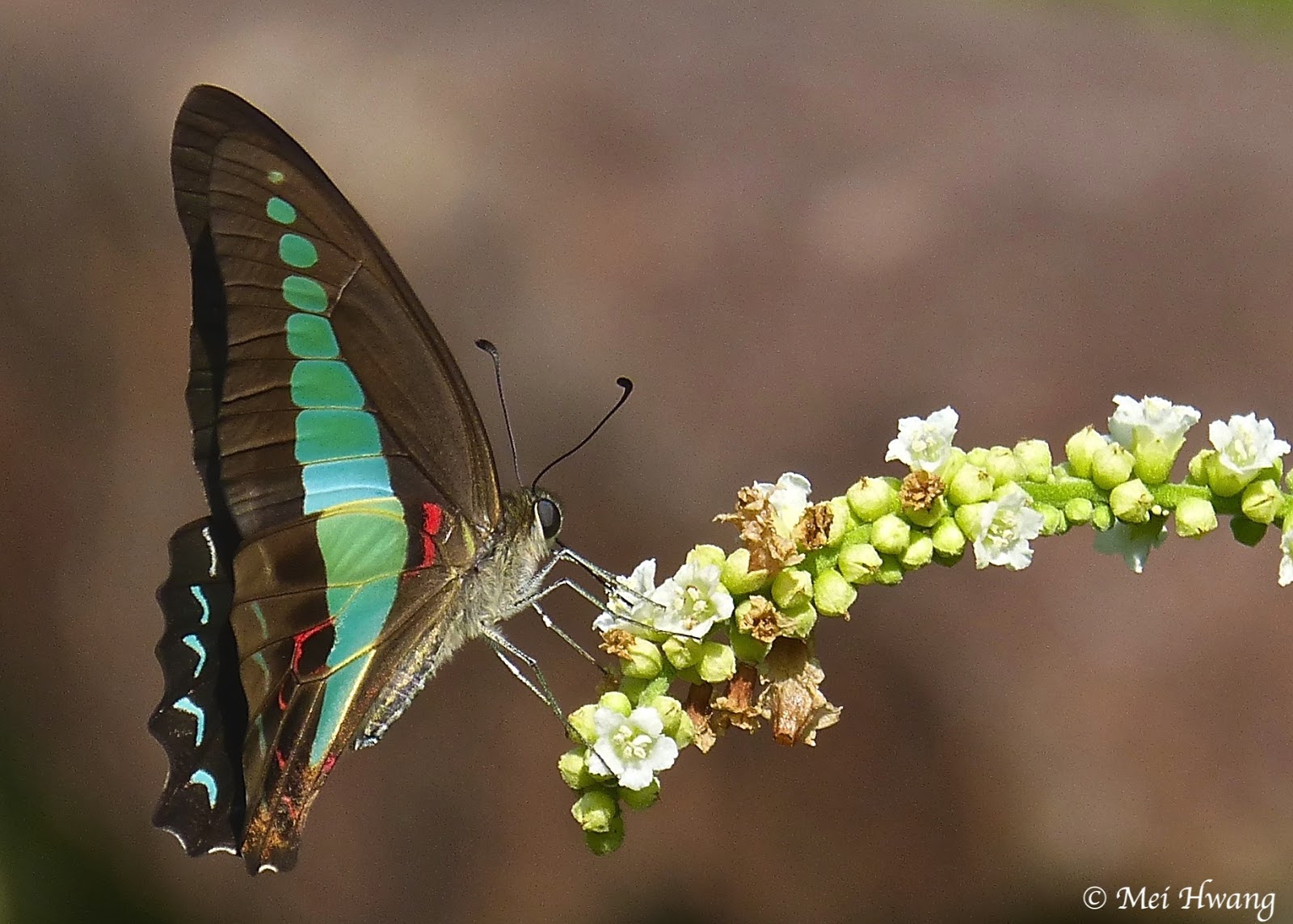
A Common Bluebottle feeding, taken with the Panasonic Lumix

However, the quality of shots from a simple PNS camera cannot be under-estimated. For example, butterfly enthusiast Mei Hwang, wielding a simple "packaged deal" PNS camera, a Panasonic Lumix DMC-FZ60 non-interchangeable lens camera, can deliver quite admirable butterfly photos. Many of her shots deliver the typical quality of higher end equipment - sharp subjects, clean backgrounds and punchy but natural colours.


Shots taken with the Panasonic Lumix DMC FZ60 by Mei Hwang.  The butterfly photos are as good as any taken with much more sophisticated equipment

We leave the PNS cameras for now, and move on to the higher end of digital cameras - the Digital Single Lens Reflex (DSLR) cameras. Even within the realm of DSLR cameras, there is a relatively wide spectrum from the entry-level DSLRs to the high-end professional DSLRs that can make a big hole in your wallet! Whilst I am not advocating any particular brand, I will use Canon and Nikon DSLRs as examples of decent camera bodies for butterfly photography as these brands are the more popular brands amongst butterfly photographers.


Some entry-level offerings from Nikon and Canon - the D7200 and EOS700D

Entry-level DSLRs are relatively good, when coupled with proper "magnifying equipment" i.e. proper lenses, close-up filters, teleconverters or extension tubes. For a butterfly photographer who is just starting out using DSLRs, he/she can consider many of the capable entry-level models. As mentioned earlier, it is important to feel comfortable with the system and camera chosen, and then going out in the field to use the camera as much as possible.


Two mid-range DSLRs from Nikon and Canon - the D750 (full frame sensor) and the EOS7D MkII (cropped frame 1.6x sensor)

The advantages of DSLRs camera bodies are :
  1. Larger sensors with higher Megapixel count. Although high MP is not the be-all and end-all of digital photography, having more MPs can make a difference whether a cropped shot of a butterfly is usable or not. For the full-frame DSLR bodies (36x24mm format) the amount of detail one can get out of it, is far superior than most cameras, if you plan to enlarge your shot significantly.
  2. The focusing and metering accuracy of the higher end models often gives a butterfly photographer an edge when chasing after these skittish subjects. The ability to track and accurately lock on a subject makes a difference between a nice shot, and those destined for the trash folder.
  3. Higher frames-per-second (FPS) does tend to help in nailing a sharp shot especially when a butterfly moves constantly when feeding, or flaps its wings unpredictably, even when puddling on the ground.
  4. Better noise control is another plus point for the DSLRs. Very often, butterfly photographers have to contend with shooting a butterfly in a dimly lit forest understorey using high ISOs. The ability of the sensor to handle high ISOs also make a difference between a "keeper" (usable shot) and those that would be deleted.
The downsides of DSLRs would of course be the cost, bulkiness, and weight. Not every photographer endears themselves with lugging around 2-3kg of equipment, hand-held, and hiking long distances to shoot butterflies. So make your decision based on the various pros and cons of choosing between a good DSLR system or a preference for simple PNS equipment in your butterfly-shooting forays.


An Orange Emigrant shot with the full-frame Nikon D750 and a Sigma 180mm macro lens

In recent times, the appearance of premium compact PNS cameras, mirrorless interchangeable-lenses cameras and more and better offerings in the market is changing the photography market rapidly, and it is anybody's guess what we will be using to shoot butterflies in the coming years.


A Red Helen shot with the cropped frame (1.5x) Nikon D500 with a Sigma 180mm macro lens

In the next part of this series, we will share our thoughts on the "magnification equipment" and recommend different lenses and equipment to shoot butterflies.

Text by Khew SK : Photos by Goh EC, Khew SK and Mei Hwang

21 May 2016

Life History of the Linna Palm Dart

Life History of the Linna Palm Dart (Telicota linna )


Butterfly Biodata:
Genus: Telicota Moore, 1881
Species: linna Evans, 1949
Wingspan of Adult Butterfly: 32-35mm
Caterpillar Local Host Plants: Bambusa multiplex (Poaceae; common name: Hedge Bamboo, Chinese Dwarf Bamboo).


A female Linna Palm Dart, wing upperside view.

A female Linna Palm Dart, wing underside view.

Physical Description of Adult Butterfly:
On the upperside, the wings are black with an orange post-discal band on the forewing running from the dorsum and bent over at vein 6 to continue along the costal margin. The orange-yellow post-discal band on the hindwing runs from vein 1b to space 6. The male has a grey brand on the forewing from about the middle of vein 1b to vein 4. The brand is usually straight and not placed closer to the forewing cell or the inner margin of the post-discal band. Base of space 2 in the forewing of the male is black or largely so. The female has the forewing generally darker, with much of the basal organge darkened. On the underside, the wings are ochreous with post-discal bands outlined with black. The veins crossing the orange-yellow band on the hindwing are not dark-dusted.

A male Linna Palm Dart, wing underside view.

A male Linna Palm Dart, wing upperside view.

Field Observations of Butterfly Behaviour:
A recent addition to the Singapore Checklist, the Linna Palm Dart is moderately rare in Singapore. The adults are strong flyers and are typically sighted along the forest edge and grassy undergrowth. The swift flying adults have been observed to visit flowers and sunbath with open wings in sunny weather.

A Linna Palm Dart visiting flowers for its sugary intake.

A male Linna Palm Dart.

14 May 2016

Butterfly of the Month - May 2016

Butterfly of the Month - May 2016
The Blue Glassy Tiger (Ideopsis vulgaris macrina)


The scorching temperatures from last month carried forward into May, with only a little reprieve when there were occasional rainy afternoons which cooled us down somewhat. The 36.7ºC temperature recorded last month was the 2nd highest temperature ever recorded in Singapore! Many days in May continued to see 33-35ºC temperatures, which, when outdoors, felt more like in the 40's! The NEA reported that the El Nino effect is likely to weaken by mid year, with changes in weather patterns caused by the La Nina effect taking over.


In the meantime, butterflying in Singapore can be a rather hot affair as the unforgiving weather takes its toll on both the butterflies and butterfly-watchers. The drying out of vegetation in many areas appeared to have an impact on butterfly population, particularly in the nature reserves. Whilst some species are subject to seasonality in their appearance in Singapore, there is a general drop in count and diversity of the forest-dependent species.


There is probably a strong correlation between new growth of plants (brought about by wetter weather) and the number of butterflies in the environment. Given that the weather has been hot and relatively dry in the first 4 months of the year, this may be one of the reasons for the lower butterfly counts in general. Urban species appear to be less susceptible and populations are generally stable.


Singaporeans wait for the dreaded annual haze, usually coinciding with the dry weather and slash-and-burn season in neighbouring countries. Thus far, it appears to be under control, but for how long, no one can tell. At least there are now satellite images that would give a forewarning of forest fires burning out of control. But that is all that it can do - warn of the imminent deterioration in air quality.


The general global economy is not particularly cheering anyone up either. Political battles in the form of a bye-election in Singapore and the Sarawak state elections in Malaysia resulted in definitive victories for the governments of the day with both the PAP and Barisan National winning their respective positions convincingly. Perhaps the voters chose to stand on the side of political stability of the governments in both countries in the face of the uncertain global economy.


Over on the western front, our American friends are also in the thick of their own forthcoming elections by year end, as the Republican and Democrat candidates slug it out in the primaries. It would be interesting to see what happens at the end of the year, when the new President steps into the Oval Office. What would be critical to the rest of the world, would be the foreign policy in the hands of the incoming 45th President of the USA.


Our Butterfly of the Month for May 2016 is the common Blue Glassy Tiger (Ideopsis vulgaris macrina). This medium-sized butterfly with an average wingspan of about 75mm, is widespread and appears in urban parks and gardens, mangrove environments as well as in the nature reserves.


Blue  Glassy Tiger feeding on a variety of flowering plants

It is most common in habitats where its lactiferous host plants, Tylophora flexuosa syn. tenuissima, Gymnema sp. and probably other similar vines of the Apocynaceae family grow wild. These host plants are most evident in mangrove and wetland environments and this is where the butterfly, and its closely related cousin, the Dark Glassy Tiger (Parantica agleoides agleoides), which shares the host plants, can be found in numbers.


The Blue Glassy Tiger has wings that are bluish-grey, streaked with black stripes. The ground colour of the wings appear bluer in flight when compared to the Dark Glassy Tiger, which appears greyish. The black transverse bar in the forewing cell distinguishes it from the Dark Glassy Tiger. In recent years, another species - the Grey Glassy Tiger (Ideopsis juventa sitah) has been spotted in Singapore, and it is likely to be a migrant species for the time being. In this latter species, the cell areas of both wings are lightly marked, and it appears much paler in flight than either of the extant species.


Blue Glassy Tiger on the dried seed pods of the Indian Heliotrope (top) and fresh flowers of the same plant (bottom)

The Blue Glassy Tiger flies in an unhurried manner with a slow flying characteristic. It is often seen feeding on flowers of many plants, but is particularly partial to the dried plants of the Indian Heliotrope (Heliotropium indicum), which also attracts other Danainae butterflies. Males of the species feature a distinct brand (usually of a darker colour than the surrounding area) at the sub-tornal area of the hindwing.


Blue Glassy Tigers feeding on False Dill flowers

Besides the Indian Heliotrope, another plant, the False Dill (Eupatorium capillifolium) also attracts various species of Danainae. The butterflies are attracted to the flowers of the False Dill and dried or damaged parts of the plant. There appears to be some form of alkaloids that the Danainaes go for. The Rattleweed (Crotalaria mucronata) also attracts the Danainaes and the Blue Glassy Tiger is no exception. It can often be seen feeding on sap from the stem, leaves and seed pods of the plant.


Blue Glassy Tigers resting in the shady understory

After feeding, a unique behaviour of the Blue Glassy Tiger is that it will look for heavily shaded areas to rest, clinging on to vines and thin branches under shade, keeping very still unless disturbed. The Blue Glassy Tiger has been successfully bred on the lactiferous vine, Tylophora flexuosa (syn. tenuissima). The spotted caterpillar sports red based tubercles and is quite attractive.


Text by Khew SK : Photos by Chng CK, Goh EC, Khew SK, Loke PF, Jonathan Soong, Horace Tan and Tea Yi Kai