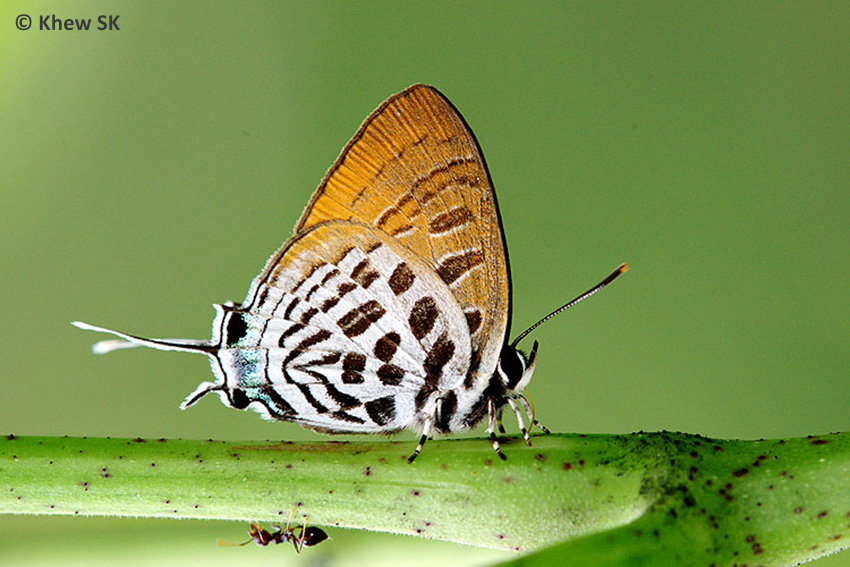
20 June 2015

A New Discovery in 2015!

A New Discovery in 2015!
The Common Yeoman (Cirrochroa tyche rotundata)


The Common Yeoman, a new addition to the Singapore Checklist

It started with a couple of shots that were sent to my WhatsApp account on my mobile phone on 10 Jun 2015. The photos were from Zhou Boyi, a Manager at the National Biodiversity Centre Div of NParks, who wanted to know if he had shot the recently discovered Malay Yeoman (Cirrochroa emalea emalea). Boyi was recording shots of butterflies on the new smartphone app known as SGBioAtlas developed by NParks.


Zhou Boyi's first shots of the newly-discovered Common Yeoman in Singapore

However, the butterfly that he encountered did not exactly match those photos of the Malay Yeoman on the SGBioAtlas, and he was curious if he got the ID of the butterfly correct. A quick look at his shots on my mobile phone indicated that what Boyi shot was indeed not the Malay Yeoman, but another close relative in the same genus Cirrochroa.


A Common Yeoman puddling in Singapore

This was the Common Yeoman (Cirrochroa tyche rotundata), a species that has not been recorded in Singapore before by the early authors. After establishing the last-seen location where Boyi shot the butterfly, ButterflyCircle members went to the urban garden to check out if the species was still around so that we could take more shots of this new discovery. Coincidentally, ButterflyCircle members also discovered another orange-coloured species, the Vagrant (Vagrans sinha sinha) in 2013, at another urban gardens in Singapore.


To our surprise, we discovered a small colony of the Common Yeoman! Earlier records of new discoveries and re-discoveries in Singapore, where individuals were reliably photographed, were either seasonal or migratory individuals chanced upon by butterfly enthusiasts. For these species, only one or two sightings were made, and many were not seen again. However, the presence of the colony of the Common Yeoman suggests that this species could have been successfully breeding in Singapore for some time already, before it was spotted.


A Common Yeoman perched on a leaf

At the location where it was first discovered by Boyi, we spotted at least half a dozen individuals and even a female ovipositing on its host plant. It is an active butterfly, flying restlessly and rarely stopping to rest, reminiscent of the common Leopard (Phalanta phalantha phalantha) - flapping and turning with half-opened wings even when at rest.  When actively fluttering around, it can tire even the most determined of photographers with its unceasing skittish flying behaviour!


After some time of patient waiting, we spotted a puddling male Common Yeoman that was cooperative enough for us to photograph it. It appeared to be a recently-eclosed individual, from its bright colours and pristine wings. In the meantime, several other females and males were spotted fluttering around the shrubbery, making only momentary stops to rest.


A Common Yeoman shot in Panti Forest Reserve, Johor

The Common Yeoman can be found in West Malaysia, and we have photographed it at the Panti Forest Reserve in southeast Johor, a mere 40-50 km drive from Singapore. There, it demonstrated the same active and skittish behaviour and was also photographed puddling on damp footpaths in forested area.


Another Common Yeoman shot in the Kuala Kangsar area (Perak state) in Malaysia

A quick comparison of the photographs of the Common Yeoman shot in Singapore showed that it matched quite closely with those shot in West Malaysia, in particular those from Panti Forest. This would be the Malaysian subspecies rotundata. The Common Yeoman is fulvous orange above, with a black distal margin or with black sinuate marginal and submarginal spots and lines. The Common Yeoman does not have the broad black apical area on the forewing like the other related species.


A mating pair of the Common Yeoman, shot in Panti Forest Reserve in Johor

The underside is paler with a silvery white or whitish transverse band across both wings. In the Common Yeoman, this pale discal band is narrow and generally uniform in width across both wings, whilst the band widens towards the costa of the forewing in the other related species.


A Common Yeoman puddling on the muddy forest floor at Panti Forest Reserve, Johor

The butterflies of the genus Cirrochroa are known to show migratory tendencies. They have been described as "rapid in flight but occasionally found at moist spots on the roadside." [Butterflies of the Malay Peninsula by Corbet & Pendlebury 4th Edition, pg 153]


A Common Yeoman perched on a leaf.  Shot in Singapore

How did the Common Yeoman appear in Singapore? Did it migrate naturally across the Straits of Johor, when the prevailing winds were in its favour? Or did the caterpillars or pupae of this species stow away on plants that came into Singapore? Many theories may be expounded as to how this species first came to Singapore, but we will never know for certain.


A Common Yeoman perched on a leaf.  Shot in Singapore.

That a colony of the butterflies has now established themselves in Singapore is now certain. For how long this will sustain, we will have to observe closely. Would the lack of genetic diversity wipe out the species after a few generations due to inbreeding? Or will it thrive and be a resident species in Singapore and adding to the biodiversity of our butterfly fauna? Its geographical range is described as "occurring throughout Sundaland", but why was it not earlier recorded in Singapore?


As with many mysterious phenomena occurring in our natural world, there are more questions than there are answers. But we will record the Common Yeoman as species #318 in the Singapore Butterfly Checklist, and observe whether the species will continue to flourish on our little island in the sun.

Text by Khew SK : Photos by Goh LC, Federick Ho, Khew SK, Horace Tan and Mark Wong

References : 

[C&P4] The Butterflies of The Malay Peninsula, A.S. Corbet and H.M. Pendlebury, 4th Edition, Malayan Nature Society, 1992.

Special thanks and credit to Zhou Boyi of the National Parks Board for the discovery of this new butterfly species to Singapore.

13 June 2015

Life History of the Grey Pansy

Life History of the Grey Pansy (Junonia atlites atlites)


Butterfly Biodata:
Genus: Junonia
Hübner, 1819
Species: atlites Linnaeus, 1763
Subspecies: atlites Linnaeus, 1763
Wingspan of Adult Butterfly: 55-60mm
Caterpillar Local Host Plants: Nelsonia canescens (Acanthaceae), Hygrophila spp. (Acanthaceae), Limnophila villosa (Plantaginaceae)


Physical Description of Adult Butterfly:
On the upperside, the wings are pale greyish buff and distinctly marked with dark brown discal and submarginal lines. Post-discal series of eye-spots, some of which are divided into an outer black half and an inner orange half, are found on both forewing and hindwing. On the underside, the wings are marked as per above but all markings are much paler.


Field Observations of Butterfly Behaviour:
This species is the rarest of the four Pansy species in Singapore. It makes seasonal and localized appearances, and can be found in nature reserves and coastal parks. It flies in the usual gliding manner of the Junonia spp. Under sunny condition, the adults have a habit of opening their wings wide to sunbathe while resting on a perch.

06 June 2015

Butterfly of the Month - June 2015

Butterfly of the Month - June 2015
The Dark Posy (Drupadia theda thesmia)


A female Dark Posy perching on a leaf

The month of June 2015 is an exciting month for Singapore nature, with two big events showcasing our local biodiversity happening during this school holiday month. In the coming weekend (13-14 Jun), NParks will be organising "Ubin Day" (should rightfully be called Ubin Weekend this year) with a bunch of very energetic and enthusiastic volunteers and nature groups.


Then at the end of June, we will have the fourth instalment of the Festival of Biodiversity at VivoCity Mall on the 27-28 June. ButterflyCircle will have a booth at the FOB2015 to feature our members' work as well as bringing some new attractions this time! The Festival of Biodiversity is also organised by NParks, and this festival to showcase Singapore's awesome biodiversity first started in 2012 at the Singapore Botanic Gardens. Do look out for our ButterflyCircle booth at the end of this month at FOB2015!


Last week, I had the opportunity of spending a whole week back in my hometown of Penang in Malaysia. My company had our Board meeting there. We also brought our Directors to visit some of our projects that are underway and to meet with our Malaysian clients. We also took the chance to visit some local historical sites to understand more about Penang.


A quick visit to the Kek Lok Si Temple complex brought back many fond childhood memories and despite many spanking new facilities and temples, I still had a preference for the old "yellow pagoda" which I climbed many times in my childhood and teenage years. This time around I approached the temple with a bit of trepidation because I wasn't sure if I was fit enough to make it to the top, having last climbed the pagoda about 25 years ago!


Fortunately, I still made it! The view at the top was no less exhilarating, although it was no longer the tallest structure around, like in the old days. As a young boy, I was told that there were 1,000 Buddha tiles adorning the walls of each storey of the pagoda - changing from bronze to gold as one climbs higher up. And then there was this old wives' tale that once you pass the threshold of the entrance of the pagoda, you must climb all the way up to the highest level for good luck!


Over in East Malaysia, the wrath of Mother Nature was felt again, this time when a 6.0 MMS magnitude earthquake struck near Mount Kinabalu in Sabah. Although not a major earthquake, magnitude-wise, as compared to the one that struck Nepal, it coincided with the school holidays and several school groups were making the climb up to the peak at that time. It was heart-breaking to learn that a Sabahan guide and a 12-year old Singaporean school girl lost their lives in the quake.


At the time of writing, 8 pupils and 2 teachers are still unaccounted for. It must be a traumatic time for the parents and loved ones of these students and teachers, and we can only pray that they are safe somewhere up on Mount Kinabalu.  But it is sad to read on social media how clueless commenters have started to blame the authorities, Ministries, schools and everyone else under the sun.  


A male Dark Posy resting in the shade.  Note its shorter sword-like tails

Coming back to our Butterfly of the Month for June 2015, we feature a small but attractive 'hairstreak' butterfly, the Dark Posy (Drupadia theda thesmia). This species is considered moderately rare in Singapore, and usually found in the forested nature reserves. Occasionally, several individuals may be seen together, frolicking at tree-top level in the late hours of the afternoon, basking on the tops of leaves when the sun shines through the forest canopy.


A male Dark Posy sunbathes showing its purple-blue upperside

The male is dark purple above with an orange discal patch on the forewing. This form, f-minara is the typical male form found in Singapore. Like its close cousin, the Common Posy (Drupadia ravindra moorei), it can sometimes be seen opening its wings to sunbathe in the late afternoon hours on a hot sunny day.


A female Dark Posy sunbathes showing its upperside

The female is brown with a bluish grey tornal patch on the hindwing which has a few black submarginal spots. The forewing post-discal area usually feature a small orange patch that can sometimes be obsolete in some individuals. Females of the Dark Posy also have slightly longer tails compared to the males.


Visual ID key to distinguish between the Common Posy (left) and the Dark Posy (right)

On the underside, the forewing is a deep orange, marked with darker transverse stripes, whilst the hindwing is white with black spots and lines. This species can be separated from the similar-looking Common Posy in that the space between the two black stripes forming the cell-end bar on the hindwing beneath is white, and not solid black as in the Common Posy.


Males are more skittish and are active in the afternoons on hot sunny days. They tend to select a few favoured perches and then flit from perch to perch where they sometimes open their wings to sunbathe. Female Dark Posies prefer to feed on the sweet sap from the young shoots of plants, and indeed, they have often been encountered doing so, in the forested areas.


The life history of the Dark Posy has been succesfully recorded on the forest creeper, Combretum sundaicum, a host plant that it shares with several other butterfly species in Singapore. You may refer to the detailed life history of the Dark Posy here.


Text by Khew SK : Photos by Sunny Chir, Khew SK, Koh CH, Loke PF, Nona Ooi and Horace Tan

30 May 2015

Life History of the Philippine Swift

Life History of the Philippine Swift (Caltoris philippina )


Butterfly Biodata:
Genus: Caltoris Swinhoe, 1893
Species: philippina Herrich-Schäffer, 1869
Sub-species: philippina Herrich-Schäffer, 1869
Wingspan of Adult Butterfly: 30-34mm
Caterpillar Local Host Plants: Bambusa_heterostachya (Poaceae; common name: Malay Dwarf Bamboo), Bambusa vulgaris (Poaceae, common names: Common bamboo, Buloh Minyak, Buloh Kuning).


Physical Description of Adult Butterfly:
The forewing is distinctly excavate at vein 2. On the upperside, the wings are dark brown. The forewing does not have any cell spots, but  there are  hyaline spots in spaces 2,3 and 4, subapical spots in spaces 6 and 7.  In addition,  the male has a pale yellow spot in the lower half of space 1b of the forewing. On the underside, the wings are unicolourous with a strong greenish tinge.

A male Philippine Swift with partially opened wings, showing the lack of forewing cell spots.

A male  Philippine Swift with partially opened wings, showing the arrangement of spots on the forewing upperside.

Field Observations of Butterfly Behaviour:
The Philippine Swift is rare in Singapore. Sightings typically took place in nature reserves or wastelands where clumps of bamboo are growing in the vicinity. The adults are usually seen perching on a leaf in a shady environment. At times, they have been observed to puddle on bird droppings.  

23 May 2015

Butterfly of the Month - May 2015

Butterfly of the Month - May 2015
The Spotted Black Crow (Euploea crameri bremeri)


The Spotted Black Crow feeding on the flower of the Sea Ox Eye (Melanthera biflora) a "weed" that is found in abundance in back mangrove areas

The month of May saw the weather changing from hot and dry to several days of torrential rain and gloomy weather. The earlier forecast of a dry spell by the National Environment Agency's Meteorological Service was quickly amended to warnings of intermittent thunderstorms and hot humid weather again.


The expected 'butterfly season' this year did not materialise. ButterflyCircle members who were out in the field all reported a rather consistent observation - that there were fewer butterflies at this time of the year compared to previous years. Did any weather phenomenon alter the butterfly activity? Or is this an exceptional year where there is distinctly a lower butterfly count than before? Whether this will continue in the coming years, we will have to continue to observe.


Globally, the wrath of Mother Nature was felt in Nepal, with a major earthquake striking towards the end of April, and another aftershock that occurred on 12 May. Considering the enormity of the earthquake, registering 7.8 on the Moment Magnitude Scale, casualty was around 8,000 fatalities and over 19,000 injured and even more made homeless.


If such an earthquake were to strike a more densely populated city, the casualty rate would have been unimaginable. Still, a life lost is a life lost. And the unfortunate citizens of Nepal who made it through the aftermath of the disaster need a lot of help in picking their lives up. My company organised an in-house donation drive, and managed to raise over S$8,000 for the victims of the quake. A lot more needs to be done, and different groups are organising themselves to give whatever assistance they can - in cash, in kind and other forms of aid.


One of the favourite nectaring source of the Spotted Black Crow is the StringBush (Cordia cylindristachya)

Over in Singapore, the SG50 (celebration of Singapore's 50th anniversary) events continue in various shapes and sizes. Preparation for the 28th South East Asian (SEA) games in Singapore is well under way. The games will commence on 5 Jun till 16 Jun. It has been 22 years since the games were held in Singapore - the last time being in 1993. With Singapore's new Sports Hub and updated facilities since then, the games venues are expected to be more sophisticated.


A Spotted Black Crow feeds on the flower of Bidens pilosa

This month, we feature one of the many "Crow" butterflies of Singapore, the Spotted Black Crow (Euploea crameri bremeri). The Crows from the genus Euploea feature medium-sized butterflies with predominantly dark coloured (navy blue or black) wings. The characteristic black or blue butterflies with prominent white spots and streaks, resembling their avian namesake Crows, probably gave rise to their collective name for this group of butterflies.


A Spotted Black Crow feeding at the flowers of Syzygium zeylanicum

The Spotted Black Crow is moderately rare in Singapore, and often observed singly where it occurs. The adult butterfly has an average wingspan of 70-90mm. It is usually found in forested areas, and particularly near mangrove and coastal areas like Pasir Ris Park, Pulau Ubin and Sg Buloh Wetland Reserve.


Visual ID key to distinguish between the Spotted Black Crow (left) and the Blue Spotted Crow (right)

The Spotted Black Crow's wings are predominantly black on the upperside and underside, except for the series of white marginal and submarginal spots on both the fore and hindwings. There are five apical spots on the forewing, two large and three small elliptical spots. The smallest spot on the forewing is one of the distinguishing features that separate this species from the closely-related Blue Spotted Crow (Euploea midamus singapura).


Unlike some of the other species in the genus, the male Spotted Black Crow does not have a brand on the forewing. The number of white spots on the hindwing and marginal area can be variable, and some individuals can have either missing spots, or larger than usual spots on the hindwings. Females are paler than the males.


Examples of the Spotted Black Crow pudding on damp concrete structure and on a damp sandbank

The butterfly flies and glides unhurriedly whilst looking for flowers to feed on. However, it is very alert and when photographing this species, a slight movement would make the butterfly take off quickly. Occasionally, males can be observed puddling at damp sandbanks and concrete structures in the nature reserves.


When alarmed the male Spotted Black Crow extrudes a pair of yellow hair pencils from its abdomen. These hair pencils are pheromone-signalling structures often present in male Danainae butterflies. Males Danainaes use hair-pencils in courtship behaviours with females. The pheromones excreted by the hair-pencils serve as both aphrodisiacs and tranquilizers to females as well as repellents to conspecific males


The full life history of the Spotted Black Crow has been successfully recorded on this blog, and can be found here. The local caterpillar host plants in Singapore are Gymnanthera oblonga (Apocynaceae, common name: Sea Rubber Vine), Parsonsia helicandra (Apocynaceae). Both plants are lactiferous and are often found in the vicinity of mangrove areas.


The typical colour and spots of the Crows are believed to be aposematic colouration that signal to would-be predators (especially birds) that the butterflies are distasteful and should be avoided.

Text by Khew SK : Photos by Sunny Chir, Chng CK, Jerome Chua, Federick Ho, Khew SK, Loke PF, Horace Tan and Jonathan Soong