20 October 2013

Butterfly of the Month - October 2013

Butterfly of the Month - October 2013
The Malayan Lascar (Lasippa tiga siaka)


It's the tenth month of the year 2013 already! Have you fulfilled that resolution that you promised to do at the beginning of this year? Did you plan to save up to complete your studies? Get that Masters thesis done? Or resolved to start that exercise regime that you have been putting aside for so long? It's still not too late. You have two more months to go!


2013 is also a significant year for the company that I work for.  This year, on 31 Oct, we will be celebrating the company's 180th anniversary!  Yup, you read that right, it's 180 years old this year. Our company's history can be traced back to the colonial times, right up to 1833 when the first Superintendent of Public Works/Convicts was appointed by the British colonial government in Singapore.  From then on, commenced the foundations of the infrastructural development upon which modern Singapore was built.  


In a Sunday Times article today, the headlines read "More than 100 butterfly species extinct". Yes, it's quite true. Reference material and checklists from two main books - Butterflies of the Malay Peninsula 3rd Edition (1978) and 4th Edition (1992) by Corbet & Pendlebury (and updated by Col John Eliot) and Butterflies of West Malaysia and Singapore by WA Fleming, 1st Edition, 1975 and 2nd Edition, 1983, indicated that there were 386 butterfly species found in Singapore.


Today, we have on record, 306 species, of which 37 were new records for Singapore.  Hence of the original 386 species, only 269 have been traced today, suggesting that at least 117 may have gone extinct from Singapore.  There are a few more species that are pending final identification that may bring the total Singapore checklist up to 310 or more, but these will be updated in a comprehensive revision at the end of this year.  Even so, the notion that "more than 100 species may have gone extinct" in Singapore is certainly not far-fetched.


Whilst strategies have been proposed for the regeneration and the recovery of urban butterfly biodiversity, it is also at the same time, important to conserve the central core of flora in Singapore. It is predicted that at least 60% of our butterfly species in Singapore is forest-dependent, and once the nature reserves are affected, the further loss of the forest species may be irreversible. On the urban front, species that are found in parks and gardens may be given a leg up with appropriate planting and creating urban habitats that are conducive for the these species to recover their numbers.


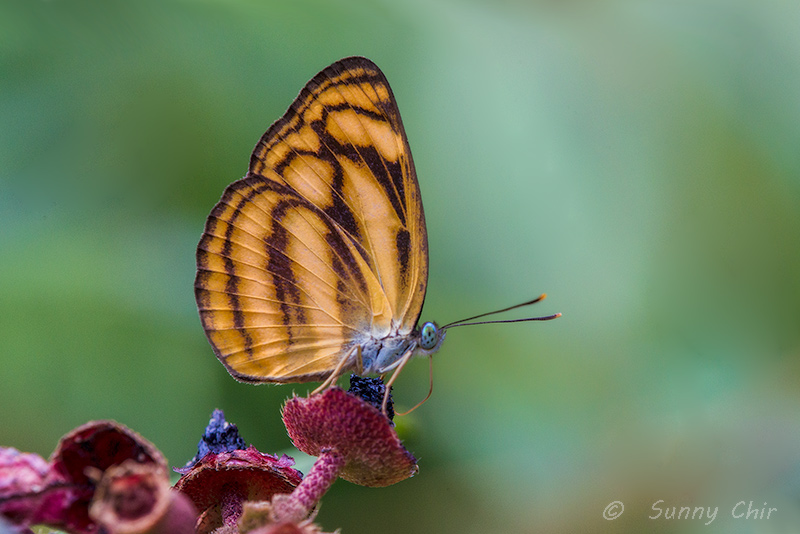
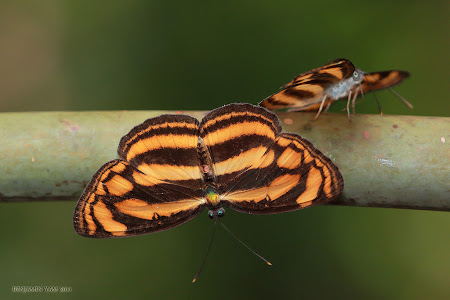
Our Butterfly for the month of October is the Malayan Lascar (Lasippa tiga siaka). This species one of four lookalike species found in Singapore that feature small. gliding butterflies with black and orange stripes across their wings. It is curious that its scientific name contains a Malay word "tiga", or "three" in it. Could it be because the author was making reference to the sub-marginal triangular spot in "space 3" of the forewing? This size of this spot is an important diagnostic feature that distinguishes it from the very similar looking Burmese Lascar.


The Malayan Lascar is widely distributed in Singapore and can be found in forested areas of the nature reserves, as well as in urban parks and gardens. Although the species has a weak gliding flight, it is skittish and alert, often frustrating many butterfly photographers who are tracking it. When alarmed, the butterfly often heads for the tree tops and perch on an inaccessible leaf, looking down at the unfortunate photographer whose effort to shoot it has been in vain!


However, the Malayan Lascar is often encountered feeding on flowering trees like Syzygium or the ripened fruits of the Singapore Rhododendron (Melastoma malabathricum) where the butterfly will be quite distracted whilst feeding, giving the photographer a much better chance at taking a good shot of the butterfly.


The upperside of the butterfly features the typical orange/black horizontal bands across both wings, whilst the undersides are a paler copy of the upperside wing patterns. The characteristic triangular orange spot in space 3 of the forewing above, which is wider (often twice as wide) as the adjacent spots in spaces 2 and 4, sets it apart from it close cousin, the Burmese Lascar (Lasippa heliodore dorelia).


The Malayan Lascar is common, and sometimes several individuals can be observed at the same location, especially when they are feeding on flowers or ripened fruits. The species has also been observed puddling on damp sandy streambanks.


The early stages of the Malayan Lascar has been fully documented here. The caterpillars have been successfully bred on two species of host plants - Erycibe tomentosa (Convolvuaceae), Bauhinia semibifida (Leguminosae, Caesalpinodeae).


Text by Khew SK : Photos by Sunny Chir, Khew SK, Koh CH, Henry Koh, Horace Tan, Mark Wong, Billy Oh, Nelson Ong & Benjamin Yam.


17 October 2013

Butterflies Galore! : Darky Plushblue

Butterflies Galore!
The Darky Plushblue (Flos anniella anniella)


Of the four Flos species that occur in Singapore, the Darky Plushblue is the rarest. It is a forest-dependent species and rarely, if ever, seen outside the nature reserves in Singapore. It can be skittish and has a strong erratic flight if disturbed. Occasionally, it stops to feed at the ripened fruits of the Singapore Rhododendron (Melastoma malabathricum) where it may stay still for a better chance of a shot at it. The species is tailless, although the hindwing is toothed at veins 2 and 3.

The upperside of the male is a lustrous violet-blue with a thin black border whilst the female is a deeper blue with a dark black border. On the underside, the purple brown markings are typical of the genus and the apical area of the forewing is whitened. This individual was photographed in the nature reserves by young ButterflyCircle member Jonathan Soong, a secondary school student in Singapore.

16 October 2013

Butterflies Galore! : Spotted Black Crow

Butterflies Galore!
The Spotted Black Crow (Euploea crameri bremeri)


This medium-sized "Crow" is moderately rare in Singapore, and is usually observed feeding at flowers or puddling on sandy footpaths and streambanks. The species is widely distributed, and can be found in urban gardens as well as in the nature reserves. It is also a resident species in back-mangrove habitats where its host plant, Gymnanthera oblonga (Apocynaceae) can be found.

The butterfly has a slow and unhurried flight but can be skittish when approached. When it is feeding at flowers or puddling, it is distracted and can be photographed much easier. This shot of the Spotted Black Crow was taken by young ButterflyCircle member, Jerome Chua, a secondary school student in Singapore.

14 October 2013

Butterflies Galore! : Gram Blue

Butterflies Galore!
The Gram Blue (Euchrysops cnejus cnejus)


This erratic and fast-flying Hairstreak can be quite challenging to photograph when they are active on hot sunny days. The Gram Blue tends to fly at low level amongst shrubs and grasses in fair weather. At certain times of the day, they can be observed stopping on their favourite perches and open their wings to sunbathe. The male of the Gram Blue is light purple above whilst the female is a lighter blue with dark wing bases. The underside is pale buff with black and dark grey spots and striae.

This mating pair of Gram Blues was shot by young ButterflyCircle member Brian Goh at a Park Connector last weekend. The pair was perched on a blade of grass, making a pleasing balance with a vertical composition of the shot.

12 October 2013

Life History of the Burmese Bush Brown

Life History of the Burmese Bush Brown (Mycalesis perseoides perseoides)


Butterfly Biodata:
Genus: Mycalesis Hübner, 1818
Species: perseoides Moore, 1892
Subspecies: perseoides Moore, 1892
Wingspan of Adult Butterfly: 40-50mm
Caterpillar Local Host Plants: Ottochloa nodosa (Poaceae), Ischaemum ciliare (Poaceae).


Physical Description of Adult Butterfly:
On the upperside, the wings are dull brown with a prominent yellow-ringed ocellus in space 2 of the forewing, and two obscure ocelli in spaces 2 and 3 of the hindwing. The male has a dark brown sex brand above vein 7 in the hindwing covered with a hair pencil. On the underside, both wings are pale brown in ground colour and have a whitish post-discal band. There is a series of ringed ocelli in the submarginal area on both wings. In the forewing, there are four faint lines (obscure in the wet season form but more readily seen in the dry season form) crossing the basal half of the cell. In the hindwing, the post-discal line is slightly curved in spaces 4 and 5, and there is a prominent dark brown indentation line stretching down to and beyond vein 1b with a "tooth" at vein 1b.


Field Observations of Butterfly Behaviour:
Once thought to be rare, this species is now a common member of the Mycalesis genus in Singapore. Adults are typically sighted flying low among vegetation in and around grassy patches found at multiple locations across the island nation. As with other Satyrinae members, the adults fly in an erratic and jerky manner as their wings are closed for a relatively long period during flights.


Early Stages:
Two local common grass species, Ottochloa nodosa and Ischaemum ciliare, have been recorded as larval hosts so far. The caterpillars feed on leaves of the host plant, and have been observed to forcefully ejecting their frass pellets, a larval habit rarely seen outside the skipper/flat families. They tend to rest lengthwise on the underside of a leaf during pauses between feeds.

Local host plant: Ottochloa nodosa.

A mating pair of Burmese Bush Brown.

The eggs are laid singly on the underside of a grass blade. Each egg is more or less spherical (about 1mm in diameter) and pale translucent with a light greenish tinge. It appears to be smooth to the naked eyes, but faintly sculptured with a hexagonal reticulum when viewed with a macro lens.

A mother Burmese Bush Brown laying an egg on its host plant.

Two views of an egg of Burmese Bush Brown.

Two views of a mature egg with the head clearly visible through the egg shell.

The egg takes about 3 days to mature. The young caterpillar nibbles away a portion of the egg shell to exit and then proceeds to devour the rest of the egg shell almost entirely. It has a cylindrical body in whitish colour, and an initial body length of about 2.8mm. The body is covered with dorso-lateral and lateral rows of moderately long setae. At the posterior end, there is a pair of backward-pointing processes. Its dark colored head features a number of setae and has a pair of short and rounded horns, a few lateral protuberances.

Two views of a newly hatched caterpillar, length: 3.1.mm

As a result of its leaf diet, the 1st instar caterpillar soon takes on a strong greenish undertone. As growth proceeds, the dorsum of the last two to three segments turns reddish. The first instar lasts about 4 days with the body length increases to about 5.5-6mm.

Two views of a 1st instar caterpillar, length: 4.9mm.

Two views of a late 1st instar caterpillar, dormant prior to its moult, length: 4.5mm.

In the 2nd instar, the cephalic horns become pointed and the two anal processes longer and thus pronounced. The few lateral conical protuberances on the head capsule are now much smaller and whitish in colour. The body color is pale yellowish with a green undertone. The head and body is also adorned with numerous minute tubercles, each with a single seta emanating from it. The 2nd instar lasts about 3 days with the body length reaches about 9mm.

Two views of a 2nd instar caterpillar, early in this stage, 4.5mm.

Two views of a 2nd instar caterpillar, length: 5.4mm.

Two views of a late 2nd instar caterpillar, dormant prior to its moult, length: 8mm.

The 3rd instar caterpillar mostly resembles the previous instar. The head capsule is dark brown in the cephalic horns and the basal areas around the mouth parts but pale brown elsewhere. This stage also takes 3 days to complete with body length reaching about 13-14mm.

Two views of a newly moulted 3nd instar caterpillar, length: 9mm.

Two views of a 3nd instar caterpillar, length: 12mm.

Two views of a late 3nd instar caterpillar, dormant prior to its moult, length: 13mm.

The 4th instar caterpillar bears a close resemblance to the 3rd instar caterpillar with no obvious change of any features or markings. The 4th instar lasts about 4 days with body length reaching 20.5-21.5mm.

Two views of a newly moulted 4th instar caterpillar, length: 13.5mm.

Two views of a 4th instar caterpillar, length: 17mm.

Two views of a late 4th instar caterpillar, dormant prior to its moult, length: 21.5mm.

Burmese Bush Brown caterpillars in the act of catapulting frass pellets. The next moult brings the caterpillar to its 5th and final instar. Now the caterpillar could appear in two colour forms: a brown form which is mostly pale to dark beige brown and a green form which is pale yellowish green. Feature wise, there is now a narrow band on the dorsum of the thorax. In addition, small black dorso-lateral spots appear at the joints between segments 2 to 7. Furthermore, faint oblique stripes adorns the body surface. In a period of 8 days, the body grows to a maximum length of about 32-35mm. Two views of a newly moulted 5th instar caterpillar, length: 20mm.
Two views of a 5th instar caterpillar, green form, length: 29mm.
Two views of a 5th instar caterpillar, brown form, length: 35mm.
Two views of a 5th instar caterpillar, late in this stage, body shortened and body colour changed to mostly green, length: 22mm. Toward the end of the 5th instar, the body gradually shrinks in length and the body of both colour forms turn mostly green. Finally the caterpillar finds a spot on the underside of a leaf blade to spin a silk pad. It then secures itself there via its anal end, and assumes its upside-down pre-pupatory pose.
A prep-pupa of Burmese Bush Brown. After one day as a pre-pupa, pupation takes place. The smooth pupa is mostly green throughout. It is somewhat angular in appearance, with a dorsal keel on the thorax and ridges defining the dorsal wing margins. There are a few small black spots dotting the wing pad margin. Dorso-lateral pairs of small yellowish spots can be observed on abdominal segments 2-6. Length of pupae: 15-16mm.
A Burmese Bush Brown caterpillar moults to its pupal stage.
Three views of a pupa of Burmese Bush Brown. After 5 days of development, the pupa becomes darkened in color, and the ringed-spot on the forewings can now be seen through the pupal skin in the wing pads. The next day the eclosion event takes place with the adult butterfly emerges to start the next phase of its life cycle.
Three views of a mature pupa of Burmese Bush Brown.
A Burmese Bush Brown caterpillar emerges from its pupal case.
A newly eclosed Burmese Bush Brown. References:
  • [C&P4] The Butterflies of The Malay Peninsula, A.S. Corbet and H.M. Pendlebury, 4th Edition, Malayan Nature Society.
  • Butterflies of Thailand, Pisuth Ek-Amnuay, 2nd Edition, 2012.
  • A Field Guide to the Butterflies of Singapore, Khew S.K., Ink On Paper Communications, 2010.
Text by Horace Tan, Photos by Bobby Mun, Federick Ho, Khew SK and Horace Tan

10 October 2013

Butterflies Galore! : Malay Baron

Butterflies Galore!
The Malay Baron (Euthalia monina monina)


The Malay Baron is one butterfly species that displays sexual polymorphism*. It is particularly noteworthy that, in the Malay Baron, the polymorphism occurs in the males. In butterflies, polymorphism occurs more frequently in females than in males. In the Malay Baron, there are three known forms of the males - form-decorata, form-monina and form-gardineri. The species is represented by only one female 'form'.

The Malay Baron is a forest-dependent butterfly, and is seldom seen in urban parks and gardens, except perhaps for those which are in close proximity to the nature reserves in Singapore. All three forms of the males are seen with regularity, and in some instances, two or more forms are seen in the same vicinity.  This male form-decorata was photographed in the nature reserves feeding on the ripened fruit of the Singapore Rhododendron (Melastoma malabathricum)

*Polymorphism in biology occurs when two or more clearly different phenotypes exist in the same population of a species — in other words, the occurrence of more than one form or morph.

09 October 2013

Butterflies Galore! : Great Orange Awlet

Butterflies Galore!
The Great Orange Awlet (Burara etelka)


This fast-flying skipper exhibits crepuscular* behaviour and is more often seen in the early hours of the day or late in the evening. With a wingspan of 50-60mm, it is a large species, by Hesperiidae standards, with only the Gangara and Erionota spp surpassing it in size. Males are predominantly brown on the upperside and unmarked, whilst the females are deep iridescent blue above. The undersides are orange-brown with pale orange cellular streaks.

This individual was photographed by ButterflyCircle member Huang CJ at around 7:30am when the butterfly was attracted to a flowering Syzygium tree in a nature park.  Besides being encountered feeding at flowers, the Great Orange Awlet has also been observed puddling at damp streambanks at times.

*Crepuscular animals are those that are active primarily during twilight, that is, during dawn and dusk.