12 December 2012

12-12-12

12-12-12
The Final Triplet of the Millennium


As far as numerology goes, we are currently in a period of eleven years all of which have a day with the last two digits of the year repeated as a triplet in mm/dd/yy format (or dd/mm/yy or yy/mm/dd). Starting on 1 Jan 2001 which was 01-01-01, progressing to 2 Feb 2002 (or 02-02-02) and so on, today, Wednesday 12 Dec 2012 will be the last of the triplets until the next millennium or the 22nd Century comes around!

Even ButterflyCIrcle chose an auspicious 10-10-10 to launch its Field Guide to the Butterflies of Singapore two years ago on 10 Oct 2010. So, the final triplet of the century is probably worth some mention, as most of us will probably not be alive to see the next round of these triplets starting in 2101!

It is noteworthy to also mention that today in Singapore, a total of 540 couples have applied to be married - a number that is eight times the daily average in the previous year. Notwithstanding the fact that some geomancers consider 12 Dec 2012 as an "average" day in terms of luck, these couples have chosen the final triplet of the millennium to celebrate their nuptials.

To commemorate this date, we feature a collage of butterfly 'couples' by ButterflyCircle members. So do something worthwhile and memorable on 12-12-12, for you are not likely to enjoy another such date again in your lifetime.  Have a great day!

Text by Khew SK : Photos by Chng CK, Koh CH, Khew SK, Bobby Mun, Simon Sng, Tan BJ, Bene Tay & Mark Wong


11 December 2012

A Commanding Work of Art

A Commanding Work of Art
The Commander (Moduza procris milonia)


In an earlier feature article on this blog, I introduced our young ButterflyCircle member, Jonathan Soong. This talented young Singaporean never ceases to amaze with his gift of painting spectacularly life-like renditions of nature subjects. Jonathan spent some of his free time this year to paint this 11" x 14" oil-on-canvas rendition of the Commander as a special Christmas gift for me.


As can be seen, his masterful brush strokes bring both the butterfly and it caterpillar host plant, Timonius wallichiana, to life! The details of the leaves and the butterfly (both upper and underside) are true to life and the colours accurate. Close ups of the butterflies in the painting shown above feature the exquisite details in Jonathan's handiwork.

Many thanks, Jonathan! I will certainly cherish your work of art that is made more meaningful because it is my avatar in cyberspace - the Commander.

Merry Christmas and a Happy and Successful New Year to you and your family!


08 December 2012

Life History of the Orange Tailed Awl

Life History of the Orange Tailed Awl (Bibasis sena  uniformis)


Butterfly Biodata:
Genus: Bibasis Moore, 1881
Species: sena Moore, 1866

Sub-species: uniformis Elwes & Edwards, 1897
Wingspan of Adult Butterfly: 45-50mm
Caterpillar Local Host Plant: Hiptage benghalensis (Malpighiaceae).


Physical Description of Adult Butterfly:
Above, both sexes are dark brown and without any markings. Underneath, both sexes are dark brown with a prominent white discal band in the hindwing, from space 1b to the costa. A large white discal patch sits in the lower half of the forewing. The upper end of this white patch is diffused into a shinning purplish blue smudge. The hindwing, produced at its tornus, is adorned with bright orange cilia along the termen from the tornal area to vein 4. The legs are colored pale yellowish orange.


Field Observations of Butterfly Behaviour:
This species is moderately rare in Singapore. Due to its crepuscular habit, the adults are rarely sighted by butterfly watchers. Essentially a forest species, Orange Tailed Awl can be found in the nature reserves as well as the Singapore Botanic Gardens, where its known local host plant H. benghalensis can be found in relative abundance in one area. Similar to the Hasora spp., the adults of Orange Tailed Awl have a swift, strong and darting flight, and have a habit of perching on the underside of a leaf when resting. The males have also been found puddling on wet grounds. 

06 December 2012

Random Gallery - Gram Blue

Random Butterfly Gallery
The Gram Blue (Euchrysops cnejus cnejus)


The Gram Blue is a moderately common Lycaenid that can be found fluttering around low shrubs in open areas like the park connectors in Singapore.  Where the species occurs, often several individuals can be found, chasing each other and frolicking in the sunshine.  The male of the Gram Blue is a light purple-blue above whilst the female is heavily black-dusted with the wing bases a pale shining blue.  The underside is pale buff with straiae and black spots in the usual Lycaeninae arrangement.  

This pristine shot of a Gram Blue was taken last weekend by ButterflyCircle member Koh Cher Hern. The shot shows the butterfly perched comfortably on the edge of the leaf with its antennae neatly aligned. Good handholding technique ensures that the butterfly is sharply in focus with a deep forest green background to contrast with the lighter coloured butterfly.

04 December 2012

Random Gallery - Pea Blues

Random Butterfly Gallery
Pea Blue (Lampides boeticus)


Canon 1D3 / Tamron 180 mm / EX580 II ISO500 1/80s f/10 , Fill-flashed , Handheld

The Pea Blue is a widespread and common butterfly, occurring whenever its caterpillar host plants, Crotalaria pallida and Crotalaria retusa are grown. The adult butterflies fly rapidly on hot sunny days, often stopping to feed at the yellow flowers of its host plants. The upperside of the males is dull purple-blue with two black tornal spots on the hindwing. The female is brown above with pale shining blue wing bases. The underside is pale buff brown with white streaks, with orange-crowned black tornal spots. There is a filamentous white-tipped tail at vein 2 of the hindwing.

This excellent shot of a pair of mating Pea Blues was shot last weekend by ButterflyCircle member Sunny Chir.  The pleasing composition with a creamy smooth background with pastel shades allow a viewer to focus on the mating butterflies perched on a green leaf tip.  A small aperture ensures a good depth-of-field to render both butterflies in sharp focus.

01 December 2012

Favourite Nectaring Plants #2

Butterflies' Favourite Nectaring Plants
The String Bush (Cordia cylindristachya)


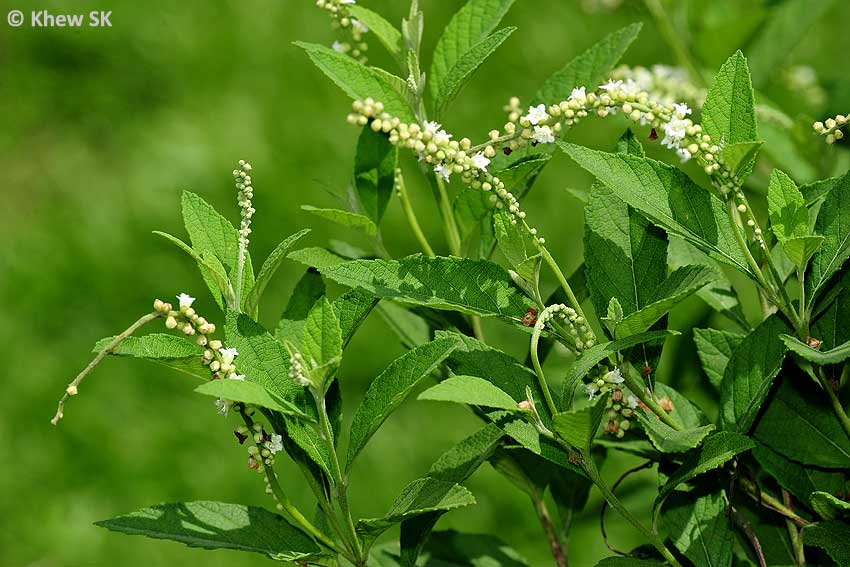
In this second article in the Favourite Nectaring Plants series, we take a look at a plant that is not that commonly cultivated in recent years. Nevertheless, where this plant occurs, it is quite a butterfly magnet! In my childhood days, I recall that this plant grew commonly as a hedge around gardens and attracted a myriad of insects, birds and reptiles. I wonder why this plant is no longer popular with landscape designers and gardeners these days.


Flowering spikes of the String Bush that are attractive to butterflies

Perhaps NParks could considering bringing this plant back for the Park Connectors and various gardens and parks around Singapore to provide a greater diversity and choice of nectaring plants for butterflies and other critters to feed on.


Plant Biodata :
Family : Boraginaceae
Genus : Cordia
Species : cylindristachya
Country of Origin : Tropical America
English Common Name : String Bush


The String Bush (Cordia cylindristachya) belongs to the Heliotrope family, of which another related plant, the Indian Heliotrope (Heliotropium indicum) is a plant to which species of the Danainae family have a special affinity.  The String Bush is a bushy shrub, growing to 1-1.5m tall.  In larger and older bushes, the stems of the plant are woody and firm.


A top view of young leaves of the String Bush

The leaves of the String Bush are rough and velvety to the touch, relatively hairy, and dull green. Each leaf is eillptical or ovate with a sawtooth edge. The mature leaves are around 5-10cm long. The leaves grow from the stem in alternate arrangement. Young stems are light green, turning woody brown as the bush matures.


The elliptical and sawtooth edged leaf of a Stringbush (above) and the flower spike with the small white flowers (below)

The flowers are small, crowded in terminal spikes.The corolla of the flower is bell-shaped, light whitish cream in colour and measure about 4-6mm long. The pistil is creamy white whilst the stamens are pale buff. The fruits are globose , pale green and about 5mm in diameter attached on the spikes but turns red when ripe.


Lush bushes of the String Bush at Pasir Ris Park Butterfly Garden

It was a common hedge plant after its introduction from tropical America until the 60's in Malaysia and Singapore, gradually disappearing, most probably due to the introduction of a beetle Schematiza cordiae that was imported from Trinidad to control the String Bush from spreading too fast. Both the adult and larvae of the beetle feed on the leaves of the plant. Given that the plant is no longer very commonly seen in recent years, would this beetle still be around, or has moved on to feed on other plants in the family?


The String Bush can be grown as a hedge as the thick foliage can be used as a privacy screen

The String Bush has been observed growing wild at the old Mandai Orchid Garden (which is now no longer in existence), at the Butterfly Hill at Pulau Ubin, and at the Pasir Ris Butterfly Garden. The last named location features a good stock of several large healthy plants of the String Bush with lush growth of leaves and flower spikes attracting a myriad of butterflies on a daily basis.


The plant is drought resistant and can grow in relatively poor soil.However, in fertile soil, the plant grows lushly, reaching more than a metre high in a few months.It does better in locations with full sun.


Common Danainae species feeding on the flowers of the String Bush

The flowers do not produce any strong scent, but is highly popular with butterflies. It is interesting to observe that butterflies of various sizes from the larger Papilionidae to the small Lycaenidae all feed on the flowers of this plant. Of the larger Papilionidae, we have observed the common butterflies like the Lime Butterfly, Common Mormon, Common Mime and even the fast-flying Common Bluebottle feeding on the flowers.


The Pierids are also fond of the flowers of the String Bush, with the Emigrants, Grass Yellows and Striped Albatross seen feeding on the flowers. Nymphalidaes include all the four Pansys, the Baron and the occasional Autumn Leaf. The Danainaes love the flowers of the String Bush, in particular the Glassy Tigers, Plain/Common/Black Vein Tigers and even the odd King Crow!


The Lycaenidae that are attracted to the flowers of the String Bush shows quite a wide diversity, particularly at Pasir Ris Park. The smallest species of butterfly in Singapore, the Pygmy Grass Blue has also been seen feeding on the nectar from the String Bush flowers.  Various genera of Lycaenidae were observed to feed on the flowers and these include the Rapala, Tajuria, Prosotas, Hypolycaena, Anthene, Chilades, Catochrysops, Zizula, Zizina and Zizeeria.


Of the Hesperiidae, spotted at the flowers of the String Bush are the Polytremis, Pelopidas, Cephrenes, Hasora, Potanthus and Caltoris.


Although the String Bush is not an aesthetically attractive plant to landscape designers and gardeners, it is certainly an important addition to any garden that wants to attract butterflies.  It is hoped that this plant will make a comeback in Singapore's butterfly-friendly environment in the near future.

Text by Khew SK : Photos by Khew SK; Loke PF & Simon Sng

References :
  • Keng, Hsuan : The Concise Flora of Singapore, 1990 ; Singapore University Press
  • Foo, Tok Shiew : A Guide to the Wildflowers of Singapore, 1985 ; Singapore Science Centre
  • Boo, CM; Omar-Hor, K & Ou-Yang CL : 1001 Garden Plants in Singapore, 2nd Edition, 2006 ; National Parks Board
 

27 November 2012

Random Gallery - The Harlequin

Random Butterfly Gallery
The Harlequin (Taxila haquinus haquinus)


Here is another shot of a female Harlequin (Taxila haquinus haquinus) taken by ButterflyCircle member CK Chng a couple of weekends ago. This species is in critical danger of disappearing from the Singapore Butterfly fauna, as the solitary known site where a small colony of the Harlequins can be found with regularity is slated for development. ButterflyCircle had earlier attempted a translocation effort, but was unable to replicate all the ideal conditions for the species' continued survival. Hence the days for this pretty butterfly's existence in Singapore may be numbered.

Ironical though it may seem, the site where the last remaining Harlequin colony is found is earmarked for a development "focusing on hosting an environmentally friendly industry, the complex is being developed with an eye towards environmentally responsible practices, with "green" buildings and maintenance of natural terrain".