24 December 2011

A Season for Red, Green and Black!

A Season for Red, Green & Black
ButterflyCircle Wishes One and All a Merry Christmas and a Happy 2012!


It's the Chrismas and the holiday season again.  As people from all over the world are preparing for a nice sumptuous dinner, merry-making and spending time with family and friends on Christmas Eve, let's remember to spread a little cheer and love to those who are less privileged or alone. 
 
On the personal front, it has been an extremely busy and challenging year, as my company prepares for an exciting future ahead with a new shareholder.  2011 has been a year of new experiences - both happy and sad, where I bade farewell to long-time colleagues and welcomed new ones.  The year ahead will be fraught with challenges and new relationships, but one which I look forward optimistically to.  It will be a time for great change and many personal quests. 
 
I am also glad that ButterflyCircle has had many new and capable members joining us and taking the high-quality photography and research work to newer heights.  The spirit of sharing and camaraderie has never been stronger, and we even have active and knowledgeable junior and senior members coming on board with us. 
 
We look forward to many new discoveries for Singapore in 2012, many of which are already under preparation for addition to the Singapore checklist after final scientific validation by a few experts.  I am optimistic that the Singapore butterfly checklist will reach 310 species by the end of the new year! 
 
ButteflyCircle would like to take this opportunity to wish all our members and friends from around the world a Merry Christmas and a Happy 2012!  May our Beloved Flying Jewels continue to survive and thrive on our lil' island in the sun! 
 
Note on Photo : A shot of Singapore's little 'red spitfire', the Common Red Flash (Rapala iarbus iarbus) sunbathing on a blade of grass in the nature reserves.  The little fast-flying butterfly is very local in distribution but can be common in the special locations where they are found.  Males tend to dog-fight in the late hours of the day and stop with their wings spread open as in the photo, showing their attractive crimson uppersides. 

17 December 2011

Life History of the Common Posy

Life History of the Common Posy (Drupadia ravindra moorei)


Butterfly Biodata:
Genus: Drupadia Moore, 1884
Species: ravindra Horsfield, 1828

Sub-species: moorei Distant, 1882
Wingspan of Adult Butterfly: 20-32mm
Caterpillar Local Host Plants:
Saraca cauliflora (Leguminosae, common name: Yellow Saraca), Desmos chinensis (Annonaceae, common name: Dwarf Ylang Ylang), Dimocarpus longan var. malesianus  (Sapindaceae, common name: Wild Longan), Lithocarpus elegans (Fagaceae, common name: Spike Oak), Agelaea macrophylla (Connaraceae).


A male Common Posy.

Physical Description of Adult Butterfly:
Above, the male is dark brown on the forewing (which also bears an obscure orange discal patch in some specimens) and is purplish blue on the hindwing for most of the lower portion; the female is dark brown on both wings (with traces of an orange discal patch on the forewing) and a series of marginal black spots on the pale bluish tornal area of the hindwing. Underneath, both sexes are alike in having mostly orange forewing and mostly white hindwing. The forewing has post-discal and discal series of faint black striae while the hindwing is marked with prominent bold black bands and spots. The tornal area of the hindwing bears bluish scales up to vein 3. A long filamentous tail occurs at the end of vein 2. In contrast, two much shorter tails occur at the end of veins 1b and 3 respectively.

A female Common Posy.


Field Observations of Butterfly Behaviour:
The Common Posy is relatively common  in the nature reserves of Singapore, but with its occurrence mainly confined to the Central and Bukit Timah catchment reserves. The adults typically fly in a hopping fashion, and they have been observed to sunbathe with their wings opened flat in sunlit conditions. The species have been observed to be attracted to the plant sap exuded by young shoots of Leea indica and Smilax bracteata.


Early Stages:
The immature stages of Common Posy are polyphagous. To date five plants have been recorded as its local hosts. Caterpillars of all instars feed on young and tender leaves of the host plants. They are also polychromatic in the early instars, occurring in either a green form or a pink form.

Local host plant : Desmos chinensis.

A mating pair of Common Posy.

Eggs are laid on the underside of a young leaf or other parts of a young shoot of the host plant. The white egg, about 0.9mm in diameter, is shaped like a lightly flattened chinese bun with its surface  covered with numerous polygonal pits. The polar pit holds the depressed micropylar.

An egg laid on the young shoot of Desmos chinensis.


Two views of an egg of the Common Posy. Diameter: 0.9mm.

Each egg takes about 2 to 2.5 days to hatch. The young caterpillar emerges after nibbling away sufficiently large upper portion of the egg shell. Measured at a length of about 1.3mm, its pale yellow  body bears long whitish setae dorso-laterally and laterally. Its head capsule is pale yellowish, and both its prothoracic shield and anal plate are colored as per the body base colour.


Two views of a newly hatched caterpillar of the Common Posy, length: 1.3mm

As the caterpillar grows, raised tubercles become apparent on the dorsum, one pair to each of 2nd-3rd thoracic segments, and one to each 1st-7th abdominal segments. The body colour is pale yellowish green as the caterpillar grows and feeds on the plant materail.This instar lasts for about 2 days with the body length reaching up to 3mm.


Two views of a 1st instar caterpillar, length: 2mm.

Covered with numerous short setae, the body of the 2nd instar caterpillar is either whitish with a pale green undertone or yellowish with a dark brown undertone. Each of the 2nd and 3rd thoracic segments has a pair of dorso-lateral conical projections, whilst each of the first six abdominal segments have a short conical projections, taller than those on the thoracic segments. These projections are yellowish brown around the tip and whitish at the base. The growth in this stage brings the caterpillar to a length of about 5-5.5mm, and after about 2 days in this stage, it moults again.


Two views of a 2nd instar caterpillar, length: 3.3mm.


Two views of a 2nd instar caterpillar of a different colour form,  length: 4mm.


Two views of a 2nd instar caterpillar, late in this stage, dormant prior to its moult, length: 5mm.

The 3rd instar caterpillar resembles the 2nd instar caterpillar closely with minor changes observed. The dorsal projections on the abdominal segments are now longer and pointed than those on the thoracic segments. This instar takes about 2 days to complete with the body length reaching about 8.5-9mm before the next moult.


Two views of a 3rd instar caterpillar, pink form, length: 7mm.


Two views of a 3rd instar caterpillar, green form, length: 8mm.


Two views of a 3rd instar caterpillar, late in this stage, dormant prior to its moult, length: 8.5mm.

The 4th instar caterpillar ushers in a drastic change from the 3rd instar: A diamond-shaped marking formed by a reddish brown line running from the dorsum of the 1st abdominal segment to the side of 5th abdominal segment, and then back to the dorum of the 7th abdominal segment, and straight on to the posterior end. The dorso-lateral pairs of projections seen on the 2nd-3rd thoracic segments in earlier instars are no longer discernible. The body base colour is yellowish green in one form and yellowish pink in another.  This instar lasts about 3-4 days with length reaching 17-18mm.


Two views of a 4th instar caterpillar, early in this stage, length: 13.5mm.


Two views of a 4th instar caterpillar, length: 16.5mm.


Two views of another 4th instar caterpillar, length: 17mm.


Two views of a 4th instar caterpillar, late in this stage, length: 17mm.

Towards the end of the 4th instar, the caterpillar ceases eating and wanders around for a pupation site. At this time, the caterpillar's body changes to a dark purplish brown coloration, and in some specimens, with a green underdone in the abdominal area. It typically chooses the underside of a stem or branch for its pupation. Here, the pre-pupatory larva spins a silk girdle and a silk pad and then anchors itself on it in a head-down posture.

Two views of a pre-pupatory larva of the Common Posy.

A Common Posy caterpillar molts to its pupal stage.

Pupation takes place after one day of the pre-pupal stage. In a typical colour form, the pupa is brownish with with whitish streaks/patches in the thorax and wing pads, and has a large and similarly coloured dorsal patch on the abdomen. In another form, the brown is replaced by black and the abdomen is coloured similar to the thorax. Length of the pupa: 12-13mm.


Two views of a typical pupa of the Common Posy.

Two views of another pupa of the Common Posy.

7 days later, the mature pupa turns dark in the dorsal and wing case areas, and yellowish brown elsewhere. The next day the adult butterfly emerges from the pupa.


Two views of a mature pupa of the Common Posy.


A newly eclosed Common Posy resting near its pupal case.

References:
  • [C&P4] The Butterflies of The Malay Peninsula, A.S. Corbet and H.M. Pendlebury, 4th Edition, The Malayan Nature Society.
  • Butterflies of Thailand, Pisuth EK-Amnuay, 1st Edition, 2006.
Text by Horace Tan, Photos by Benedict Tay, Mark Wong, Loke PF, Anthony Wong, Federick Ho, Khew SK  and Horace Tan

10 December 2011

Book Review by Dr Albert Orr

Book Review :
A Field Guide to the Butterflies of Singapore
by Dr Albert Orr

204 Australian Entomologist, 2011, 38 (4)

BOOK REVIEW

A Field Guide to the Butterflies of Singapore by Khew Sin Khoon. Ink on Paper Communications Ltd, 2010; xxv + 342 pp. Price (in Australia) $50. ISBN 978 981 08 7018 8 (paperback).

The city state of Singapore is home to nearly 300 species of butterfly. Perhaps this richness should come as no surprise for a place which styles itself as the ‘Garden City’ and which lies just off the tip of the Malay Peninsula, itself boasting nearly 1000 species; nonetheless it is an impressive total given Singapore’s small area of just 700 km2 and largely urban environment.


This charming book is the first ever to depict almost all species currently known from Singapore. A glossy production in standard octavo field-guide format, it begins with a concise but adequate introduction to the butterflies, covering the topics of nomenclature, adult morphology, early stages, ecology and behaviour, where to find butterflies in Singapore (together with a map of local hotspots) and the techniques of butterfly watching and photography.


A lot of information is packed into a very few pages. A section on how to use the book explains clearly the conventions adopted with regard to describing abundance, habitat, speed of flight and other information.


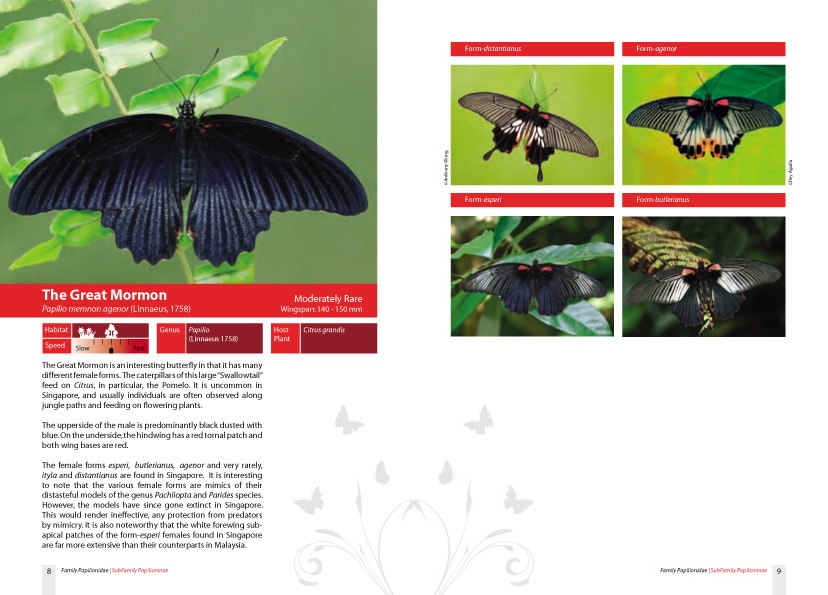
There follows a family by family, subfamily by subfamily, species by species account. Typically, each species receives a single page, with two pages for the highly polymorphic Papilio memnon agenor (Linnaeus, 1758).


Half the page is devoted to a large scale portrait of the species, typically perching or feeding, occasionally in flight. Virtually every one of these main photos is stunning. In many cases, particularly in the smaller species, individual rows of scales may be discerned, a level of resolution that was almost unobtainable using film.


The main image is supplemented by two thumbnail photos, generally showing a different posture and frequently the opposite side of the wings to those depicted in the main portrait. Each species is identified primarily by an English common name. Many of these have been in use for years but a few are of more recent coinage. However, all are evocative and appealing and give the impression that they have established their worth by natural selection within the very active Singapore butterfly interest group.

Australian readers may be surprised to find that Graphium agamemnon (Linnaeus, 1758) is known as ‘The Tailed Jay’ and ‘The Palm Dart’ is not Cephrenes augiades (C. Felder, 1860) but Telicota augias (Linnaeus, 1763). In finer print is given the full trinomial designation with author and date, its abundance class, ranging from common to very rare, and its wingspan in mm. (Here forewing length would have been a more useful measure, especially as most species are photographed with wings folded). Habitat is indicated by one of four icons: Urban, Parks and Gardens, Forests, Mangroves/Coastal.

Speed of flight is shown on a five point scale from slow to fast. Larval hostplants are listed in another small box (with family names sometimes wrongly italicised). A brief text describes habits, habitats and salient identification features. The formula is extremely easy to use and much information can be obtained for little effort. For ease of reference the six families have a colour code visible along the fore edge of the book when closed.

The book is very definitely aimed at the butterfly watcher and photographer, rather than the collector. Not a single photograph of a dead butterfly appears within its pages. It will, however, surely become indispensable to every local enthusiast and interested visitor to the island state and be useful elsewhere in the region.


Dr Albert Orr

About the Reviewer
Dr Albert Orr is a professional entomologist of 35 years standing. He is a retired lecturer in ecology and invertebrate zoology and has been an Honorary Research Fellow at Griffith University since 1996. Dr Orr is a writer and illustrator, as well as a consultant and scientific editor.

A Selection of Books by Dr Albert Orr
Acknowledgments : Special thanks to Dr Albert Orr for reviewing my "Field Guide to the Butterflies of Singapore" in the Australian Entomologist.  The original PDF article can be found here.


03 December 2011

Life History of the Orange Awlet

Life History of the Orange Awlet (Burara harisa consobrina)


Butterfly Biodata:
Genus: Burara Swinhoe, 1893
Species: harisa Moore, 1866

Sub-species: consorbrina Plötz, 1884
Wingspan of Adult Butterfly: 45-50mm
Caterpillar Local Host Plant: Arthrophyllum diversifolium (Araliaceae)


Physical Description of Adult Butterfly:
Burara harisa  (The Orange Awlet) is the look-alike cousin of the larger (and less common)  Burara etelka  (The Great Orange Awlet). Above, the male is coppery brown with no brand; the female is deep steely blue with greenish wing base. Underneath, both sexes are shaded in dark orangy brown and have pale orange streaks beyond the cell-end on both wings. Basal halves of the forewings are shaded purplish blue, more extensive and prominent in the female.  Orange  cilia are found on the hindwings, along the termen from spaces 1 to 3. The head, palpi, legs and the ventral surface of the thorax and abdomen are colored orange.


Field Observations of Butterfly Behaviour:

The adults can be found in the nature reserves as well as the Southern Ridges. They are more likely to be encountered in early morning hours and late afternoon, frequenting shaded forest areas. At times adults can be found nectaring at  flowering plants and puddling at damp grounds. Compared to the adults,  the larval stages are more readily found in leaf shelters on its host plant, Arthrophyllum diversifolium, which is a relatively common plant growing in the reserves as well as urban parks. The adults fly with swift, strong and darting flights. 


Early Stages:
The caterpillars of the Orange Awlet feed on the leaves of the host plant, Arthrophyllum diversifolium, and seek concealment and protection in  a leaf shelter. For its shelter, an early instar caterpillar typically makes a sinuous cut from the leaf edge, and proceeds to fold the leaf fragment onto the leaf underside where silk threads are used to secure the leaf edge to the leaf surface. The shelters for the much larger caterpillars in late instars are simply made by joining the two opposing edges of a leaf.

 
The leaf shelter of an early instar caterpillar seen on the leaf underside of the host plant.


A leaf shelter of a late instar caterpillar of the Orange Awlet.

 
A young specimen of the local host plant: Arthrophyllum diversifolium.

A far view of an Arthrophyllum diversifolium in a Hill Park  bearing signs of an infestation of the Orange Awlet.

The eggs are laid singly on the leaf upperside of a middle-aged or mature leaf of the host plant. Each dome-shaped egg is creamy white with a beige tinge. The micropylar sits atop and a number of vertical ridges running longitudinally from it to the base. An equatorial series of short, reddish, intermittent patches can be seen as the egg develops. The diameter is about 1mm.

Two views of an egg of the Orange Awlet
 
 
A sequence of three views of a maturing egg of the Orange Awlet over a span of 2 days.

It takes 3-4 days for the collected egg to hatch. The young caterpillar eats just enough of the shell to emerge, and has a length of about 2.9mm. Its pale  yellowish brown body is cylindrical in shape with rather long lateral and sub-spiracular white setae. There are dorso-lateral dark brown markings on a number of body segments.   The large head is pale brown with three black roundish markings. The head also bears similar white setae as those on the body. 

Newly hatched 1st instar caterpillar, length: 3mm

The body soon takes on a green undertone after a few feeding sessions on the leaf. Its movement on leaf was observed to be rather quick-paced.  By the time the caterpillar lies dormant for its moult to the 2nd instar, its length has reached 4.5mm. The 1st instar takes a total of 2.5-3.0 days to complete.

1st instar caterpillar, late in this stage,  length: 4.5mm

Top: late 1st instar caterpillar prior to its moult. Bottom: newly moulted 2nd instar caterpillar.

The body of the 2nd instar caterpillar is yellowish green and has prominent black dorso-lateral patches on the thoracic segments, 2nd, 4th, 6th, 8th and 9th abdominal segments. The black marking on the 10th segment form a black stripe across the dorsum. There is a pair of faint yellowish dorsal bands and faint obligue markings between the black spots.   The head is pale orange with two rows of black spots.  This instar lasts about 3-4 days with the body length reaching about 9mm.

2nd instar caterpillar, early in this stage, length: 6.5mm

2nd instar caterpillar, dormant prior to its moult, length: 8mm.

The 3nd instar caterpillar resembles the 2nd instar caterpillar closely in markings and coloration. The dorsal bands and dorso-lateral bands/stripes are more prominent now, yellowish in abdominal segments and becoming whitish in the thorac segments.  This instar lasts a total of 3-4 days with the body length reaching about 14mm.

3rd instar caterpillar, length: 11.5mm.

3rd instar caterpillar, dormant prior to its moult,  length: 13.8mm.

The 4th instar caterpillar resembles the 3rd instar caterpillar closely but has additional black spots/markings appearing between the yellowish/whitish dorsal and dorso-lateral bands.   Both the body and the head sport numerous short setae. This instar lasts 3-4 days with the body length reaching up to 25mm.

4th instar caterpillar,  length: 24mm.

4th instar caterpillar, dormant prior to its moult, length: 23mm

The 5th instar caterpillar has larger and very prominent black spots and markings on all body segments. With more black patches filling in the spaces between the whitish/yellowish dorsal and dorso-lateral bands, it gives the impression of large saddle patches, one to each segment,  being traversed and criss-crossed by the whitish/yellowish lines.  This instar takes about 6-7 days to complete with the body length reaching 40mm.

A newly moulted 5th instar caterpillar, length: 23mm.

Two views of a 5th instar caterpillar, length: 35mm.

Two views of a 5th instar caterpillar, late in this stage, length: 40mm

Towards the end of  5th instar, the body of the caterpillar shortens gradually and its body base colour decolorised to a shade of beige with pink tinge between the black spots.  It then stays in its leaf shelter to become a pre-pupatory larva. Within the shelter, the pre-pupa prepares for the pupal phase with a series of silk construction work with the main pieces being a silk girdle across the dorsum of its anterior abdominal segments, and a short and thickened transverse silk band on the substrate near its posterior end. Both the dorsal point of the girdle and the transverse band are further secured by vertical/oblique threads to the inner wall of the shelter. Soon the pre-pupa becomes dormant in its leaf shelter and enters the prepupatory phase which lasts for about 0.5 to 1 day.

A final instar caterpillar of the Orange Awlet eating away on a nearly defoliated branch in the nature reserve.

Two views of a pre-pupa of the Orange Awlet.

Pupation takes place within the leaf shelter. The pupa is secured  with its cremaster attached to the short transverse band on the substrate and has a silk girdle. It has a short thorax, a rather long abdomen, a short and pointed rostrum. The body is initially orangy with reddish patches and large black spots. However all these markings fade away after a day and  the base color becomes a uniform pale milky yellow. The body becomes coated in a thin layer of whitish powerdery substance. There is a series of small dorso-lateral black spots on all body segments. Another series lines  the leading edge of mesothorax and one solitary spot sits atop the dorsum of mesothorax. Length of pupae: 22-23mm.


An Orange Awlet catarpillar moults to a pupa.

Two views of a  pupa of the Orange Awlet

After 8-9 days, the pupa becomes mostly black in color in the wing pads and parts of  the body segments, signally the end of development of the adult lying within. Eclosion takes place the next day.

Two views of a mature pupa of the Orange Awlet.

A newly eclosed Orange Awlet.

References:
  • [C&P4] The Butterflies of The Malay Peninsula, A.S. Corbet and H.M. Pendlebury, 4th Edition, Malayan Nature Society.
  • Butterflies of Thailand, Pisuth Ek-Amnuay, 1st Edition, 2006
  • A Field Guide to the Butterflies of Singapore, Khew S.K., Ink On Paper Communications, 2010.
Text by Horace Tan, Photos by Loke PF,  Sunny Chir  and Horace Tan