18 May 2011

Butterfly Portraits - Grass Demon

Butterfly Portraits
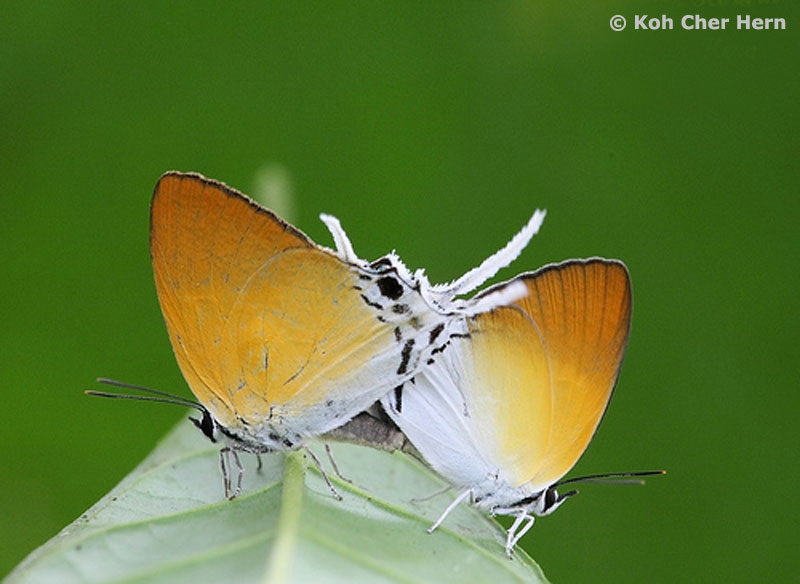
The Grass Demon (Udaspes folus)


Canon EOS 500D; flash (built in); Tamron 180mm f3.5; ISO 250; f5.6; 1/160s in AV mode; handheld.

It was another typical Saturday morning. The day started with me hoping the weather would be decent for butterfly photography and that I could head out for an outing after a tiring week at school. I completed my homework in the morning and I wanted to go for a butterfly outing after lunch. There wasn’t a rain cloud in sight so after a last-minute discussion with my parents, we decided on the Dairy Farm Nature Park. My sister reluctantly agreed and off we went.

After an hour or so in the forested areas of the reserve looking for butterflies, but to no avail, my mother and I trudged up the slope that led to a flower patch. I was hoping to encounter the Ultra Snow Flat amongst the Pagoda Flowers when the heat became unbearable. We took cover from the scorching sun in a shaded spot. Then, I saw a black and white butterfly darting around the Spider Lily patch. Curious, I got up to see what it was. The butterfly landed on a leaf and I immediately recognised it as the Grass Demon. I did not have a decent shot of it so far. I slowly got down and kneeled to the butterfly's eye-level. Focusing on the butterfly, I almost pressed the shutter when the skipper zoomed off. I chased it for quite some time until I finally lost sight of it.

Disappointed, my mother and I were about to call it a day, when I noticed the same Grass Demon perched on a Spider Lily leaf. I approached it very slowly this time, taking extra care not to spook it off. Lowering my body into an awkward angle, I knelt on one leg and used the other leg to support my body. It was very uncomfortable for there were leaves in my face. I got as parallel as I could to the butterfly, focused, and after the whole insect appeared sharp I took a few shots. Right after that, the butterfly flew off. When I checked the shots most of them were blurred due to motion but this one stood out. Lovely! I had finally gotten my decent record of this beautiful skipper.

ButterflyCircle Photographer : Jonathan Soong, a very talented 12-year old and ButterflyCircle's youngest member, studying at Nanyang Primary School

14 May 2011

Butterfly of the Month - May 2011

Butterfly of the Month - May 2011
The Green Imperial (Manto hypoleuca terana)


A male Green Imperial showing its emerald green upperside

The month of May proved to be an interesting month for Singaporeans. Often described as a politically-apathetic bunch of people, the 2011 General Elections proved that Singaporeans have indeed matured politically. A colleague who is from another country said that it was quite amazing that the Singapore GE was so well organised, peaceful and efficient, unlike elections in his home country.


A male Green Imperial feeds on the inflorescence of a Yellow Cane Palm

Indeed, as the dust settles down on the political battlefield and everyone goes back to their own lives, a few key messages left a lot of food for thought. The first is that of the electorate's resolve for an alternative voice in Parliament. Next is the increasing use of social media and the cyberspace to launch campaigns and communication amongst the net-savvy. This media is something of a phenomenon that both the ruling party and the alternative parties had not fully exploited, and it will be a platform on which future elections will be fought. That the alternative parties have secured 6 seats out of a total of 87 in Parliament is in itself a historical moment for Singapore politics. But for the ruling party, the Peoples Action Party, the results of the elections 2011 would be something that the incumbents of any other independent democratic country would die for... perhaps even literally!


The month of May in Singapore has seen relatively decent weather, although there have been days of thundery showers that have kept butterfly shooters cooped up and moping at home. The month is traditionally associated with the gemstone Emerald. The stone is of the mineral beryl, and usually coloured green by trace deposits of chromium or vanadium.


Who first beholds the light of day
In spring's sweet flowery month of May
And wears an emerald all her life
Shall be a loved and happy wife.
-Gregorian Birthstone Poems


A pair of Green Imperials - male (right) and female (left)

For May 2011, we feature a little green gem of a butterfly, the Green Imperial (Manto hypoleuca terana). The species is one of the long-tailed Lycaenids of Singapore's butterfly fauna. It is a rare forest-dependent species that is not often observed, and probably frequent tree-tops rather than visiting lower level plants.


The male of the Green Imperial is a shining bluish-green at the wing bases of the forewings and on the hindwings, probably giving it its common English name with its emerald green appearance. The broad black apical area of the forewings contrasts strongly with the green.


A female Green Imperial showing its upperside

The female is a drab brown above with black and white markings on the tornal area of the hindwings. Both sexes feature a long pure white tail at vein 2 of the hindwing and a shorter stubby tail at the adjacent vein 3.


A male Green Imperial feeding on a young fern

The underside is dark orange and unmarked on the forewing, although the apical area of the forewing tends to appear darker in colour than the rest of the wings. The hindwing has black sub-marginal and marginal spot and stripes. The hindwing of the male is almost totally orange, whilst the female has a whitened dorsum.


The Green Imperial flies rapidly and is usually quite skittish. It also has a habit of perching on the underside of a leaf at times. It has been successfully bred on the parasitic plant, Macrosolen cochinchinensis that is not uncommonly found on many mature trees.


A mating pair of Green Imperial - male (left), female (right)

This emerald beauty depends very much on the survival and conservation of its parasitic host plant, and it is hoped that with proper management and conservation of the host plant, the Green Imperial will survive as part of Singapore's butterfly fauna for a long time to come.


Text by Khew SK : Photos by Sunny Chir, Federick Ho, Khew SK, Koh Cher Hern, Horace Tan & Tan BJ

10 May 2011

Butterfly Portraits - The Saturn

Butterfly Portraits
The Saturn (Zeuxidia amethystus amethystus)


Canon EOS 5D MkII fill-flashed with Speedlite 580EX II : Tamron 180mm f/3.5 : ISO 2000 ; f/6.3 ; 1/125s in AV Mode, Handheld

I would never have expected myself to be a butterfly enthusiast 3 years ago, much less an avid butterfly photographer! It all began when I wanted to start a project on butterfly conservation and building a butterfly garden for my school. That’s where I had to link up with fellow butterfly enthusiasts to learn more about butterflies and their different habitats. ButterflyCircle provided me the essential knowledge for that.

Butterfly photography came about after marveling at the splendid shots by ButterflyCircle members. I often wondered how these beautiful butterfly shots came about, especially when the butterflies were always fluttering around.

For this shot of the Saturn, the day started with SMS exchanges with Loke on Mothers’ day to check whether he was shooting and determined a common place to meet. Upper Seletar Reservoir Park was chosen as we had shot a very rare Yellow Banded Awl just the day before.

We proceeded to the spot where we observed a few different species feeding on some fallen fruits on the forest floor. This time around, we encountered not one, but four Saturn butterflies! I was quite excited to see them close up because my earlier encounters with them were from afar and they would quickly disappear deep into the forest at the slightest movement. For months, I had been hoping to chance upon one for a decent shot but was often left disappointed.

As we moved in closer, all four took off from the ground. One female Saturn landed itself on the tree trunk which provided a nice perch for photo shooting. Fortunately, the female Saturn looked pristine and tame which provided me time to adjust and experiment with different angles. Immediately, I tried to get as parallel to the butterfly as possible, pressed my arms against tree branches for more stability and quickly took a series of shots.

Butterfly photography has helped me to understand and appreciate nature’s beauty, its serenity and the importance of conservation for our environment. Indirectly, this hobby has also helped to exercise my body, maintain my alertness and most importantly, the friendship of like-minded butterfly enthusiasts. Through the sharing of the different species of beautiful butterflies especially with younger children, I hope to raise their awareness of the things around them and to instill in them the importance of butterfly conservation.


ButterflyCircle Photographer : Koh Cher Hern, in his mid 40's, working in the teaching profession

08 May 2011

Life History of the Peacock Pansy

LIfe History of the Peacock Pansy (Junonia almana javana)


Butterfly Biodata:

Genus: Junonia
Hübner, 1819
Species: almana Linnaeus, 1758
Subspecies: javana C. Felder, 1862
Wingspan of Adult Butterfly: 40-55mm
Caterpillar Local Host Plant: Ruellia repens (Acanthaceae)


A Peacock Pansy displaying its upperside.


A Peacock Pansy on a leaf perch

Physical Description of Adult Butterfly:
Above, the wings are rich yellowish brown with darker brown edges at both termen and costal margins. On each of the forewings, there are four distinct costal bars, the outermost three of which are filled with darker shadings. There is a prominent ``peacock'' eye-spot in space 2 near the tornal area, and a lesser one in space 5. On each hindwing, a much larger and more prominent eye-spot is featured in spaces 5-6 near the apex. The termens of both fore- and hindwings are marked by two series of marginal striae. Underneath, the wings are duller and the costal bars are filled with paler shadings instead. Compared to those on the upperside, the ocelli are smaller and on the hindwing, there is an additional ocellus in space 2, and the spot in spaces 5-6 appears to be a conjoined pair. Each of the fore- and hindwings has a dark stripe traversing from the costa to the dorsum. The stripes appear to be continuous across the two wings. The stripe on the hindwing is outlined by a broad pale band on the inner edge.


Field Observations of Butterfly Behaviour:
This species is rather common across multiple habitats in Singapore, with ubiquitous presence in open areas in the nature reserves as well as urban and suburban areas. It flies in the usual gliding manner of the Junonia spp. and typically several individuals can be seen together in one location. Under sunny condition, they have a habit of opening their wings wide to sunbathe while resting on a perch.


A Peacock Pansy visiting Ixora flowers.


A Peacock Pansy giving us a view of its underside.

Early Stages:
Caterpillars of the Peacock Pansy feed on leaves of the the recorded local host plant, Ruellia repens (Acanthaceae) which occurs as widespread weeds in Singapore. It is likely that Peacock Pansy utilizes more members of the same plant family as larval food plants.


Local host plant: Ruellia repens.


A mating pair of the Peacock Pansy.


A mother Peacock Pansy laying an egg on a grass blade.

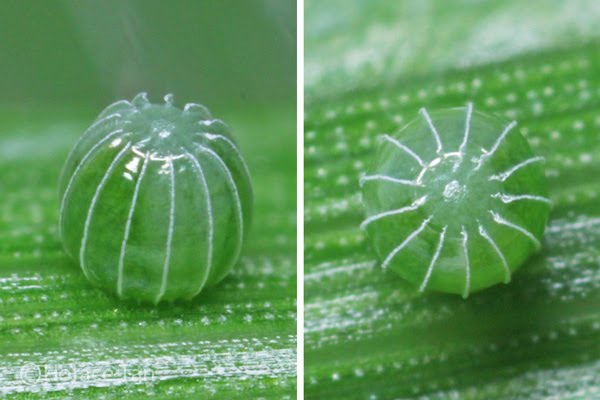
The eggs of the Peacock Pansy are laid singly on leaves or shoots of the host plant and rather frequently, on plants of other species in the vicinity of the host plant. The greenish egg is somewhat globular in shape but with a blunt top. Eleven to thirteen raised whitish ridges run from the top to the base of the egg. Each egg has a diameter of about 0.75mm.


An egg of the Peacock Pansy laid on a grass inflorescence.


Two views of an egg of the Peacock Pansy. Diameter: 0.75mm.


Two views of a mature egg of the Peacock Pansy.

The egg takes about 2.5-3 days to hatch. The young caterpillar emerges by eating away part of the egg shell, and then proceeds to eat the rest of the egg shell from the outside. The newly hatched measures at about 1.5-1.6mm. The
cylindrical and pale yellowish green body is covered with many small tubercles. Long dark setae emanate from these tubercles. The head capsule dark brown to black.


Two views of a newly hatched caterpillar, length: 1.5mm.

If the egg was not laid on the host plant, the newly hatched will have to make its way to the host plant in the vicinity. The 1st instar caterpillar has a preference for the lamina of young leaves or emerging shoots of the host plant. After reaching about 3.2mm in 2 days, the caterpillar moults to the 2nd instar.


Two views of a 1st instar caterpillar, length: 2.5mm.

The body of the 2nd instar caterpillar is dark brown to black. Moderately long and branched brownish processes run along the length of the body. Fine setae emanate from these processes and from other small tubercles on the body surface. The head capsule is still black to dark brown in colour. This instar lasts about 2 days with the body length reaching about 6mm.


Two views of a 2nd instar caterpillar, length: 3.7mm

The 3rd instar caterpillar has proportionately longer dorso-lateral and lateral processes. The base of most dorsal and dorso-lateral processes are colored in yellowish to orangy brown. The body is mostly dark brown to black with a fair number of numerous thin rings, pale whitish and inconspicuous, appear on the body segments. This instar takes about 2 days to complete with body length reaching about 11mm.


Two views of a 3rd instar caterpillar, length: 8.5mm.

The 4th instar caterpillar closely resembles the 3rd instar caterpillar. More conspicuous at this instar is an orangy collar which appears immediately after the head capsule, and white collars between the thoracic segments. The 4th instar lasts about 2 days with the body length reaching about 16.5mm.


Two views of a 4th instar caterpillar, length: 16.5mm.

The 5th (and penultimate) instar caterpillar is similar to the 4th instar caterpillar. This instar lasts for 2-3 days, and the body length reaches up to 25mm.


Two views of a 5th instar caterpillar, length: 25mm.


Two views of a 5th instar caterpillar, about to moult, length: 24.5mm.

The 6th (and final) instar caterpillar has a few visible changes to its body features. Now it has a dense carpet of whitish fine setae on the body surface and more prominent white collars on the thoracic segments than in earlier instars. In the head capsule, the periphery and some of the conical tubercles are now colored in orangy brown.


Two views of a 6th instar caterpillar, early in this stage, length: 25mm.


Two views of a 6th instar caterpillar, late in this stage, length: 43mm.

The 6th instar lasts for 3-5 days, and the body length reaches up to 43mm. On the last day, the caterpillar ceases feeding and wanders around. Eventually it stops at a spot on the underside of a leaf, young shoot/stem and spins a silk pad from which it hangs vertically to take on the pre-pupatory pose.


A pre-pupa of the Peacock Pansy.


The pupation event of a Peacock Pansy caterpillar.

Pupation takes place about 0.5 days later. The pupa suspends itself from the silk pad with no supporting silk girdle. It is brown with a number of large white bands or patches. There is a series of dorso-lateral pairs of short and pointed processes, one pair to each segment. The dorsum is sharply raised at the mesothorax. Length of pupae: 18-21mm.


Three views of a pupa of the Peacock Pansy.


Three views of a mature pupa of the Peacock Pansy.

After about 5.5-6 days of development, the pupal skin of the mature pupa turns translucent and the pupa turns dark brown as a result. Patches of orangy brown can also be noticed in the wing pad. The adult butterfly emerges from the pupa within the next 6-12 hours.


A newly eclosed Peacock Pansy resting on its pupal case.


References:

  • [C&P4] The Butterflies of The Malay Peninsula, A.S. Corbet and H.M. Pendlebury, 4th Edition, Malayan Nature Society.
  • Butterflies of Thailand, Pisuth Ek-Amnuay, 1st Edition, 2006
  • A Field Guide to the Butterflies of Singapore, Khew S.K., Ink On Paper Communications, 2010.
Text by Horace Tan, Photos by Tan Chung Pheng, Sum Chee Meng, Anthony Wong, Federick Ho, Tan Ben Jin and Horace Tan

02 May 2011

Butterfly Portraits - Branded Imperial

Butterfly Portraits
Branded Imperial (Eooxylides tharis distanti)


Nikon D90 fill-flashed with SB600 ; Tamron 180mm f3.5 ; ISO 800 ; f4.5 ; 1/125s in Aperture Priority Mode ; Handheld

It was a Saturday afternoon and the weather was perfect for a butterfly outing. I headed for Upper Seletar Reservoir Park. I got to the place at around 2:00pm and as usual, I was welcomed by its serene and quiet environment. Hoping that I could spot a Saturn, the Plane or a Dark Blue Jungle Glory, I decided to check one of the well-shaded trails which are the known habitats of these species.

After walking around for awhile, I spotted a pristine Branded Imperial (Eooxylides tharis), resting on a leaf near me. This species prefers shaded forests and is quite often encountered along the trails at this reservoir park. I am very fond of these butterflies because of their fascinating reddish-orange coloured wings and their two white tails that twirl elegantly in the breeze.

When the butterfly positioned itself on a stem, I did not waste any time and quickly took several shots of it. This is my favourite shot amongst the many shots that I took of this Branded Imperial.

I started butterfly photography using the manual mode on my Nikon D90. Shooting in this mode gives me more flexibility in adjusting the needed settings and allows me to easily correct exposure levels during the post processing stage. But this doesn't work all the time, especially if your subject is a butterfly. Butterflies are skittish and move from perch to perch frequently. When they land in a different lighting environment, frequent re-adjustments of the camera settings are required - something that has to be done quickly.

Thanks to my friend Bobby Mun, a ButterflyCircle member, who shared with me his technique of shooting in Aperture Priority Mode and using the flash as a fill light. This eliminates the darker backgrounds that I tended to get from my earlier outings. Using the camera's technical capability to assist me, I can now concentrate more on composition and getting the shot right without frequent re-adjustments on my camera settings.

I enjoy butterfly photography because it gives me a chance to appreciate nature and enjoy its beauty. The sense of communion with the environment has always been rewarding to me. It doesn’t matter if I go home with only a few good shots. For me, every butterfly outing I do is worth the effort and an opportunity to enjoy the peace and quiet in this busy city.

ButterflyCircle Photographer : Glenn Q. Bagnas, an IT Professional in his early 30's, working as a Web Programmer

30 April 2011

An Eagle's Tale

An Eagle's Tale -
Saving an Injured White Bellied Sea Eagle


A healthy White Bellied Sea Eagle soaring in the skies. This was shot at a Reservoir Park.

Hang on... what's a picture of a White Bellied Sea Eagle doing in ButterflyCircle's Blog? Have our butterflies gone to the birds? No, although this blog article is an unprecedented departure from our usual features about our beloved Flying Jewels, it is a story worth sharing with all our nature-loving readers out there. Here is an Eagle's Tale...


I was taking a good rest at home on this Easter Sunday, after a tiring marathon out in the field shooting butterflies the previous two days, when I received a text message from ButterflyCircle member Chng CK. Whilst out shooting with Loke PF, they had come across an injured eagle that some fishermen had pointed them to.


Another shot of the poor eagle. Note the torn off tail feathers

As we were all inexperienced at handling birds, and particularly one as big as this bird of prey, I advised Chng and Loke to leave it where it was, just in case the bird panicked and injured itself further, or even injured them! After a few quick SMSs to friends and nature enthusiasts, I received a reply from Biswajit Guha, the Director of Zoology at the Singapore Zoo.


Bis had conveyed our SOS to the General Curator of the Jurong Bird Park, Mr Raja Segran. After a few SMS exchanges, Raja headed out to the location where Chng and Loke were waiting with the injured bird. He identified the eagle as a mature White Bellied Sea Eagle that appeared badly injured.


The injured eagle. Note the near-opaque right eye, indicating that the eye may be infected and blind

In the meantime, Loke kept watch over the bird to ensure that it did not fall prey to any predators that may be lurking around the forest. The traumatised bird was in a bad state, with its tail feathers completely torn off. Its right eye appeared opaque and it was obviously blind on that side.


A closeup 'macro' shot of the head and beak of the Eagle

Keeping a safe distance, our ButterflyCircle members took photos of the bird for record, as this was the first them either of them was this close to this magnificent bird of prey to be able to shoot it at macro range!


We had just been shooting the White Bellied Sea Eagle the week before, when a couple of them swooped low enough for decent shots with our Tamron 180mm macro lenses!


The bird succumbed to its hunger and quickly wolfed down the fish that was offered to it

The bird appeared weak and even though it flapped its wings occasionally, it was unable to fly. One of the fishermen gave our members a catfish, and this was thrown to the injured bird. After a few tries, the eagle ate the fish hungrily, finishing the meal in its usual predator style.


Chng with our experienced friends from the Jurong Bird Park carefully picking up the injured eagle

After about an hour, Raja and an assistant arrived at the location and with expert handling, captured the injured eagle and wrapped it in a towel so that it would not further injure itself or the handlers. The bird was too weak to put up much of a fight.


The injured eagle is wrapped snugly in a towel by the experienced experts from the Bird Park

From the condition of the eagle, Raja opined that it was probably kept by some poachers in a cage for some time and dumped in the forest to die, when the owner saw that it was in a condition that it was unlikely to survive for long.


Putting the eagle safely into a kitty box, Raja and his assistant brought it back to the Jurong Bird Park where the injured eagle could be examined and its injuries treated. Hopefully the eagle can recover and soar with the wind beneath its wings once again.


The eagle, safe and sound in a kitty box, and off to the "hospital" for treatment!

An update a week later when Loke contacted Raja at the Bird Park. Raja said that the eagle is still alive and recovering from its injuries, but is blind on one side as the eye was permanently damaged. The Bird Park will continue to do its best to treat the eagle, but given its severe injuries when it was found, it may take a long time for the bird to heal.


Kudos to Loke and Chng for doing a good deed to try to save the injured White Bellied Sea Eagle, and a feather in the cap for ButterflyCircle's members, whose nature conservation efforts extend beyond just butterflies.

Text by Khew SK : Photos by Chng CK & Loke PF

  • Thanks to my friends who responded to my SMSs and offered their advice - Ria Tan, R Subaraj, Serene Chng, Ng Bee Choo, Johnny Wee & Robert Teo.

  • Special thanks to Biswajit Guha of Singapore Zoo and Raja Segran from the Jurong Bird Park for the rescue exercise.