03 April 2011

Life History of the Common Imperial

Life History of the Common Imperial (Cheritra freja frigga)


Butterfly Biodata:
Genus: Cheritra Moore, 1881
Species: freja Fabricius, 1793

Sub-species: frigga Fruhstorfer, 1912
Wingspan of Adult Butterfly: 30-42mm
Caterpillar Local Host Plants:
Adenanthera pavonina (Leguminosae, common name: Red Saga), Callerya atropurpurea (Leguminosae), Cinnamomum iners (Lauraceae, common name: Wild Cinnamon), Duabanga grandiflora (Lythraceae)


A male Common Imperial displaying its upperside

Physical Description of Adult Butterfly:
Above, the male is purplish brown and the female is dark brown. Both sexes have large quadrate tornal spots in spaces 1b and 2 of the hindwing. These spots are outlined in white, more broadly so in the female than in the male. Underneath, both sexes are mostly white and have orange brown shadings on nearly the entire forewing and just the apical area of the hindwing. There is a narrow, indistinct ochreous brown post-discal line on the forewing. On the hindwing, the post-discal line occurs in short stripes and becomes darker and bolder towards the lower half of the wing. In addition, there is an interrupted dark submarginal line, a series of tornal spots on the tornal lobe and spaces 1b, 2 and 3. Metallic bluish green scalings overlay these spots. A long filamentous tail, up to 25mm, occurs at the end of vein 2. In contrast, a much shorter tail occurs at the end of vein 1b.


Field Observations of Butterfly Behaviour:
The Common Imperial is moderately rare in Singapore. The adults are more commonly sighted in the Southern Ridges, in addition to sporadic sightings in the nature reserves and other urban parks and gardens. It frequents forested areas and flies in a similar manner as its more common relative, the Branded Imperial. As the adult butterfly flies from one perch to the next, the long tails trails elegantly behind the butterfly.


Early Stages:
The immature stages of Common Imperial are polyphagous. To date 4 plants have been recorded as its local hosts. Caterpillars of all instars feed on young and tender leaves of the host plants. They are also polychromatic, occurring mainly in either a green form or a pink form.


Local host plant #1: Duabanga grandiflora.


Local host plant #2: Adenanthera pavonina


Local host plant #3: Cinnamomum iners


A mating pair of the Common Imperial.

A mother Common Imperial laying an egg on a young leaf of the Wild Cinnamon.

Eggs are laid on the underside of a young leaf or other parts of a young shoot of the host plant. The white egg, about 0.9mm in diameter, is shaped like a slightly flattened chinese bun. The surface is covered with numerous pits of varying sizes. The polar pit holds the depressed micropylar.


Two views of an egg of the Common Imperial. Diameter: 0.9mm.
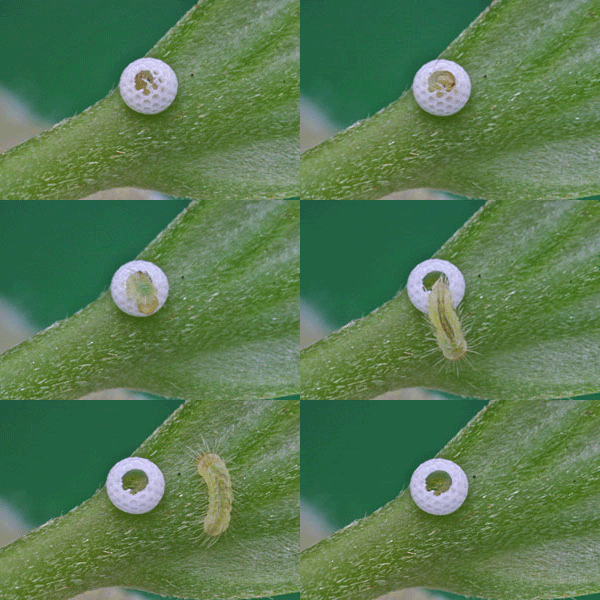

A Common Imperial caterpillar emerges from its egg shell.

Each egg takes about 2 to 2.5 days to hatch. The young caterpillar emerges after nibbling away sufficiently large upper portion of the egg shell. Measured at a length of about 1.1-1.2mm, its pale yellow green body is roughly cylindrical in shape. Dark and long setae run dorso-laterally and whitish long setae run laterally. Its head capsule is pale yellowish, and both its prothoracic shield and anal plate are colored as per the body base colour.


Two views of a newly hatched caterpillar of the Common Imperial, length: 1.2mm


As the caterpillar grows, raised tubercles become apparent on the dorsum, one pair to each of 2nd-3rd thoracic segments, and one to each 1st-7th abdominal segments. Body color is whitish alongside this row of tubercles, forming two white bands visually. Another two yellowish green bands line the outer sides of these white bands. This instar lasts for 2.5 to 3 days with the body length reaching up to 2.7mm.


Two views of a 1st instar caterpillar, length: 2mm.

Covered with numerous short setae, the body of the 2nd instar caterpillar is either whitish with a yellowish green tone or pinky tone. Each of the 2nd and 3rd thoracic segments has a pair of dorso-lateral conical projections, whilst each of the first six abdominal segments have a tall conical projections, taller than those on the thoracic segments. These projections are yellowish brown around the tip and whitish at the base. The 7th abdominal segment is broadened laterally compared to the other segments. In addition to the dorso-lateral white bands, a lateral white band also become discernible along the rim of the body. The growth in this stage brings the caterpillar to a length of about 5mm, and after about 2 days in this stage, it moults again.


Two views of a 2nd instar caterpillar, lengths: 4mm.


Two views of a 2nd instar caterpillar, late in this stage, length: 4.9mm.

The 3rd instar caterpillar resembles the 2nd instar caterpillar closely with minor changes observed. The dorsal projections on the abdominal segments are now much longer and pointed than those on the thoracic segments. The lateral projections on the 7th thoracic segments are also much more pronounced than in the earlier instar. both the prothoracic shield and the anal plate are black and well developed. This instar takes 2.5-3 days to complete with the body length reaching about 10.5mm before the next moult.


Two views of a 3rd instar caterpillar, length: 5mm.


Two views of a 3rd instar caterpillar, late in this stage, length: 10.5mm.

The 4th instar caterpillar bears a few changes from the 3rd instar. One visual difference is the missing white bands flanking the dorsal projections on the abdominal segment. The body base color is either green (green form) or pink (pink form). The dorso-lateral pairs of projections seen on the 2nd-3rd thoracic segments in earlier instars are no longer discernible. Furthermore, yellowish brown to dark brown patches occur laterally in 3rd-5th abdominal segments, increasing in size from the 3rd to the 5th segment. This instar lasts about 3-4 days with length reaching 20-22mm.


Two views of a 4th instar caterpillar, length: 14.5mm.

Two views of a 4th instar caterpillar, red form, late in this stage, length: 20mm.


Two views of a 4th instar caterpillar, green form, late in this stage.

Towards the end of the 4th instar, the caterpillar ceases eating and chooses a spot on an inclined leaf surface or a stem for its pupation site. At this time, the caterpillar's body shrinks in length and its body changes to a shade of green color (even for the pink form). The lateral patches surrounding the dorsal projections also decolorise drastically. It spins a silk pad and then anchors itself on it in a head-down posture.


Two views of a pre-pupatory larva of the Common Imperial.

Pupation takes place after one day of the pre-pupal stage. The pupa has the typical lycaenid shape, yellowish green in base colour with pale yellowish brown markings on the first 6 abdominal segments. The wing case and the dorsum of the thorax is greyish brown to greenish brown. Length of the pupa: 10-12mm.


Two views of a pupa of the Common Imperial.

5.5-6 days later, the mature pupa turns dark in the dorsal and wing case areas, and yellowish brown elsewhere. The next day the adult butterfly emerges from the pupa.


Two views of a mature pupa of the Common Imperial.


A newly eclosed Common Imperial resting near its pupal case.

References:
  • [C&P4] The Butterflies of The Malay Peninsula, A.S. Corbet and H.M. Pendlebury, 4th Edition, The Malayan Nature Society.
  • Butterflies of Thailand, Pisuth EK-Amnuay, 1st Edition, 2006.
Text by Horace Tan, Photos by Anthony Wong, Federick Ho, Sunny Chir, Khew Sin Khoon and Horace Tan

31 March 2011

Return of a Magnificent Giant

Return of a Magnificent Giant
Species #301 - Rediscovery of the Malayan Birdwing


It was after a fruitless outing at Telok Blangah Hills Park on a Sunday morning when I decided to pay an 'old friend' a visit. Having last been to the Alexandra Hospital Butterfly Trail some months back, I thought that I'd go check out the trail to see if there were any more Black Roses flying around the area.


When I reached the trail, I could see some butterfly activity, but the weather was cloudy, and the trail was quieter than expected. A couple of macro photographers were shooting spiders and other critters. The number of butterflies was way below the heydays of the AH Butterfly Trail, where the place was busy with fluttering butterflies. I noted that some of the landscaping material had been replaced with plants that were not too attractive for butterflies. Their favourite Lantana plants were gone, as were the Heliotropium indicum. The attendant and active Leopards were also missing, as their caterpillar host plant, Salix babylonica had been removed.


I made a mental note to talk to the person in charge of the landscaping at AH to try to bring back the former glory of the trail, as far as butterflies are concerned. Alexandra Hospital is now run and managed by JurongHealth, and is the holding hospital whilst the new Ng Teng Fong Hospital is being constructed at Jurong. The new 700-bed acute care is designed with good integration of the greenery into the building fabric and features a "window for every patient" as a cutting edge ward design that departs from the conventional rectilinear wards. The hospital is scheduled for completion in 2014. CPG Consultants, the firm that I work for, are the architects for the project :)


On days where there is very little butterfly activity, I usually check out the various host plants at the trail for the early stages of butterflies. There have been times in the past where we stumbled on the caterpillars and pupae of many species. As I walked past the Aristolochia acuminata trellises, I noted that the plants were quite lush, indicating that there was low caterpillar activity. However, I noticed a few early instar and one large late instar Common Birdwing caterpillars on one of the trellises.


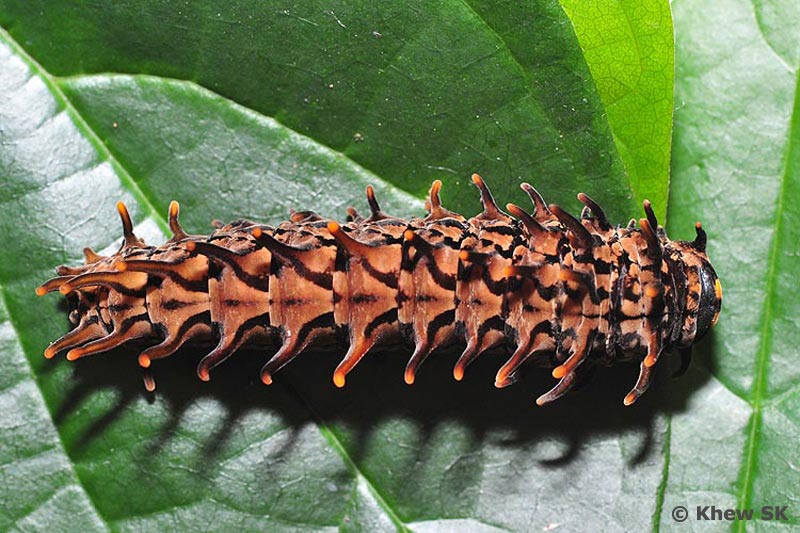
As I approached the other trellis, I noticed another medium-sized caterpillar on the underside of one of the large leaves of the host plant. It had curved reddish spines but was strangely speckled. Initially, I thought that it was a caterpillar of the Common Rose, but my instincts told me that this could be something different.


I noticed that the patterns on the caterpillar was indeed different from the two local Aristolochia feeding species that I was familiar with. It did not have the usual whitish-yellow saddle mark that the caterpillars of the Common Rose and Common Birdwing have.


A partially everted osmeterium of the Malayan Birdwing caterpillar

After checking my reference books and also online resources, the other species of Troides that matched the caterpillar that I found were either T. aeacus or T. amphrysus. A few references later, I managed to narrow it down to T. amphrysus as it was the only species between the two to have A. acuminata as one of its host plants.

"The earlier instars larvae usually have a rather plump appearance, constantly lack the pale "saddle 'and have dorsal tubercles that are black with orange to orange-red spines or 'thorns'. Young larvae are black with dark and pale, spineless tubercles. Those dorsally on the abdominal segment nos. 2, 3, 6 and 7 are black, and the remainder a bright orange. The penultimate instar larvae assume the 'mature' colouration and are almost coffee-brown with indistinct markings. There is no 'saddle-mark'.... Large larvae will kill smaller ones when they are present on the same host plant but in the other instances two or more equally large, grown larvae have been observed sharing the plant so that it seems the cannibalistic behaviour may be response to crowding."

(From: A Monograph of the Birdwing Butterflies, volume 2 - The genera Trogonoptera, Ripponia and Troides by J. Haugum, A. M. Low & D. Wilson.)


It was an exciting find, because thus far, the majority of our new discoveries or re-discoveries of butterfly species in Singapore had been through the observation of the adult butterflies. With the exception of the Lycaenidae and Hesperiidae that were bred successfully by ButterflyCircle members to validate the discovery/re-discovery of a species, all of the larger butterflies of the other families added to the Singapore Checklist had been through adult individuals spotted in the field.

Now I had the possibility of a re-discovery, but in the form of a caterpillar! But as I could not be absolutely sure of the identity of the adult butterfly, I continued to feed the caterpillar and watched and waited. The 3rd instar caterpillar moulted after a couple of days, and continued to eat voraciously.


Fortunately, I had cultivated a large pot of Aristolochia in my garden, and hence had adequate supply of fresh leaves for the hungry caterpillar. Almost a week later, it moulted to its 5th and final instar. By this time, the caterpillar had grown to about 90mm long, and was large and heavy. It fed intermittently, but was most active at night.


The Malayan Birdwing caterpillar in its pre-pupation pose. Note the black girdle attached to the stem of the host plant

About two and a half weeks after I discovered the caterpillar, it settled down on a strong stem of the host plant and curled up in its pre-pupation pose. It stayed in that position for over 36 hours and then pupated in the early hours of the morning. The large pupa had the usual Papilionidae girdle and was positioned upright.


After a few days I checked on the pupa, and it wriggled as it sensed something was near. The normal pupation period for many of the Troides spp can range from 12 days to as long as 20 days, so I waited in anticipation for the eclosion, with the hope that the caterpillar was not parasited! I checked on the pupa from time to time over the week or so, and each time I moved its perch, it wriggled violently making 'shuffling' sounds that was clearly audible. It wasn't exactly a squeak as reported in some literature, but definitely loud enough to scare a curious predator off.

"The pupa is usually prominently marked with grey to greenish or brownish green lines... Male pupae are around 5.2 cm long and female pupae measure about 5.8 cm in length. Pupae are capable of sound-production, a distinctly hissing sound is heard when they are disturbed. It is to prevent them from parasitized. The duration of pupal stage lasts about 3 to 4 weeks from Sumatra breeding results. Dupont mentioned that a duration of 15 to 16 days, whilst a Malay Peninsular record mentions exactly 17 days."

(From: A Monograph of the Birdwing Butterflies, volume 2 - The genera Trogonoptera, Ripponia and Troides by J. Haugum, A. M. Low & D. Wilson.)


After the 19th day from its pupation, the pupal shell turned semi-transparent, and I could see the pupa darken with the black forewings of the butterfly. Unfortunately, it was a weekday and I headed off to work, frustrated that I could not record its eclosion. When I returned that evening, a magnificent female Malayan Birdwing (Troides amphrysus ruficollis) greeted me.

Two shots of the Malayan Birdwing (top - male ; bottom - female) taken at Gopeng, Perak in Malaysia

The Malayan Birdwing has a recorded wingspan of up to 180mm and the females are much larger than the only other (until now) Troides species in Singapore, the Common Birdwing. The Malayan Birdwing has the veins of distal area of the forewing streaked with pale yellow or white. The black submarginal spots on the hindwing of the female are large and conjoined, whilst the hindwing of the male has a very narrow black border.


It was the final confirmation that I needed of the existence of this species in Singapore, and we record it as the re-discovery of this species in Singapore and #301 on the Singapore Checklist. Tracing the early stages of this caterpillar, I estimated that a female Malayan Birdwing visited the Aristolochia trellis at Alexandra Hospital Butterfly Trail around late January or early February, perhaps around the Lunar New Year period, and oviposited on the host plant. I was just fortunate to have stumbled upon its caterpillar and bred it successfully.


In one of his technical papers in the Malayan Nature Journal, R Morrell, one of the early authors and butterfly specialists in Malaysia and Singapore, commented that "the Malayan Birdwing was found at the Singapore Botanic Gardens from time to time during the NorthEast monsoon months of the year. He surmised that they could have crossed over from Johor"


So, whichever way the Malayan Birdwing may have come over to Singapore from Malaysia, we hope that the species will return to stay and be part of the butterfly fauna of Singapore once more.


Text by Khew SK ; Photos by Khew SK & Ellen Tan. Special thanks to ButterflyCircle member Teo TP for highlighting the references of the early stages of the Malayan Birdwing, and Keith Wolfe for confirming the ID of the caterpillar


References :


  • [C&P4] The Butterflies of The Malay Peninsula, A.S. Corbet and H.M. Pendlebury, 4th Edition, Malayan Nature Society.

  • A Monograph of the Birdwing Butterflies (the Systematics of Ornithoptera, Troides and Related Genera): The Genera Trogonoptera, Ripponia and Troides Vol 2 by J. Haugum and A.M. Low (1985)

  • ButterflyCorner.Net - Troides amphrysus

26 March 2011

Butterfly of the Month - March 2011

Butterfly of the Month - March 2011
The Common Rose (Pachliopta aristolochiae asteris)


The month of March was a very eventful one globally , with widespread unrest in the Middle East as public protests crippled Egypt and removed its President, Hosni Mobarak, from power. The 'people power' protests spread to other countries like Bahrain and Libya. It would appear that the citizens of these countries, long oppressed by their governments, have had enough of being treated that way, and have risen in unison to overthrow the people behind years of near-dictatorial rule. May these countries and their people find peace again soon.


Over in Asia, on March 11, a massive earthquake calculated at a magnitude 9.0 on the Richter scale occurred near the north-east coast of Honshu, Japan. The devastating tsunami that followed inundated the Miyagi Prefecture, causing at least 10,000 or more deaths. The quake caused damage to the cooling systems at the Fukushima nuclear plants, causing a potential nuclear meltdown and radiation risk to the cities in the vicinity and even further afield in Asia.


Whilst the world reels from this shocking and sad news, our prayers go to the Japanese people that they would recover from this crisis and rebuild their lives.


The month of March is associated with the mineral heliotrope, also known as the Bloodstone. The classic Bloodstone is deep green chalcedony usually with red inclusions of iron oxide or red jasper, giving the stone a dark appearance with blood red spots.


By her who in March was born
No gem save bloodstone shall be worn
They will ensure her constancy
True friendship and fidelity.
- Gregorian Birthstone Poems


A newly eclosed Common Rose clings onto its pupal case.

For the month of March, we feature the spectacular swallowtail, the Common Rose (Pachliopta aristolochiae asteris). The species is moderately common in Singapore, often found in the vicinity of where its caterpillar host plants, Aristolochia spp., are found. Although the preferred local host plant is Aristolochia acuminata, which it shares with the Common Birdwing, it has also been successfully bred on other Aristolochia like A. ringens, A. foveolata and A. grandiflora.


At times, several individuals can be seen in a particular location where the butterfly flies restlessly, always on the move and stopping occasionally to feed at its favourite nectaring plants. During the day, it is always fluttering with a slow unhurried flight, displaying its aposematic warning colouration (a bright red body and red marginal spots on its hindwings) to would-be predators that it is distasteful.


The female Common Mormon mimics the Common Rose for protection from predators by exhibiting similar reddish submarginal spots and white markings on the hindwings.

A female Common Rose oviposits on its host plant, Aristolochia acuminata

In recent years, individuals of the Common Rose have been observed where the hindwings are totally black - this "variation" we call the Black Rose. It consistently appeared for some time from 2008 onwards but became rarer in recent years. The jury is still out on the status of this species. The physical appearance of this Black Rose matches the subspecies antiphus, but in some literature, it has been upgraded to a full species status - Pachliopta antiphus.


In both cases, whether it is Pachliopta aristolochiae antiphus or Pachliopta antiphus, a butterfly of such appearance originates from Borneo. If it were, then it may have been inadvertently brought over from Borneo via human agency through the import of plants, perhaps?


A pristine Black Rose perches on a branch

However, when the Black Rose appeared particularly at the Alexandra Hospital Butterfly Trail and also at the Singapore Botanic Gardens, the black individuals flew and co-existed with the normal subspecies asteris. Could the black "variant" be a morph of subspecies asteris? If it were a distinct subspecies, how then could the two different subspecies co-exist in the same locations?


The Black Rose appeared to be even more common than the Common Rose for a period of time, and then suddenly became rare again! What happened? Natural selection and an unknown evolutionary process that allowed the more 'dominant' subspecies asteris to take control again?


Upperside shot of the Black Rose

Perhaps breeding experiments would prove (or disprove) the status of antiphus. Could a male asteris mate with a female antiphus or vice versa? What would the offspring yield? This opportunity to breed the two "Roses" which were distinctively different in appearance was missed. Until the Black Rose appears again, we will just keep the postulation on the backburner.


Hence the status of the Black Rose is uncertain, and needs to be further researched before ascertaining it as a subspecies (or in some references, as a full and distinct species). So until then, we will leave it as an unsolved mystery and hopefully a job for someone to discover in the near future! In the meantime, let us just enjoy the beauty of the Common Rose.

Text by Khew SK : Photos by James Chia, Sunny Chir, Khew SK, Simon Sng, Horace Tan & Anthony Wong
Further Reading :