06 November 2010

200 - A Milestone

200 - A Milestone
Butterflies of Singapore Blog


200 - Not quite yet the number of Spartans who made history under King Leonidas at the Battle of Thermopylae. But that's the number of articles on this blog with this post, chugging along with at least an article a week, sometimes more, for the past three years.


It is now 11 Nov 2010, and this blog has soldiered on since it was set up on 16 Aug 2007 and the first articles on our beloved butterflies started on 5 Nov 2007. Since then, we have produced articles of interest about butterflies, ranging from behaviour and ecology, early stages, conservation, photography, travelogues and so on. In a manner of speaking, we can now celebrate our third anniversary of this Butterflies of Singapore Blog.


I would like to thank my fellow members at ButterflyCircle, many of whom had written articles for this blog, or have been willing to share their photographic works of butterflies. In particular, my sincere thanks to Horace Tan, who has written some of the most engaging and informative articles on the early stages of Singapore's butterflies available to date - complete from egg to eclosion and many with amazing video clips of the butterflies' moulting, pupation and eclosion.


We hope that this blog will be able to continue in the years to come as we endeavour to share and learn more about our beloved Flying Jewels in Singapore and beyond our shores. This is our contribution to biodiversity conservation and education in Singapore and for all and sundry to learn and enjoy the articles.


There have been a couple of unkind individuals who have criticised and trivialised the articles and even the recent Field Guide that was a culmination of years of effort and the combined work of many ButterflyCircle members. To these unhappy individuals, we can only express our sympathy, as it merely reflects their childish behaviour and unfortunate upbringing that they seek only to destroy the work that others have done. We would urge them to make peace with whatever unhappiness that they have in their lives, and channel their energies to do their own part in promoting the appreciation of butterflies and spend their time more productively, instead of making unsavoury remarks from the sidelines - which only undermines their own credibility and wins them no respect from the nature community in Singapore.


We are, however, encouraged by the growing membership in ButterflyCircle, and with more mature and sincere individuals who are able to contribute productively in this hobby and past-time pursuit that has yielded happy times and pleasant memories out in the field together.


We also wish to thank all the guests and readers of this blog, most of whom had left complimentary comments and cheery well-wishes on the blog's articles. We are encouraged and happy to know that our efforts are not in vain, as there are many readers from Singapore and all over the world who appreciate, and have benefited from our work.


With that, please join us in the journey ahead, as we continue to do our work in butterfly conservation, learning and sharing on this blog. For our work is never finished and there are more and more things to learn in the years to come. Happy 3rd Birthday to the Butterflies of Singapore Blog!


Text and Photos by Khew SK

31 October 2010

Life History of the Malayan Lascar

Life History of the Malayan Lascar (Lasippa tiga siaka)


Butterfly Biodata:
Genus: Lasippa Moore, 1898
Species: tiga Moore, 1858
Subspecies: siaka
Moore, 1881
Wingspan of Adult Butterfly: 45mm
Caterpillar Host Plants:
Erycibe tomentosa (Convolvuaceae), Bauhinia semibifida (Leguminosae, Caesalpinodeae).


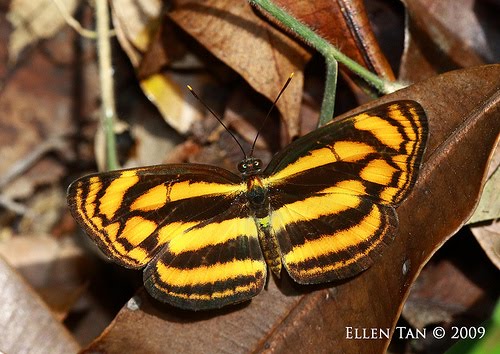
A Malayan Lascar perching at a leaf edge.

Physical Description of Adult Butterfly:
The adult has vein 10 rising from the cell on the forewing. Above, the wings are black with broad orange bands and patches arranged in the usual manner. There are two submarginal bands on the forewing, the outer one narrower, and the inner one broader with serrated inner edges. The inner submarginal band typically reaches the costa. A distinguishing feature is that the inner submarginal spot in space 3 on the forewing is usually wider than the adjacent spots in spaces 2 and 4. This is more so in the female than in the male. The male has a greyish speculum in the costal area. Underneath, the wings are marked similarly as on the upperside but with the orange bands/streaks broader and in a much paler shade of yellowish orange.


A Malayan Lascar sunbathing among forest litter.


A puddling Malayan Lascar.

Field Observations of Butterfly Behaviour:
This species is relatively common in Singapore and can be found in multiple habitats including nature reserves, western wastelands and the Southern Ridges. This is likely due the wide distribution of its host plant, Erycibe tomentosa, in these locations. The sun-loving adults are often observed gliding in a "sailing" fashion. The adults also visit flowers and ripening fruits for energy intakes.


A Malayan Lascar visiting flowers.


Another Malayan Lascar displaying its uppserside.

Early Stages:
The prefered host plant, Erycibe tomentosa, is a woody climber, and locally can be found on hedges, edges of forests and sides of forest trails, in areas such as the Central Catchment Area and Southern Ridges.


Host plant: Erycibe tomentosa.


Another host plant: Bauhinia semibifida.

The caterpillars of the Malayan Lascar feed on the young to middle-aged leaves of the host plant. They typically feed in the open on the leaf surface, and rest on the midrib between feeds. The lamina of each leaf is usually eaten from the tip, leaving the midrib uneaten. As with the Common Sailor and the Short Banded Sailor, the caterpillars of the Malayan Lascar have the habit of cutting and hanging leaf fragments for concealment as part of its feeding routine. In addition, the caterpillars show a preference for leaf fragments which are browning and decaying.


A sequence of three shots showing the cutting of leaf fragments by a 2nd instar caterpillar.


A sequence of 4 shots showing how the first leaf fragment is cut down further in a 5-day period. The caterpillar continues to eat the brown and decaying fragments.


A mating pair of the Malayan Lascar.


A female Malayan Lascar ovipositing an egg at the leaf tip of its host plant.

The eggs of the Malayan Lascar are laid singly at the tip of a leaf on the host plant. The ovipositing female shares the same ovipositing routine with quite a few Nymphalidae species: After landing on a leaf and finding it suitable, the female reverses along the leaf surface, typically along the midrib, until its abdomen tip reaches the leaf tip, and there it deposits an egg.


Two views of an egg laid at a leaf tip. Height: 1.2mm, base diameter: 1.1mm.

The eggs are somewhat globular in shape, with surface marked with hexagonal pits and bearing spines at pit corners, giving them the appearance of minute sea-urchins. The micropylar sits atop. Freshly laid eggs are green in colour, but turning pale green and then yellowish green when maturing. Each egg has a base diameter of about 1.1mm, and a height of about 1.2mm.


Two views of a mature egg.

The egg takes about 3-3.5 days to hatch. The young caterpillar emerges by eating away part of the egg shell. The rest of the egg shell becomes the first meal for the newly hatched which has an initial length of about 2.8mm. Its yellowish green body is cylindrical and covered with many small tubercles and short setae. The posterior segment is whitish, and the head capsule is pale brown in color.


Two views of a newly hatched caterpillar, length: 2.5mm.

As the caterpillar grows, the body turns increasingly darker green in base colour, and small tubercles turn yellowish green in coloration. Three pairs of subdorsal tubercles becomes larger and prominent on the 2nd and 3rd thoracic segments, and the 8th abdominal segment. After reaching about 4.5-5.5mm in 4-5 days, the caterpillar moults to the 2nd instar.


Two views of a 1st instar caterpillar, length: 4.5mm.

The body color of the 2nd instar caterpillar is yellowish green. Besides tiny tubercles covering most of its body surface, the 2nd instar caterpillar also features spairs of sub-dorsal branched spines, still rather short at this stage, on the 2nd and 3rd thoracic segment and the 8th abdominal segment. The pair on the 8th abdominal segment is much more tightly spaced on the dorsum compared to the other two.


Two views of a 2nd instar caterpillar, newly moulted, length: 4.5mm.

The head capsule is brown and dotted with a number of paler conical tubercles, and has a pair of short apical spines. The outline of a long dorsal saddle (of a lighter shade) ending at the dorsal start to appear at this stage too. A whitish dorsal band can be found on the thorax up to the subdorsal pair of spines on the 3rd segment, and from the pair on the 8th abdominal segment to the posterior end. This instar lasts about 6-8 days with the body length reaching about 7.5mm.


Two views of a 2nd instar caterpillar, lengths: 6.5mm (left), 7.2mm (right).

The 3rd instar caterpillar is olive brown with varying degree of green undertones. It has similar body markings as the 2nd instar but with the subdorsal spines much longer and featuring prominent branches, with the pair on the 3rd thoracic segment much longer than the other two pairs, and forward bending. The pair on the 2nd thoracic segment, on the other hand, is minuscule in comparison. The long dorsal saddle is now featured prominently. A series of faint oblique stripes appear on the sides of the saddle. This instar takes about 6-8 days to complete with body length reaching about 11mm.


Two views of a 3rd instar caterpillar, newly moulted, length: 6mm


Photobucket
A time-lapse sequence of the movement of a 3rd instar caterpillar along the midrib and through hanging leaf fragments.


Two views of a male 3nd instar caterpillar, later in this stage, length: 10.2mm


Two views of 3rd instar caterpillar, later in this stage, about to moult.

The 4th instar caterpillar resembles the 3rd instar caterpillar closely but with the subdorsal pair of spines on the 2nd thoracic segment much longer proportionately, and forward bending. On the head capsule, the two apical spines (horns) are longer proportionately. This instar lasts 7-8 days with body length reaching about 16.5mm.


Two views of a 4th instar caterpillar, early in this stage, length: 10mm.


Two views of a 4th instar caterpillar, length: 14.5mm.


Two views of a 4th instar caterpillar, length: 16.4mm.

The 5th instar caterpillar is mostly unchanged from the 4th instar in most body markings and features. Again the subdorsal pair of spines on the 2nd thoracic segment grows longer proportionately. Regularly spaced white spots on the dorsum and black spots on the sides also appear. The body colour varies from dark olive brown to greenish brown in a number of specimens.


Two views of a 5th instar caterpillar, early in this stage, length: 14mm.


Two views of 5th instar caterpillar, lenght: 19mm.


Two views of a 5th instar caterpillar, length: 21mm.

The 5th instar lasts for about 12 days, and the body length reaches up to 24mm. On the last day, the color of the dorsal saddle and the spines changes to pale/pinkish brown. The caterpillar ceases feeding and wanders around. Eventually it comes to a half on a leaf underside, where the caterpillar spins a silk mound on the midrib from which it soon hangs vertically to take on the pre-pupatory pose.


Two views of a pre-pupa of the Malayan Lascar.

Pupation takes place a day later. The pupa suspends itself via an angled cremastral attachment to the silk mound with no supporting silk girdle. It is almost entirely yellowish brown in color. The abdominal segments are slender. The thoracic portion being larger with wing cases dilated laterally. The dorsum of the thorax is angular. The head is bluntly cleft at its front edge with small pointed vertices. Length of pupae: 11-13mm.


Three views of a pupa of the Malayan Lascar.

After about 6 days of development, the pupal turns dark as the development within the pupal case comes to an end. The orange spots and streaks on the forewing upperside also become discernible. The following day, the adult butterfly emerges from the pupal case.


Three views of a mature pupa. Orange markings on the forewings are now visible.


The eclosion event of a Malayan Lascar (time-lapsed sequence).


A newly eclosed Malayan Lascar 'drying' its wings on its pupal case.


A newly eclosed Malayan Lascar giving us a full view of its upperside.

References:
  • The Butterflies of The Malay Peninsula, A.S. Corbet and H.M. Pendlebury, 4th Edition, The Malayan Nature Society.
  • Butterflies of Thailand, Pisuth Ek-Amnuay, 1st Edition, 2006
Text by Horace Tan, Photos by Wong Chee Ming, Henry Koh, Koh Cher Hern, Ellen Tan, Sunny Chir, Ben Jin Tan, Khew SK and Horace Tan

27 October 2010

Butterfly of the Month - October 2010

Butterfly of the Month - October 2010
Semanga superba deliciosa


The month of October heralds autumn in the northern hemisphere and spring in the southern hemisphere. The month was originally the eighth month of the ten-month Roman Calendar, but later became the tenth month of the Gregorian calendar which features 12 months in a year. However it retained its name as "Octo" means "eight".


October was an exciting month for butterflies in Singapore, where the most comprehensive Field Guide to the Butterflies of Singapore to date was launched on the 10th of the month.


However, it was also a month when the dreaded haze, caused by the burning of forests in neighbouring Indonesia, returned. The last two serious haze periods occurred in 1997 and 2003. This time around, the hot spots returned and the PSI index of the National Environment Agency crossed the 100-mark for the first time in several years, when the 3-hour PSI index at 5pm hit 102 on 21 Oct 2010.


The last time a prolonged haze hit Singapore in 1997, I recall that the butterfly population and activity dropped significantly. However, this time around, it appears that the rains helped and the weekend PSI dropped back to the healthy range. The butterflies didn't seem worse for wear this time around, and hopefully, the winds and rains will keep the haze under control.


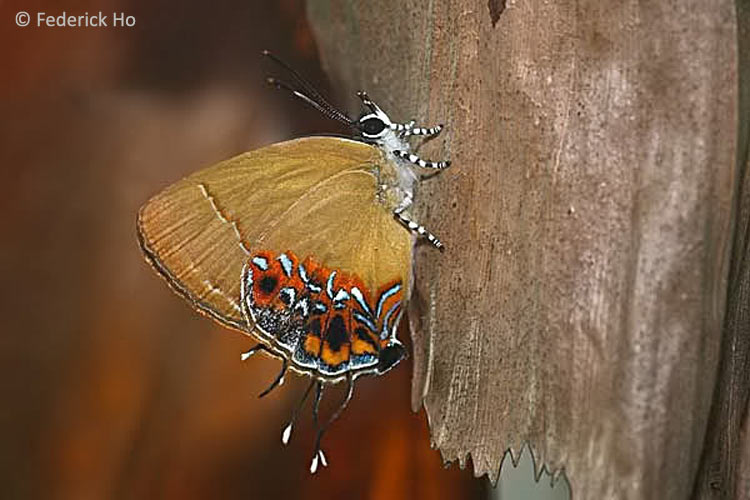
This month, we feature the very pretty Lycaenid, Semanga superba deliciosa. This dimunitive butterfly is fast-flying and skittish, but occasionally can be found feeding or perched to rest, sometimes with wings opened.


We have not christened a common English name for it yet, but its scientific name is something that is easily remembered and definitely not a tongue-twister like many others.


This diminutive Lycaenid has an interesting scientific name, almost declaring it a “superbly delicious” butterfly! This species is the only one of its genus found in Malaysia and Singapore. Semanga superba deliciosa is a fast flying butterfly and frequents open areas on the fringes of the nature reserves as well as urban parks and gardens. It has been known to feed on a number of host plants and are associated with ants during its early stages. Its early stages has been recorded here.


The male Semanga superba deliciosa is a lustrous purple above with a black border on the forewing and an orange-red distal border on the hindwing. The female is bluer than the male but with a wider forewing border. The buff brown underside has a narrow reddish brown post discal line, and the tornal area of the hindwing has an attractive array of red and black spots with metallic blue and green zigzagged lines.


A male Semanga superba deliciosa feeds off the ripened fruit of the Singapore Rhododendron

The male has long white-tipped filamentous tails at veins 2 and 3 of the hindwing, whilst the female has an extra tail at vein 4, giving it a total of six tails.


The butterfly occasionally stops to rest whilst sliding its hindwings up and down as if to accentuate the fact that the false head and antennae are active. This is to fool predators into attacking the 'wrong' side of the butterfly.


Though often observed singly, the species is just moderately rare, and from the number of members of ButterflyCircle that have been able to shoot it, it has been encountered with regularity in the various parks and gardens in Singapore.


Text by Khew SK : Photos by Sunny Chir, Chng CK, Federick Ho, Bobby Mun, Khew SK, Henry Koh, Koh CH, Loke PF, Nelson Ong, Horace Tan, Tan BJ & Mark Wong