23 August 2010

Fabulous Fraser's Hill

Fabulous Fraser's Hill
A Return Trip to Malaysia's popular Hill Resort


After a fruitful butterfly-shooting outing last year at Fraser's Hill, my wife and I decided to organise another trip up the famous Malaysian Hill resort. This time, we sought out my sister-in-law's assistance to book her company bungalow again. As booking was based on a balloting system, we hoped for the best, and were rewarded with an off-peak allocation of the Maybank Lodge from Tuesday to Friday.


Gathering the group from ButterflyCircle, the 9 of us drove up in three cars, this time with much less fuss, but still depending on our trusty GPS navigator part of the way. After a pit-stop at Pagoh for a coffee break, we zoomed all the way up the N-S Highway, and exited towards the bypass, heading north, avoiding the usually congested roads leading to Kuala Lumpur, the capital city of Malaysia. Lunch was at the small town of Rawang, and off we went towards Kuala Kubu Bahru, and the 45-odd kilometres of winding road up to the Gap and Fraser's Hill.


The majestic colonial Maybank Lodge that was home for 3 nights!

We made it to the MayBank Lodge at around 5:30pm, after waiting patiently at the one-way-up/one-way-down road to open for the upward time slot. After a quick briefing by the caretaker and settling in, we headed down to the town centre for dinner, and an evening of moth-shooting at the porch of the Lodge.


The next morning saw the group heading towards Jeriau Waterfalls, our first stop of the day. After laying our usual butt-attractants, we waited patiently for the butterflies to turn up. Unfortunately, the sun wasn't shining too strongly, and only a few customers visited.

A newly constructed 'swimming pool' at the Jeriau Waterfalls

We decided to move off just after mid-day and drove towards the Telecom Loop on the eastern side of Fraser's Hill. Our Australian ButterflyCircle member, David Fisher had stayed at a facility at this location earlier this year, and had encountered quite a few butterflies around the paths.


We stopped and saw quite a number of the Red Spot Jezebel (Delias descombesi eranthos) one of the signature Jezebels. However they were mostly uncooperative and stayed high up. A quick recce by Sunny Chir located a few Lantana bushes up the hill at the Government Resort and the group was in business shooting the hungry Jezebels.


As the sun was shining brightly by 2pm, we decided to make another trip back to the Jeriau Waterfalls, and this time, we had slightly more butterflies showing up, but still not as plentiful as the trip last year. However, we managed to get some of the rarer species like the Indian Yellow Nawab, the Four Bar Swordtail and the Orchid Tit.


Back at the Lodge, and after quick wash up, the weather was cooling down to below 20degC and we got the barbecue fire started. Getting the fire going proved to be a challenge, but with so many willing hands, we managed to get a decent barbecue up and running. There was lots of food and everyone, including Anthony, who seemed to have a bottomless pit for a stomach, was happy and contented (at least for the next half and hour).


After dinner was a busy time for night macro, when the local moths showed up in numbers. Someone remarked that the group appeared to be shooting more species of moths than butterflies, and that we may have to change our group's name to MothCircle very soon!


Members shooting moths at the porch of the Lodge

The next morning, the group was up early, and several members were out shooting the colourful and friendly bird life around the bungalow's grounds. The weather was mysteriously cool and we found out, to our dismay, that the rain clouds had covered most of the hill resort.

Members shooting a RedSpot Jezebel. The yellow arrow marks the spot where the butterfly landed

Most of the morning was spend pacing up and down although some members spend the time fruitfully by learning some new Photoshop tricks, courtesy of Sunny and Anthony.


By mid-day, the skies were still overcast, but it appeared less likely to rain, so the intrepid group headed out to the Telecom Loop again, and back to the Lantana bushes for better shots of the Jezebels. After about an hour or two up the hill, with some members leaning precariously over the barrier to get at the Jezebels, most of us had our fill of the Jezebel and any other species that happened to fly to the hilltop to feed at the Lantana flowers, we headed to the Olde Smokehouse to make a reservation and order our dinner. Then it was back to the Lodge for a quick rest.


This was our final night and we decided to spend it in style, having a scrumptious English meal at the Olde Smokehouse. The icing on the cake was the dessert of Bombe Alaska and other sinful sweet stuff. Then it was back to the Lodge again, for an evening full of moth-shooting.


Dinner at the Olde Smokehouse and a sample of the western cuisine that we had. Yummy!

After a quick breakfast and finishing up all the remaining food, we headed out to the checkpoint to wait for the 10am downward schedule.


A Group shot in front of the Maybank Lodge for keepsake before leaving Fraser's Hill

The winding trip down was uneventful, and no one contributed his breakfast on the road along the way.
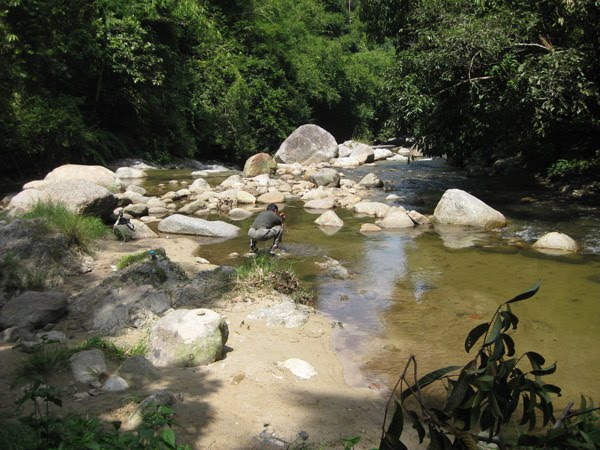


En route back to Kuala Kubu Bahru, we stopped at a river which was a designated picnic spot. For about an hour and a half, we were kept busy with the puddlers that came to visit. Amongst the rarer species shot were the Jewel Nawab, Great Orange Tip and Banded Peacock.


The Rajah Brooke's Birdwings that were puddling earlier were not cooperative, even though they persisted on flying around the group but never stopping for long.


After a quick snack of sandwiches prepared by Irene and Shirley, the group bade farewell to the butterflies (most reluctantly) and headed to Rawang for lunch. Sunny and Irene went on to KL for a further three days, and the other two cars headed back to Singapore. After an eventful but tiring drive, the seven of us arrived back via Tuas Checkpoint around 7pm, tired but with happy memories of the four days of shooting and fun up on the fabulous Fraser's Hill.

I'm sure that if we managed to get an apartment or the lodge again next year, we would be having ButterflyCircle members clamouring for a spot to go up there again!

Text by Khew SK : Photos by Sunny Chir, Chng CK, Federick Ho, Khew SK, Loke PF, Tan BJ & Anthony Wong

20 August 2010

Butterfly of the Month - August 2010

Butterfly of the Month - August 2010
The Blue Nawab (Polyura schreiber tisamenus)


The month of August is an important month for Singapore as its National Day falls on the 9th of August annually. This year is Singapore's 45th birthday, and it was a particularly happy occasion as Singapore came out strongly from the global recession with a double digit GDP growth for the quarter and the year looks bullish for a strong economic performance.


Other than a few days of the exceptionally rainy weather spilling over from July, the month was beginning to show some signs of the waning "Sumatras" as the intermonsoon winds begin to shift. The inaugural Youth Olympic Games - the first in the games' history, is being held in Singapore from 14 - 26 August as some 5,000 athletes aged between 14 and 18 years, will take part in 26 sporting events.


Our feature butterfly this month, is the majestic and awesome Charaxinae, the Blue Nawab (Polyura schreiber tisamenus). This proud and magnificent butterfly can be described as moderately rare, although it has been spotted with regularity in Singapore - more so than in neighbouring Malaysia.


The Blue Nawab is the less often encountered of the two Polyura species found in Singapore. It is a strong flyer like the Plain Nawab and prefers to remain at high levels. The Blue Nawab has been found in urban parks and gardens, forested areas and also within mangrove areas. The males of the species have been observed feeding on decomposing animal matter but are also attracted to overripe fruits.


The Blue Nawab has a silvery underside marked with brown and purple patterns. The upperside has a white median band ornamented with blue. It possesses two pairs of tails on the hindwings. The female of the species is usually larger often attaining a wingspan of 80mm, with broader and longer tails.


The species has a robust body, and like a typical Nymphalidae, has only four fully-developed legs for walking. The forelegs appear more brush-like and are not used for walking.


The butterfly is usually very skittish, and can fly powerfully for long periods of time. Unless one encounters a recently-eclosed individual or in a feeding mood, photographing the Blue Nawab is often a challenge.


Unlike the Plain Nawab, the Blue Nawab does not display territorial behaviour where it perches on a few favourite spots and returns to those spots time and again after chasing away intruders. Where observed, the Blue Nawabs are almost always in full flight, as if in a hurry to go somewhere.


The caterpillar of the Blue Nawab has been found and bred successfully on a variety of plants. Amongst these are Acacia auriculiformis, Adenanthera pavonina, Chorisia speciosa, Nephelium lappaceum, Bauhinia kockiana and another unidentified plant. Hence it is quite interesting that the caterpillars can feed on so many common plants, and yet the species is not as common as it should be.


Text by Khew SK : Photos by Khew SK, Simon Sng, Horace Tan and Tan Ben Jin

14 August 2010

Life History of the Sumatran Sunbeam

Life History of the Sumatran Sunbeam (Curetis saronis sumatrana)


Butterfly Biodata:
Genus: Curetis
Hübner, 1819
Species: saronis Moore, 1877
Subspecies: sumatrana Corbet, 1937
Wingspan of Adult Butterfly: 40mm
Caterpillar Local Host Plants:
Derris trifoliata (Leguminosae)


A Sumatran Sunbeam taking a typical perch on the underside of a leaf.


A sunbathing female Sumatran Sunbeam on a leaf perch.

Physical Description of Adult Butterfly:
Above, the wings are orange with black borders. The female is in paler orange than the male and has much broader black borders. On the hindiwng the orange portion in the female only occupies a small crescentic area. Underneath, the wings are silvery white. On the hindwing, the post-discal striae are lunulate and irregular, with those in spaces 4 and 5 shifted out distad. The post-discal striae are hardly shaded inwardly. Legs are banded in red.

Another Sumatran Sunbeam adult.

Another sunbathing female Sumatran Sunbeam.

Field Observations of Butterfly Behaviour:
This species is locally common in Singapore in coastal mangrove areas such as the Sungei Buloh Wetland Reserve, Kranji Nature Trail, Pasir Ris Park and Pulau Ubin. Adults can be sighted along walking trails in these areas where they are observed to engage in sunbathing, frolicking or dog-fighting activities. The adults also have the habit of perching on the underside of a leaf.

Early Stages:
The host plant, Derris trifoliata, is a scandent shrub with 3-5 leaflets in a pinna, pink flowers, thin and flat pods. This plant is commonly found in coastal areas and thus account for the rather localized distribution of the Sumatran Sunbeam in these areas. The caterpillars of the Sumatran Sunbeam feed on the young foliage of the host plant.


Host plants : Derris trifoliata
Eggs are laid singly on young shoots of the host plant. It is common for a number of eggs to be found on the same shoot. Each egg resembles a flattened sphere with coarse hexagonal reticulations. It is initially light greenish when newly laid but turns whitish as it matures. Each egg has a basal diameter of about 0.8mm.


Two views of an egg of the Sumatran Sunbeam.

It takes 2-3 days for the egg to hatch. The young caterpillar consumes the upper portion of the egg shell to emerge. With a length of 1.9mm, it has numerous fine setae on its body surface, with those occurring dorso-laterally and laterally particularly long. The caterpillar is initially yellowish green but turns dark yellowish as it develops in this instar. Numerous short lateral stripes, pale in coloration, also appear in the later stage of this instar. The first instar lasts about 2 days and with the body reaching about 3mm.


Two views of a newly hatched caterpillar, length: 1.9mm.


Two views of a 1st instar caterpillar, length: 2.6mm.

The 2nd instar caterpillar does not have the long dorso-lateral and lateral setae as in the first instar. Instead, the body is covered with many minute setae. The body colour is dark yellowish initially turn increasing greenish as it grows in this instar. On each body segment, there are several oblique pale stripes laterally. A prominent change occurs on the 8th abdominal segment where a pair of long cylindrical and erect processes, black to dark brown in colour, is now present. When the caterpillar is disturbed or stressed, tentacles with tuffs of white and black hairs at their apices, are everted from these procesess and whirled around at great speed. This instar lasts for about 2 days and reaches a length of about 4.5-5.0mm.


Two views of a 2nd instar caterpillar, early in this stage, length: 3.2mm..


Two views of a 2nd instar caterpillar, later in this stage, length: 5.5mm

The 3rd instar caterpillar looks similar to the 2nd instar caterpillar but has a pair of white, quadrate lateral patches on the 6th abdominal segment.
White lateral stripes, varying in lengths but lesser in prominence than that on the 6th abdominal segment, appear later and becoming more prominent on the body segments. The caterpillar reaches up to 9.5mm in this instar which lasts about 2.5-3.0 days.


Two views of a 3rd instar caterpillar, early in this stage, length: 6.3mm.


Two views of a 3rd instar caterpillar, late in this stage, length:9.5mm


The eversion of the tentacles of a Sumatran Sunbeam caterpillar. The same 1-second eversion and withdrawal event is played back three times, with first and last time being at actual speed, and the second time in slow motion (20 times slower).

The 4th (and final) instar caterpillar resembles the 3rd instar caterpillar but with a more prominent contrast of white stripes/patches against the base colour of yellowish green to velvety green. The dorsum of the body segments of the 2nd and 3rd thoracic segments are pale green to whitish in coloration. The lateral oblique white stripes on the 1st two abdominal segments are joined while those on other segments are well separated.


Two views of a 4th instar caterpillar, early in this stage, length: 10mm.


Two views of a 4th instar caterpillar, later in this stage, length: 16mm


Two views of another 4th instar caterpillar, length: 16mm.

The 4th (and final) instar lasts about 3 days and the body reaches a length of about 16-17mm. In the last day of this stage, the caterpillar ceases feeding, and its body shrinks in length. The entire body colour changes to a dark shade of jade green. Eventually it comes to rest on a spot on the surface of leaf. Here the caterpillar prepares for pupation by spinning a silk pad and a silk girdle to secure itself. It then becomes immobile in this pre-pupatory state for about 1 day.


Two views of a pre-pupa of the Sumatran Sunbeam

The next day the pupation takes place. The pupa is held via its cremaster and a weak silk girdle to the silk pad on the substrate. It is almost hemispherical and has a flat under surface, almost completely jade green in ground colour and carries a whitish marking on the dorsum of the thorax. Length: 9-10mm.


Two views of a pupa of the Sumatran Sunbeam

Six days later, the pupa becomes darkened in color signaling the imminent emergence of the adult. The orange patch on the forewing upperside can now be seen through the pupal skin in the wing case. The next day the adult butterfly emerges from the mature pupa.


Two views of a mature pupa of the Sumatran Sunbeam.


A newly eclosed Sumatran Sunbeam resting on its empty pupal case.


A newly eclosed specimen of the Sumatran Sunbeam.

References:
  • The Butterflies of The Malay Peninsula, A.S. Corbet and H.M. Pendlebury, 4th Edition, Malayan Nature Society.
  • Butterflies of Thailand, Pisuth Ek-Amnuay, 1st Edition, 2006
Text by Horace Tan, Photos by James Chia, Sunny Chir and Horace Tan