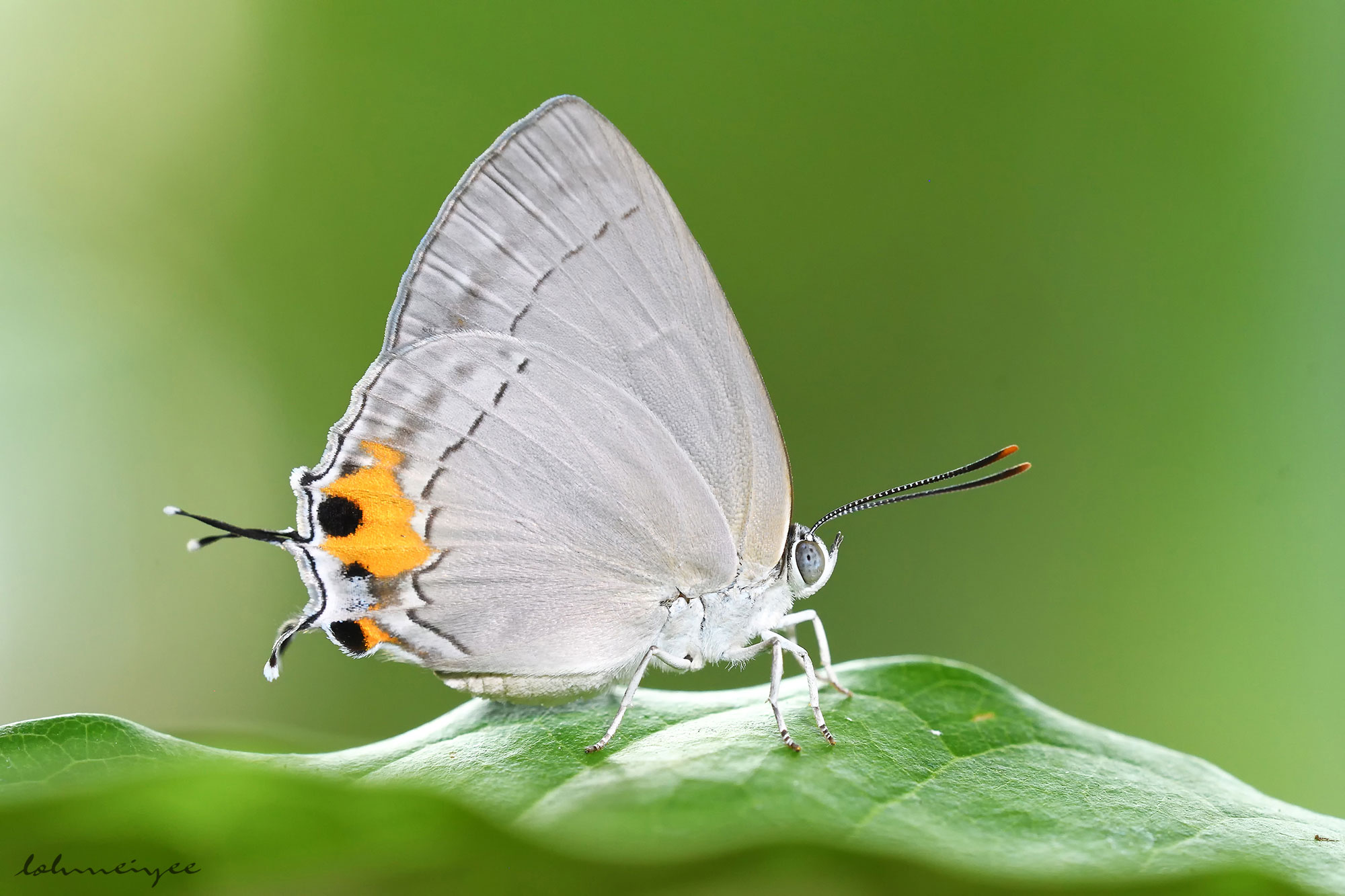
Butterfly Biodata:
Genus: Horaga Moore, 1881
Species: albimacula Wood-Mason & de Nicéville, 1881
Subspecies: albistigmata Moulton, 1912
Wingspan of Adult Butterfly: 10.5-11.5 mm
Caterpillar Local Host Plant: Adenanthera pavonina (Fabaceae, common name: Saga).


Physical Description of Adult Butterfly:
On the upperside, both sexes are brown with the white spot on the forewing not extending below vein 2. Both sexess have blue scales in the basal area. On the underside, both sexes are yellowish-brown with a dark post-discal line present on both fore- and hindwings, outwardly edged whitish. In the forewing, the edging forms a broad white band which does not go above vein 6. Both sexes have three filamentous tails on the hindwing, at veins 1b, 2 and 3, with the one at vein 2 longest among the three. The hindwing also has two black tornal spots and metallic green scaling in the tornal area.


Field Observations:
The Brown Onyx is rare in Singapore. A handful of recent sightings of the early stages have so far been restricted to the Southern Ridges.


Early Stages:
Only one larval host plant, Adenanthera pavonina (Saga), has been identified in Singapore. Just like the Common Onyx, caterpillars of the Brown Onyx feed on young leaves of Saga. In all four instars, the caterpillars of the Brown Onyx closely resembles those of the Common Onyx, and it is impossible to tell them apart in the field.
 Local host plant: Adenanthera pavonina (Saga)
Eggs are laids singly on the young shoot of the host plant. Each egg resembles a bun with coarse hexagonal reticulations. It is initially pale greenish when newly laid but turns whitish as it matures. Each egg has a basal diameter of about 0.8mm.
 Two views of an egg of the Brown Onyx.
The egg takes about 3 days to hatch. The caterpillar nibbles away the top part of the egg shell to emerge. The newly hatched is about 1mm long, with a pale yellowish brown head and a pale yellowish brown body covered with long setae dorsally and laterally. The basal part of the dorsal setae on the metathorax and the abdomen is marked in reddish brown. As growth progresses, dorsal tubercles on the metathorax (a pair) and abdominal segments (one each) become prominently marked in dark reddish brown. The first instar sees the body length reaches up to 2.5mm, and lasts about 2.5-3 days before the moult to the next instar.
 Two views of an early 1st instar caterpillar of the Brown Onyx, length: 1.3mm.
 Two views of a first instar caterpillar of the Brown Onyx, late in this instar, length: 2.5mm.
The second instar caterpiller is pale yellowish green in base colour. It features numerous short setae on the body surface and has a number of prominent and pointed tubercles projecting from the body surface. On the mesothorax, there are 2 short dorso-lateral tubercles. On the metathorax, there are two long dark red tipped dorso-lateral tubercles. On each of the 1st-6th abdominal segments, there is one long dark reddish dorsal tubercle, with those on the 2nd and 6th segments longer than those on the other two segments, and the one on the 3rd segment being the shortest. On the 2nd abdominal segment, there is a short sub-spiracular tubercle on both sides of the body. There is also a pair of such sub-spiracular tubercles on the 7th abdominal segment, but longer than those on the 2nd abdominal segment. The 2nd instar lasts about 2.5-3 days with the body length reaches up to 4.7-4.9mm.
 Two views of a second instar caterpillar of the Brown Onyx, early in this stage, length: 2.5mm.
 Two views of a second instar caterpillar of the Brown Onyx, length: 4.1mm.
 Two views of a second instar caterpillar of the Brown Onyx, dormant prior to its moult, length: 4.6mm.
The third instar caterpiller has the same configuration of dorsal, dorso-lateral and sub-spiracular tubles as in the 2nd instar, but they are now proportionately longer and prominent. Whitish patches adorn the basal part of the dorsal tubercles. A whitish band also run sub-spiracularly along the side of the body. The third instar lasts about 3 days and the body length reaches up to about 8.1-8.3mm before the moult to the 4th (and last) instar.
 Two views of a third instar caterpillar of the Brown Onyx, early in this instar, length: 4.9mm.
 Two views of a third instar caterpillar of the Brown Onyx, length: 7mm.
 Two views of a third instar caterpillar of the Brown Onyx, dormant prior to its moult, length: 8mm.
The 4th instar caterpillar has proportinately longer dorsal, dorso-lateral and sub-spiracular tubecles then those seen in the 3rd instar. Laterally, the lateral part of the 1st, 3rd, 4th and 5th abdominal segments are suffused with reddish brown to varying extent.
 Two views of a 4th instar caterpillar of the Brown Onyx, early in this instar, length: 8.3mm.
 Two views of a 4th instar caterpillar of the Brown Onyx, length: 12.5mm.
 Two views of a 4th instar caterpillar of the Brown Onyx, late in this stage, length: 14mm.
The 4th instar lasts about 3.5-4 days with the body length reaches up to 14.0-14.2mm. On the last day, the body gradually shortens. The caterpillar stops feeding, wanders around and eventually comes to rest on a spot on the stem where it begins the silk spinning effort to turn it into its pupation site. Once the silk pad is done, the caterpillar secures itself to it and turns into an immobile pre-pupa.
 Two views of a pre-pupa of the Brown Onyx.
The pre-pupal stage of the caterpillar lasts about one day. The ensuing pupation event turns it into a yellowh green pupa with the typical shape of a lycaenid pupa. The small pupa is about 8mm in length. The pupa attaches itself to the stem via its broad cremaster end. The pupal surface is mostly smooth, with only a few short protrusions appearing on the dorsum in several abdominal segments. There is a pair of small reddish dorso-lateral patches on the 1st abdominal segment, and U-shaped whitish markings overlayed with reddish brown patches on the 3rd to 5th abdominal segments. Small irregularly shaped whitish patches also occur on the pupal surface and in appreciable concentration on the fronter part of the wing pads.
 Two views of a pupa of the Brown Onyx, length: 8mm.
After six days, the pupa gradually turn dark towards the end of the day, with the wing pads prominently black with a small whitish and irregularly-shaped patch embedded. Next morning, the adult butterfly emerges from the mature pupa. It rests on the pupal case or nearby stem surface to have its wings gradually expanded. A few hours later, the adult Brown Onyx takes its first flight.
 Two views of a mature pupa of the Brown Onyx.
Video: A Brown Onyx emerges from its pupal case.
 A newly eclosed Brown Onyx resting near its pupal case.
References:
On the upperside, both sexes are brown with the white spot on the forewing not extending below vein 2. Both sexess have blue scales in the basal area. On the underside, both sexes are yellowish-brown with a dark post-discal line present on both fore- and hindwings, outwardly edged whitish. In the forewing, the edging forms a broad white band which does not go above vein 6. Both sexes have three filamentous tails on the hindwing, at veins 1b, 2 and 3, with the one at vein 2 longest among the three. The hindwing also has two black tornal spots and metallic green scaling in the tornal area.


Field Observations:
The Brown Onyx is rare in Singapore. A handful of recent sightings of the early stages have so far been restricted to the Southern Ridges.


Early Stages:
Only one larval host plant, Adenanthera pavonina (Saga), has been identified in Singapore. Just like the Common Onyx, caterpillars of the Brown Onyx feed on young leaves of Saga. In all four instars, the caterpillars of the Brown Onyx closely resembles those of the Common Onyx, and it is impossible to tell them apart in the field.

Eggs are laids singly on the young shoot of the host plant. Each egg resembles a bun with coarse hexagonal reticulations. It is initially pale greenish when newly laid but turns whitish as it matures. Each egg has a basal diameter of about 0.8mm.

The egg takes about 3 days to hatch. The caterpillar nibbles away the top part of the egg shell to emerge. The newly hatched is about 1mm long, with a pale yellowish brown head and a pale yellowish brown body covered with long setae dorsally and laterally. The basal part of the dorsal setae on the metathorax and the abdomen is marked in reddish brown. As growth progresses, dorsal tubercles on the metathorax (a pair) and abdominal segments (one each) become prominently marked in dark reddish brown. The first instar sees the body length reaches up to 2.5mm, and lasts about 2.5-3 days before the moult to the next instar.


The second instar caterpiller is pale yellowish green in base colour. It features numerous short setae on the body surface and has a number of prominent and pointed tubercles projecting from the body surface. On the mesothorax, there are 2 short dorso-lateral tubercles. On the metathorax, there are two long dark red tipped dorso-lateral tubercles. On each of the 1st-6th abdominal segments, there is one long dark reddish dorsal tubercle, with those on the 2nd and 6th segments longer than those on the other two segments, and the one on the 3rd segment being the shortest. On the 2nd abdominal segment, there is a short sub-spiracular tubercle on both sides of the body. There is also a pair of such sub-spiracular tubercles on the 7th abdominal segment, but longer than those on the 2nd abdominal segment. The 2nd instar lasts about 2.5-3 days with the body length reaches up to 4.7-4.9mm.


The third instar caterpiller has the same configuration of dorsal, dorso-lateral and sub-spiracular tubles as in the 2nd instar, but they are now proportionately longer and prominent. Whitish patches adorn the basal part of the dorsal tubercles. A whitish band also run sub-spiracularly along the side of the body. The third instar lasts about 3 days and the body length reaches up to about 8.1-8.3mm before the moult to the 4th (and last) instar.


The 4th instar caterpillar has proportinately longer dorsal, dorso-lateral and sub-spiracular tubecles then those seen in the 3rd instar. Laterally, the lateral part of the 1st, 3rd, 4th and 5th abdominal segments are suffused with reddish brown to varying extent.


The 4th instar lasts about 3.5-4 days with the body length reaches up to 14.0-14.2mm. On the last day, the body gradually shortens. The caterpillar stops feeding, wanders around and eventually comes to rest on a spot on the stem where it begins the silk spinning effort to turn it into its pupation site. Once the silk pad is done, the caterpillar secures itself to it and turns into an immobile pre-pupa.

The pre-pupal stage of the caterpillar lasts about one day. The ensuing pupation event turns it into a yellowh green pupa with the typical shape of a lycaenid pupa. The small pupa is about 8mm in length. The pupa attaches itself to the stem via its broad cremaster end. The pupal surface is mostly smooth, with only a few short protrusions appearing on the dorsum in several abdominal segments. There is a pair of small reddish dorso-lateral patches on the 1st abdominal segment, and U-shaped whitish markings overlayed with reddish brown patches on the 3rd to 5th abdominal segments. Small irregularly shaped whitish patches also occur on the pupal surface and in appreciable concentration on the fronter part of the wing pads.

After six days, the pupa gradually turn dark towards the end of the day, with the wing pads prominently black with a small whitish and irregularly-shaped patch embedded. Next morning, the adult butterfly emerges from the mature pupa. It rests on the pupal case or nearby stem surface to have its wings gradually expanded. A few hours later, the adult Brown Onyx takes its first flight.

Video: A Brown Onyx emerges from its pupal case.

- [C&P5] The Butterflies of The Malay Peninsula, A.S. Corbet and H.M. Pendlebury, G. and N. van der Poorten (Eds.), 5th Edition, Malayan Nature Society, 2020.