26 March 2016

Larval Host Plant for Butterflies: Yellow Saraca

Butterflies' Larval Host Plants #8
The Yellow Saraca (Saraca thaipingensis)


This 8th instalment of our Butterflies' Larval Host Plants series features Saraca thaipingensis (Yellow Saraca), a species of the family Fabaceae (Bean Family) which has members taking on a variety of growth forms (tree, shrub, herb, vine, liana). The Yellow Saraca is a perennial member of this family which assumes the tree form. The species name "thaipingensis" has the meaning "of or from Taiping, Malaysia".


Yellow Saraca is native to the Southeast Asia region, but it is also widely cultivated in a number of tropical and sub-tropical countries for its attractive yellow inflorescence and drooping pink/purple young leaves. In Singapore, the Yellow Saraca can be found in many parks and gardens as ornamental trees. Besides its obvious ornamental purpose, Yellow Saraca has potential medicinal uses as extracts of its flowers, leaves and twigs have been found to have antimicrobial and antioxidant properties in recent studies.


Plant Biodata :
Family : Fabaceae
Genus : Saraca
Species : thaipingensis
Synonyms : S. cauliflora, S. declinata, Jonesia declinata.
Country/Region of Origin :  Southeast Asia
English Common Name : Yellow Saraca, Yellow Asoka,
Other Local Names :  Gapis Golak, Talan, Bunga Asoka, Gapis, Gapis Batan, Gapis Batang, 黄花无忧树
Larval Host for Butterfly Species: Hypolycaena erylus teatus (Common Tit), Jamides caeruleus caeruleus (Sky Blue), Jamides alecto ageladas (Metallic Caerulean), Jamides elpis pseudelpis (Glistening Caerulean), Semanga superba deliciosa, Drupadia ravindra moorei (Common Posy), Rapala pheretima sequeira (Copper Flash), Anthene emolus goberus (Ciliate Blue).

A Yellow Saraca tree next to the Symphony Lake in the Singapore Botanic Gardens.

Yellow Saraca is a medium-sized, evergreen tree which can grow up to about 8m in height. The fully grown tree has a wide spreading crown.

A flowering Yellow Saraca tree in the Mount Faber Park.

Another Yellow Saraca tree in the Singapore Botanic Gardens.

Leaves of the Yellow Saraca are simple pinnate (with no terminal leaflet) with 4 to 8 pairs of opposite leaflets, each of which is lanceolate in shape and can grow up to 8-25cm long. Young leaves occurs in drooping form and are initially dark reddish brown. As it grows larger, the tender leaflets turns pink or purple colour, before finally turning green and stiffen.

Young leaves of the Yellow Saraca in its early stage of development.

Drooping young leaves of the Yellow Saraca in cream/pink coloration.

A wide-field view of both young and mature leaves of the Yellow Saraca.

A Yellow Saraca tree in Singapore Botanic Gardens with attractive pink/purple young leaves.

Mature leaves of the Yellow Saraca.

Flowers of the Yellow Saraca occur in dense clusters each of which is up to 40cm broad and arises from trunk, stems or branches. Each flower is small, about 2cm in diameter, initially pale yellow, turning deep yellow with a crimson eye-spot. Most flowers are functionally male with the rest bisexual. Flowers of the Yellow Saraca are mildly fragrant. It is interesting to note that each flower bears no petals but 4 sepals.

Clusters of flower buds of the Yellow Saraca arising from a branch.

Closer view of a cluster of flower buds of the Yellow Saraca.

Closer view of a cluster of flowers of the Yellow Saraca.

Left: A functionally male flower; Right: A bisexual flower of the Yellow Saraca.

Each fruit is a thin and flat pod. When fully developed, it is purple and large, 20-45cm long and 4-8cm broad. When ripened, the fruit turns dark brown and splits into two halves, exposing the flat, black seeds.

Young pods of the Yellow Saraca in very early stage of development.

Fully developed pods of the Yellow Saraca.

Ripened pods of the Yellow Saraca.

When a Yellow Saraca tree is in bloom, it could attract many nectar-seeking visitors such as various species of butterflies, other insects and birds.


Butterflies visiting flowers of the Yellow Saraca.


Various insects found on flowers of the Yellow Saraca.

A nectar-seeking bird found among flower clusters of the Yellow Saraca.


In Singapore, the Yellow Saraca also serves as the larval host plant for eight butterfly species: Common Tit, Sky Blue, Metallic Caerulean, Glistening Caerulean, Semanga superba deliciosa, Common Posy, Copper Flash and Ciliate Blue. All are lycaenid.


Clockwise from upper left: Ciliate Blue, Common Tit, Semanga superba deliciosa, Common Posy.


Clockwise from upper left: Sky Blue, Glistening Caerulean, Copper Flash, Metallic Caerulean.

Eggs of these butterfly species are laid on flower parts or on the surface of young leaves or stem. In the case of the Ciliate Blue, the eggs are laid in a tight cluster while those of the other seven are laid singly.

A female Glistening Caerulean laying an egg in the flower cluster of the Yellow Saraca.

An egg of the Sky Blue laid on a flower sepal of the Yellow Saraca.

Caterpillars of the three Jamides species and Copper Flash feed on the flower parts of the Yellow Saraca, whilst those of the Common Tit, Common Posy, Semanga superba deliciosa and Ciliate Blue feed on young leaves of the Yellow Saraca. They possess the usual nectary organs which attract attending ants.

A caterpillar of the Glistening Caerulean on the flower part of the Yellow Saraca.

A caterpillar of the Sky Blue on the flower part of the Yellow Saraca.

A caterpillar of the Metallic Caerulean on the flower part of the Yellow Saraca.

A caterpillar of the Ciliate Blue being attended by a group of weaver ants.

A caterpillar of the Common Posy resting on a leaf of the Yellow Saraca.

A caterpillar of Semanga superba deliciosa on a leaf of the Yellow Saraca.

A caterpillar of the Copper Flash nibbling away on a flower of the Yellow Saraca.

Caterpillars of these lycaenid species pupate either on a leaf surface or in a leaf litter. In the case of the Common Posy, the pupation site is typically a spot on a stem or branch.

Two views of a pupa of the Ciliate Blue on a young leaf of the Yellow Saraca.

Two views of a pupa of the Metallic Caerulean on a leaf surface.

Two views of a pupa of the Common Posy on a stem.

With so much insect and bird activities observable in a blooming Yellow Saraca tree, it is always worthwhile to check out such a tree that you happen to chance upon in one of our many parks and gardens.

References:
Text and Photos by Horace Tan.

19 March 2016

Butterfly of the Month - March 2016

Butterfly of the Month - March 2016
The Ambon Onyx (Horaga syrinx maenala)


Even as the wet months of the year gave way to a much warmer weather, the prospects of facing the Indonesian-generated haze begins to threaten the fresh air that we take for granted. Already, there are sporadic reports of fires burning out of control in Indonesia and we brace ourselves again for the dreaded haze in the not-too-near future. The hotter weather in the month of March is expected to hit 34deg C according to the National Environment Agency's fortnight forecast, and this is certainly not going to be helpful as far as the haze is concerned.


It has also been disheartening to continue to hear butterfly watchers from Thailand, Malaysia and Singapore lamenting that the butterfly count in their respective favourite butterfly hunting locations is very low. Is it due to the ever-changing weather patterns over the past year, climate change, or is this something that will be a permanent feature in the coming year? Even if this is the case, where have all the butterflies gone? This is something that we should continue to monitor and share our observations over the various social media platforms.


Global news has been rather unexciting, other than repeated reports of a slowdown across most economies around the world. As a pall of gloom descends on Singapore, with constant reminders of an imminent recession, many firms are reported to be cutting headcount, withholding increments and taking steps to restructure and right-sizing their organisations to mitigate the effects of a downturn.


On a personal front, I finally found the time to carry out my cataract surgery. I had been putting it off for some time already, but my deteriorating eyesight was preventing me from enjoying my hobby of watching and photographing my beloved butterflies. So, off I went "under the knife" and had my artificial intra-ocular implants put in to replace my natural v1.0 lenses. Modern cataract surgery, usually referred to as phaco-emulsification, is a simple day surgery procedure. After a month of healing, I'm quite ready to head out again to look for our winged jewels in Singapore!


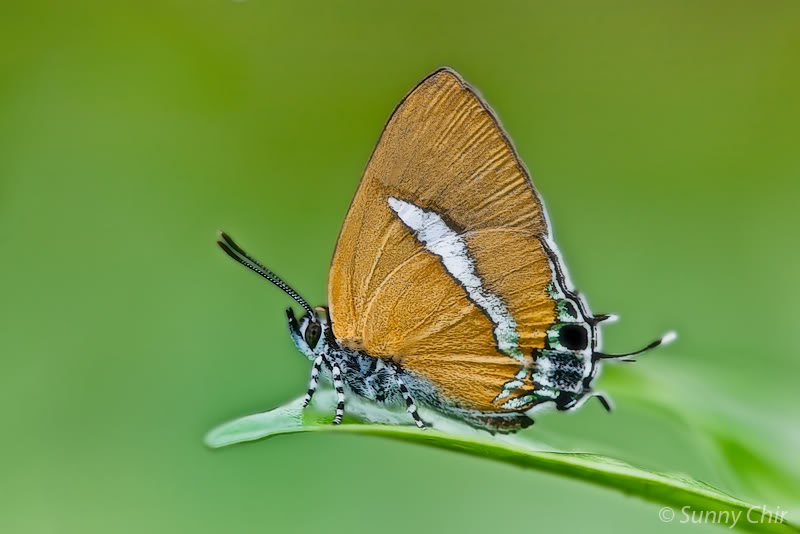
Our feature butterfly for March 2016 is the Ambon Onyx (Horaga syrinx maenala). Currently the only representative of the genus in Singapore, it is highly likely that another species, of which there have been evidence of, also exists here. It is a matter of time before an actual voucher specimen is collected to validate the other species.


The Ambon Onyx is fairly common in Singapore, and is observed with regularity at urban hill parks and gardens. It is sometimes found in the forested nature reserves as well. The butterfly is small, with a forewing length of 13-16mm (wingspan of about 22-26mm). It is skittish and often flies at treetop level on hot sunny days. At certain hours of the day, it can be spotted perched with its wings opened to sunbathe.


The butterfly has a rapid flight and often observed engaged in "dogfights" with other individuals of the same species. It returns repeatedly to a few favourite perches to settle with its wings folded upright, waiting for the next opportunity to "attack" another individual flying past.


The Ambon Onyx is bright blue on its upperside, with a broad black border on the forewing. It features a small white discal spot on the forewing, often crossed by dark dusted veins. Females are larger in size, with a correspondingly bigger white discal spot on the forewing. Both sexes have three pairs of filamentous white-tipped tails originating from veins 1b, 2 and 3 on the hindwing.


The underside is a buff brown with a irregular white macular band stretching across both wings. The tornal area of the hindwing features three large black eyespots edged with light blue iridescent scales. The legs are black and white banded and all three pairs of legs are fully developed.


The caterpillars of the Ambon Onyx have been found to feed on the flowers and buds of Ixora javanica and the young shoots of Citrus microcarpa. It is believed that there are more alternative host plants for this species as well.

Text by Khew SK : Photos by Sunny Chir, Chng CK, Khew SK, Koh CH, Loke PF, Nelson Ong and Anthony Wong.

13 March 2016

Life History of the Malayan Swift

Life History of the Malayan Swift (Caltoris malaya)


Butterfly Biodata:
Genus: Caltoris Swinhoe, 1893
Species: malaya Evans, 1928
Wingspan of Adult Butterfly: 38-42mm
Caterpillar Local Host Plant: Bambusa heterostachya (Poaceae; common name: Malay Dwarf Bamboo).


A male Malayan Swift.

A female Malayan Swift.

Physical Description of Adult Butterfly:
On the upperside, the wings are dark brown with hyaline spots in spaces 2,3 and 4, subapical spots in spaces 6 and 7 and no cell spots in the forewing. Compared to the other Caltoris sp., the male is almost always missing a spot in space 1b. On the underside, the wings are dark ferruginous in the male, and ochreous in the female.

A female Malayan Swift.

A male Malayan Swift.

Field Observations of Butterfly Behaviour:
The Malayan Swift is moderately rare in Singapore. Sightings of adults typically occur in forested nature reserves and wastelands where its host plant is growing. Being similar looking to other Caltoris spp. in the underside, it is usually difficult to confirm its id in the field unless a glimpse of its upperside is possible.

A male Malayan Swift with a partial view of its upperside, showing the absence of cell spots in the forewing.