
Butterfly Biodata:
Genus: Ypthima Hübner, 1818
Species: pandocus Moore, 1858
Subspecies: corticaria Butler, 1879
Wingspan of Adult Butterfly: 40-45mm
Caterpillar Local Host Plant: Ischaemum muticum (Poaceae).


Physical Description of Adult Butterfly:
On the upperside, the wings are greyish brown with a moderately large, bi-pupilled, yellow-ringed, subapical ocellus on the forewing, and two yellow-ringed ocelli in spaces 1b and 2 on the hindwing. The male has a greyish black sex brand in the distal area of the forewing. On the underside, both wings are pale greyish to bluff brown and are traversed by numerous fine dark brown striae. The forewing has a large, bi-pupilled, yellow-ringed, subapical ocellus. The hindwing has three yellow-ringed ocelli in spaces 1b, 2 and 6 with the one in space 1b bi-pupilled.
 A female Common Three Ring sun-bathing between oviposition runs in a grass patch.

Field Observations of Butterfly Behaviour:
The Common Three Ring is moderately common in Singapore, and is mostly sighted in the nature reserve. Adults are typically observed flying low among vegetation in and around grassy patches on open areas within the nature reserve. As with other Satyrinae members, the adults have a feeble flight. They typically fly in an erratic and jerky manner as their wings are closed for a relatively long period during flights. In sunny conditions, the adults have the tendency to sun-bath with fully open wings.


Early Stages:
Only one local host plant, a moderately common grass species, Ischaemum muticum, has been recorded so far. The caterpillars feed on leaves of the host plant, and have been observed to forcefully ejecting their frass pellets, a larval habit rarely seen outside the skipper/flat families.
 Host plant:Ischaemum muticum.
 A mating pair of Common Three Ring.
The eggs are laid singly on the leaf blade or the stem of its host plant, or on other plants or objects in close proximity to the host plant. Each egg is globular in shape (about 0.95mm in height, and 0.9mm in diameter) and lime green in colour. The surface is reticulated with numerous, small polygonal faces.
 A mother Common Three Ring laying an egg on its host plant.
 An egg of the Common Three Ring laid on a web in a grass patch.
 Two views of an egg of the Common Three Ring.
 Two views of a mature egg with the head faintly visible through the egg shell.
The egg takes about 3 days to mature. The young caterpillar nibbles away a portion of the egg shell to exit and proceeds to devour the rest of the egg shell. It has a pale yellowish body tinged in pink in the lateral and posterior portion of its body. The body has an initial length of about 2.5mm, and is covered with dorso-lateral and lateral rows of long setae. At the posterior end, there is a pair of backward-pointing processes. Its yellowish brown head features a number of setae and has a pair of short and rounded horns, and a few lateral protuberances which are smaller.
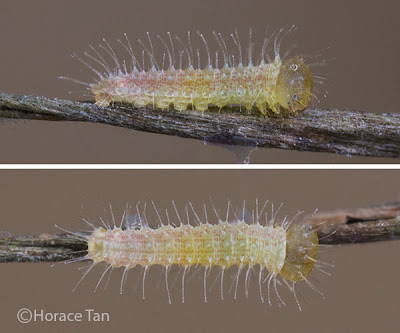 Two views of a newly hatched caterpillar, length: 2.5.mm
As a result of its leaf diet, the 1st instar caterpillar soon takes on a strong greenish undertone. The first instar lasts about 4-5 days with the body length increases to about 5-5.5mm.
 Two views of a 1st instar caterpillar, length: 4mm.
 Two views of a late 1st instar caterpillar, dormant prior to its moult, length: 5mm.
In the 2nd instar, the head turns pale greenish in colour and the cephalic horns become more pointed, though still small in size. The body color is pale yellowish green. There are numerous, tightly spaced, tiny, whitish protuberances on the body and the head, each of which has a setae emanating from it. The two anal protuberances are now proportionately longer and more pointed. The 2nd instar lasts about 5 days with the body length reaches about 7.5-8mm.
 Two views of a 2nd instar caterpillar, early in this stage, 5.2mm.
 Two views of a 2nd instar caterpillar, length: 7.5mm.
 Two views of a late 2nd instar caterpillar, dormant prior to its moult, length: 7.5mm.
The 3rd instar caterpillar mostly resembles the previous instar. Many whitish and narrow bands, running lengthwise across the body segments, are now prominently featured. The two anal protuberances are mostly pink in color. This stage also takes 5 days to complete with body length reaching about 13-14mm.
 Two views of a newly moulted 3nd instar caterpillar, length: 8.5mm.
 Two views of a 3nd instar caterpillar, length: 11.5mm.
 Two views of a late 3nd instar caterpillar, dormant prior to its moult, length: 12.8mm.
The 4th instar caterpillar bears a strong resemblance to the 3rd instar caterpillar with no obvious change of any features or markings. The 4th instar lasts about 6-7 days with body length reaching 20-21mm.
 Two views of a newly moulted 4th instar caterpillar, length: 13mm.
 Two views of a 4th instar caterpillar, length: 20.5mm.
 Two views of a late 4th instar caterpillar, dormant prior to its moult, length: 19.5mm.
Common Three Ring caterpillars in the act of catapulting frass pellets.
The next moult brings the caterpillar to its 5th and final instar. Now the caterpillar could appear in two colour forms: a brown form which is mostly pale to dark beige brown and a green form which is yellowish green. In a period of 8 days, the body grows to a maximum length of about 30-31mm.
 Two views of a newly moulted 5th instar caterpillar, length: 19mm.
 Two views of a 5th instar caterpillar, length: 25mm.
 Two views of a 5th instar caterpillar, green form, length: 30mm.
 A 5th instar caterpillar, brown form, length: about 30mm.
Toward the end of the 5th instar, the body gradually shrinks in length. Finally the caterpillar finds a spot on the underside of a leaf blade to spin a silk pad. It then secures itself there via its anal end, and assumes its upside-down pre-pupatory pose.
 A prep-pupa of a green form Common Three Ring caterpillar. Left: early in this stage; Right: late in this stage.
After 1.5-2 days in the pre-pupal stage, pupation takes place. The pupa could appear in either a brown form or a green form. It is interesting to note that the colour form in the pupal stage need not correspond to the form in the larval stage. It has been observed that a green form caterpillar could moult to either a green or brown form pupa. The lone brown form caterpillar bred moulted to a green form pupa. The pupa is somewhat angular and longish, with a dorsal keel on the thorax and ridges defining the dorsal wing margins. Length of pupae: 12-13mm.
A Common Three Ring caterpillar moults to its pupal stage. Pupa is brown form.
A Common Three Ring caterpillar moults to its pupal stage. Pupa is green form.
 Two views of a pupa of Common Three Ring, brown form.
 Two views of a pupa of Common Three Ring, green form.
After 8 days of development, the pupa becomes darkened in color, and the subapical ringed-spot on the forewings can now be seen through the pupal skin in the wing pads. The next day the eclosion event takes place with the adult butterfly emerges to start the next phase of its life cycle.
 Three views of a mature pupa of Common Three Ring.
A Common Three Ring caterpillar emerges from its pupal case.
 A newly eclosed Common Three Ring.
References:
Genus: Ypthima Hübner, 1818
Species: pandocus Moore, 1858
Subspecies: corticaria Butler, 1879
Wingspan of Adult Butterfly: 40-45mm
Caterpillar Local Host Plant: Ischaemum muticum (Poaceae).


Physical Description of Adult Butterfly:
On the upperside, the wings are greyish brown with a moderately large, bi-pupilled, yellow-ringed, subapical ocellus on the forewing, and two yellow-ringed ocelli in spaces 1b and 2 on the hindwing. The male has a greyish black sex brand in the distal area of the forewing. On the underside, both wings are pale greyish to bluff brown and are traversed by numerous fine dark brown striae. The forewing has a large, bi-pupilled, yellow-ringed, subapical ocellus. The hindwing has three yellow-ringed ocelli in spaces 1b, 2 and 6 with the one in space 1b bi-pupilled.


Field Observations of Butterfly Behaviour:
The Common Three Ring is moderately common in Singapore, and is mostly sighted in the nature reserve. Adults are typically observed flying low among vegetation in and around grassy patches on open areas within the nature reserve. As with other Satyrinae members, the adults have a feeble flight. They typically fly in an erratic and jerky manner as their wings are closed for a relatively long period during flights. In sunny conditions, the adults have the tendency to sun-bath with fully open wings.


Early Stages:
Only one local host plant, a moderately common grass species, Ischaemum muticum, has been recorded so far. The caterpillars feed on leaves of the host plant, and have been observed to forcefully ejecting their frass pellets, a larval habit rarely seen outside the skipper/flat families.


The eggs are laid singly on the leaf blade or the stem of its host plant, or on other plants or objects in close proximity to the host plant. Each egg is globular in shape (about 0.95mm in height, and 0.9mm in diameter) and lime green in colour. The surface is reticulated with numerous, small polygonal faces.


The egg takes about 3 days to mature. The young caterpillar nibbles away a portion of the egg shell to exit and proceeds to devour the rest of the egg shell. It has a pale yellowish body tinged in pink in the lateral and posterior portion of its body. The body has an initial length of about 2.5mm, and is covered with dorso-lateral and lateral rows of long setae. At the posterior end, there is a pair of backward-pointing processes. Its yellowish brown head features a number of setae and has a pair of short and rounded horns, and a few lateral protuberances which are smaller.

As a result of its leaf diet, the 1st instar caterpillar soon takes on a strong greenish undertone. The first instar lasts about 4-5 days with the body length increases to about 5-5.5mm.


In the 2nd instar, the head turns pale greenish in colour and the cephalic horns become more pointed, though still small in size. The body color is pale yellowish green. There are numerous, tightly spaced, tiny, whitish protuberances on the body and the head, each of which has a setae emanating from it. The two anal protuberances are now proportionately longer and more pointed. The 2nd instar lasts about 5 days with the body length reaches about 7.5-8mm.


The 3rd instar caterpillar mostly resembles the previous instar. Many whitish and narrow bands, running lengthwise across the body segments, are now prominently featured. The two anal protuberances are mostly pink in color. This stage also takes 5 days to complete with body length reaching about 13-14mm.


The 4th instar caterpillar bears a strong resemblance to the 3rd instar caterpillar with no obvious change of any features or markings. The 4th instar lasts about 6-7 days with body length reaching 20-21mm.


The next moult brings the caterpillar to its 5th and final instar. Now the caterpillar could appear in two colour forms: a brown form which is mostly pale to dark beige brown and a green form which is yellowish green. In a period of 8 days, the body grows to a maximum length of about 30-31mm.


Toward the end of the 5th instar, the body gradually shrinks in length. Finally the caterpillar finds a spot on the underside of a leaf blade to spin a silk pad. It then secures itself there via its anal end, and assumes its upside-down pre-pupatory pose.

After 1.5-2 days in the pre-pupal stage, pupation takes place. The pupa could appear in either a brown form or a green form. It is interesting to note that the colour form in the pupal stage need not correspond to the form in the larval stage. It has been observed that a green form caterpillar could moult to either a green or brown form pupa. The lone brown form caterpillar bred moulted to a green form pupa. The pupa is somewhat angular and longish, with a dorsal keel on the thorax and ridges defining the dorsal wing margins. Length of pupae: 12-13mm.


After 8 days of development, the pupa becomes darkened in color, and the subapical ringed-spot on the forewings can now be seen through the pupal skin in the wing pads. The next day the eclosion event takes place with the adult butterfly emerges to start the next phase of its life cycle.


References:
- [C&P4] The Butterflies of The Malay Peninsula, A.S. Corbet and H.M. Pendlebury, 4th Edition, Malayan Nature Society, 1992.
- Butterflies of Thailand, Pisuth Ek-Amnuay, 2nd Edition, 2012.
- A Field Guide to the Butterflies of Singapore, Khew S.K., Ink On Paper Communications, 2010.


