28 May 2011

Observation Notes on the Variability of Two Blues

Observation Notes on the Variability of Two Blues
Common Hedge Blue & Cycad Blue


A typical Common Hedge Blue with its full complement of spots and streaks in the usual arrangement

From the large number of photographs taken by ButterflyCircle members of two common Lycaenidae species - the Common Hedge Blue (Acytolepis puspa lambi) and the Cycad Blue (Chilades pandava pandava), there have been many occurrences of interesting variations of the spots and streaks on the underside of both species. Whilst in most cases, we would consider these as variations in the markings, we observe that in some individuals the variations are so marked that it would be more accurate to consider these aberrations.

The Common Hedge Blue (Acytolepis puspa lambi)


Another Common Hedge Blue with the typical complement of spots and streaks on the underside of its wings

Firstly, we will take a look at the high variability of the Common Hedge Blue. A relatively common species that can be found in urban parks and gardens as well as along open trails of the nature reserves, this butterfly is shining blue above with narrow black margins in the male, but is paler with broad black borders in the female. The underside features a series of black spots and streaks.

The variability of the underside spots and streaks of the Common Hedge Blue is the subject of discussion of this article. The variations range from the size of spots, the alignment of the spots and streaks, as well as the presence or absence of these features.


In the first series of shots below, we examine the arrangement of some of the key spots and streaks on the underside of the species. The grey streak at the end of the hindwing cell in relation to the spot adjacent to it can vary between being almost contiguous to distinctly separated. In certain individuals, the spot is even missing.


Note the arrangement of the discal-end streak and the adjacent grey spot in this individual


In this example, the grey streak and spot are slightly separated


This example shows an even larger separation between the streak and spot


In this individual, the grey discal streak is present, but the adjacent spot is missing altogether

Another series of variations involve the location and sizes of the various spots. Some are large and distinct, whilst others are small and inconspicuous. In some cases, there are extra, or even missing spots.


The forewing costal pair of spots appear to be almost contiguous in this example


A typical Common Hedge Blue


Compare the size of the spots of this individual with the typical one above, and note the missing small sub-basal black spot. Also note the relative sizes of the spots and streaks.

In yet another example, the marginal spots are indistinct and the fuzzy markings of the submarginal spots give it the appearance of a thick grey band. Note that the grey spots on the underside of the hindwing are very indistinct and small and some features are missing. The overall appearance of this individual may give the impression that it is a totally different species!


The indistinct marginal spots and the fuzzy sub-marginal band makes this individual of the Common Hedge Blue appear as though it is a totally different species!

The last example shown here is an extreme case of aberration where the characteristic spots at the costal region of the hindwing are conjoined to form a thick black marginal band. This could be related to a phenomenon known as melanism.


An extreme aberration of the Common Hedge Blue where the costal spots are conjoined to form a long black bar

Three morphological distinct types of melanism were described by Dr. Frederik H. Nijhout:
  1. A general darkening of the background colour of the wing.
  2. A broadening of existing dark pattern elements.
  3. A change in colour of most or all pattern elements (e.g. switch from brown (phaeomelanin) to black (eumelanin)).

The Cycad Blue (Chilades pandava pandava)

A typical Cycad Blue with its full complement of spots and streaks on the underside of the wings. This is the most common "variant" that is featured in reference books

In this species, we also see a display of variability of the spots and streaks that are featured in a typical example of the Cycad Blue. The Cycad Blue is a common butterfly, and is usually found in the vicinity of its host plant, the Sago Palm (Cycas revoluta). The caterpillars of this species is considered a pest of this plant, that is commonly used in ornamental horticulture.

The upperside of the male is light purplish-blue with narrow black margins and a prominent tornal spot on the hindwing. The female has broad boarders and is a paler blue above.

Like in the preceding species, the Cycad Blue has also been observed to have a variability in the range of individuals photographed, albeit slightly less dramatic than the Common Hedge Blue. In many cases, there are extra, or missing spots on the hindwing below. The size of the spots and streaks are also variable.


Another example of a typical Cycad Blue with the usual spots and streaks

From the many examples that ButterflyCircle members have photographed in the field, we can separate the variants into 2-, 3- and 4-spotted examples. The spots in question being the black, almost circular post-basal spots on the underside of the hindwing.


A individual with the dorsal black spot missing. This is an example of a "Two-Spotted" variant of the Cycad Blue


A "Three-Spotted" variant, but with the dorsal spot very tiny, almost imperceptible


A typical "Three-Spotted" variant, which displays the 'standard' appearance most commonly found in the Cycad Blue

An example of a "Four-Spotted" variant where there is an additional post-basal spot on the underside of the hindwing

A mating pair of the "Four-Spotted" variant. What is unique about this photo is that both the male and female are "Four-Spotted"!

The most extreme example that we have come across is where the costal spot is so enlarged as to appear like an elliptical patch, and the usual three post-basal missing. Again, at a glance, an observer may be forgiven, if he had assumed that this was a totally different species altogether!

Two shots of the same individual of a rare aberrant Cycad Blue where the apical black spot on the hindwing is large and elongated, and the post-basal spots are missing

In the separation of different species of butterflies where a slight shift of a spot here and there, or the absence or presence of a spot or streak, would distinguish a different species, the variability in some species of Lycaenidae will add confusion and the occasional challenge to the identification of a butterfly, particularly through field observations and photography.

The discussion in this article shows the wide range and variability of the physical distinguishing features of two Lycaenidae through aberration and melanism. Perhaps these could be distinctly different species? If anyone out there who reads this can shed additional information on this, please feel free to post a comment on this thread to share your knowledge.

Text by Khew SK ; Photos by Sunny Chir, Federick Ho, Bobby Mun, Khew SK, Henry Koh, Jonathan Soong, Horace Tan, Anthony Wong & Benjamin Yam

Special thanks to Teo TP for additional notes

25 May 2011

Butterfly Portraits - Malayan Bush Brown

Butterfly Portraits
The Malayan Bush Brown (Mycalesis fusca fusca)

Nikon D300 fill-flashed with SB900 ; Tamron 180mm f3.5 ; ISO640 ; f/5 ; 1/100 in Aperture Priority Mode ; Handheld

The oh-so-common Dingy and Long Brand Bush Browns aren't the most attractive species for the butterfly photographer. Being fairly skittish and often perching on low shrubs, they do not make very attractive or convenient photographic subjects. Every once in a while however, a more interesting Bush Brown comes along to liven the day up. My first encounter with the Malayan Bush Brown was along a wooden boardwalk with Benjamin in the Central Catchment area. I managed a record shot to which Ben exclaimed "Now that's something special "

I've been peering a little more closely at these Bush Browns ever since, and realised that the Malayan Bush Brown was actually fairly common, but darn, aren't they skittish!

Luck however was on my side on this May saturday morning. Trudging around the shrubs in Upper Seletar Reservoir Park with Benjamin, we spotted this rather pretty fellow flitting from plant to plant. After a wild-bush(brown)-chase around the prickly and mozzy infested shrubs, our dear Malayan Bush Brown decided to play ball and stay put for a whole 30 seconds. Down-on-one-knee, Face-in-prickly shrub, the Tamron 180 was levelled at this usually skittish butterfly. "Smile for the camera!!". As the image sharpened in the viewfinder, along came the familiar "this-is-it" feeling. This feeling reached a climax when the D300 announced the *beep beep* focus confirmation *prrrrrrrrrrrrrrrrrrrrrrrak* GOTCHA! at 6fps!

Technically it was not a difficult shot. Conditions were slightly overcast and my shooting posture was a tad awkward, hence the decision to use a marginally higher ISO of 640 and a larger aperture of f5 to get the creamy-smooth backgrounds that have become the signature of ButterflyCircle photographers. Indeed, the wonderful community at ButterflyCircle has shown me that macro can be shot handheld at larger apertures with wonderful results!

Till the next rare brown!


ButterflyCircle Photographer : Zhuang Yaoyang, an electrical engineer in his late 20's.

22 May 2011

Life History of the Blue Pansy

LIfe History of the Blue Pansy (Junonia orithya wallacei)


Butterfly Biodata:

Genus: Junonia
Hübner, 1819
Species: orithya Linnaeus, 1758
Subspecies: wallacei Distant, 1883
Wingspan of Adult Butterfly: 40-55mm
Caterpillar Local Host Plant: Asystasia gangetica (Acanthaceae)


A Blue Pansy perching on a flower giving a view of its wing underside.


A sunbathing female Blue Pansy showing its wing upperside.

Physical Description of Adult Butterfly:
Above, the forewing for the male is black to dark brown with a whitish sub-apical band, two orange and two blue bars in the cell, and two post-discal eye-spots in spaces 2 and 5. The hindwing of the male is brilliant blue with orange post-discal eye-spots in spaces 2 and 5. In some specimens, the eye-spot in space 5 is much reduced in size and black in colour. The female is similarly marked but with a much duller hue. Underneath, both sexes are grayish brown with cryptic orange/brown markings and have eye-spots similarly placed as on the upperside.


A sunbathing male Blue Pansy displaying its upperside.


Another female Blue Pansy.


Field Observations of Butterfly Behaviour: This species is relatively common in Singapore, although much less so than its cousins, the Chocolate Pansy and the Peacock Pansy. The adults can be occasionally be found in parks and gardens, but more often in open grassy wastelands. They tend to visit tiny flowers growing in grassy areas, and sunbathe with wings fully open. The flight is rapid and typically done in a gliding fashion.


A female Blue Pansy.


A newly eclosed female Blue Pansy with a view of its wing underside.

Early Stages:
The caterpillars of the Blue Pansy feed mainly on leaves of its local host plant, Asystasia gangetica, which is a very common weed in wastelands, fringes of nature reserves and strips of land left untended for a period of time.


Local host plant: Asystasia gangetica.

A mother Blue Pansy laying an egg on flower buds.

The eggs of the Blue Pansy are laid singly on the young leaves or shoots of the host plant or other plants in the vicinity. The greenish egg is somewhat globular in shape but with a blunt top. Twelve raised ridges run from this top end to the base of the egg. Each egg has a diameter of about 0.6-0.7mm.


Two views of an egg of the Blue Pansy. Diameter: 0.6-0.7mm.

Two views of a mature egg of the Blue Pansy.

The egg takes about 2.5-3 days to hatch. The young caterpillar emerges by making an exit by eating away part of the egg shell. The rest of the egg shell becomes the first meal for the caterpillar. The initial length of the newly hatched is about 1.3mm. The
cylindrical and pale yellowish green body is covered with many small dark-colored tubercles. Long dark setae emanate from those tubercles occurring dorso-laterally and laterally. The head capsule is black.


Two views of a newly hatched caterpillar, length: 1.3mm.

The 1st instar caterpillar feeds on the lamina of young leaves and it has a preference for the very young leaves of an emerging shoot. After reaching about 3mm in 2-3 days, the caterpillar moults to the 2nd instar.


Two views of a 1st instar caterpillar, late in this stage, length: 3mm.

The body of the 2nd instar caterpillar is mostly dark brown on all segments except for the prothoracic segment which is orange in color. Moderately long and branched dark brownish processes run along the length of the body. Fine setae emanate from these processes and from other small tubercles on the body surface. The head capsule is still entirely black. This instar lasts about 2-2.5 days with the body length reaching about 5mm.


Two views of a 2nd instar caterpillar, newly moulted, length: 2.9mm


Two views of a 2nd instar caterpillar, late in this stage, length: 5mm

The 3rd instar caterpillar has proportionately longer dorso-lateral and lateral processes which are dark brown to black in color as is the case for the body ground colour. This instar takes about 2 days to complete with body length reaching about 9.5mm.


Two views of a 3rd instar caterpillar, early in this stage, length: 6mm.


Two views of a 3rd instar caterpillar, length: 8mm.

The 4th instar caterpillar closely resembles the 3rd instar caterpillar, except for the proportionately longer body processes and the change to orange color for the frons at the front of the head capsule. The 4th instar lasts about 3 days with the body length reaching about 13mm.


Two views of a 4th instar caterpillar, length: 11mm.


An agitated 4th instar caterpillar displaying its kung-fu stance, length: 11mm.
Two views of a 4th instar caterpillar, late in this stage, length: 13mm. Inset: head capsule.

The 5th (and penultimate) instar caterpillar is similar to the 4th instar caterpillar. One discernible difference is in the head capsule which has an expanded presence of orange markings on the lateral and top sides. Two small and short black apical cephalic horns are now easily discernible. This instar lasts for about 3 days, and the body length increases rather dramatically and reaches up to 22.5mm. As it lies dormant prior to its moult, lateral orange markings appear at the base of various tubercles.


A 5th instar caterpillar, early in this stage, length: 13mm. Inset: head capsule.


Two views of a 5th instar caterpillar, late in this stage, length: 22.5mm.


A late 5th instar caterpillar in a dormant stage prior to the moult to the next instar.

The 6th (and final) instar caterpillar is structurally similar to the 5th instar caterpillar but with several changes in markings and coloration. Now the body processes are black with a bluish sheen. The base of the sub-spiracular row of tubercles are orange, and are linked with a series of intermittent white streaks. The lateral row of tubercles are lined with white streaks on most of the abdominal segments. The head capsule is now mostly orange and has two small black patches flanking the frons.


Two views of a 6th instar caterpillar, length: 31.5mm.


Two views of a 6th instar caterpillar, late in this stage, length: 44mm.


A 6th instar caterpillar found in the field on its host plant.

The 6th instar lasts for 4-5 days, and the body length reaches up to 45mm. The caterpillar ceases feeding and wanders around. Eventually it stops at a spot on the underside of a leaf, young shoot/stem and spins a silk pad from which it hangs vertically to take on the pre-pupatory pose.


A pre-pupa of the Blue Pansy.


The pupation event of a Blue Pansy caterpillar.

Pupation takes place about 0.5 days later. The pupa suspends itself from the silk pad with no supporting silk girdle. It is mainly dark brown, but pale brown in wing pads and on the ventrum. Whitish bands runs on the dorsum near the cremaster and mid-abdomen. There is a series of dorso-lateral pairs of very short and pointed processes, one pair to each segment. The dorsum is slightly raised at the mesothorax. Length of pupae: 17-19mm.


Three views of a pupa of the Blue Pansy.


Three views of a mature pupa of the Blue Pansy.

After about 6 days of development, the pupal skin of the mature pupa turns translucent and the pupa turns dark brown to black as a result. Patches of orangy brown can also be noticed in the wing pad. The adult butterfly emerges from the pupa the next day.


The eclosion event of a Blue Pansy caterpillar.


A newly eclosed Blue Pansy resting on its pupal case.
References:
  • [C&P4] The Butterflies of The Malay Peninsula, A.S. Corbet and H.M. Pendlebury, 4th Edition, Malayan Nature Society.
  • Butterflies of Thailand, Pisuth Ek-Amnuay, 1st Edition, 2006
  • A Field Guide to the Butterflies of Singapore, Khew S.K., Ink On Paper Communications, 2010.
Text by Horace Tan, Photos by James Chia, Simon Sng, Sum Chee Meng, Federick Ho, Khew S K and Horace Tan

18 May 2011

Butterfly Portraits - Grass Demon

Butterfly Portraits
The Grass Demon (Udaspes folus)


Canon EOS 500D; flash (built in); Tamron 180mm f3.5; ISO 250; f5.6; 1/160s in AV mode; handheld.

It was another typical Saturday morning. The day started with me hoping the weather would be decent for butterfly photography and that I could head out for an outing after a tiring week at school. I completed my homework in the morning and I wanted to go for a butterfly outing after lunch. There wasn’t a rain cloud in sight so after a last-minute discussion with my parents, we decided on the Dairy Farm Nature Park. My sister reluctantly agreed and off we went.

After an hour or so in the forested areas of the reserve looking for butterflies, but to no avail, my mother and I trudged up the slope that led to a flower patch. I was hoping to encounter the Ultra Snow Flat amongst the Pagoda Flowers when the heat became unbearable. We took cover from the scorching sun in a shaded spot. Then, I saw a black and white butterfly darting around the Spider Lily patch. Curious, I got up to see what it was. The butterfly landed on a leaf and I immediately recognised it as the Grass Demon. I did not have a decent shot of it so far. I slowly got down and kneeled to the butterfly's eye-level. Focusing on the butterfly, I almost pressed the shutter when the skipper zoomed off. I chased it for quite some time until I finally lost sight of it.

Disappointed, my mother and I were about to call it a day, when I noticed the same Grass Demon perched on a Spider Lily leaf. I approached it very slowly this time, taking extra care not to spook it off. Lowering my body into an awkward angle, I knelt on one leg and used the other leg to support my body. It was very uncomfortable for there were leaves in my face. I got as parallel as I could to the butterfly, focused, and after the whole insect appeared sharp I took a few shots. Right after that, the butterfly flew off. When I checked the shots most of them were blurred due to motion but this one stood out. Lovely! I had finally gotten my decent record of this beautiful skipper.

ButterflyCircle Photographer : Jonathan Soong, a very talented 12-year old and ButterflyCircle's youngest member, studying at Nanyang Primary School

14 May 2011

Butterfly of the Month - May 2011

Butterfly of the Month - May 2011
The Green Imperial (Manto hypoleuca terana)


A male Green Imperial showing its emerald green upperside

The month of May proved to be an interesting month for Singaporeans. Often described as a politically-apathetic bunch of people, the 2011 General Elections proved that Singaporeans have indeed matured politically. A colleague who is from another country said that it was quite amazing that the Singapore GE was so well organised, peaceful and efficient, unlike elections in his home country.


A male Green Imperial feeds on the inflorescence of a Yellow Cane Palm

Indeed, as the dust settles down on the political battlefield and everyone goes back to their own lives, a few key messages left a lot of food for thought. The first is that of the electorate's resolve for an alternative voice in Parliament. Next is the increasing use of social media and the cyberspace to launch campaigns and communication amongst the net-savvy. This media is something of a phenomenon that both the ruling party and the alternative parties had not fully exploited, and it will be a platform on which future elections will be fought. That the alternative parties have secured 6 seats out of a total of 87 in Parliament is in itself a historical moment for Singapore politics. But for the ruling party, the Peoples Action Party, the results of the elections 2011 would be something that the incumbents of any other independent democratic country would die for... perhaps even literally!


The month of May in Singapore has seen relatively decent weather, although there have been days of thundery showers that have kept butterfly shooters cooped up and moping at home. The month is traditionally associated with the gemstone Emerald. The stone is of the mineral beryl, and usually coloured green by trace deposits of chromium or vanadium.


Who first beholds the light of day
In spring's sweet flowery month of May
And wears an emerald all her life
Shall be a loved and happy wife.
-Gregorian Birthstone Poems


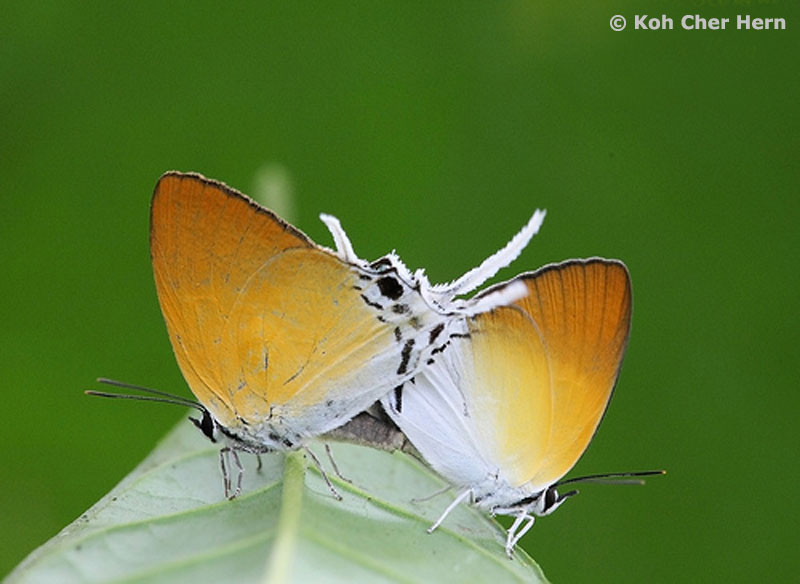
A pair of Green Imperials - male (right) and female (left)

For May 2011, we feature a little green gem of a butterfly, the Green Imperial (Manto hypoleuca terana). The species is one of the long-tailed Lycaenids of Singapore's butterfly fauna. It is a rare forest-dependent species that is not often observed, and probably frequent tree-tops rather than visiting lower level plants.


The male of the Green Imperial is a shining bluish-green at the wing bases of the forewings and on the hindwings, probably giving it its common English name with its emerald green appearance. The broad black apical area of the forewings contrasts strongly with the green.


A female Green Imperial showing its upperside

The female is a drab brown above with black and white markings on the tornal area of the hindwings. Both sexes feature a long pure white tail at vein 2 of the hindwing and a shorter stubby tail at the adjacent vein 3.


A male Green Imperial feeding on a young fern

The underside is dark orange and unmarked on the forewing, although the apical area of the forewing tends to appear darker in colour than the rest of the wings. The hindwing has black sub-marginal and marginal spot and stripes. The hindwing of the male is almost totally orange, whilst the female has a whitened dorsum.


The Green Imperial flies rapidly and is usually quite skittish. It also has a habit of perching on the underside of a leaf at times. It has been successfully bred on the parasitic plant, Macrosolen cochinchinensis that is not uncommonly found on many mature trees.


A mating pair of Green Imperial - male (left), female (right)

This emerald beauty depends very much on the survival and conservation of its parasitic host plant, and it is hoped that with proper management and conservation of the host plant, the Green Imperial will survive as part of Singapore's butterfly fauna for a long time to come.


Text by Khew SK : Photos by Sunny Chir, Federick Ho, Khew SK, Koh Cher Hern, Horace Tan & Tan BJ

10 May 2011

Butterfly Portraits - The Saturn

Butterfly Portraits
The Saturn (Zeuxidia amethystus amethystus)


Canon EOS 5D MkII fill-flashed with Speedlite 580EX II : Tamron 180mm f/3.5 : ISO 2000 ; f/6.3 ; 1/125s in AV Mode, Handheld

I would never have expected myself to be a butterfly enthusiast 3 years ago, much less an avid butterfly photographer! It all began when I wanted to start a project on butterfly conservation and building a butterfly garden for my school. That’s where I had to link up with fellow butterfly enthusiasts to learn more about butterflies and their different habitats. ButterflyCircle provided me the essential knowledge for that.

Butterfly photography came about after marveling at the splendid shots by ButterflyCircle members. I often wondered how these beautiful butterfly shots came about, especially when the butterflies were always fluttering around.

For this shot of the Saturn, the day started with SMS exchanges with Loke on Mothers’ day to check whether he was shooting and determined a common place to meet. Upper Seletar Reservoir Park was chosen as we had shot a very rare Yellow Banded Awl just the day before.

We proceeded to the spot where we observed a few different species feeding on some fallen fruits on the forest floor. This time around, we encountered not one, but four Saturn butterflies! I was quite excited to see them close up because my earlier encounters with them were from afar and they would quickly disappear deep into the forest at the slightest movement. For months, I had been hoping to chance upon one for a decent shot but was often left disappointed.

As we moved in closer, all four took off from the ground. One female Saturn landed itself on the tree trunk which provided a nice perch for photo shooting. Fortunately, the female Saturn looked pristine and tame which provided me time to adjust and experiment with different angles. Immediately, I tried to get as parallel to the butterfly as possible, pressed my arms against tree branches for more stability and quickly took a series of shots.

Butterfly photography has helped me to understand and appreciate nature’s beauty, its serenity and the importance of conservation for our environment. Indirectly, this hobby has also helped to exercise my body, maintain my alertness and most importantly, the friendship of like-minded butterfly enthusiasts. Through the sharing of the different species of beautiful butterflies especially with younger children, I hope to raise their awareness of the things around them and to instill in them the importance of butterfly conservation.


ButterflyCircle Photographer : Koh Cher Hern, in his mid 40's, working in the teaching profession