11 September 2010

The Life History of the Long Banded Silverline

Life History of the Long Banded Silverline (Spindasis lohita senama)


Butterfly Biodata:
Genus: Spindasis Distant, 1884
Species: lohita H. Druce, 1873

Sub-species: senama Seitz, 1926
Wingspan of Adult Butterfly: 28mm
Caterpillar Local Host Plants:
Terminalia catappa (Combretaceae), Melastoma malabathricum (Melastomataceae), Trema tomentosa (Ulmaceae), Talipariti tiliaceum (Malvaceae), Flagellaria indica (Flagellariaceae), Psidium guayava (Myrtaceae, common name: guava), Thespesia populnea (Malvaceae).


A Long Banded Silverline perching on a leaf tip.


A sunbathing male Long Banded Silverline displaying its striking upperside.

Physical Description of Adult Butterfly:
Above, both sexes are brown with an orange tornal patch on the hindwing. In addition, the male is purplish blue in the dorsal area of the forewing, as well as for almost the whole hindwing except the costal border. Underneath, both sexes are similar with a pale yellow ground colour. Both wings are traversed by 5 or 6 silverlines broadly edged with dark red or black. There are white-tipped, moderately long filamentous black tails at the end of veins 1b and 2, of which the pair at vein 1b longer is.The abdomen is striped in red to dark red.

A female Long Banded Silverline sunbathing between its ovipositing runs..


A Long Banded Silverline perching on a leaf.

Field Observations of Butterfly Behaviour:
This attractive species is uncommon in Singapore, despite the fact that it has a wide distribution across the main Singapore island. The fast flying adults have been sighted in multiple locations including Pulau Ubin, Sungei Buloh Wetland Reserve, Kranji Nature Trial, as well as iwastelands in the western and northern eastern part of Singapore. The adults seemed to have a fondness for flowers of the Mile-a-minute weed commonly found in wastelands.

A Long Banded Silverline taking nectar from flowers of the mile-a-minute.


Two close-up views of the silver lines on the wings.

Early Stages:
The immature stages of Long Banded Silverline are polyphagous and so far 6 plants have been recorded as local host. It is noteworthy to point out that one of them, Flagellaria indica, is a monocot and this is a very unusual host for a lycaenid butterfly. Caterpillars of all instars of the Long Banded Silverline feed on young to middle-aged leaves of the hosts, and have a strong association with ant species living on the same host plant.


Host plant: Sea Almond. Leaves and fruits are featured here.


Host plant: Flagellaria indica.

In the field, a typical encounter of a Long Banded Silverline caterpillar would see it being attended by many ants. It is also likely that several caterpillars, sometimes of different instars, share the same leaf. Where available, the caterpillar also takes advantage of the ant pavilion, typically constructed by the attending ants on the leaf underside, and uses it as shelter from predator or parasitoids. Such strong association with ant species has earlier been observed and documented in earlier literature on this species. This strong ant association could be a reason why caterpillars of this species never made it to adulthood when they were taken from the field and bred in captivity. Breeding from the egg stage is however possible, and so far several ButterflyCirlce members have been able to do so successfully. The following account of the complete life history of Long Banded Silverline is based on specimens bred on Sea Almond.


A video clip showing the ant-caterpillar assocation between one Long Banded Silverline caterpillar and one ant species. Note the eversion of the tentacular organs when the ant got too close.
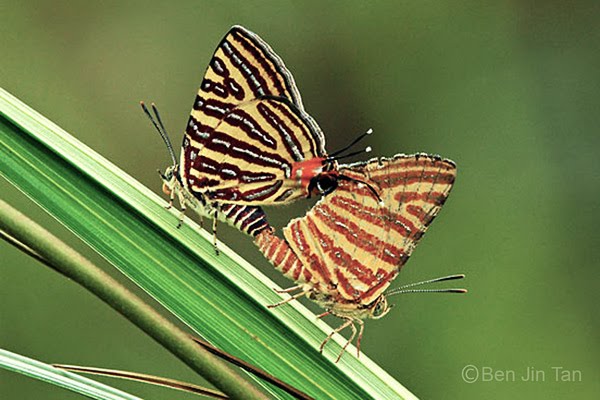

A mating pair of Long Banded Silverline on a grass blade.


A female laying the second of a pair of eggs on the leaf upperside.
The first egg can be seen near the abdomen tip.

Eggs are laid on the leaf surface or on a petiole. When laid on the green leaf surface, the female typically seeks out a small brown patch (where the leaf has been somehow damaged previously) to lay its eggs. The eggs are laid either singly or in pairs. Each egg is initially whtiish green, but turning light brown within minutes of being laid, and eventually chocolate-brown within hours. The coloration makes the eggs almost indiscernible against the brown substrate they were adhered to. Each egg is about 0.8mm in diameter, with a thick discoid shape. The egg is coarsely recticulated with rather large and deep pits and ridges. The micropylar sits atop at the center of the upper surface.


Two views of a pair of eggs laid on a damaged and brown patch on the upperside of a leaf.

Each egg takes about 6-7 days to hatch. The young caterpillar emerges after nibbling away sufficiently large upper portion of the egg shell. Measured at a length of about 1.8mm, its pale yellow green body is somewhat flatish with four rows of moderately long fine setae running lengthwise. Each body segment has a short protrusion laterally on both sides of the body. A very long black setae and a few shorter whitish setae emanate from each protrusion. The thorax except for the dorsal area of the 3rd thoracic segment is dark red, and there is a dark and rather large prothoracic shield. The posterior segments from the 8th abdominal segment are also dark red with a large black anal plate. Two small lateral processes are discernible on the 8th abdominal segment. The head capsule is black.


Left: a pair of mature eggs. Right: one new hatched caterpillar with another still eating its way out..


Two views of a 1st instar caterpillar, early in this stage, length: 2mm.

As the caterpillar grows, its body broadens sideway. The growth is slow and after about 3-3.5 days, it only reaches about 3-3.5mm in length when it stops for the moult to the 2nd instar.


Two views of a 1st instar caterpillar, late in this stage, length: 2.8mm.

Covered with numerous short setae (each with an enlarged tip), the body of the 2nd instar caterpillar is pale yellow in base color and is flattened dorso-ventrally. The prothoracic shield is dark and much larger than in the 1st instar. There are two dorso-lateral series of small red markings on the first 6 abdominal segments. Each of the three thoracic segments and the first 7 abdominal segments bears a pair of lateral cone-shaped projections furnished with a tuft of short to moderately long whitish setae. Each of these setae is not smooth but carry a number of spikes along its length. The dorsal nectary organ is now discernible on the 7th abdominal segment. On the 8th abdominal segment, there are two prominent cone-shaped projections housing the tentacular organs. The last 2 posterior segments are fused into an enlarged flat structure carrying the black anal plate on its dorsum.


Two views of a 2nd instar caterpillar, early in this srage, length: 3.3mm.

The growth in this stage brings the caterpillar to a length of about 4.5-5mm, and after about 3-3.5 days in this stage, it moults again.


Two views of a 3rd instar caterpillar, late in this stage, length: 4mm.

The 3rd instar resembles the 2nd instar caterpillar in most aspects. Now the eversion of the tentacular organs can be readily observed. A large dorsal band, bordered by the two dorso-lateral series of dashed markings, is vaguely defined. Each of these dorso-lateral markings consists of a dark red patch flanked upwardly by a whitish patch. This instar takes 3-4 days to complete with the body length reaching about 7-8mm before the next moult.


Two views of a 3rd instar caterpillar, newly moulted, length: 4mm.

Two views of a 3rd instar caterpillar, late in this stage, length: 6mm.

The 4th instar caterpillar has a distinct dorsal band highlighted by a much darker shade of yellowish green along its doro-lateral border, in contrast to the much lighter shade in the body ground colour. A thin pale dorsal line sits in the middle of the dorsal band. The another visual difference is in the greater orange tone in the first 2 thoracic segments. This instar lasts about 3.5-4 days with length reaching 10mm.


Two views of 4th instar caterpillar, early in this stage, length: 6.5mm.
Two views of 4th instar caterpillar, late in this stage, length: 9mm.

Several caterpillars of the Long Banded Silverline taking shelter in an ant pavilion on the underside of a Sea Hibiscus leaf.

The 5th instar caterpillar has a much more prominent dorsal band due to the assumption of a much darker tone of yellow and orange in its coloration. The greater orange tone is also found in the thoracic and posterior segments. The body base colour is yellowish green in one form, and brownish in another. This instar lasts about 3.5-4.0 days with length reaching 14mm.


A 5th instar caterpillar, newly moulted, length; 8.5mm.


A 5th instar caterpillar, early in this stage, length: 9mm.


Two views of a 5th instar caterpillar, late in this stage, length: 12mm.

Compared to the earlier instars, the 6th (and final) instar caterpillar has a much darker coloration especially in the dorso-lateral series of markings. The thin dorsal line is also highlighed by flanking black lines. This instar lasts about 6-7 days with the length reaching up to 24mm.


The two late instar caterpillars in a shallow leaf shelter. The left one is about to moult to the 6th instar, and the right one is in early 6th instar.


Two views of a 6th instar caterpillar, early stage, length: 12.5mm.


Two vliews of 6th instar caterpillar, later in stage, length: 18mm.

Two final instar caterpillars found on the underside of a Sea Almond Leaf in the field.
One was partially hidden in an ant pavilion while another was feeding nearby.


Towards the end of the 6th instar, the caterpillar ceases eating and its body shortens in length as it seeks out a pupation site. In the field, one common pupation site is an available ant pavilion. Otherwise the caterpillar creates a shallow pupation shelter on a spot of the leaf surface with a number of silk threads. Within the pupation shelter, the pre-pupatory caterpillar readies itself for pupation by spinning a silk pad to the substrate. No silk girdle is used as the pre-pupa secures itself to the silk pad via the claspers at its posterior end.


Two views of a pre-pupatory larva of the Long Banded SIlverline.
Pupation takes place after 1.5-2 days of the pre-pupal stage. The pupa has the typical lycaenid shape, yellowish green in the abdomen and green in the thorax and wing pads. The pupa has a length of about 10-12mm.


Two views of a pupa of the Long Banded Silverline.
A pupa of the Long Banded Silverline found in the field. Pupa was seated within an ant pavilion.
The bottom picture shows the pupa exposed after the top of the ant pavilion was removed.


Eight days later, the pupa becomes darkened in color signaling the imminent emergence of the adult. The next day the adult butterfly emerges from the mature pupa. (Note: Based on breeding experience of ButterflyCircle members of this species, having six instars for the larval stage seems to be norm but there were exceptions where the number of instars reached up to 8.)


Two views of a mature pupa of the Long Banded Silverline.
A newly eclosed Long Banded Silverline "drying" its wings.

References:
  • The Butterflies of The Malay Peninsula, A.S. Corbet and H.M. Pendlebury, 4th Edition, Malayan Nature Society.
  • Life Histories of Asian Butterflies, Vol. II, Igarashi S. and Fukuda H., Tokai University Press, 2000.
Text by Horace Tan, Photos by James Chia, C K Chng, Ben Jin Tan, Sunny Chir, Khew SK and Horace Tan

04 September 2010

Observation Notes on Forest Hopper / Coon

Observation Notes on the Forest Hopper & Coon
Updating the Butterflies of Singapore Checklist


A shot of the Coon taken at Endau Rompin Forest Reserve in Malaysia

The family Hesperiidae (or commonly known as Skippers) feature rather unattractive butterflies. They are fast flying, with big eyes and many of them perch with their wings opened in a unique fashion, known only to the Hesperiidae - with their forewings held out at a 45 deg angle, whilst the hindwings are opened flat.


A shot of the Forest Hopper taken in Singapore

Many skippers are brown, unmarked and not typical of what enthusiasts, hobbyists and nature photographers would find particularly beautiful in a butterfly. Hence it is not surprising that many of these ubiquitous butterflies go about their daily lives, flitting amongst flowers in the early morning hours and later hours of the day largely unnoticed.


A Forest Hopper perches on a blade of grass

Of particular interest would be the many lookalikes which are difficult to identify with a high level of confidence from just field shots. To add to this difficulty, the large variations in the physical characteristics like their hyaline spots, markings and colours in both the males and females make it extremely challenging to distinguish between certain species without examining them scientifically - i.e. dead in a collection or via dissection of the genitalia.


Another Forest Hopper on a leaf

Early in the compilation of the Butterflies of Singapore checklist, I had inadvertently classified a predominantly brown and unattractive skipper as the Coon (Psolos fuligo fuligo). For a long time, we had assumed that this was the species flying around the grasslands in Singapore.

Recently, one of ButterflyCircle members, Dr S. Kalesh, who hails from Trivandrum (or Thiruvananthapuram) in India, and who is a specialist in Hesperiidae, corrected this mistake. The Singapore Checklist has been updated accordingly, as after examining the repository of photographs and also voucher specimens amongst ButterflyCircle members and my own collection, the Coon (Psolos fuligo fuligo) is unfortunately no longer extant in the Singapore environment. Although it is listed in the Checklists of Butterflies of the Malay Peninsula (C&P4), there has be no reliable evidence that this species still exists in Singapore and therefore removed from the Checklist until such time any evidence of its presence can be validated.


A shot of the Coon taken in India

The butterfly that had earlier been mis-identified as the Coon, has now been confirmed to be the Forest Hopper (Astictopterus jama jama) and reinstated to the Singapore Checklist. This predominantly brown skipper is described as "above and below the butterfly is dark brown and is usually unmarked although there may be two or three white hyaline subapical dots on the forewing.


A Forest Hopper feeds on a yellow flower

In C&P4, page 351, the authors continued to mention that "The unicolourous underside and porrect palpi differentiate this species from the superficially similar Psolos fuligo (Coon)". The Coon, on the other hand, is described to have a few small and rather obscure ferruginous spots on the forewing and hindwing.

Dr S Kalesh further added that,

Note the 'hunchbacked' appearance of the Coon and also the obscure spots

In the Coon : The forewing tips diverge from each other and the wings are more produced in coon. Underside hue is brown with a violetish tinge with some pale brown areas. The forewings also curve in a convex manner, giving the butterfly a "hunchbacked" look.


The unicolourous underside of the Forest Hopper and the three subapical hyaline spots on the forewing

In the Forest Hopper : The underside is blackish brown with grey scales occationally also with 3 apical spots and the wingtips dont diverge from each other.


Another Forest Hopper perched on a blade of grass

The shots in this blog article show the differences between the Coon and the Forest Hopper. The other species that are extant in Singapore and that may be confused with these two species would be the Chocolate Demon (Ancistroides nigrita maura) and the all-brown male of the rare skipper Quedara monteithii monteithii.

Text by Khew SK ; Photos by Federick Ho, Dr S Kalesh, Khew SK, Horace Tan & Wong CM
Special thanks to Dr S Kalesh. His blog : The Skippers of Kerala

28 August 2010

Life History of the Studded Sergeant

Life History of the Studded Sergeant (Athyma asura idita)


Butterfly Biodata:
Genus: Athyma Westwood, 1850
Species: asura Moore, 1858
Subspecies: idita Moore, 1858
Wingspan of Adult Butterfly: 60mm
Caterpillar Host Plants:
Ilex cymosa (Aquifoliaceae), and another Ilex species in the nature reserve.


Open-wing shot of a Studded Sergeant perching on a branch.


A closed-wing shot of a Studded Sergeant revealing the underside of its wings.

Physical Description of Adult Butterfly:
Forewing cells are open. Above, the wings have white markings set against black ground colour. Each forewing cell has a short and undivided basal streak with a large detached spot lying beyond. A white post-discal spot is present in space 3, in addition to the spot typically present in space 2 for Athyma spp. On the hindwing, a post-discal series of white spots is present with the leading 2 to 3 spots each marked with an interior black spot. Underneath, the wings are orangy brown in ground colour, and are similarly marked as per upperside. In addition, on both wings, there is a marginal series of white spots. In the forewing, the leading edge of the basal cell streak and the white spot lying beyond are outlined in black. Furthermore, the space between the cell streak and this white spot is dusted in white, and lying beyond the white spot is a triangular black spot.


A Studded Sergeant perching on a leaf of its host plant, Ilex cymosa.


The same Studded Sergeant shown in the previoius pic displaying its underside.

Field Observations of Butterfly Behaviour:
This species is rather rare in Singapore with very few sightings recorded in the past 5 years. Its local distribution is however wide-ranging with sightings of the fast flying adults in as far north as the Sungei Buloh Wetland Reserve, in the Central Catchment Nature Reserve and down south in the Southern Ridges. The males have been observed to puddle on damp grounds, whilst the females are more likely observed flying in the vicinity of its host plants.


A puddling Studded Sergeant.


A Studded Sergeant sun bathing in an open-wing pose.

Early Stages:
Thus far, two species of Ilex have been recorded as the local host plants. Caterpillars of the Studded Sergeant feed on the middle-aged to mature leaves of the host plant, and they adopt the same feeding and frass-management routines as described for the Commander and other Athyma species in earlier blog articles.


Host plant: Ilex cymosa. Left: mature leaves; Right: fruits.


Host plant: an Ilex sp. found in the nature reserve. The red arrow points to a final instar caterpillar.

The eggs of the Studded Sergeant are laid singly at the tip of a leaf on the host plant. The greenish eggs are somewhat globular in shape, with its surface marked with hexagonal pits and bearing short spines at pit corners, giving them the appearance of minute sea-urchins. Each egg has a diameter of about 1.1mm.


A female Studded Sergeant ovipositing on the tip of a leaf of Ilex cymosa.


Two views of an egg of the Studded Sergeant.


Two views of a mature egg of the Studded Sergeant.

The egg takes about 3.5-4 days to hatch. The young caterpillar emerges by eating away part of the egg shell. The rest of the egg shell becomes the first meal for the newly hatched, which has a cylindrical pale yellowish green body covered with many small tubercles and short setae. The head capsule is pale to dark brown in color.


A newly hatched caterpillar of the Studded Sergeant, length: 1.8mm.
Left: pausing of its emergence from the egg shell. Right: eating its egg shell.


As with other Athyma spp., the 1st instar caterpillar of the Studded Sergeant feeds from the leaf tip and leaves the midrib intact and protruding. A frass chain is also constructed laboriously by the young caterpillar at the tip of the exposed midrib. Between feeds, the caterpillar rests on either the exposed midrib or the frass chain. In later instars, the caterpillar tends to rest near where the protruding midrib joins the remaining lamina. At this site, it also attempts to camouflage itself with a collection of frass pellets secured with silk threads to the lamina.


Two views of a 1st instar caterpillar, early in this stage, length: 2.5mm.

As the caterpillar grows in this first instar, tubercles occurring dorso-laterally and laterally become larger and prominent. After reaching about 5.5mm in about 3 days, the caterpillar moults to the 2nd instar.


Two views of a 1st instar caterpillar resting on the exposed midrib, late in this stage, length: 4.6mm.

The body color of the 2nd instar caterpillar is dark brown. Tubercles seen in the first instar have now developed into short and branched spines which appear dorso-laterally, laterally and spiracularly. The pairs of branched dorso-lateral spines on the prothorax, 1st abdominal and 5th abdominal segments are pale in coloration. The head capsule is dark brown and dotted with a number of conical tubercles. This instar lasts about 2.5-3 days with the body length reaching 8-8.5mm.


Two views of a 2nd instar caterpillar, at the base of the exposed midrib
and next to its frass barricade. Length: 6mm


Two views of a 2nd instar caterpillar, later in this stage, length: 7.2mm

The 3rd instar caterpillar has longer spines throughout. Dorso-lateral spines are among the longest and most prominent, particularly so for the pairs on the 2nd and 3rd thoracic segments, 2nd and 7th abdominal segments. Its head capsule is dark brown to black, irorated with dark and pale brown tubercles. The pairs of dorso-lateral spines on the prothorax, 1st abdominal and 5th abdominal segments are whitish to pale yellowish in coloration.. This instar takes about 2.5-3 days to complete with body length reaching up to 12mm.


Two views of a 3rd instar caterpillar, newly moulted, length: 7.5mm


Two views of 3rd instar caterpillar, late in this stage. Resting near its frass barricade. Length:12mm.

The 4th instar caterpillar resembles the 3rd instar closely but its dorso-lateral spines are longer and more heavily branched. This instar lasts about 4 days with body length reaching up to 20mm.


Two views of a newly moulted 4th instar caterpillar, length: 12mm.


Two views of a 4th instar caterpillar, later in this stage, length: 17mm.


Two views of a 4th instar caterpillar moments before its moult to the next instar, length: 18.5mm.

The 5th (final) instar sees a dramatic change in colour throughout the body. The branched dorso-lateral spines are now very well developed with those on the 2nd and 3rd thoracic segments being the longest. The base of these dorso-lateral spines are raised and colored in blue, with the exception of those on the 2nd and 7th abdominal segments which are black. These dorsal-lateral spines are yellow to yellowish green except for the pair on the 2nd abdominal segment which are in red. The posterior segment is black. The body base colour is yellowish green. Three thin and dark bands run dorsally, and another one runs laterally. The head capsule is pale to grey/yellowish brown and is decorated with long lateral spines. All in all, the combination of these brightly coloured body features gives the caterpillar a very eye-catching appearance.


Two views of 5th instar caterpillar, newly moulted, length: 17mm.


Two views of a 5th instar caterpillar, midway in this stage, length: 33mm.

When disturbed, the caterpillar adopts a characteristic posture with its anteror bended backward and the head tucked against the mid body segment.


A 5th instar caterpillar seen in the field adopting a defensive posture.

The 5th instar lasts for 6-7days, and the body length reaches up to 40mm. On the last day, the various colored features decolorise rather drastically. The body base colour changes to pale yellow, the blue bases of spines change to purple and then to dull purple, and red spines on the 2nd abdominal segment decolorize to dull salmon red.


Two views of a 5th instar caterpillar, late in this stage.

On the final day of the 5th instar, the caterpillar ceases feeding and wanders around. Eventually it chooses a spot on the underside of a branch/stem/leaf/petiole and spins a brown-coloured silk pad from which it hangs vertically to take on the pre-pupatory pose. Observations in the field indicate that the underside of a petiole is a popular choice as a pupation site.


Pre-pupatory larva of the Studded Sergeant.

Pupation takes place a day later. The pupa suspends itself from the silk pad with no supporting silk girdle. It is almost entirely pale brown in color with segments and parts outlined in a darker shade of brown. The abdominal segments are slender, and the thoracic portion being larger and expanded laterally. Dorsally, there are two prominent processes curved towards and touching each other. The pupa has a pair of large and curved cephalic horns which tips touching the leading edge of the wing case in most specimens. When disturbed, the abdominal segments flex laterally, and could stay in that position for a period of time. Length of pupae: 26-27mm.


The pupation event of a Studded Sergeant caterpillar


Three views of a pupa of the Studded Sergeant.


A pupa of the Studded Sergeant sighted on the underside of a petiole in a hill park.

After about 7.5-8 days of development, the pupal skin turns translucent as the development within the pupal case comes to an end. The spots and streak on the forewing upperside also become discernible. The next day, the adult butterfly emerges from the pupal case, typically during the morning hours.


Three views of a mature pupa of the Studded Sergeant.


The eclosion event of a Studded Sergeant caterpillar


A newly eclosed Studded Sergeant resting on its pupal case.


A newly eclosed Studded Sergeant.

References:
  • The Butterflies of The Malay Peninsula, A.S. Corbet and H.M. Pendlebury, 4th Edition, The Malayan Nature Society.
  • Butterflies of Thailand, Pisuth Ek-Amnuay, 1st Edition, 2006
Text by Horace Tan, Photos by Koh Cher Hern, Sunny Chir and Horace Tan.