11 June 2010

Observation Notes on the Variability of the Common Four Ring

Observation Notes on the Variability of the Common Four Ring
Aberration or Valid Species?


Many butterfly enthusiasts amongst the members of ButterflyCircle often get excited over observations of slight differences in the physical markings and colours of various butterfly species - wondering if it is a new or different species (or subspecies) and even hoping for the possibility of discovering something that is new to science! In urban Singapore, the latter is probably unlikely, because if there is a butterfly species still lurking around in our Singapore forests that is new to science, it would have long been discovered (of course, I'd be happy to be proven wrong!)


Indeed, with the many lookalikes, particularly in the Lycaenidae and Hesperiidae families of butterflies, and also proven with the discoveries and re-discoveries of many species that were thought to have gone extinct in Singapore, many ButterflyCircle members are always keeping a sharp lookout for unusual behaviour or butterflies that look slightly different from the norm.


In this blog article, I discuss my personal observations of the wide variations in the size and arrangement of the ocelli on the hindwing of the Satyrinae, the Common Four Ring (Ypthima huebneri). These observations are purely from my records of field photographs of this species that may begin to suggest the possibility of a distinct species (or perhaps a subspecies) of the Common Four Ring that could exist in Malaysia and Singapore.


A Common Four Ring where the ocelli are separated but those in spaces 2 & 3 are almost touching, but not contiguous

An example of the Common Four Ring where the tornal ocellus is contiguous with those in spaces 2 & 3

The Common Four Ring, like its larger cousin, the Common Three Ring (often referred to as a "Cinderella of Butterflies"), is as under-appreciated and more often than not, ignored by most butterfly watchers. Drab-coloured, unattractive and small, this species tends to keep close to the edges of forested areas where it discreetly goes about feeding on wildflowers or fluttering unassumingly amongst the grass.


The Common Four Ring is described as having greyish brown uppersides with a large subapical ocelli (eye spot) on the forewing above. The undersurface of both wings is greyish or pale buff brown with fine dark brown striations. The hindwing features four ocelli (if the two small tornal spots enclosed in a single yellow ring is counted as a single ocellus).


A Common Four Ring with the tornal ocellus and those in spaces 2 & 3 separated

With a number of years of observing this species in the field, and photographing them, I noticed that the arrangement and size of the ocelli on the hindwings fall into three main categories :

  1. Where the ocelli in spaces 2 & 3 are large and contiguous, and usually also contiguous with the tornal ocelli.

  2. Where the ocelli in spaces 2 & 3 are almost touching or contiguous but are separated from the tornal ocellus This seems to be by far the most typical of the majority of individuals of the species that I've encountered.

  3. Where all the ocelli are separated.

A typical example of a Common Four Ring where all the ocelli - tornal ocelli and those spaces 2 & 3 are contiguous

I am quite confident that there will be other individuals of this species encountered that may display further permutations to these three categories, as this species and many of the others in this genus, display a wide variability in the sizes of the ocelli and at times even feature some extra ocelli in uncommon individuals.


A Common Four Ring where the tornal ocellus and those in spaces 2 & 3 are distinctly apart from each other. Also note the striations on the hindwing are more sparse than those of the other individuals shown here, giving the hindwing a much "paler" appearance.

In looking at these field shots (all taken in Singapore) and placing them side-by-side, a non-local observer may be excused if he concludes that there could be more than one species of the Common Four Ring here, particularly where the ocelli (and hence the physical appearance of the butterfly) are so distinctly different.

A strange individual of a Common Four Ring where the tornal ocelli and those in spaces 2 & 3 are distinctly apart, but the ocellus in space 3 is very much smaller, as well as a hint of another very small ocellus in space 4 as well!

One has to just turn the pages of the book "Butterflies of Thailand" by Pisuth Ek-Amnuay to conclude that there are more species of Ypthima in Thailand than have been recorded in Malaysia and Singapore. Although invariably, most books on South East Asian lepidoptera only depict a single species of the Common Four Ring, could there actually be more than one species or subspecies? Or are they just aberrations and variations of this single species? It is also pertinent to note that this species is only featured up to species level in many reference books - Ypthima huebneri. Could there be a subspecies in existence in Malaysia and Singapore that has yet to be documented? Or are these just seasonal variations i.e. dry and wet season forms?


An example of a Common Four Ring where the ocelli in spaces 2 & 3 are contiguous, but separated from the tornal ocellus.

Food for thought, and more research needed before those questions can be answered with a higher level of confidence. Observers should continue to scrutinise individuals of the Common Four Ring when out in the field, and record their observations for future reference.

Text & Photos by Khew SK

Further References :

05 June 2010

Life History of the Striped Albatross

Life History of the Striped Albatross (Appias libythea olferna)


Butterfly Biodata:
Genus: Appias
Hübner, 1819
Species: libythea Fabricius, 1775
Subspecies:
olferna Swinhoe, 1890
Wingspan of Adult Butterfly: 55mm
Caterpillar Local Host Plants:
Cleome rutidosperma (Capparaceae, common name: Purple Cleome, Fringed Spiderflower).


A female Striped Albatross visiting a flower of Bidens alba.


Another female Striped Albatross with its upperside revealed.

Physical Description of Adult Butterfly:
The forewing apex is acute in the male but rounded in the female. Vein 9 on the forewing of both sexes arises before the end of vein 10. The male has a pair of hair pencils between the 8th abdominal segment and the saccus (a male mating structure). Above, the wings are white with a dentate black border in the male, and heavily black dusted with several broad white streaks and a series of yellow submarginal spots on the forewing in the female. Beneath, the wings are white in the male and yellow dusted in the female. The veins are dark dusted. A yellow basal streak, broader and longer in the female than in the male, lies along the costa on each hindwing.


A male Striped Albatross in a open-wing posture on a leaf perch.


A male Striped Albatross puddling on a damp patch.


Field Observations of Butterfly Behaviour: Although common in countries such as India, Sri Lanka and Myanmar, the Striped Albatross only established itself in Singapore and Malaysia about 70 years ago. The species has become rather common due to the widespread occurrence of its local host plant, Cleome rutidosperma, which is a weed found in many areas. The fast flying adults are most active in sunny weather and frequently visit flowers for nectar. They can be found in open habitats such as fringe of the nature reserve, wastelands, grass fields and even in urban and residential areas. The males have the habit of puddling for mineral intakes.


A newly eclosed female Striped Albatross.


A male Striped Albatross visiting a flower of the Coat Button (Tridax procumbens).

Early Stages:
The host plant, Cleome rutidosperma, is a common herbaceous weed with violet-blue to pink flowers. The caterpillars of the Striped Albatross feed on the relatively young to middle-aged leaves as well as young shoots, stems and flower parts.


Host plant: Cleome rutodosperma.


A mating pair of the Striped Albatross.

A mother Striped Albatross laying an egg on its host plant.

The eggs of the Striped Albatross are laid singly on a leaf or flower part of the host plant. The egg is spindle-shaped and standing on one end with a height of about 1mm, about 2.5 times as tall as broad. It has vertical ridges and numerous transverse striations. The vertical ridges end in low projections encircling the micropylar. The color of the egg is initially white but changes to orange overnight.


Two eggs of the Striped Albatross.


Two maturing eggs of the Striped Albatross.

The egg takes about 2 days to hatch. The newly hatched has a length of about 1.8mm and has a yellowish orange head capsule. Its cylindrically-shaped body is also yellowish orange and featuring sub-dorsal, dorso-lateral and lateral rows of small tubercles running lengthwise. Each tubercle has a short setae emerging from the middle of it. The end of each setae bears a tiny droplet of fluid.

A newly hatched caterpillar eating its egg shell.


Two views of a 1st instar caterpillar, early in this stage, length: 2mm.

The newly hatched eats the empty egg shell for its first meal, and then moves on to eat the leaf lamina. The body takes on a strong green undertone with the intake of leaf diet. The 1st instar growth is fast paced and the body length reaches about 4mm. After about 1.5 days of the 1st instar, the caterpillar moults to the 2nd instar.

Two views of a late 1st Instar caterpillar hours before its moult, length: 3mm.

The 2nd instar caterpillar is yellowish green in body color with similar setae-bearing tubercles as in the 1st instar. In addition, there are nuermous small conical tubercles dotting the body surface.The head capsule has changed to pale yellow. Laterally, the body surface is covered in numerous light brown speckles which are only discernible with a close-up examination. The posterior end also two tiny and short pointed ends.
This instar lasts about 1.5 days with the body length reaching 5.5-6mm.


Two view of a 2nd instar caterpillar, length: 4.5mm


Two view of a 2nd instar caterpillar, late in this stage, length: 5mm

The 3rd instar caterpillar resembles the 2nd instar caterpillar closely except for the appearance of a faint yellowish dorsal band and a stronger green undertone in the body color. The head capsule is now yellowish green. It is also easier to discern the two anal points. This instar takes about 1-1.5 days to complete with body length reaching about 9mm.


Two views of a 3rd instar caterpillar, length; 6mm.


Two views of a 3rd instar caterpillar, length: 8.5mm.

Again, the 4th instar retains all the features as the 3rd instar. In addition, a white lateral line appears sub-spiracularly, initially faint in appearance but becoming more prominent as growth progresses. Numerous fine setae moderately long appear laterally just below the white lateral lines. This penultimate instar lasts 1-1.5 days with body length reaching about 17.5mm.


Two views of a 4th instar caterpillar, early in this stage, length: 9.5mm.


Two views of a 4th instar caterpillar, late in thie stage, length: 17.5mm.

The 5th and final instar caterpillar resembles the 4th instar caterpillar closely. The many tubercles dotting the body surface are blue to dark blue, giving the body a speckled appearance. The green head capsule also carries numerous conical tubercles with some fine setae emerging from most of them. The 5th instar lasts for 2-2.5 days, and the body length reaches up to 33mm.


Two views of a 4th instar caterpillar, newly moulted, length: 17.5mm.


Two views of a 5th instar caterpillar, length: 24mm.


Two views of a 5th instar caterpillar, late in this stage, length: 33mm.On the last day of the 5th instar, the body of the caterpillar shortens and changes to a dull shade of pale green. It ceases feeding and comes to rest on the underside of the stem/stalk of the host plant or larger leaves of other plants in the vicinity. Typically the caterpillar shows a strong preference for a vertical or steeply inclined surface. Here the caterpillar spins a silk pad and a silk girdle to secure itself and then becomes immobile in a head-up pre-pupatory pose.


Left: The head of a 5th instar caterpillar.
Right: The anal points of a 4th instar caterpillar.


Two views of a pre-pupatory larva of the Striped Albatross.


Pupation takes place about 0.5 day later. The yellowish green pupa secures itself with the same silk girdle as in the pre-pupal stage, but with cremaster replacing claspers in attaching the posterior end to the silk pad on the stem. The pupa has a long, pointed, slightly curved cephalic horn which is yellow in colour. There is a prominent thoracic ridge which is sharply raised dorsally at thoracic segment 2, and is colored in white to yellow along the ridge line. The abdominal segments 2-4 are produced laterally into a pointed tooth at each side of the abdominal segment 2. Two lateral ridge lines, white mostly and twice interrupted with yellow, run from the abdominal segment 2 to the posterior end. Length of pupae: 21-22mm.


Two views of the pupa of a Striped Albatross.


Two views of the maturing pupa of a female Striped Albatross.
Right panel shows the pupa in more advanced stage of development.


Two views of the maturing pupa of a male Striped Albatross.
Right panel shows the pupa in more advanced stage of development.

After about 5 days of development, the pupal skin turns translucent as the development within the pupal case comes to an end. The markings on the forewing upperside become discernible and indicative of the gender of the soon-to-emerge adult. The following day, the adult butterfly emerges from the pupal case.


Newly eclosed Striped Albatross drying wings on their respective pupal case.
Left: female; Right: male.

References:
  • The Butterflies of The Malay Peninsula, A.S. Corbet and H.M. Pendlebury, 4th Edition, The Malayan Nature Society.
  • Butterflies of Thailand, Pisuth Ek-Amnuay, 1st Edition, 2006.
Text by Horace Tan, Photos by Benedict Tay, Henry Koh, Sunny Chir, Khew S K and Horace Tan

03 June 2010

Racing for Butterflies on a Saturday morning

Racing for Butterflies on a Saturday Morning
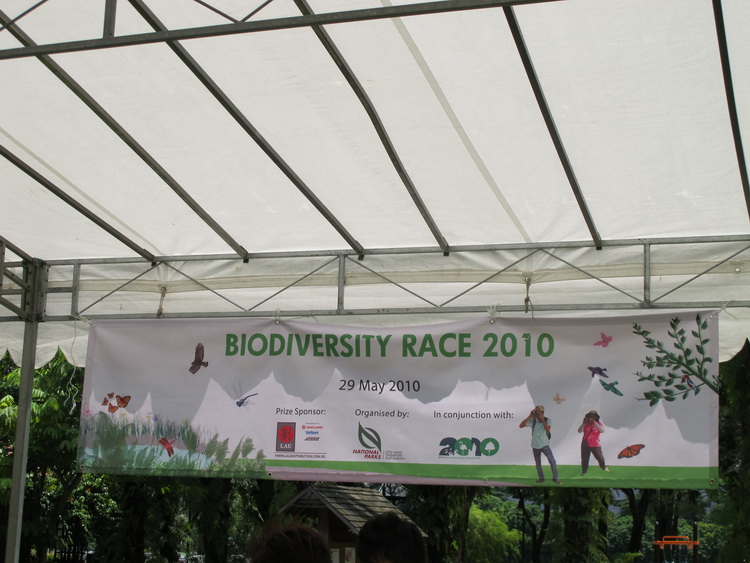
NParks Biodiversity Race 2010


Last Saturday, 29 May 2010, veteran butterfly enthusiast Steven Neo and I were at the Chua Chu Kang Park as arbitrators for the National Parks Board's Biodiversity Race 2010. We arrived at the finishing point of the Biodiversity Race at around 11:00am (the participants were flagged off at 8:30am that morning). I must admit that it was the first time that I've visited Choa Chu Kang Park, and I must say that it's a nice size and has good potential for good butterfly activity.


Participants making their submissions at the official end-point station

Coming back to the Biodiversity Race, the arbitrators had been briefed earlier about our roles, and there were four pairs of arbitrators, covering the bird, butterfly, dragonfly and plant groups, that the participants were competing to score points on. Each participating team had four members and had to survey a prescribed route and record a checklist of species of birds, butterflies, dragonflies and plants that they spot along the route. They were also encouraged to photograph what they see, and points awarded for photos with correct IDs.


By the time the arbitrators had tucked in to a specially catered buffet lunch, the teams of participants had begun streaming in and reporting to the checkpoint coordinators who collected their observation sheets and storage cards for their photos. The whole process was well-coordinated and from the smiling faces of the participants (and the officials), everything went well without a glitch.


Race officials processing the submissions from the teams

The arbitrators then convened at the Information Kiosk to start the validation process of scoring points based on the criteria given - 1 point for a species (that is likely to be found in the competition route) and 2 points for a photo with the species correctly identified. During the process, the arbitrators agreed that if a photo was provided, but with a wrong identity of the species, then no points would be awarded. As the objective of the Biodiversity Race was to identify as many species as possible correctly, teams were therefore penalised if they had incorrect identifications.


Bird arbitrator Alan Owyong having a thoughtful moment at the Arbitrators' workstations

The Race officials thoughtfully provided enough notebook PCs for the arbitration process and the checking of checklists and photos by the arbitrators proceeded very efficiently. For the butterfly group, Steven and I were disappointed that even though a couple of shots of relatively rare butterflies were submitted, the teams had identified the butterflies incorrectly! For example, one of the teams featured a shot of a female Green Baron (Euthalia adonia pinwilli), but named it as "Lime Butterfly (Papilio demoleus malayanus)" instead! There were a few lookalike challenges. A classic example was the Malayan Eggfly (Hypolimnas anomala anomala), which many of the teams managed to photograph, but only one team managed to ID it correctly. The rest thought that it was a King Crow (Euploea phanaereta castelnaui). In a sense, the mimicry phenomenon worked as the Malayan Eggfly indeed evolved to mimic one of the Crows for protection against predation as part of their survival strategies, and fooled even human observers!


Prizes galore!

We had a moment of amusement when we evaluated one photograph that was cluttered with trees and bushes and an ID of "Common Birdwing". To give the benefit of the doubt to the team, we called the members in to help show us where the butterfly was. When the team came in, they could not find it either! Looking for a needle in a haystack came to mind as we scrolled up and down, left and right to try to find the elusive butterfly in the photo. But it was all in good spirit, and even the participants could not remember where exactly where the butterfly was in the picture!

So, Humans 0 : Butterfly : 1


A few words from the Director, Parks Division, Dr Nigel Goh, before the winners were announced

After all the four teams of arbitrators completed their work the officials then tallied the points and we quickly went for the prize-giving ceremony, where the participants were already seated and anxiously awaiting the results. The prizes were giving out by the Director/Parks Division, Dr Nigel Goh. There were squeals of excitement from the participants as the winners were announced and prizes were handed out. The overall winning team had a rather decent prize of a good pair of binoculars each, donated by the sponsor. Prizes were also won for the best butterfly, bird and dragonfly of the Race.


The all-lady winning team!

As far as butterflies are concerned, it was an eye-opener for Steven and me that the general nature-loving public is very much in need of a comprehensive field guide to help them ID butterflies in the wild.


Arbitrators receiving their tokens of appreciation

It was a nice time catching up with friends in the nature community and we are encouraged to see many young (and young-at-heart) participants who enjoy nature and a day out to appreciate Mother Nature's creations.


Text & Photos by Khew SK ; Poster courtesy of National Parks Board

01 June 2010

A Tinsel Surprise

A Tinsel Surprise
Re-Discovery of the Gray Tinsel (Catapaecilma major emas)


A Gray Tinsel shot on Singapore island in May 2010

It was on a hot humid Saturday when ButterflyCircle members Nelson Ong and CK Chng were out on their usual weekend butterfly-shooting outing when Nelson spotted something that he had never encountered before. The small butterfly was perched on a leaf in a forested area near a mangrove habitat and allowed him to squeeze off a couple of shots before Chng took his turn at it. But the small skittish butterfly took off rapidly and made its escape amongst the lush vegetation.

When they posted their day's trophies at the ButterflyCircle Forums, it was found that they had shot a rare Lycaenid that had not been seen for quite some time. Listed on the early authors' checklists, this species, the Gray Tinsel (Catapaecilma major emas) had not been reliably identified until Nelson's excellent shot of this species recently at the end of May 2010.


A Gray Tinsel shot in Oct 2004 at Pulau Ubin

We now officially record the existence of the Gray Tinsel as a re-discovery and add it to the Singapore Checklist as species #295. Congratulations to Nelson and Chng for confirming the existence of this elusive species that was first recorded by ButterflyCircle member Tan Chung Pheng on the offshore island of Pulau Ubin in Oct 2004! The record shot was not totally clear enough to establish the identity of the species and we had put it as Catapaecilma sp., until the day that a better shot became available.


The Gray Tinsel is described as an uncommon butterfly with a wingspan of 32-40mm. The butterflies are said to frequent secondary growth and lowland forests. The upperside of the male of the Gray Tinsel is purple blue above with a narrow submarginal border on both wings. The female is a light shining blue with broader black submarginal borders. The underside is pale buff brown with reddish brown striae infilled with silver markings broken up into separate rather irregular spots. Both sexes have three pairs of filamentous tails of which the middle pair is the longest. The legs of the the butterfly are remarkably hairy.

Caterpillars of this species have been recorded on the host plant of Terminalia paniculata.


A collage of Gray Tinsel shots taken on Koh Samui, Thailand

The butterfly has a rapid flight but has been observed to return to favourite perches with partially opened wings at certain times of the day. The species is said to be more common on the Thai island of Koh Samui, where our northern ButterflyCircle "correspondent", Leslie Day resides. The shots below are courtesy of Les, LC Goh and Matthew, who encountered the Gray Tinsel on their outings at Koh Samui.


A Gray Tinsel shot at Koh Samui, Thailand

So the Singapore Butterfly Checklist slowly, but surely inches towards the 300 mark with the addition of the Gray Tinsel as species #295, and we look forward to more discoveries and re-discoveries in the coming months.

Text by Khew SK : Photos by CK Chng, Leslie Day, Nelson Ong & Matthew