Showing posts sorted by date for query Cephrenes trichopepla. Sort by relevance Show all posts

31 August 2025

Butterfly of the Month - August 2025

Butterfly of the Month - August 2025
The Plain Palm Dart (Cephrenes acalle niasicus)

A male Plain Palm Dart feeding on a Periwinkle flower at Pulau Ubin

In the month of August, Singapore spared no effort in celebrating its 60th birthday after independence. The island state had its National Day over several locations, featuring its airshow, fireworks and celebratory concerts. As a young nation, Singapore has come a long way from the fateful day of separation with Malaysia, and defied all odds to become one of the world's richest nations in terms of Gross Domestic Product per capita.


It was also PM Lawrence Wong's first National Day Rally after the recent General Elections gave him and his team a decisive mandate to take the country forward for another five-year term of office. The victory for the 4G leadership team had even higher votes than the previous election, garnering 65.57% of the valid votes - an increase of 4.35% over the 2020 General Elections.


The traditional Asian Hungry Ghost Festival started late this month, commencing on 23 Aug and ending on 21 Sep in 2025. The Hungry Ghost Festival is a traditional Chinese festival (also known as Zhong Yuan Jie 中元节 in Mandarin, Chung-Yuan 中元 in formal Chinese or Zhongyuan Festival in Taoism) and marks the opening of the Gates of Hell where the ghosts or spirits were able to return to Earth. Often called the Chinese Ghost Festival, it’s celebrated by Buddhist and Taoist devotees to honour the memories of the deceased.


Our Butterfly of the Month for August 2025 is from the Hesperiidae family - The Plain Palm Dart (Cephrenes acalle niasicus).  For a while it was the sole representative of the genus in West Malaysia and Singapore until the discovery of another Indo-Australian species the Yellow Palm Dart (Cephrenes trichopepla) in Singapore in 2005. The Plain Palm Dart is described as "rare in the cultivated lowlands on the Malay Peninsula and is swift in flight and difficult to capture." (C&P5)

A male Plain Palm Dart feeding on the flowers of Syzygium sp.
A female Plain Palm Dart feeding on the flower of the Spanish Needle

The Plain Palm Dart is not uncommon in Singapore, although sightings are not regular. At times, both males and females have been seen feeding on flowering plants e.g. Syzygium flowers in bloom. Its distribution is ranges over urban parks and gardens and fringes of the nature reserves. It is regularly spotted on the offshore island of Pulau Ubin.

A male Plain Palm Dart perching on Coconut Palm - one of its caterpillar host plants

The adults of this species are similar to the Telicota sp. but are generally larger in size. The Plain Palm Dart is sexually dimorphic, with the males and females looking noticeable different in their external appearance. Above, the male is dark brown with orange-yellow markings on both wings. On the underside, the male is ochreous with markings sharply outlined in black, with a characteristic post-discal arrow-shaped black mark on the underside of the hindwing.

A female Plain Palm Dart feeding on the flower of Lantana camara

Females are sullied and may appear rather brownish and on the hindwing below, it has a purplish oily sheen, although it has been described as extremely variable and sometimes appear greenish, bluish, besides the more commonly encountered purplish sheen. Females appear to be more commonly observed than males.


The life history of the Plain Palm Dart has been fully documented in Singapore on the Coconut Palm (Cocos nucifera) and a species of Livistonia. The early stages records can be found on this blogpost here. In West Malaysia, alternative host plants are Calamus (Rotan) and Elaeis guineensis (Oil Palm).

Text by Khew SK : Photos by Federick Ho, Khew SK, Loke PF and Horace Tan

30 April 2022

Butterfly of the Month - April 2022

Butterfly of the Month - April 2022
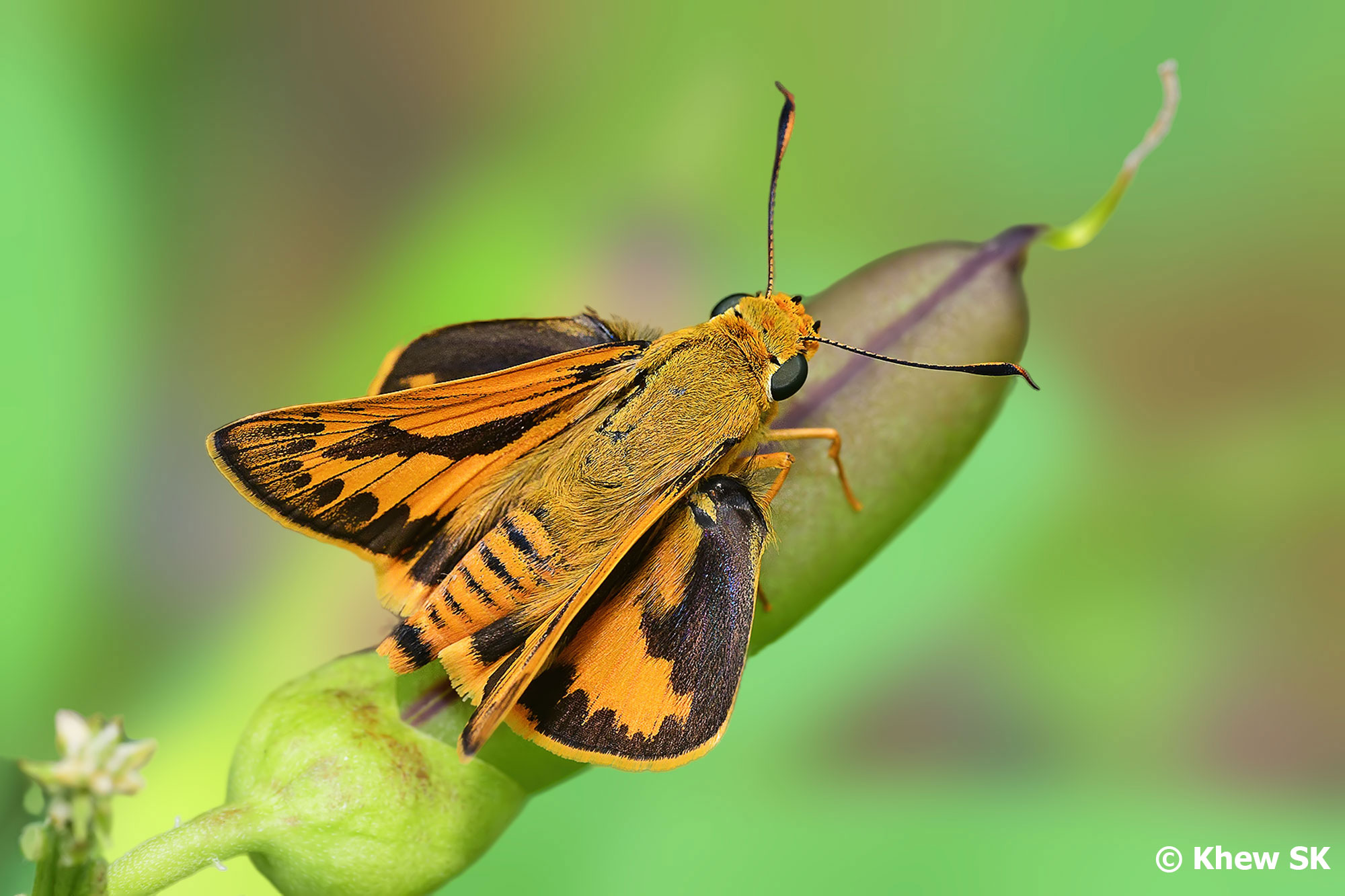
The Yellow Palm Dart (Cephrenes trichopepla)

A Yellow Palm Dart perched on the flower of the Feather Cockscomb

The month of April is almost over, but overall, it has been an optimistic month for most of the world's governments who are dealing with the pandemic. It has been more than two and a half years since the dreaded coronavirus descended on the world and covid-fatigue has set in for most communities around the world. Economies and livelihoods have been battered blue-black for many months, and many countries have begun to deal with the virus as an "endemic".


The virus continues to mutate, but the more recent variants, though highly transmissible, have a milder effect on infected individuals, albeit there are still some fatalities. It is the combination of the milder variants, a highly vaccinated population and healthcare systems in place, that Singapore has reverted to a largely pre-covid normalcy. Malls and places of public resort, food and beverage outlets, recreational facilities and so on, are now open without having entrance restrictions.


Other than certain mask-on requirements in enclosed spaces, our environment in Singapore has gone back to almost pre-covid conditions in 2020 before the lock-downs all started. As the citizenry heave a collective sigh of relief, we pick up the pieces and look forward to a world that we were used to. Travel is no longer the luxury of a privileged few, and cross-border forays are now enjoyed by all and sundry.


Over in northern Europe, the Russia-Ukraine war continues unabated, although the invaders still have to contend with a very tenacious and surprisingly determined defence forces of the Ukrainian. As with all wars, it is the civilians and commoners who suffer and this is no different in Ukraine. No one can tell what the outcome will be, or when the invasion will end. But the world is watching and gleaning learning lessons from such an invasion of a sovereign nation by an aggressive neighbour.


Our Butterfly of the Month for April 2022 is a recent addition to the Singapore butterfly fauna - the Yellow Palm Dart (Cephrenes trichopepla). Originally a native to the Australian region, the Yellow Palm Dart was first confirmed recorded in Singapore in 2009 after some years of skepticism that this species actually existed in Singapore. However, records show that it was probably extant in Singapore as early as 1999 when a sighting of this species was reported but not confirmed.

Yellow Palm Darts are often observed perched on the top surfaces of leaves to rest with their wings folded upright

The Yellow Palm Dart is considered a widespread and common species in Singapore today, where it can be found in various habitats from urban gardens to the forested nature reserves and offshore islands. Where its preferred caterpillar host plant can be found - the common coconut palm (Cocos nucifera), this species is often not too far away. It is now found in Malaysia and has also been reported from as far west as Sri Lanka.

A Yellow Palm Dart feeding on the pink flowers of Lantana camara


The species is swift on the wing, and skittish if disturbed. However, it occasionally perches to rest with its wings opened to sunbathe in the typical skipper fashion. It can sometimes be observed feeding on flowering plants in urban parks and gardens. It is also attracted to bird droppings.

A Yellow Palm Dart perches on the seed pod of a Rattlebox Weed with its wings opened to sunbathe

The Yellow Palm Dart's wings are black above with prominent orange-yellow streaks and spots that are typical of the genera Cephrenes. The orange yellow colour of the post-discal band on the forewing above is continued along the veins towards the termen. The males of this species do not possess a sex brand on the forewing above. The abdomen is orange banded and there is a black patch at the abdominal tip.

A mating pair of the Yellow Palm Dart

On the underside, the colour of the wings are a deep orange-yellow. The post-discal band on the underside of the hindwing is distinctly edged with black, and the band itself is a deeper orange than the surrounding ground colour of the wings. The antennal tips are orange on the inward side of the club, whilst the outer side is black.


The species' caterpillar feeds on various palms, like the Coconut Palm (Cocos nucifera), Livistona sp. (Arecaceae) and Lipstick Palm (Cyrtostachys renda). Given the widespread distribution of the Yellow Palm Dart, it is likely that the caterpillars feed on other species of palms. 

Text and Photos by Khew SK

21 March 2020

Lepidoptera exotica

Lepidoptera exotica : The Non-Natives
Exotic butterfly species in Singapore


An "exotic" species in Singapore, the Great Orange Tip 

Recently, I attended a workshop conducted by NParks to discuss the definitions and clarify questions about various categories that are defined in the IUCN guidelines on threatened species. The workshop was held for the team leads and assessors of the forthcoming 3rd Edition of the Singapore Red Data Book. The Singapore Red Data Book conforms to the IUCN Red List of Threatened Species but is focused specifically on Singapore's biodiversity.


The IUCN status categories in the Red List

A group of over 60 experts and taxonomic leads/assessors from academia, government organisations and the public, specialising in various terrestrial and marine groups were there to share experiences and views on the Red Data Book.  The workshop session was to help standardise how we were going to assign categories and status of the various species in our respective taxonomic areas of interest.
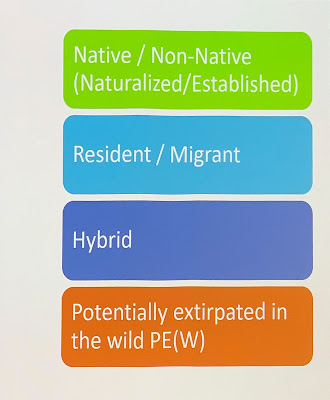

Some controversial categories that were debated at the Workshop

Amongst the different classifications and categories discussed, was how to consider indigenous (native) species vs exotic (non-native) species. In many cases, some of our exotic butterfly species have been "naturalised" and have established viable and sustainable colonies in Singapore. In our human world, perhaps it could somewhat be comparable to a foreigner who has lived here for many years, became a permanent resident and then took up Singapore citizenship - what is often referred to as a "naturalised Singaporean".
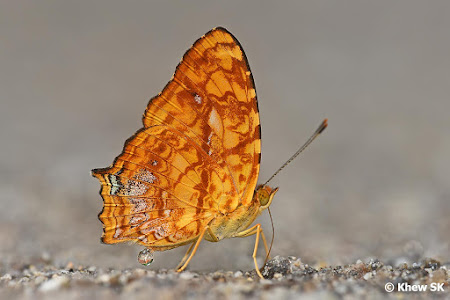

Another non-native species found in Singapore, the Malayan Jester

Hence do we consider "naturalised" species as native? And how long should they be "naturalised" before we take them as native? Eventually, it was decided that only native species will be assessed (irrespective of whether they are naturalised or not) while non-native species will be excluded unless they are of conservation concern, but they will be placed in a separate holding section. For the butterfly group, the question that remained was, so which species is native and which is non-native?
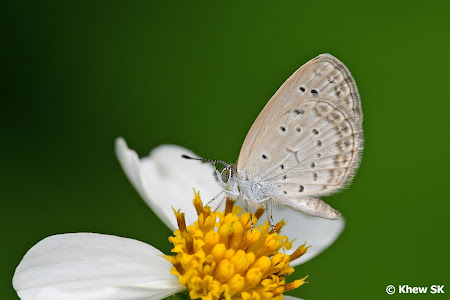

The Pale Grass Blue can be considered a "naturalised" exotic in Singapore, having been continuously seen in urban parks and gardens since it was first discovered in the early 2000's

Native (indigenous) is described as "naturally existing in a place or country rather than arriving from another place" or "produced, growing, living, or occurring naturally in a particular region or environment. On the other hand, a non-native (exotic) species is one that "relates to a plant or animal that is not indigenous to a region" or "an organism that living or growing in a place that is not the location of its natural occurrence."


A mating pair of Tawny Costers, an exotic that was first discovered here in 2006

Whilst the definition of native and non-native is easy to understand, the challenge is the reference baseline information. For butterflies, we have often turned to the checklists that were produced by the authors of "Butterflies of the Malay Peninsula" and "Butterflies of West Malaysia and Singapore". These checklists made reference to data from collections that dated back to the late 19th century and are used as the baseline for the definition of what species is "native' or occurred naturally in Singapore.
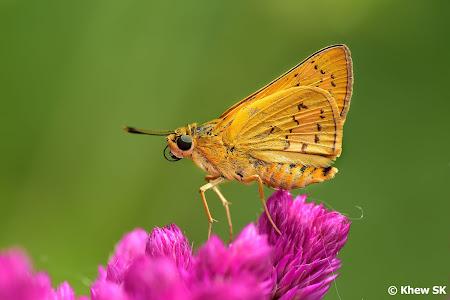

The Yellow Palm Dart was discovered around 2009 and is now considered common in Singapore

Let us take a look at some of these "exotic" species in Singapore, and their status based on the IUCN guidelines, if they were to be assessed. These species are deemed as non-native as they were never recorded in Singapore before, based on our reference baseline checklists.  Other than Riodinidae, all the other five families of butterflies have examples of what is non-native in Singapore.

1) The Common Jay (Graphium doson evemonides) - IUCN : Vulnerable


The non-native Common Jay was discovered in 2004, and there is a resident population on Pulau Ubin

The Common Jay was not listed in the reference checklists of the early authors and thus far, we have had no evidence of its having been captured in Singapore in the reference collections that correspond to the checklists. It was hence a "new discovery" for Singapore when it was first spotted on the offshore island of Pulau Ubin in 2004. Over the years, however, there is a sustainable colony of the species on Pulau Ubin, and continues to be seen to this day.
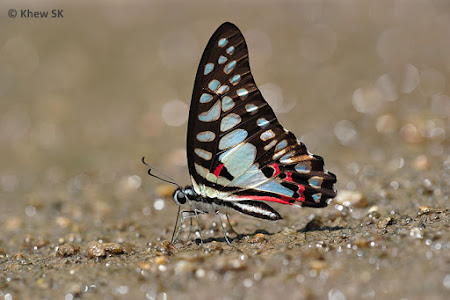


Given its continued presence in Singapore, the Common Jay may be assumed to be a naturalised exotic to Singapore. As it has been bred on a variety of caterpillar host plants, amongst which are Desmos chinensis, Michelia alba and Polyathia longifolia, the species has a higher chance of sustaining its existence as part of Singapore's butterfly biodiversity. However, being a non-native species, it would be excluded from being assessed for the Singapore Red Data Book 3rd Edition.

2) The Great Orange Tip (Hebomoia glaucippe arturus) - IUCN : Endangered
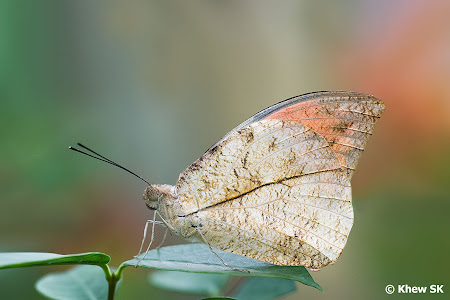


The Great Orange Tip is a relatively large butterfly and has a strong flight. It was recorded from Singapore near one of our reservoir parks in the early 2000's. Several reported sightings were made on the island of Pulau Ubin in subsequent years. The sightings of this non-native species were probably of vagrant individuals that made it south to Singapore carried over by prevailing winds.
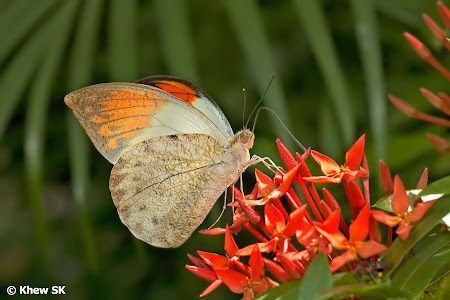


The Great Orange Tip is also a feature species in butterfly parks and individuals seen in Singapore could also have been escapees from these aviaries. This non-native is rarely seen in recent years, and will not be assessed for the Red Data Book 3rd Edition.

3) The Tawny Coster (Acraea terpsicore) - IUCN : Least Concern
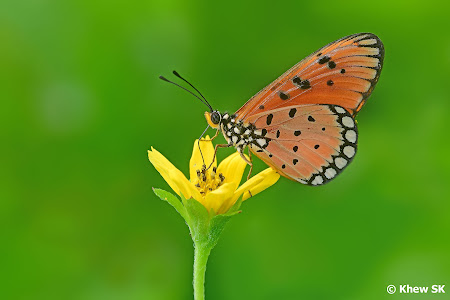


First recorded as a new discovery to Singapore in 2006, the Tawny Coster is common here today, and continues to be seen regularly in urban and suburban areas. It has several alternative caterpillar host plants, and is hence able to maintain a sustainable population in Singapore for the past 14 years. It is also considered naturalised and is part of our urban biodiversity in Singapore.


The exotic Tawny Coster is now a naturalised species in Singapore, where it is common in urban areas

This slow-flying species is known to be distasteful to predators and that adds to its tenacity to survive and thrive in Singapore. Another naturalised species, the non-native Tawny Coster is likely to stay for the long term and has even widened its range to as far south as Australia in recent years.

4) The Malayan Jester (Symbrenthia hippoclus selangorana) - IUCN : Endangered
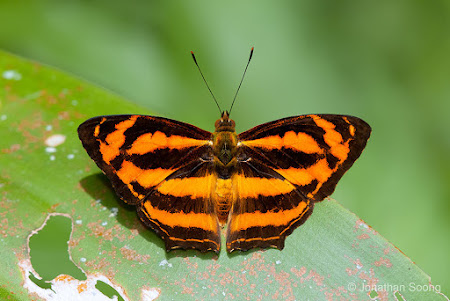

A small colony of the Malayan Jester survived at the Dairy Farm Nature Park for some time.

An individual of the Malayan Jester was first recorded as a new discovery for Singapore when it was spotted in 2012. The species was considered a possible vagrant until in the past 3-4 years when a colony established itself at the Dairy Farm Nature Park area. Whether the population can be sustained to qualify this species as a naturalised species remains to be seen.


Unlike other non-native species that have become common in Singapore, the appearance of this species has been erratic. However, where it occurs in Malaysia, the species is not uncommon. However, its appearance in Singapore would classify it as a non-native species and will not be assessed for the Singapore Red Data Book 3rd Edition.

5) The Pale Grass Blue (Zizeeria maha serica) - IUCN : Least Concern


This small butterfly was discovered here in the early 2000's, and was validated by the late Col John Eliot. The species was included in his Malayan Nature Journal : Update to C&P4 paper. The species has been considered extant in Singapore since the early 2000's and continues to be found here as a relatively common species. An individual was photographed at the Bt Panjang Butterfly Garden as recently as last weekend.
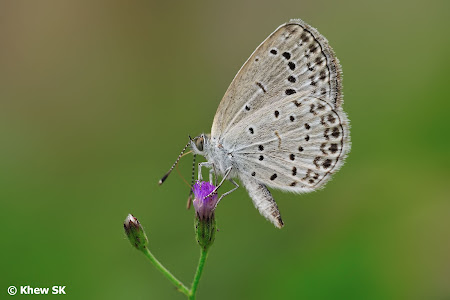


This naturalised species is relatively common, and in areas where they fly, there can be as many as 6-12 individuals fluttering around the grasses and wild flowers. Its caterpillar host plant, the Yellow Sorrel (Oxalis corniculata) is a common "weed". The Pale Grass Blue would be considered as "Least Concern" under the IUCN guidelines, but is still classified as a non-native species in Singapore and will not be assessed in the Singapore Red Data Book 3rd Edition.

6) The Yellow Palm Dart (Cephrenes trichopepla) - IUCN : Least Concern
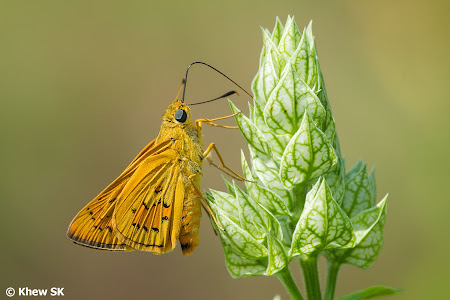


A species that is more associated with the Australian region than Southeast Asia, this species first appeared in 2009 in Singapore. Since then, it has also moved northwards and has been spotted in West Malaysia. The fact that the common coconut palm (Cocos nucifera) is its caterpillar host plant may explain its rapid spread across the region.
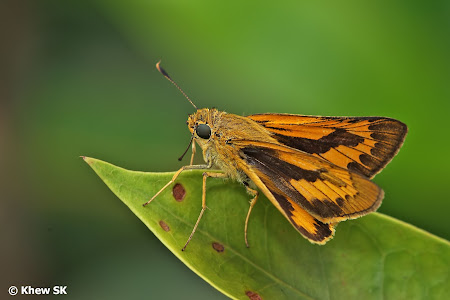


This exotic species has now become common and is regularly seen at urban parks and gardens where the coconut palm can be found. It was even recorded from the offshore island of Pulau Semakau during our surveys conducted for the National Environment Agency on the island.
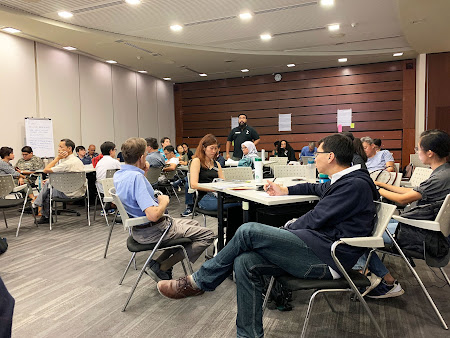

Participants at the Red Data Book 3rd Edition Workshop organised by NParks

And so, here we see a small sample of the exotics or non-native butterflies of Singapore. Some have become naturalised and common, whilst others continue to be elusive or probably vagrants. There are many other species that are exotic to Singapore, and they will not be assessed and featured in the main section on butterflies in the Singapore Red Data Book 3rd Edition.

Text by Khew SK : Photos by Khew SK, Loh MY, Jonathan Soong and Anthony Wong

27 July 2019

Butterflies of Australia

Feature Book :
Butterflies of Australia


Recently, a friend who visited Australia sent me some butterfly photos that he took on his trip, for identification. Most were relatively common urban butterflies and were easy to identify. One of the books that I turned to was my favourite personal reference, Butterflies of Australia by Dr Albert Orr and Professor Roger Kitching. Both accomplished and renown biologists and entomologists, the authors intended for the book to be a field guide "for a general readership, and not a scientific monograph".


What is additionally unique about this book, is that all the illustrations of the butterflies, their environment, host plants, caterpillars and so on, are hand-drawn pictures! The amazing pictures in the book itself was illustrated by Dr Orr, an excellent artist in his own right.


The New Guinea Birdwing (Ornithoptera priamus) male

This blogpost introduces this excellent book which is great for beginners and the more sophisticated enthusiast alike. Only sample photos of the book are shown here, and for readers who are interested in getting this large 335-page book, you are strongly encouraged to purchase your own copy from reputable bookshops or online.


Introduction to butterflies and useful information about butterflies in Part I of the book

Part 1 of the book covers the mandatory subjects like introduction to Lepidoptera, classification, life cycle, colours and reproduction in Chapter 1. Chapter 2 features the Australian biogeography in relation to butterfly distribution, and where observers can find the various species. Chapter 3 deals with butterflies' relationships with plants and other animals, competition for food and mates and predators. Chapter 4 discusses conservation, gardening and how one can become an avid student of butterflies. For beginners, these first 60 pages of the book would be good to read in greater detail.


Various chapters featuring Australian species from the 5 families of butterflies

The 2nd and more substantial part of the book covers almost all of the 400+ species of Australian butterflies - divided over the 5 families. At the point of writing, the authors probably stayed with the earlier classification where Riodinidae was still classified as a sub-family of the Lycaenidae. The book then ends with references, a good index, and two important checklists of Australian butterflies and larval host plants of Australian butterflies.


A useful appendix listing all the known caterpillar host plants of Australian Butterflies

Part 2 starts with the Hesperiidae, with plates covering the Australian skippers. In keeping with their intent to make this book a readable field guide, the authors grouped the species by their collective English common names, rather than sort them by taxonomic names. This makes the book an easy reference for the Australian (and other) butterfly enthusiasts to search for the various species by their local vernacular names, instead of look for genera and species names.


Typical pages in the book which organises the species by their collective common names, and illustrations of the butterflies, host plants, life histories and distribution in Australia

The Yellow Palm Dart (Cephrenes trichopepla) an Australian species that is now extant in Singapore and Malaysia

In these sample pages, the Yellow Palm Dart (Cephrenes trichopepla) is featured. This is the same species that was discovered in Singapore back in 1999 by Kelvyn Dunn. The blogpost of that discovery that was documented here on this blog can be found here. This species, a new discovery to Singapore at that time, is now a common species and has even moved up north to Malaysia where it has been spotted regularly.


The New Guinea Birdwing (Ornithoptera priamus) female

The next chapter features the spectacular Papilionidae and the mouth-watering Ornithoptera birdwings found in Australia. Although the Papilionidae is represented by only 19 species in Australia, these are some of the most spectacular butterflies to be found in the continent. Large and showy, some of the species are amongst the world's largest butterflies. It is also interesting to note that many of the species that can also be found in Singapore, bear different common names in Australia.


The Ambrax Butterfly (Papilio ambrax) an Australian butterfly fairly common in rainforest in north Queensland's wet tropics region

Graphium sarpedon - Common Bluebottle in Singapore, Blue Triangle in Australia

For example, the Common Bluebottle (Graphium sarpedon) is called the Blue Triangle in Australia, whilst the Tailed Jay (Graphium agamemnon) is known as the Green-spotted Triangle. Our common urban Lime Butterfly (Papilio demoleus) goes by the name Chequered Swallowtail in Australia, whilst the Five Bar Swordtail refers to the species Graphium aristeus instead of Graphium antiphates.


The Imperial Jezabel (Delias harpalyce) found in Australia

The Pieridae family follows in the next chapter. Australia has amongst the most beautiful and exotic-looking Delias (or commonly known as Jezebels) in the world. In the book, they are called Jezabels. Amongst the Whites and Sulphurs that are usually associated with the family Pieridae, the Australian Jezabels feature prominently with 8 species extant.


Common urban species that are also found in Singapore - Blue Pansy (Blue Argus in Australia) and Common Tiger (Orange Tiger in Australia)

In Chapter 8 of the book, most of Australia's 81 species of Nymphalids are featured, with twelve sub-families occuring in Australia. There are some species that are also found in Singapore, with the Common Tiger (Danaus genutia) called the Orange Tiger as its local common name. The Blue Pansy (Junonia orithya) and the Chocolate Pansy (Junonia hedonia) are known as the Blue Argus and Brown Soldier respectively in Australia.


The Two Spotted Line Blue (Nacaduba biocellata) was a new discovery for Singapore and is now extant on the island

The butterfly families in the book ends with the Lycaenidae, of which more than 140 species are recorded from Australia, and counting! Amongst the many spectacular blues, coppers and hairstreaks, one species was recently recorded as a new species to Singapore - the Two-Spotted Line Blue (Nacaduba biocellata). An Australian species, it has somehow found its way to Singapore, and is now a permanent resident.


The Sword-tailed Flash (Bindahara phocides) is known as the Plane in Singapore

For a butterfly primer and an introduction to Australian butterflies, this book by Dr Orr and Prof Kitching can be considered one of the best and easy-to-read references available. Enthusiasts who have their own library of butterfly books from all over the world should not miss having this book in their collection.

Text by Khew SK : Photos by David Fischer and Khew SK

Photo plates featured here from the book are copyrighted property of the respective authors and publishers, and samples of the pages from the books are featured here under the principles of fair use.

I have also had the privilege of having Dr Albert Orr review my book, A Field Guide to the Butterflies of Singapore 2010, and the review published in the Australian Entomologist  - Volume 38 Issue 4 (Nov 2011)