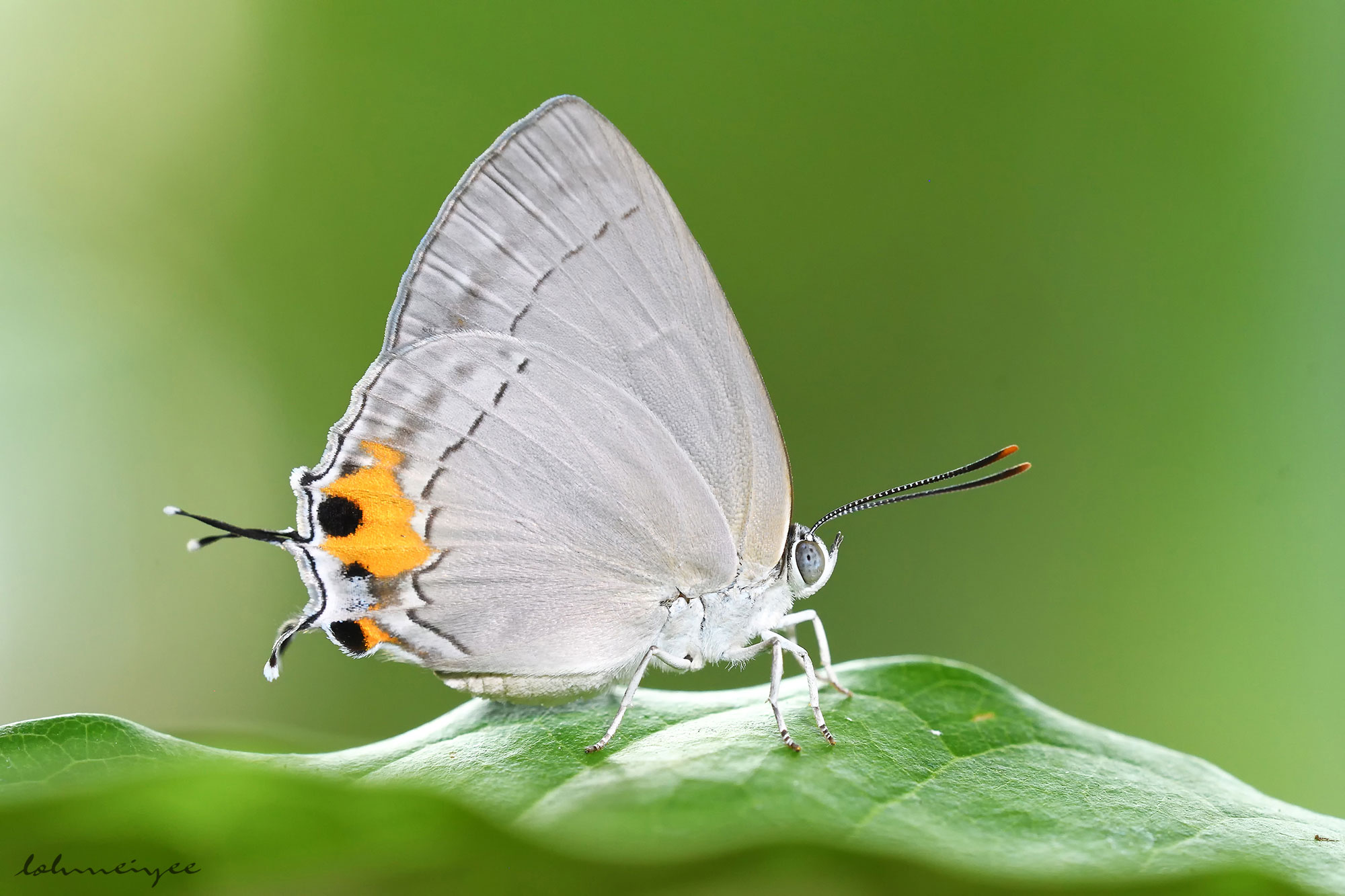
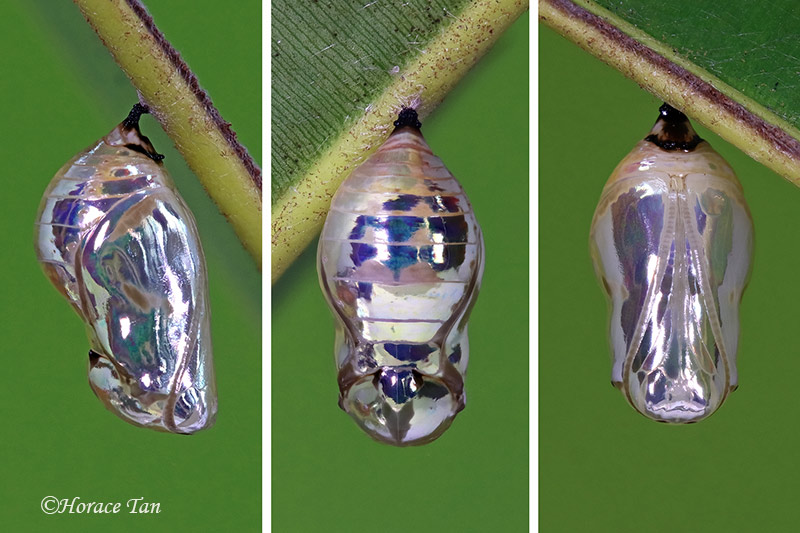
A pristine female Indigo Flash perches on a dew covered grass blade in the early morning hours. Note the slight purplish wash on the wing bases.
March 2024 has whizzed past in a flash, and on this final day of the month, we feature one of our "Flash" butterflies that exists in Singapore. A butterfly that belongs to the Lycaenidae family, called the "Blues and Hairstreaks", these species found in Singapore are mainly classified under the genus Rapala. The Flash butterflies are fast-flying skittish species and are difficult to spot when they flash from perch to perch.
Our feature butterfly for March 2024 is the Indigo Flash (Rapala varuna orseis). It is one of nine extant species from the genus Rapala that have been found in Singapore. Only recently, the early stages of the species were recorded on the local caterpillar host plant, Bridelia tomentosa. The Indigo Flash is often encountered in urban parks and gardens as well as within the nature reserves of Singapore.
The species is skittish and is usually quite alert. It is widely distributed across Singapore, where it is regularly encountered singly but at times more than one individual is spotted in the same location. At certain hours of the day, both sexes are sometimes observed perched on the uppersides of leaves with their wings opened almost flat to sunbathe.
Upside-down behaviour of both sexes of the Indigo Flash where the butterfly perches upside down on leaves and stems
It is sometimes encountered feeding on flowering plants and weeds like Mile-A-Minute, Spanish Needle and Stringbush. When it is resting in the shade, the Indigo Flash sometimes displays an upside-down behaviour where it perches on the undersides of leaves to rest. Both males and females are observed to behave this way.
A female Indigo Flash perched with open wings to sunbathe
A male Indigo Flash showing a glimpse of its deep indigo-blue upperside
The Indigo Flash belongs to the varuna group of the genus Rapala, where the males and females are a shade of blue or bluish-green on the upperside. Males of the Indigo Flash is indigo blue above and unmarked, whilst females are steely blue and also unmarked. The underside is dark brown in the male and is strongly purple-washed. The female is a lighter brown and usually lacks the purple wash found in the males.
The post discal bands are white-edged, and broader than usual compared to other species in the genus, and darker than the ground colour of the underside. There is a large orange-crowned eyespot at the tornal area of the hindwing, with iridescent blue-green scales adjacent to it. On the hindwing, the cell-end bar is angled towards the post-discal band and closer, often touching each other. There is a white-tipped black filamentous tail at vein 2 of the hindwing.
Note the circular disc on the underside of the hindwing that houses the scent brand in the male Indigo Flash
The eyes of the Indigo Flash are jet-black and smooth. The legs are black-banded. The antennae are also black-banded and orange-tipped at the antennal club. There is a scent brand within space 7 on the hindwing and appears as a prominently raised circular disc on the underside of the males of the Indigo Flash.
Text by Khew SK : Photos by David Chan, Khew SK, Horace Tan, Bene Tay and Mark Wong
On this special once-every-four-years day of 29 Feb, we feature one of our "royal" butterflies from the Lycaenidae family. The Lycaenidae, often referred to as the Blues and Hairstreaks, is represented by the largest number of species in Singapore. As many of the species are cryptic and superficially very similar-looking, more species are being added to the Singapore checklist as new information becomes available, or observations of species which were previously missed are included to the list.
Our Butterfly of the Month for February 2024 is the moderately rare White Royal (Pratapa deva relata). This species was a recent re-discovery back in 2007 when it was first photographed at an urban area near Telok Blangah Hills Park. It was subsequently observed that the caterpillars of this species depends on the parasitic mistletoe, Rusty Mistletoe (Scurrula ferruginea) as its host plant. With a more targeted observation of habitats where this parasitic plant grows, it was observed that the species is often present in the vicinity of the host plant.
The White Royal is widely distributed across Singapore and found in urban parks and gardens, as well as the nature reserves and areas where the caterpillar host plant can be found. The distinctive parasitic plant can often be spotted growing on other plants where its "rusty" undersides of its leaves stand out. The adult butterflies are often spotted singly where they occur, but females have been seen in small numbers, ovipositing on its host plants.
Male (top) and Female (bottom) White Royal showing their upperwings
The upperside of the male White Royal is a deep lustrous blue with broad black borders, particularly at the apical area, on the upperside of the forewings and a series of black marginal spots on the hindwings. The females feature paler blue uppersides, also with broad black apical borders on the forewings.
A female White Royal sunbathing with open wings
A "rear view" of the White Royal showing its tornal lobe
The underside of both sexes is greyish white with a series of post-discal narrow black streaks. The underside of the hindwing has a prominent orange-crowned black marginal spot in space 2. There is a pair of white-tipped tails at the ends of veins 1b and 2. The tornal lobe on the hindwing is black and orange with white cilia on pristine individuals.
The eyes of the White Royal are transparent instead of jet black, as in the case with many of the related species. The legs are greyish-white throughout. The antennae are black-and-white banded, and orange tipped at the club.
A female White Royal resting on the leaf of the Rusty Mistletoe after ovipositing
The complete life history of the White Royal has been successfully recorded in Singapore on its single caterpillar host plant, the Rusty Mistletoe (Scurrula ferruginea). This host plant, one of only a few parasitic and hemi-parasitic plants found in Singapore, is featured in an earlier blogpost about Mistletoes and their importance to the butterfly fauna in Singapore. At least 4 species of Lycaenidae caterpillars depends on the Rusty Mistletoe for survival and continued existence in Singapore.
Text by Khew SK : Photos by Khew SK, Loh MY, Richard Ong, Horace Tan, May Yap and Yip Jen Wei
The Fulvous Pied Flat (Pseudocoladenia dan dhyana)
A male Fulvous Pied Flat sunbathing on top of a leaf in the late afternoon
We kick start the Butterfly of the Month series with a species from the family Hesperiidae, or commonly referred to as Skippers. Skippers tend to fly rapidly and are often mistaken for moths. They have exceptionally large eyes and fat robust bodies. The sub-family Pyrginae, or Flats and Spread-Winged Skippers, is represented by 12 species from 8 genera in Singapore. Some are very rare and are classified Data Deficient in the latest Singapore Red Data Book, due to very few or very recent sightings and there is an element of doubt as to the species' existence in Singapore.
Fulvous Pied Flat - Male (Top) and Female (Bottom)
Our Butterfly of the Month for January 2024 is the Fulvous Pied Flat (Pseudocoladenia dan dhyana) a medium-sized species that was originally not recorded from Singapore in the early authors' reference checklists. It is hence deemed as a non-native or exotic species. However, after its discovery it has regularly been observed and hence appears to be naturalised with several colonies found in Singapore.
First spotted at the Bukit Timah Nature Reserve, the species is closely associated with forested habitats where its caterpillar host plant, Cyathula prostata (Amaranthaceae) grows in abundance. The plant is not difficult to cultivate, and where it is found, can be common. It is a low growing plant, usually seen as ground cover and spreads quite fast when it grows. The species is widely distributed, with colonies found at Upper Seletar Reservoir Park and at the forested areas beside Cleantech One in Nanyang Avenue in Jurong.
Fulvous Pied Flats feeding on various flowering plants
The common name of the Fulvous Pied Flat generally describes the species. Fulvous is an adjective that describes a dull yellowish-brown or tawny colour. Pied is an adjective that describes something that has two or more different colours usually in patches or spots. And being a member of the Pyrginae sub-family, it is a Flat that describes the behaviour of the species - usually perched with its wings spread open flat.
The Fulvous Pied Flat usually makes its appearance in the cool early hours of the morning. It can also be observed in the later part of the afternoon on hot sunny days, where it is seen to sunbathe on the top surfaces of leaves. During other times of the day, it tends to fly and perch on the undersides of leaves - a behaviour that is similar to many of the Pyrginae species.
Fulvous Pied Flat - Male (Top) Female (Bottom) - Note the forewing cell spot differences.
The upperside of the Fulvous Pied Flat is reddish brown. The two large yellow hyaline spots at the end of the forewing cell, which are conjoined to form a distinctive V-shaped spot, distinguishes the male from the female of this species. In the female the spots are much reduced and appear whitish. There are other dark brown diffused spots on the fore and hindwings.
The full life history has been successfully recorded in Singapore on the caterpillar host plant Cyathula prostata. This plant has a wide distribution and can be found in Asia, Australia, Africa and tropical America. Parts of the plant are used as food and medicines for diarrhoea, dysentery, pain-relief etc. Locally, this plant can be found in waste places, forest margins and alongside trails in the northern and western catchment reserves. All early stages of the Fulvous Pied Flat feed on the leaf lamina of the host plant and retreat to their leaf shelters between feeds. Typically, they rest in a curled-up posture within the shelter.
Text by Khew SK : Photos by Ash Foo, Khew SK, Lee Yue Teng, Richard Ong, Michael Soh, Horace Tan and Alson Teo
Life History of the Dwarf Crow (Euploea tulliolus ledereri)
Butterfly Biodata: Genus: Euploea Fabricius, 1807 Species: tulliolus Fabricius, 1793 Sub-species:ledereri C. & R. Felder, 1860 Wingspan of Adult Butterfly: 60-70mm Caterpillar Local Host Plant: Malaisia scandens, (Moraceae, syn: Trophis scandens, common name: Burny Vine).
Upperside view of a female Dwarf Crow.
Physical Description of Adult Butterfly: The Dwarf Crow is the smallest member of the Euploea genus. On the upperside, the wings are reddish brown and the apical portion of the forewing is deep-blue with a few bluish or whitish discal and submarginal spots. The hindwing is unmarked in the male but the female has submarginal series of small, diffused whitish spots. The male has much rounded wings and deeply curved forewing dorsum. There is no brand in the male's forewing, but there is a raised patch of pale yellow scent scales at the front part of the cell in the hindwing. On the underside, the wings are brown with the usual Euploea white spotting along the wing margins.
Upperside view of a male Dwarf Crow.
Field Observations of Butterfly Behaviour: Dwarf Crow was earlier assumed to be locally extinct in Singapore, but since its re-discovery in 2002 in the offshore island of Pulau Ubin, it has been regularly observed there. From time to time, the species can be rather abundent at certain localities. In its habitats, the adults have been observed visiting flowers of various weeds and cultivated plants for nectar. The males also have the habit of puddling on wet grounds for minerals.
A group of Dwarf Crow seen during a time of abundance.
Early Stages:
A video clip showing the adult and immature stages of the Dwarf Crow.
Only one local host plant, Malaisia scandens (syn: Trophis scandens, Burny Vine), has been recorded thus far. This vine is rather common in Pulau Ubin, and this is probably the main reason behind the frequent sightings of Dwarf Crow in the offshore island. Caterpillars of the Dwarf Crow mainly feed on young to immature leaves of the vine.
Host plant: Malaisia scandens (Burny Vine).
Eggs of the Dwarf Crow are laid singly on the underside of a leaf (typically young leaf) of the host plant. The creamy yellow eggs are tall (about 1.3mm in height) and somewhat cylindrical (diameter: about 0.85mm) with a rounded top. The egg surface is ribbed.
Far view of an egg of the Dwarf Crow laid on the underside of a young leaf of Burny Vine.
Close-up view of an egg of the Dwarf Crow.
Two views of a fully developed egg of the Dwarf Crow.
The egg takes about 3 days to hatch. The young caterpillar emerges by eating away part of the egg shell. The rest of the egg shell becomes the first meal for the newly hatched, which has a length of about 2.5mm. The newly hatched has a pale yellowish body and black head capsule. A pair of very short and inconspicuous protuberances can be found on the dorsum of each of the 2nd, 3rd thoracic segments and the 8th abdominal segment.
Two views of a newly hatched caterpillar of the Dwarf Crow.
Once the newly hatched moves on to feed on the leaf lamina, its body starts to take on a green undertone. All its legs also turn conspiculously black in colour. In the final half day of the 1st instar, the body takes on a dark yellowish coloration, with the short protuberances turning dark brown at the same time. This first instar lasts for about 1.5 days with the body length doubled up to 5 mm.
Two views of a 1st instar caterpillar of the Dwarf Crow, length: 3.2mm.
Two views of a 1st instar caterpillar of the Dwarf Crow, length: 4.8mm.
Two views of a late 1st instar caterpillar of the Dwarf Crow, dormant prior to its moult, length: 5mm.
The body of the 2nd instar caterpillar has yellowish brown transverse rings interspersed with whitish stripes. A whitish band runs sub-spiracularly across the body segments. Another change is the slight lengthening of the 6 tiny protuberances, each of which is dark brown in colour. There are two small black spots on the dorsum of the prothorax, and one black patch (anal plate) on the posterior end of the body. This instar lasts only 1.5 days with the body length reaching 8.5mm before the moult to the 3rd instar.
Two views of a 2nd instar caterpillar of the Dwarf Crow, length: 8.4mm.
Two views of a late 2nd instar caterpillar of the Dwarf Crow, dormant prior to its moult.
The 3rd instar caterpillar is similar in appearance to the 2nd instar caterpillar with one obvious change being the proportionally longer protuberances, especially the pair present on the 2nd thoracic segment. In some specimens, two faint whitish lateral streaks appear on the black head capsule. This instar takes about 1.5 days to complete with body length reaching up to about 13.5mm.
Two views of a newly moulted 3rd instar caterpillar of the Dwarf Crow.
Two views of a 3rd instar caterpillar of the Dwarf Crow, length: 13.5mm.
Two views of a late 3rd instar caterpillar of the Dwarf Crow, dormant prior to its moult.
Compared to the 3rd instar, the 4th instar caterpillar has proportionally longer protuberances which also have its color changed to reddish brown. The pair of protuberances on the 2nd thoracic segment is the longest among the three pairs present. On the body segments, the transverse white stripes have become more prominent with one stripe being broader on the dorsum of each abdominal segment. More strikingly, all yellowish brown transverse rings turn reddish as growth progresses in this instar. Small yellowish to orangy patches are also featured above the sub-spiracular white band. The black head capsule features two frontal, and oblique white stripes and an outer peripheral white ring. This instar lasts about 2.5 days with the body length reaching about 24.5mm.
Two views of a newly moulted 4th instar caterpillar of the Dwarf Crow.
Two views of a 4th instar caterpillar of the Dwarf Crow, length: 19.5mm.
Two views of a 4th instar caterpillar of the Dwarf Crow, length: 21mm.
Two views of a late 4th instar caterpillar of the Dwarf Crow, dormant prior to its moult.
The 5th instar caterpillar is largely similar to the 4th instar caterpillar except for having proportionately longer protuberances. Generally, the reddish transverse rings are broader than those in the previous instar, giving the caterpillar a more striking appearance.
Two views of a newly moulted 5th instar caterpillar of the Dwarf Crow.
Two views of a 5th instar caterpillar of the Dwarf Crow, length: 26mm.
Two views of a 5th instar caterpillar of the Dwarf Crow, length: 31mm.
Two views of a late 5th instar caterpillar of the Dwarf Crow, length: 26mm.
The 5th instar lasts about 2.5-3 days, and the body length reaches up to 31-33mm. On the last day, the caterpillar ceases feeding, and its body becomes shortened and decolorised to a shade of pale yellowish brown. For pupation, the caterpillar typically chooses a spot on the mid-rib of a leaf underside. At this pupation site, the caterpillar spins a silk pad from which it then hangs vertically to take on the pre-pupatory pose.
Two views of a late 5th instar caterpillar of the Dwarf Crow, with body in the midst of decolorization.
Three views of a pre-pupatory caterpillar of the Dwarf Crow
Pupation takes place about 0.5 days after the caterpillar assumes the hanging posture. The
pupa has a length of about 18-19mm, and suspends itself from the silk pad with no
supporting silk girdle. Initially, the pupa is in a light shade of pale
yellowish brown, but the surface gradually takes on a silvery
glitter about a day later. The pupa is rather rotund, and has a few
tiny black spots on the dorsum.
Three views of a newly formed pupa of the Dwarf Crow.
Three views of a one-day old pupa of the Dwarf Crow.
Three views of a maturing pupa of the Dwarf Crow.
Three views of a fully developed pupa of the Dwarf Crow with eclosion to occur soon.
After about 6 days of development, the pupal turns black as the development within the pupal case comes to an end. The white spots on the forewing upperside become discernible through the now translucent skin. In the following morning, the adult butterfly emerges from the pupal case, and perches nearby to expand and dry its wings before taking its first flight.
A newly eclosed Dwarf Crow hanging on to its pupal case.
References:
[C&P5]
The Butterflies of The Malay Peninsula, A.S. Corbet and H.M.
Pendlebury, G. and N. van der Poorten (Eds.), 5th Edition, Malayan Nature Society, 2020.
Butterflies of Thailand, Pisuth Ek-Amnuay, 2nd Edition, 2012.
The contents of all material available on this Blog are copyrighted by ButterflyCircle and its members unless otherwise stated. All rights are reserved by ButterflyCircle, and the contents may not be reproduced, downloaded, disseminated, published, or transferred in any form or by any means, except with the prior written permission of ButterflyCircle and the photographer.
Copyright infringement is a violation of law and is subject to criminal and civil penalties.