Showing posts sorted by relevance for query hasora badra. Sort by date Show all posts

17 November 2018

Butterfly of the Month - November 2018

Butterfly of the Month - November 2018
The Common Awl (Hasora badra badra)


A pristine Common Awl perches on a palm leaf

We are into the second last month of 2018 already! We can feel Christmas round the corner when colourful decorations, twinkling lights and the melodious songs of the season echo through the shopping malls and commercial complexes in Singapore. Websites and media scream of Christmas sales and offers of discounts of the holiday season.


The weather in Singapore has also been rather wet, with particularly extreme heavy rains on some days causing flash floods in various areas. Yet, in spite of the extra effort and engineering interventions by our utilities agency, floods can still happen in Singapore - often emphasising the inevitable outcome of man vs nature, when nature is in no mood to negotiate.


For those of us who travel by air regularly, the recent Lion Air crash with 189 fatalities brings a grim reminder to our over-dependence on technology. The anti-stall function and flight speed indicator had apparently malfunctioned, causing the almost brand new plane to plunge into the sea.


The fantasy world of super-heroes lost its iconic creator, Stan Lee, who passed away at the ripe old age of 95. Those who grew up in the era of comic books, waiting with bated breath for the next issue of Spider Man, Fantastic Four, Iron Man and so on, will appreciate the enjoyment of browsing through the pages of a comic book and fantasising about saving the world with our favourite characters.


A typical pose of the Common Awl, perched upside down beneath a leaf

Coming back to reality, this month's feature butterfly for November 2018 is the Common Awl (Hasora badra badra). This drab, medium-sized skipper can be considered moderately common in Singapore with a distribution across urban parks and nature reserves. It is most often found in mangrove areas where its caterpillar host plant, Derris trifoliata and Derris elliptica grows wild.


The Common Awl flies rapidly amongst heavily-shaded habitats where it is usually found, and is more often seen and photographed perched upside down on the undersides of leaves. When disturbed from its perch, it zips off quickly, and selects another perch under which it will try to conceal itself in its typical upside down position.


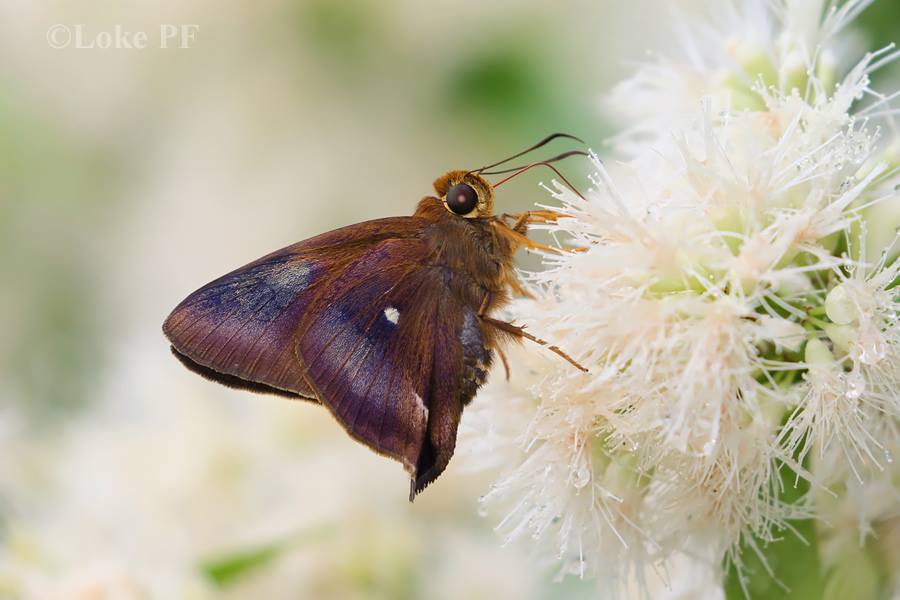
A Common Awl feeding at the flowers of a Syzygium tree

The species is known to puddle, particularly on damp organic matter or excretions of birds spattered on the top surfaces of forest vegetation. Other sightings of this species, besides being perched on the undersides of leaves, are when the Syzygium trees bloom. The Common Awl is seen feeding at the nectar-rich flowers together with other butterflies.


A newly eclosed female Common Awl showing the upperside hyaline spots on its forewing

The Common Awl is a drab brown on the upperside with the wings usually unmarked in the male. There may be a series of usually 2-3 small subapical spots on the forewing. The female has three large pale yellow hyaline spots in the discal area of the forewing, with the wing bases ochreous.


A Common Awl feeding on the minerals on the damp surface of a brick wall

The underside is brown, with a purplish glazed sub-marginal band that may appear more pronounced depending on the angle of incident light on the wings. A prominent white spot in the cell on the underside of the hindwing is characteristic of this species. There is usually a white streak at the tornal area of the hindwing.


Two female Common Awls, note the large pale yellow hyaline spots visible on the forewing

Sightings of the Common Awl are usually in the early morning hours before 9am and in the late evenings, when the species is more active. Its crepuscular habit makes the species rather elusive during the normal hours when other butterfly species are up and about. However, along mangrove trails and boardwalks, the Common Awl may be often seen at other times of the day if it is disturbed from its slumber.

Text by Khew SK : Photos by David Chan, Foo JL, Khew SK, Loke PF, Jonathan Soong and Horace Tan

10 March 2010

Return to Semakau

Return to Semakau
A Hot Sunday Butterfly Outing


Last Sunday, 7 Mar 2010, twelve members of ButterflyCircle made a return trip to Pulau Semakau for a butterfly survey, after the last outing over a year ago on 28 Feb 2009. The objective of this outing was to ascertain if there are more species that have been missed out in the previous surveys during the writing of the book on Semakau.


This time, the team comprised several senior members of ButterflyCircle, as well as a number of newbies going to Semakau for the first time.


The happy adventurers!

After an uneventful and short trip under an overcast morning sky, the group disembarked at the jetty on Semakau, and greeted by our bubbly host, Patrick Yu of the NEA. For the benefit of the first-timers, we did a quick tour of the waste processing facilities at the main building, before heading towards the forested patch where we did our surveys during our last few outings.


Sunny showing Federick the naval map and the islands around Singapore

By this time, the sun was out and the scorching heat of the past few days greeted us. Whilst some of us headed for the shade of the forested area, the braver members headed out to the grassland of the filled cells. Surprisingly, we did not encounter the 'commando' mosquitoes of the previous trips, and we attributed this to the hot and dry weather where all the stagnant pools of water and streams were all but parched.


ButterflyCircle members, the hunt begins!

But our butterfly friends were still up and about, and the usual Common Tigers, Tawny Costers and Grass Yellows were fluttering restlessly about the wild grasses. The shady forested areas were still active with butterflies, with the Orange Tit (Hypolycaena thecloides thecloides) flitting skittishly around the shrubs, whilst there were a few Palm Bobs still lurking around near their favourite perches.


Two Danainae - the King Crow (Euploea phaenareta castelnaui) and the Spotted Black Crow (Euploea crameri bremeri) were added to the Semakau checklist for the first time. Both were spotted in the forested patch. The Common Awls (Hasora badra badra) were found in the shady areas and behaved typically by zipping under leaves and hanging upside down. A large butterfly which appeared to resemble a Palm King (Amathusia phidippus phidippus) zoomed across my path but being unable to have a shot for positive identification, I am leaving it out of the checklist for the time being.


A mating pair of the Two Spotted Line Blue

Out in the open grasslands, the Two Spotted Line Blue (Nacaduba biocellata) was still at its favourite location under the host plant's shade. Blue Pansys and some skittish skippers abound in the long grass areas. This time around, four new Lycaenidaes were spotted. These were Pea Blue (Lampides boeticus), Gram Blue (Euchrysops cnejus cnejus), Indian Cupid (Everes lacturnus rileyi) and the Pygmy Grass Blue (Zizula hylax pygmaea) and were added to the checklist.


The hot humid weather started to take its toll on most of our members, and we retreated to the 'base camp' hut for shelter and lunch. After a rest, some of us made a second tour in the forested patch and some headed for the grassy area in the hope of spotting further new finds. However, our tally of new species spotted stopped at six.


John Lee, our fearless bee and wasp expert, was also having a field day chasing after his busy subjects.


At around 2 pm, most of us were drained by the heat, and we decided to call it a day. Happy with an additional six species to the Semakau Checklist, we called for our transport and Patrick Yu happily obliged. We were treated to a short rest at the airconditioned administration building whilst our boatman headed out from West Coast Terminal.


We bade farewall to Patrick and his NEA colleagues and boarded the boat "3931" back to the main island of Singapore. The trip back was uneventful, and some of us took the chance for a much-needed nap on the boat. Before long, we had our feet planted firmly on land again, and headed for our transport back home.


The ButterflyCircle Dozen
Back Row : L-R : Sunny, John, Horace, Ben Jin, Khew & Nelson
Front Row : L-R : Ellen, Cher Hern, Loke, Chng, Anthony & Federick

Thus ended a rather fruitful re-visit to Semakau after over a year when we last did our survey on the Landfill Island off the southern coast of Singapore island. Thanks to all ButterflyCircle members who contributed and participated in this first survey of 2010.

Updated Checklist of Butterflies Observed at Pulau Semakau (As at 7 Mar 2010)

  1. Common Mormon (Papilio polytes romulus)
  2. Common Grass Yellow (Eurema hecabe contubernalis)
  3. Three Spot Grass Yellow (Eurema blanda snelleni)
  4. Striped Albatross (Appias libythea olferna)
  5. Common Tiger (Danaus genutia genutia)
  6. Black Veined Tiger (Danaus melanippus hegesippus)
  7. Blue Glassy Tiger (Ideopsis vulgaris macrina)
  8. King Crow (Euploea phaenareta castelnaui) - NEW
  9. Spotted Black Crow (Euploea crameri bremeri) - NEW
  10. Striped Blue Crow (Euploea mulciber mulciber)
  11. Tawny Coster (Acraea violae)
  12. Baron (Euthalia aconthea gurda)
  13. Leopard (Phalanta phalantha phalantha)
  14. Perak Lascar (Pantoporia paraka paraka)
  15. Autumn Leaf (Doleschallia bisaltide bisaltide)
  16. Great Eggfly (Hypolimnas bolina bolina)
  17. Blue Pansy (Junonia orithya wallacei)
  18. Blue Nawab (Polyura schreiber tisamenus)
  19. Common Palmfly (Elymnias hypermestra agina)
  20. Silver Forget-Me-Not (Catochrysops panormus exiguus)
  21. Gram Blue (Euchrysops cnejus cnejus) - NEW
  22. Pea Blue (Lampides boeticus) - NEW
  23. Indian Cupid (Everes lacturnus rileyi) - NEW
  24. Ciliate Blue (Anthene emolus goberus)
  25. Centaur Oakblue (Arhopala centaurus nakula)
  26. Common Tit (Hypolycaena erylus teatus)
  27. (Hypolycaena thecloides thecloides)
  28. Long Banded Silverline (Spindasis lohita senama)
  29. Two Spotted Line Blue (Nacaduba biocellata)
  30. Tailless Line Blue (Prosotas dubiosa lumpura)
  31. Lesser Grass Blue (Zizina otis lampa)
  32. Pygmy Grass Blue (Zizula hylax pygmaea) - NEW
  33. Common Awl (Hasora badra badra)
  34. Common Palm Dart (Telicota colon stinga)
  35. Yellow Palm Dart (Cephrenes trichopepla)
  36. Palm Bob (Suastus gremius gremius)
  37. Chestnut Bob (Iambrix salsala salsala)
  38. Lesser Dart (Potanthus omaha omaha)
  39. Large Dart(Potanthus serina)
  40. Banded Demon (Notocrypta paralysos varians)
Text by Khew SK : Photos by Sunny Chir, Chng CK, Federick Ho, Khew SK, Koh Cher Hern, Loke PF, Nelson Ong, Tan BJ, Ellen Tan & Horace Tan

05 December 2009

Life History of the Common Awl

Life History of the Common Awl (Hasora badra badra)


Butterfly Biodata:
Genus: Hasora Moore, 1881
Species: badra Moore, 1858
Subspecies: badra Moore, 1858
Wingspan of Adult Butterfly: 47mm
Caterpillar Host Plants: Derris trifoliata (Leguminosae, Papilionoideae),
D. elliptica and two others (suspected to be Derris species).


A female Common Awl on the leaf surface of the Coconut Palm.

Physical Description of Adult Butterfly:
Adults are rather large in size with pointed forewing apex and markedly lobate hindwings. Above, the wings are dark brown. In the male, the wings are typically unmarked or with faint subapical spots. In contrast, the female has three pale yellowish subapical spots, large pale yellow hyaline spots in the cells and in spaces 2 and 3 on the forewing Wings bases of the female are ochreous. Below, both sexes are brown and often washed with purple, more so in pristine specimens. The forewing is pale yellowish to whitish at dorsum entering middle of space 2. On the hindwing, there is a small white roundish spot in the cell and an elongated white spot in the subtornal area. The spots on the forewing upperside correspond to those on the underside.


A female Common Awl with partially opened wings, showing us the various spots on its forewings

Field Observations of Butterfly Behaviour:
Adults are rarely seen in Singapore, likely due to its crepuscular nature. In contrast, the larval stages are rather readily found on various Derris species at multiple locations in Singapore. The adults are usually sighted in the vicinity of its larval food plants, typically ovipositing females. The usual perching site is on the underside of a leaf or other plant parts, resulting in photographs of "upside-down" adults being the most common takes of this species.


A male Common Awl on the underside of a leaf.


A male Common Awl pertching on the underside of a leaf.

Early Stages:

The 1st local host plant, Derris trifoliata, is a scandent shrub with 3-5 leaflets in a pinna, pink flowers, thin and flat pods. This plant is commonly found on coastal areas such as the Sungei Buloh Wetland Reserve and Kranji Nature Reserve.


Host plants : Derris trifoliata.

The 2nd host plant, Derris elliptica, is also a scandent shrub but with 9-15 obovate-oblong leaflets in a pinna and has brown pubescent branches. Extracts from both Derris species have been used as insecticides and by locals as "poison" for catching fish/shrimps.


Host plant : Derris elliptica.

Two other host plants, found in the nature reserves and in the Southern Ridges, are also woody climbers with 5-foliate and 7-foliate leaves. It is likely that they are Derris species too. The variegated early stages of the Common Awl feed on the young and still tender leaves of the host plants. The newly hatched and the 1st and 2nd instars typically feed on the youngest and still yellow/brown leaflets. Common Awl caterpillars of all instars also construct leaf shelters by joining leaf blades with silk threads.


Local host plants : unknown sp. #1 (left); unknown sp. #2 (right).


A mother Common Awl ovipositing on young shoots of Derris elliptica.

The eggs are laid singly on young shoots of the host plants. Each egg is white with a biege tinge. It is shaped like a pressed bun with a large flattened base (diameter: 0.9mm) and prominent ridges running from the pole to the base. The micropylar sits atop at the pole.


Two views of an egg of the Common Awl.


Mature egg (left), empty egg shell (right)

It takes 2-3 days for the collected egg to hatch. The young caterpillar eats just enough of the shell to emerge, and has a length of about 2mm. It has the typical cylindrical shape for skipper caterpillars, and the pale yellowish brown body has a number of moderately long setae. The large head is black, slightly bi-lobed and lightly hairy.


1st instar caterpillars. Top: early in this stage, length: 1.9mm.
Bottom: later in this stage, length :2.5mm.


The young caterpillar constructs its first leaf shelter by bringing two halves of a small young leaf together with silk threads. It rests within the flap and ventures out to eat on nearby leaf surface. In later instars, the Common Awl caterpillars also construct leaf shelters in a similar fashion but do so with larger and older leaves.


Leaf shelters and eggs found on young shoots and leaflets of unknown host #1.

After 2 days in 1st instar and reaching a length of about 4mm, the caterpillar moults to the next instar. The 2nd instar caterpillar has four faint yellowish dorsal bands, and a large number of faint yellowish rings on the body segments. Black dorso-lateral patches are found on the 3rd thoracic segment, 2nd, 4th, 6th and 8th abdominal segments.These patches increase in size as the caterpillar grows in this instar. All three thoracic segments are much smaller (narrower) compared to the abdominal segments, with the prothoracic segment being dark brown to black. The body and the head capsule are also covered in short fine setae.


2nd instar caterpillars. Top: early in this stage, length: 4mm.
Bottom: late in this stage,length: 8.5mm.


The 2nd instar caterpillar reaches a length of about 9mm, and after 2 days in this stage, it moults again. The 3rd instar caterpillar resembles the 2nd instar caterpillar but with more striking yellow coloration on the segmental rings and dorsal bands. This instar lasts another 2 days with the length reaching 14-15mm.


3rd instar caterpillars. Top: early in this stage, length: 9mm.
Bottom: late in this stage,length: 13.5mm.


The 4th instar caterpillar resembles the 3rd instar caterpillar closely. One noticeable change is the appearance of a pair of narrow black dorso-lateral patches on the 2nd thoracic segment. This stage takes about 6-9 days to complete with the body length reaching 25-29mm.


4th instar caterpillars. Top: early in this stage, length: 14mm.
Bottom: late in this stage, length: 25mm.


The final and 5th instar caterpillar has similar body markings and coloration as the 4th instar caterpillar. One unmistaken change is in the head capsule which has now become dark cherry red with three medium-sized black spots. The prothoracic segment is colored as per the head capsule and has a pair of black dorso-lateral stripes. Dense white setae cover the whole body. This stage takes about 6-9 days to complete with body length reaching about 41mm.


5th (final) instar caterpillars of the Common Awl. Lengths: 33mm (top); 36mm (bottom).


A close-up view of the head capsule of the final instar larva of the Common Awl.

Towards the end of 5th instar, the body of the caterpillar gradually shrinks in length. It ceases feeding and stations itself in its leaf shelter and enters the preparatory pupa phase. During the early part of this stage, the caterpillar spins large quantity of silk threads to seal the pupation shelter, and in particular, constructs a silk girdle at its 2nd/3rd abdominal segment and a short transverse silk band near its posterior end. Both the dorsal point of the girdle and the transverse band are also secured by vertical/oblique threads to the inner wall of the shelter.


Two views of a pre-pupa of the Common Awl.

After about 1 day of the pre-pupal phase, pupation takes place within the pupation shelter. The pupa secures itself with its cremaster attached to the transverse band. The pupa has a short thorax, a rather long abdomen and a black and pointed rostrum. Fresh after the pupation event, the body is pale yellow with large and cherry red spots (corresponding to the black patches on the larval body), but these fade 0.5 to 1 day later, and the body surface becomes mostly covered in a white substance. Length of pupae: 24-26mm.


Two views of a newly formed pupa. Note the red spots which will fade away within a day.


Two views of a pupa of the Common Awl with a coating of whitish powdery substance.


Sequence of three shots of the silk girdle from the pre-pupal to the pupal stage.
Note the girdle is suspended vertically with another silk thread to the shelter wall (or ceiling).


Three views of the posterior end from the pre-pupal to the pupal stage.
Note the transverse silk band and cremastral attachment to it during the pupal stage.


Two views of the cremastral attachment to the bundle of transverse silk strands.
Note the cluster of brown to dark brown hooks protruding from the cremaster to engage the silk threads.


After 6-7 days, the pupa becomes darkened in color signaling the imminent emergence of the adult. The next day the adult butterfly emerges from the mature pupa.


Two views of a mature pupa of the Common Awl


A newly eclosed Common Awl drying its wings near its pupal case.


A newly eclosed female Common Awl.

References:

  • The Butterflies of The Malay Peninsula, A.S. Corbet and H.M. Pendlebury, 4th Edition, The Malayan Nature Society.
  • Butterflies of Thailand, Pisuth Ek-Amnuay, 1st Edition, 2006
  • The Butterflies of Hong Kong, M. Bascombe, G. Johnston, F. Bascombe, Princeton University Pres 1999

Text by Horace Tan, Photos by Khew SK and Horace Tan.