Showing posts sorted by relevance for query eurema blanda. Sort by date Show all posts

25 April 2009

The Grass Yellows of Singapore (Part 1)

The Grass Yellows of Singapore (Part 1)

This blog article features the genus Eurema which comprise comparatively small, deep-lemon yellow butterflies with black borders. The Eurema, often referred to as the "Grass Yellows" are relatively common in Singapore, although there are actually six distinct species occuring on the island, and one of the species is a recent re-discovery and its habitat is threatened with development.


The more common species are found throughout the island, from urban areas to the forested nature reserves. At times, they can be abundant, where hundreds can be seen fluttering in an almost 'migratory' fashion in certain parts of the island. However, these rare 'break-outs' are seasonal, and could have been triggered by a variety of factors - from abundance of host plants, to the absence of predators and parasitic insects which keep the population in check and maintains a balance in nature.

The Grass Yellows are generally weak flyers, fluttering low around bushes and flowers. The caterpillars of the species feed on Leguminosae and it is known that various species have various alternative host plants. Amongst the favourite genera are Cassia (Senna), Caesalpinia, Paraserianthes (Albizia), Acacia and many others.

The identification of the species of Eurema is often not easy, particularly when the butterflies have a rather restless flight, and are alert when approached. The main identifying characteristics rely on certain distinguishing markings, particularly the number of spots at the cell on the underside of the forewing. The following is an identification key to the separation of the species in the genus :


Eurema species with no cell spots on the underside of the forewings

Eurema brigitta senna (No Brand Grass Yellow) - Upperside forewing black apical border serrated but not more deeply excavated in spaces 2 & 3. Male has no brand.

Eurema species with one cell spot on the underside of the forewings

Eurema sari sodalis (Chocolate Grass Yellow) - Underside forewing apical area entirely dark brown.

Eurema andersonii andersonii (Anderson's Grass Yellow) - Underside forewing apical area not entirely darkened. Inner edge of black border in space 1a and 1b inclined slightly towards tornus. Upperside black distal border not more deeply excavated in space 2 than in space 3.

Eurema species with two cell spots on the underside of the forewings

Eurema hecabe contubernalis (Common Grass Yellow) - Upperside forewing black border in space 1a and 1b at right angles to dorsum or sloping towards base.

Eurema simulatrix tecmessa - Underside forewing has a large cleft reddish brown apical spot.

Eurema species with three cell spots on the underside of the forewings

Eurema blanda snelleni (Three Spot Grass Yellow) - Upperside of the male with reduced and narrower black borders.

In Part 1 of this article, we feature three of the six Eurema species extant in Singapore.


The No Brand Grass Yellow (Eurema brigitta senna)


This species is a recent re-discovery, after missing from the Singapore checklist for a number of years. In an earlier blog article, we featured this species in detail. The No Brand Grass Yellow is the only species where the underside forewings are without cell spots. Upperside forewing black apical border serrated, but not more deeply excavated in spaces 2 and 3. Females are slightly more unique in that the yellow colour of the hindwings are lighter than the forewings on the undersides. The males' undersides are unicolourous as with the other species of this genus.


Both sexes undersides are covered with small brown 'freckles' which give the wings a rather spotted appearance, as compared to the other species in the genus. In certain individuals, the freckles are distinctly pronounced as to give the butterfly a very uniquely heavily spotted appearance, almost obscuring the clean yellow background colour of the wings.


The host plant of the species, Cassia mimosoides has been cultivated and located to other parts of the island in the hope of allowing the species to be translocated from its current habitat, which is under the threat of development. The species is highly vulnerable, although it can be common where its host plant occurs, and its preferred habitat of open sunny wasteland.


The Chocolate Grass Yellow (Eurema sari sodalis)


The Chocolate Grass Yellow is amongst the easiest of the genus to identify, especially when the butterfly stops to feed or puddle. The species' distinct solid brown apex on the forewing beneath sets it apart from the other species amongst the Eurema. The species is locally common, in locations where its preferred host plant is available.


However, it is not as widespread as the more common species of the genus, preferring the sanctuary of the fringes of the nature reserves in forested areas. It is more often encountered in well-vegetated areas of the forested parts of Singapore than flying in urban parks and gardens.

Where it occurs, males of the Chocolate Grass Yellows are often observed to puddle at sandy banks which have been tainted with fermenting organic matter, carrion and the like. Once it settles down to puddle, it remains quite still as it feeds, and allows an observer to get quite close to it.


The Anderson's Grass Yellow (Eurema andersonii andersonii)


This is a species that almost exclusively remains in the forested areas of Singapore's nature reserves. It is probably one of the rarer species of the genus (though one can argue that none of the species can be considered 'rare'). Usually seen singly, the Anderson's Grass Yellow features only one cell spot on the forewing beneath, like the Chocolate Grass Yellow. However, it does not have the former's solid brown apical patch.


Like its close cousin, the species has also often been observed to puddle at forest paths and sand banks of streams. In the morning hours, it also visits various flowering bushes as it feeds. Favourites are the white flowers of the Common Asystasia (Asystasia gangetica), the purple flowers of the Common Snakeweed (Stachytarpheta indicus) and several other wildflowers found in the forests.


The wings of the species also appear to be more rounded than its close cousins, and it has a comparatively more robust flight. At times it tends to have a habit of fluttering around low bushes, and then settling on the undersides of leaves.


Text by Khew SK ; Photos by Khew SK

References:

  • The Butterflies of The Malay Peninsula, A.S. Corbet and H.M. Pendlebury, 4th Edition, Malayan Nature Society.

01 May 2009

The Grass Yellows of Singapore (Part 2)

The Grass Yellows of Singapore (Part 2)

Part 2 of this article on the Grass Yellows of Singapore features the remaining three species of the genus Eurema, all of which have either two or three cell spots on the underside of their forewings. (Refer to the ID Key in Part 1 of the article).

The Common Grass Yellow (Eurema hecabe contubernalis)


The Common Grass Yellow is described as the "commonest butterfly in the eastern tropics" and has a range that extends from Sri Lanka to Australia. This species, and the Three Spot Grass Yellow, has been observed to have seasonal 'breakouts' where large numbers of the same species can be found flying at many locations across Singapore. There was a year when the species was observed flying across one of the expressways, and a large number of roadkills was recorded as the butterflies were smashed by the speeding oncoming traffic.


The Common Grass Yellow is as frequently observed in urban parks, gardens and wherever there is a patch of greenery, as well as in the forested areas. It is widespread, and the caterpillars feed on a variety of Leguminosae plants.


The butterfly, with its bright lemon yellow wings with black bordering on the upperside and dark brown markings on the underside, is often very variable, particularly in the underside markings. The female is larger and a paler yellow, with broader black but diffused markings on the uppersides of both wings, particularly on the black marginal border on the hindwings.

(Eurema simulatrix tecmessa)


This species, which can be considered the rarest of the Grass Yellows, is also the largest amongst the 6 species in the genus found in Singapore. The characteristic cleft subapical reddish-brown marking on the underside of the forewing distinguishes it from the other species.


Whenever encountered, they are usually observed singly, either feeding at flowering plants, or puddling on sandy mudbanks. It is never abundant, and rarely, if ever, seen in large numbers unlike the Common Grass Yellow or the Three Spot Grass Yellow.


A rare threesome puddling shot of E. simulatrix

The Three Spot Grass Yellow (Eurema blanda snelleni)


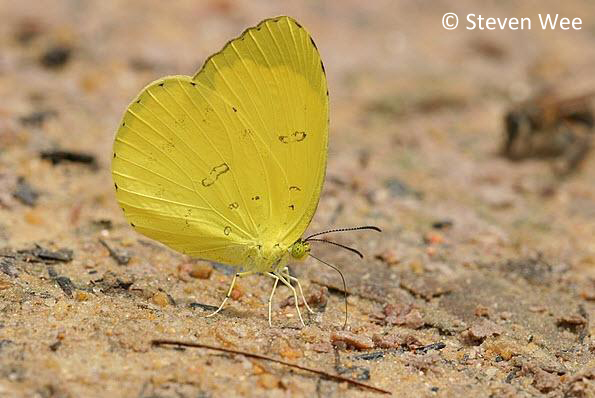
This species probably rivals the Common Grass Yellow for the title as the most common Grass Yellow. As widespread as its cousin, the Three Spot Grass Yellow is unique in having three cell spots on the underside of the forewing. Males tend to have reduced upperside black marginal borders, although the females bear the typically broader and diffused borders.


Found in urban locations as well as in the nature reserves, the Three Spot Grass Yellow is also known to puddle in numbers along forest trails and sandy banks of streams which have been contaminated by decomposing organic material.


Females of the Three Spot Grass Yellow have been observed to lay large clutches of eggs on the host plant Falcataria moluccana (Albizia). In a single sitting, a female was seen to have laid at least 103 eggs on a leaf of the host plant!


How many E. blanda eggs can you count on the leaf?

Besides the six species which have been reliably identified in the Singapore Checklist, it is very likely that several other species, primarily those that occur in the Malay Peninsula, may appear in Singapore one day. Two of the species have not been observed since the early records of their presence is Singapore, and may eventually appear again. Thus far, our records have shown that these two species, Eurema ada iona and Eurema lacteola lacteola have not been reliably sighted (or may have been missed), and effort should be made to establish their status in the Singapore checklist.

Text by Khew SK ; Photos by Khew SK & Federick Ho

09 January 2016

Butterfly of the Month - January 2016

Butterfly of the Month - January 2016
The Three Spot Grass Yellow (Eurema blanda snelleni)


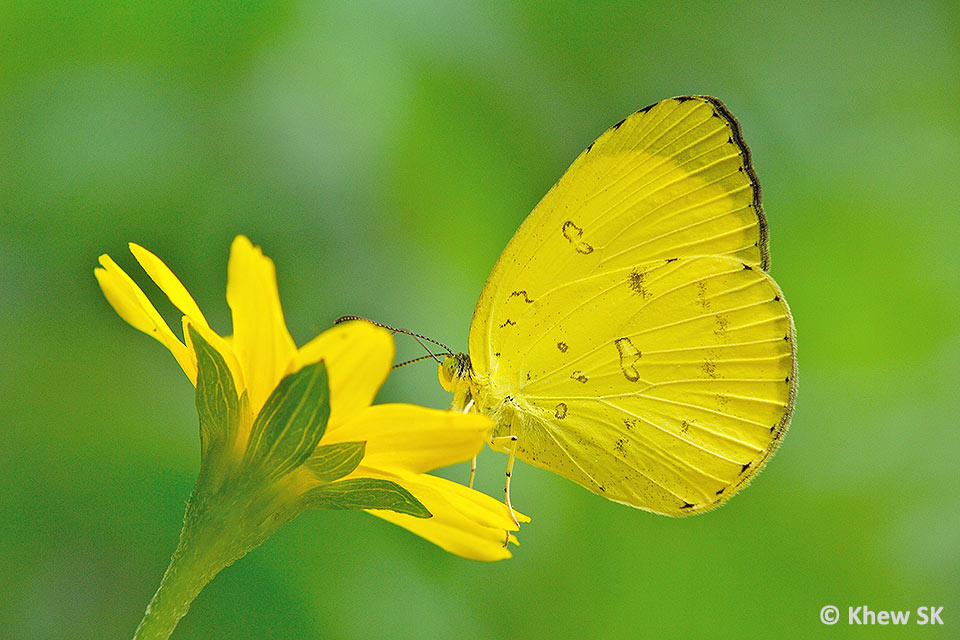
A Three Spot Grass Yellow feeding on the flower of the Creeping Yellow Daisy (Wedelia trilobata)

2016 is upon us already. As the euphoria of the new year countdowns die down, and the last strains of Auld Lang Syne fade from our minds, we get back to the grind and prepare for new challenges and look forward to opportunities in our work and family life. 2016 is a leap year, a special year that comes once in every four years. The leap year is usually associated with 29 days in February, and the year in which the Olympic games are held. This year, the Summer Olympics XXXI will be held in Rio de Janeiro in Brazil.


On the global economic front, the outlook is generally bleak, with predictions of slow economic growth in many countries. In particular, the growth of Asian powerhouse, China, is likely to be severely dampened and the resultant effect is expected to impact many other Asian economies. Already, on the first trading day of the year, the Chinese stock exchange lost 7% of its value, triggering a "circuit breaker" in the system and halted trading for the day. Although trading resumed after intervention by the Peoples' Bank of China, the global stock markets will likely be unpredictable for the foreseeable future.


On our little red dot, life goes on. Following a successful (for the ruling party) General Elections, we see a new bunch of goodies for the citizens (e.g. the Skills Future Study awards), and more programmes to improve the lives of various stakeholder groups. A year after our city-state's 50th birthday, Singaporeans are looking ahead and planning for "what next?". SG50 + 1, as a Minister refers to 2016, starts a whole new anticipation about where Singapore should head.


A mating pair of Three Spot Grass Yellow (male top, female bottom)

I recently participated at the dialogue of a multi-agency symposium to talk about a "cleaner, greener and smarter Singapore". This SGconversations series will focus on topics related to A City in a Garden, Vibrant Community Spaces, Eco Smart Towns and a Green and Conserving Culture. Urban greenery should embody biodiversity as well. Lush plants and landscaped parks and gardens are not just for humans, but for our birds, butterflies, dragonflies, spiders, and a whole bunch of fauna that call Singapore home as well. Can developments and improvements for our city life co-exist harmoniously with biodiversity? Do share your ideas at the various symposium sessions or on the e-portals that collect feedback.


A puddling male Three Spot Grass Yellow

2016, where new year resolutions are made. What would be ours for the butterflies? For ButterflyCircle members, our next book project will commence in earnest this year. There will be urban and nature reserve surveys and a lot of work to be done on researching host plants, habitats and conservation strategies for butterflies in Singapore. There have been more requests to set up community butterfly gardens and other similar butterfly-conservation initiatives. What have we learnt from the existing efforts that we can share with these newbies?


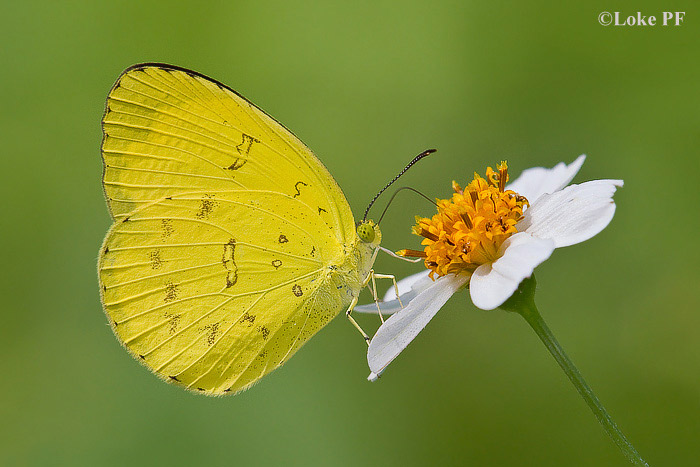
A Three Spot Grass Yellow feeding on the flower of the Bandicoot Berry (Leea indica)

We continue into our 9th year with our Butterfly of the Month series. Let's start 2016 with a bright cheery yellow butterfly to symbolise hope and optimism. Our feature butterfly this month is the common and ubiquitous Three Spot Grass Yellow (Eurema blanda snelleni). A small but easily encountered butterfly, the species can sometimes be even abundant at certain times of the year.


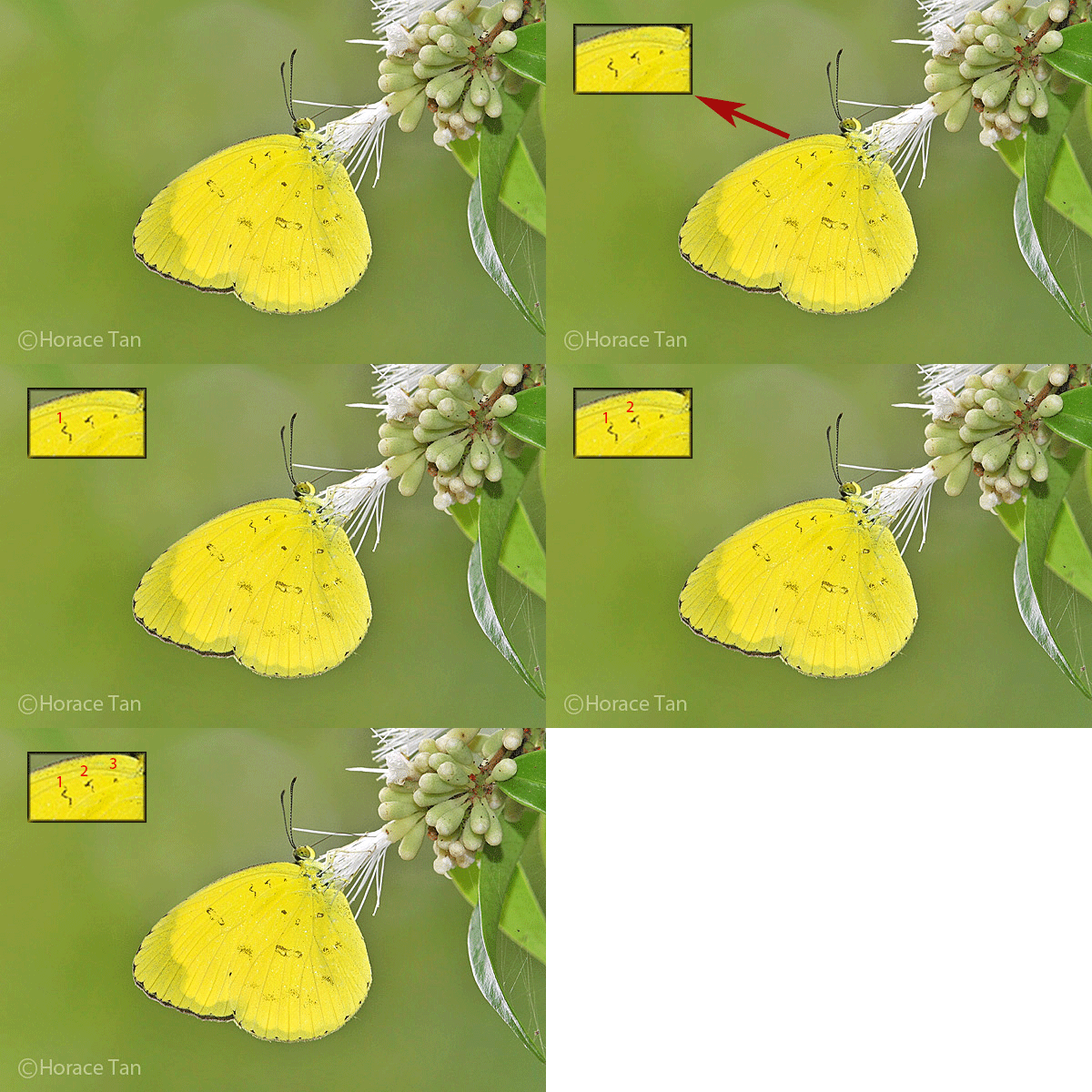
An animated shot showing the three cell spots that are unique to identify this species

The Three Spot Grass Yellow is one of several lookalikes of the genus Eurema or commonly referred to as the Grass Yellows. The Three Spot Grass Yellow is unique in that it is the only species in the genus to feature three cell spots on the underside of the forewing. Males tend to have reduced upperside black marginal borders compared to the other related species in the genus. The females bear the typically broader and diffused borders.  The apical streak on the underside of the forewing appears to be a feature that is mainly associated with females of this species.


The species can be found in urban locations as well as in the nature reserves. The Three Spot Grass Yellow is often seen feeding at flowering plants but is also observed to puddle in numbers along forest trails and sandy banks of streams which have been contaminated by decomposing organic material. Males appear to be commoner of the two sexes and is sometimes seen with other butterfly species when they are puddling.


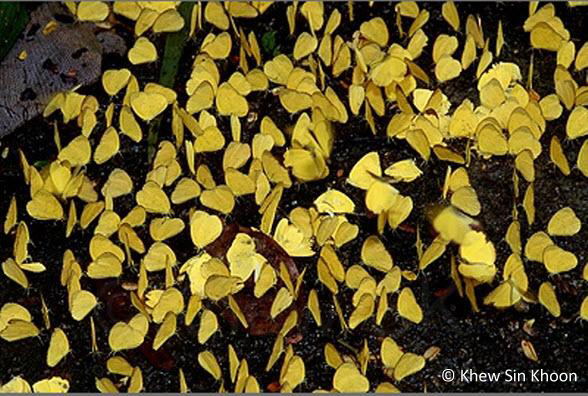
Top : An outbreak of Three Spot Grass Yellows in Singapore's nature reserves.
Bottom : How many eggs can you count on this leaf?

Females of the Three Spot Grass Yellow have been observed to lay large clutches of eggs on the host plant Falcateria moluccana (Albizia), a fairly common tree that grows easily. In a single sitting, a female was observed to have laid at least 103 eggs on a single leaf of the host plant! This may explain the occasional outbreaks of this species, as "clouds of yellow butterflies" appear in parts of Singapore.


And so we look ahead to 2016 with a bit more optimism and cheer with our bright yellow Three Spot Grass Yellow and hope that this year will be a better year for all!

Text by Khew SK : Photos by Sunny Chir, Huang CJ, Khew SK, Loke PF, Horace Tan and Tan BJ

03 January 2015

Life History of the Three Spot Grass Yellow

Life History of the Three Spot Grass Yellow (Eurema blanda snelleni)


Butterfly Biodata:
Genus: Eurema
Hübner, 1819
Species: blanda Boisduval, 1836
Subspecies: snelleni Moore, 1907
Wingspan of Adult Butterfly: 35-45mm
Caterpillar Local Host Plant: Falcateria moluccana (Fabaceae, common name: Albizia).


A large group of puddling Three Spot Grass Yellow adults.

A Three Spot Grass Yellow with the "three spots" illustrated.

Physical Description of Adult Butterfly:
Above, the wings are deep lemon-yellow. The forewing has a black border which is regularly scalloped and deeply excavated between veins 2 and 4 (more so in the female than in the male). Underneath, the wings are yellow with freckled brown spots. There are typically three cell spots on the forewing and a black spot at the base of space 7 on the hindwing. It is not uncommon for some individuals to have a large brown apical spot/patch on the forewing. Males have a brand lying along the cubital vein on the forewing underside.


Field Observations of Butterfly Behaviour:
The Three Spot Grass Yellow is common in Singapore and can be found both inside and outside the nature reserves. The adults can be seen fluttering in their habitatss in the company of other Grass Yellow spp. leading to difficulty in identifying them correctly. They regularly visit flowers for nectar and puddle on wet grounds for minerals. There have been records of population outbreaks when hundreds of them can be seen together in various locations across Singapore.

10 March 2010

Return to Semakau

Return to Semakau
A Hot Sunday Butterfly Outing


Last Sunday, 7 Mar 2010, twelve members of ButterflyCircle made a return trip to Pulau Semakau for a butterfly survey, after the last outing over a year ago on 28 Feb 2009. The objective of this outing was to ascertain if there are more species that have been missed out in the previous surveys during the writing of the book on Semakau.


This time, the team comprised several senior members of ButterflyCircle, as well as a number of newbies going to Semakau for the first time.


The happy adventurers!

After an uneventful and short trip under an overcast morning sky, the group disembarked at the jetty on Semakau, and greeted by our bubbly host, Patrick Yu of the NEA. For the benefit of the first-timers, we did a quick tour of the waste processing facilities at the main building, before heading towards the forested patch where we did our surveys during our last few outings.


Sunny showing Federick the naval map and the islands around Singapore

By this time, the sun was out and the scorching heat of the past few days greeted us. Whilst some of us headed for the shade of the forested area, the braver members headed out to the grassland of the filled cells. Surprisingly, we did not encounter the 'commando' mosquitoes of the previous trips, and we attributed this to the hot and dry weather where all the stagnant pools of water and streams were all but parched.


ButterflyCircle members, the hunt begins!

But our butterfly friends were still up and about, and the usual Common Tigers, Tawny Costers and Grass Yellows were fluttering restlessly about the wild grasses. The shady forested areas were still active with butterflies, with the Orange Tit (Hypolycaena thecloides thecloides) flitting skittishly around the shrubs, whilst there were a few Palm Bobs still lurking around near their favourite perches.


Two Danainae - the King Crow (Euploea phaenareta castelnaui) and the Spotted Black Crow (Euploea crameri bremeri) were added to the Semakau checklist for the first time. Both were spotted in the forested patch. The Common Awls (Hasora badra badra) were found in the shady areas and behaved typically by zipping under leaves and hanging upside down. A large butterfly which appeared to resemble a Palm King (Amathusia phidippus phidippus) zoomed across my path but being unable to have a shot for positive identification, I am leaving it out of the checklist for the time being.


A mating pair of the Two Spotted Line Blue

Out in the open grasslands, the Two Spotted Line Blue (Nacaduba biocellata) was still at its favourite location under the host plant's shade. Blue Pansys and some skittish skippers abound in the long grass areas. This time around, four new Lycaenidaes were spotted. These were Pea Blue (Lampides boeticus), Gram Blue (Euchrysops cnejus cnejus), Indian Cupid (Everes lacturnus rileyi) and the Pygmy Grass Blue (Zizula hylax pygmaea) and were added to the checklist.


The hot humid weather started to take its toll on most of our members, and we retreated to the 'base camp' hut for shelter and lunch. After a rest, some of us made a second tour in the forested patch and some headed for the grassy area in the hope of spotting further new finds. However, our tally of new species spotted stopped at six.


John Lee, our fearless bee and wasp expert, was also having a field day chasing after his busy subjects.


At around 2 pm, most of us were drained by the heat, and we decided to call it a day. Happy with an additional six species to the Semakau Checklist, we called for our transport and Patrick Yu happily obliged. We were treated to a short rest at the airconditioned administration building whilst our boatman headed out from West Coast Terminal.


We bade farewall to Patrick and his NEA colleagues and boarded the boat "3931" back to the main island of Singapore. The trip back was uneventful, and some of us took the chance for a much-needed nap on the boat. Before long, we had our feet planted firmly on land again, and headed for our transport back home.


The ButterflyCircle Dozen
Back Row : L-R : Sunny, John, Horace, Ben Jin, Khew & Nelson
Front Row : L-R : Ellen, Cher Hern, Loke, Chng, Anthony & Federick

Thus ended a rather fruitful re-visit to Semakau after over a year when we last did our survey on the Landfill Island off the southern coast of Singapore island. Thanks to all ButterflyCircle members who contributed and participated in this first survey of 2010.

Updated Checklist of Butterflies Observed at Pulau Semakau (As at 7 Mar 2010)

  1. Common Mormon (Papilio polytes romulus)
  2. Common Grass Yellow (Eurema hecabe contubernalis)
  3. Three Spot Grass Yellow (Eurema blanda snelleni)
  4. Striped Albatross (Appias libythea olferna)
  5. Common Tiger (Danaus genutia genutia)
  6. Black Veined Tiger (Danaus melanippus hegesippus)
  7. Blue Glassy Tiger (Ideopsis vulgaris macrina)
  8. King Crow (Euploea phaenareta castelnaui) - NEW
  9. Spotted Black Crow (Euploea crameri bremeri) - NEW
  10. Striped Blue Crow (Euploea mulciber mulciber)
  11. Tawny Coster (Acraea violae)
  12. Baron (Euthalia aconthea gurda)
  13. Leopard (Phalanta phalantha phalantha)
  14. Perak Lascar (Pantoporia paraka paraka)
  15. Autumn Leaf (Doleschallia bisaltide bisaltide)
  16. Great Eggfly (Hypolimnas bolina bolina)
  17. Blue Pansy (Junonia orithya wallacei)
  18. Blue Nawab (Polyura schreiber tisamenus)
  19. Common Palmfly (Elymnias hypermestra agina)
  20. Silver Forget-Me-Not (Catochrysops panormus exiguus)
  21. Gram Blue (Euchrysops cnejus cnejus) - NEW
  22. Pea Blue (Lampides boeticus) - NEW
  23. Indian Cupid (Everes lacturnus rileyi) - NEW
  24. Ciliate Blue (Anthene emolus goberus)
  25. Centaur Oakblue (Arhopala centaurus nakula)
  26. Common Tit (Hypolycaena erylus teatus)
  27. (Hypolycaena thecloides thecloides)
  28. Long Banded Silverline (Spindasis lohita senama)
  29. Two Spotted Line Blue (Nacaduba biocellata)
  30. Tailless Line Blue (Prosotas dubiosa lumpura)
  31. Lesser Grass Blue (Zizina otis lampa)
  32. Pygmy Grass Blue (Zizula hylax pygmaea) - NEW
  33. Common Awl (Hasora badra badra)
  34. Common Palm Dart (Telicota colon stinga)
  35. Yellow Palm Dart (Cephrenes trichopepla)
  36. Palm Bob (Suastus gremius gremius)
  37. Chestnut Bob (Iambrix salsala salsala)
  38. Lesser Dart (Potanthus omaha omaha)
  39. Large Dart(Potanthus serina)
  40. Banded Demon (Notocrypta paralysos varians)
Text by Khew SK : Photos by Sunny Chir, Chng CK, Federick Ho, Khew SK, Koh Cher Hern, Loke PF, Nelson Ong, Tan BJ, Ellen Tan & Horace Tan