Showing posts sorted by relevance for query Tapena thwaitesi. Sort by date Show all posts

31 December 2023

Butterfly of the Month - December 2023

Butterfly of the Month - December 2023
The Dark Flat (Tapena thwaitesi bornea)

A female Dark Flat feeds on Bidens alba flower at a forest edge

December 2023 is almost over, and we count down to a new year ahead! Christmas has come and gone, as we reflect on what we have achieved over the past year and make resolutions and set targets for the new year. The month of December belongs to the astrological sign Sagittarius. For those born between 23 November to 21 December, you are a Sagittarian. We featured Capricorn, Aquarius, Pisces, Aries, Taurus, Gemini, Cancer, Leo and Virgo in the preceding Butterfly of the Month blogposts and will now move into the next in the series. The 12 zodiac signs are Aries, Taurus, Gemini, Cancer, Leo, Virgo, Libra, Scorpio, Sagittarius, Capricorn, Aquarius, and Pisces.

A male Dark Flat puddling at a damp footpath

Sagittarius (♐︎) (Greek: Τοξότης, romanized: Toxótēs, Latin for "archer") is the ninth astrological sign, which is associated with the half human and half horse, Centaur of mythology - the learned healer whose higher intelligence forms a bridge between Earth and Heaven. Also known as the Archer, Sagittarius is represented by the symbol of a bow and arrow. As an archer, Sagittarius never fails in hitting the mark and this depiction alludes to the power of prophecy, hence, the claim that seers and prophets are born in this sign.

Underside of a puddling male Dark Flat

The primary strength of Sagittarians is their optimism. Being born with a bold, jovial disposition, Sagittarians usually find it easy to feel happy, enthusiastic, and to see the bright side of life. Being influenced by Jupiter's affirming and confident nature, Sagittarians rarely succumb to self-doubt and are usually able to propel themselves forward in life, believing that everything will work out for the best.


Personal integrity is very important to Sagittarians, and they will have a difficult time accepting a situation which puts them in situations they feel to be false or inauthentic roles, ideas, or laws. Sagittarians are very unlikely to be possessive or materialistic since their lives prioritize being able to change, move, and adapt easily. Though they can be non-committal, they are also rarely jealous, extending the same freedoms to others who would also love to enjoy themselves.


Sagittarians will passionately state their points of view or principles in the moment, yet reserve the right to always change their mind, stating just as passionately their amended views later on. This can be disorienting for others who were sure they knew a Sagittarian's position on a matter, giving them a reputation for being fickle, or at times unreliable. Due to their adventurous spirit, and love of change and travel, Sagittarians are famously non-committal when it comes to plans, as they also reserve the right to change their agendas with their moods.

Female (top) and male (bottom) Dark Flats

The final Butterfly of the Month for 2023 is the moderately rare skipper, The Dark Flat (Tapena thwaitesi bornea). It belongs to the subfamily Pyrginae from the family Hesperiidae, referred collectively as "Flats", where the adult skippers are usually observed with their wings spread opened flat. It was a new discovery for Singapore when first recorded in the 1990's as it was not on the early authors' checklists for Singapore. It is the sole representative of its genus Tapena in the region.


Though moderately rare, it makes its appearance regularly in the forested areas of Singapore, and is widely distributed across the island. It is usually skittish and a fast-flyer but is able to be photographed when perching on the tops of leaves to sunbathe, or puddling on bird droppings and other organic matter on the forest floor.

Underside of a female Dark Flat

The Dark Flat is a dark brown on the upperside with obscure dark blotchy patches on both wings. On the forewing, there are usually two or three small hyaline subapical spots in the male. The female sports a few larger hyaline spots at the cell end on both wings and is usually larger in size. The species has been successfully bred in Singapore on the host plant Dalbergia rostrata (Leguminosae).

Text by Khew SK : Photos by Federick Ho, Khew SK, Henry Koh, Lee YT, Loke PF, Sebastian Ow, Zick Soh, Anthony Wong and Mark Wong

07 July 2012

Life History of the Dark Flat

Life History of the Dark Flat (Tapena thwaitesi bornea)


Butterfly Biodata:
Genus: Tapena Moore, 1881
Species: thwaitesi Moore, 1881
Sub-Species: bornea, Evans, 1931
Wingspan of Adult Butterfly: 30-35mm
Caterpillar Local Host Plant: Dalbergia rostrata (Leguminosae).

A puddling male Dark Flat showing its wing underside.

A male Dark Flat perching on a leaf in the nature reserve.

Physical Description of Adult Butterfly:
Both wings are angulated at vein 3, more strongly so in the hindwing. Above, the male is dark brown with obscure dark and blotchy markings. In contrast, the female is paler brown with more prominent blotchy dark markings On the forewing, there are two (spaces 7-8) or three (in spaces 6-8)  small and hyaline subapical spots. The female has more hyaline spots in the base of spaces 2, 3 and 9, 10 in the forewing, and a hyaline spot near cell-end in the hindwing.  Underneath, the wings are similarly marked as per above. The male has a hair tuft on its hind tibiae.

The upperside of a female Dark Flat.

An animated sequence illustrating the hyalinity of the spots in the wings of a female Dark Flat.

Field Observations of Butterfly Behaviour:
Although C&P4 describes Dark Flat as being rare in the Malay peninsula, this species is only moderately rare in Singapore as there has been a good number of  sightings  made each year.  Its  distribution is restricted to the forested areas within the  Central catchment and Bukit Timah nature reserves. The adults are fast and strong flyers  and  have the habit of perching  with their wings opened flat. They are typically sighted when puddling on wet grounds in the nature reserve.

A Dark Flat puddling together with a Common Hedge Blue on a wet ground soiled with bird dropping.

Another puddling Dark Flat.

Early Stages:
At least two Dalbergia species have been recorded as the larval host for the Dark Flat. One of them has been identified as Dalbergia rostrata, a climber which can be found in several sites in the nature reserves.  The caterpillars of the Dark Flat feed on  leaves of the host plant. When not  feeding, the caterpillars seek safety and concealment in a leaf shelter formed by cutting and folding a leaf fragment along the edge of the leaf.

Local host plant: Dalbergia rostrata.

A partially eaten leaf of the host plant Dalbergia rostrata with a leaf shelter (center of picture).

The eggs of the Dark Flat are laid singly on the young shoot of  host plant. The rosy red egg is dome-shaped with a base diameter of about 0.75mm. There are a number of white longitudinal ridges running from near the top of the egg to the rim of the base. Some of these ridges originate from as far up as the micropylar whilst a few are rather short and end only a short distance from the top.

Two views of an egg of the Dark Flat.

Two views of a mature egg of the Dark Flat. Note the polar portion of the egg shell had already been nibbled away.

Two views of an empty egg shell of the Dark Flat.

The egg decolorises as it matures and takes about 3 days to hatch. The young caterpillar emerges by eating away the polar part of the egg shell. The rest of the egg shell is not eaten by the newly hatched which is about 2mm in length. At this stage, the  body is golden yellow in colour. It has very rather short setae on the body surface, and a small tuff of setae at the posterior end. The black head capsule is  heart-shaped. 

Two views of a newly hatched caterpillar, length: 2mm.

Top: Newly hatched caterpillar resting after making two cuts along the leaf edge. The cutting would resume later and continue until a flap of lamina can be folded over. Bottom: The finished leaf shelter one day later.

The newly hatched makes its way to the leaf edge to construct its very first leaf shelter right away. It ventures out of the shelter from time to time to feed on the leaf lamina in the vicinity. As the caterpillar grows, the body assumes a yellowish brown coloration. After reaching about 4.5-5mm in about 4 days, the caterpillar moults to the 2nd instar.

Two views of a 1st instar caterpillar, length: 3.1mm.

Two views of a 1st instar caterpillar, late in this stage, dormant prior to its moult, length: 4.5mm.

The 2nd instar caterpillar resembles the 1st instar caterpillar closely in body features except for the body colour being  pale whitish. The body has a strong yellowish brown undertone   initially but this changes to a duller tone the instar progresses. This instar lasts about 4 days with the body length reaching about 8-8.5mm.

Two views of a 2nd instar caterpillar, early in this stage, length: 6mm.

Two views of a 2nd instar caterpillar, dormant prior to its moult, length: 7.8mm.

The folded leaf shelter of  a 2nd instar caterpillar.

Another folded leaf shelter of a 2nd instar caterpillar, with varying illumination angles to reveal the presence of the caterpillar in the shelter.

The 3rd instar caterpillar differs from the 2nd instar caterpillar in having a body colour which is  strong whitish and with a weak yellowish to greyish brown undertone.  The head capsule is still mostly black  but the area at its lower periphery decolorises to greyish brown.    This instar takes about 5-5.5 days to complete with body length reaching about 13-14mm.

Two views of a 3rd instar caterpillar,length: 9mm.

A late 3rd instar caterpillar, dormant prior to its moult, length: 13.5mm.

The 4th instar brings about a prominent change in the head capsule which is now broader and mostly beige brown in colour. The head is also outlined in dark brown on its periphery and along the frontal cleavage line. The body colour assumes a  solid milky white coloration as the instar progresses.  This instar lasts about 8-10 days with body length reaching about 18-19mm.

Two views of a 4th instar caterpillar, early in this stage, length: 13mm.

Two views of a 4th instar caterpillar,  late in this stage, length: 17mm.

The 5th instar caterpillar has similar body markings and colour as in the late 4th instar except for the colour of its head which has now changed to a uniform beige brown due to the loss of the   frontal dark brown stripe. The 5th instar lasts for about 13-14 days, and the body length reaches up to 28-29mm.

Two views of a 5th instar caterpillar,  early in this stage, length: 20mm.

Two views of a 5th instar caterpillar, late in this stage, length: 27.5mm.

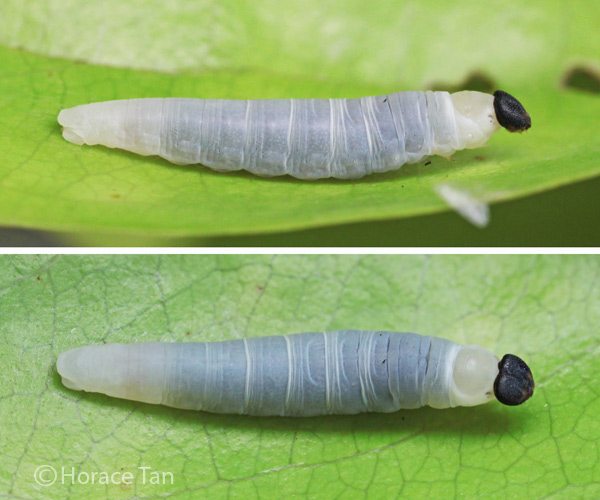
On the last day of 5th instar, the body decolorises  to a very pale translucent white. The caterpillar ceases feeding and stays within its leaf shelter. The pre-pupatory larva prepares for the pupal phase with a series of silk construction work with the main pieces being a silk girdle across the dorsum of its early abdominal segments, and a short and thickened transverse silk band on the substrate at  its posterior end. Both the  girdle and the transverse band are further secured by vertical/oblique threads to the inner wall of the shelter. Soon the pre-pupatory larva becomes dormant in its leaf shelter. Pupation takes place about 1 day later.

Two views of a  pre-pupatory larva of the Dark Flat.

The girdled pupa is secured with its cremaster attached to the short transverse band on the substrate. It has a short thorax, a rather long abdomen and  a pointed rostrum. The body is pale whitish green with no markings. Length of pupae: 18-19mm.

Two views of a pupa of the Dark Flat.

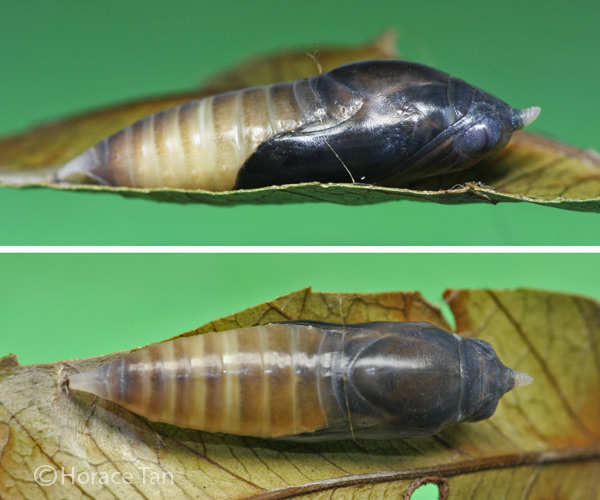
After about 7 days in the pupal stage, the development within the pupa  comes to an end and the pupa turns brown in the abdomen,  dark brown to black in the thorax and wing case. The following day, the adult butterfly emerges from the pupal case.

Two views of a mature pupa of the Dark Flat.

A newly eclosed female Dark Flat.

A newly eclosed male Dark Flat.

References:

  • [C&P4] The Butterflies of The Malay Peninsula, A.S. Corbet and H.M. Pendlebury, 4th Edition, The Malayan Nature Society.
  • A Field Guide to the Butterflies of Singapore, Khew S K, Ink on Paper Comm. Pte. Ltd., 2010. 
  • Butterflies of Thailand, Pisuth EK-Amnuay, 1st Edition, 2006.
Text by Horace Tan, Photos by Jonathan Soong, Henry Koh, Loke P F, Anthony Wong   and Horace Tan