Showing posts sorted by relevance for query Lexias canescens pardalina. Sort by date Show all posts

14 December 2019

Butterfly of the Month - December 2019

Butterfly of the Month - December 2019
The Yellow Archduke (Lexias canescens pardalina)


A Yellow Archduke foraging amongst the leaf litter along a shaded forest path

And we reach December 2019, the final month of the 10-year period starting from 2010, we stand on the threshold of 2020 and an exciting new decade ahead. The world is changing at an even faster rate, with unprecedented technological disruptions, new experiences and a new way of life that we would never have dreamed of in the 20th century.


In the developed and emerging economies of the world, it would be hard to imagine life without the ubiquitous smartphone that has penetrated every aspect of our daily lives. It is this "computer in our hands" that has accelerated so many changes in our our lives, from ordering food to daily mobility and consuming information and news. Today, it is almost unthinkable that there are still people around who does not carry a smartphone - so dependent are we on it.


A Yellow Archduke sunbathing on a patch of leaves

And then comes AI or Artificial Intelligence, which is developing so rapidly that it is beginning to make Skynet (of the Terminator movies) somewhat a reality rather than fiction. Today, we hear possibilities of unmanned vehicles, unmanned stores, unmanned banks and unmanned schools? One begins to wonder what the world will be like in 2100?


The subject of environmental issues and climate change will be more and more actively debated. Countries that have the means, are already looking at how they can protect themselves from the adverse effects of climate change, whilst there are some that ignore the signs or are just too helpless to do anything effective. But this is a global issue and not a geographical nor political one. After all, don't we all breathe in the same air everywhere we go and it's not air that belongs to only one country?


Some newsworthy items in Singapore include the decision to put the mass transit Cross Island Line right below the nature reserve. Whilst it sparked off a huge debate when it was first announced, the nature community engaged the authorities to try to find a middle ground. Although the outcome will not satisfy everyone, the optimists will conclude that at least the authorities have compromised and found mitigation measures to reduce the environmental impact of the construction of this mega transportation project across a "nature reserve".


When PMDs (electric personal mobility devices) came into the environment and shared transportation networks with pedestrians, there are bound to be unfortunate interactions that neither side will find acceptable. However, it had to take several fatal accidents and lives lost, before the authorities took decisive action to ban them from shared pedestrian footpaths. And then the extent of the use of these devices in the food delivery business became obvious, as livelihood issues were raised. The problems of a developed and techology-dependent world!


Our final butterfly of the month for this decade is a medium-sized forest-dependent species called the Yellow Archduke (Lexias canescens pardalina). One of three Singapore-extant species from the genus Lexias, the Yellow Archduke is rather local in distribution and the rarest of the species found in Singapore.


A Yellow Archduke perched on a leaf 

The Yellow Archduke is an interesting species in that both the males and females are similar in appearance, but both look like the females of its related species, the Archduke and Dark Archduke. This often creates a confusion in the identification of the species, especially when all three can be found in the same habitats - in the shaded forest understorey of the nature reserves in Singapore.


A mating pair of Yellow Archdukes

The species is usually encountered foraging on forest litter and overripe fruits on the forest floor. At its preferred habitats, sometimes several individuals may be found together, and engaging in "dogfights" just a few feet above the forest floor. They are skittish and alert to movement, making them rather hard to approach for a photo. At times, when they are feeding greedily, they may be sufficiently distracted to allow an observer to approach them without scaring them off.


The Yellow Archduke is generally smaller in size, but is similarly marked as the females of the Archduke and Dark Archduke. Males and females are similar in appearance, except that the males are usually smaller in size. The species is dark brown above, with yellow spots on both the fore and hindwings.


A Yellow Archduke showing its undersides whilst foraging amongst leaf litter

The underside is a deep ochreous brown with yellow spots. Only the basal area of the hindwing is pale greyish blue, unlike the females of the Archduke and Dark Archduke, where almost the underside of the entire hindwing is pale greyish blue.


A weathered Yellow Archduke puddling along a muddy footpath

A Yellow Archduke feeding on ripened berries on the forest floor

Besides the underside of the hindwing, one of the most obvious diagnostic feature of the Yellow Archduke, is the 3rd spot from the base in space 1b of the forewing. This spot is coalesced into a single spot, whereas it is split into two spots in the female of the Archduke and Dark Archduke.

Text by Khew SK : Photos by David Chan, Huang CJ, Khew SK, Koh CH, Nelson Ong, Simon Sng and Jonathan Soong

01 September 2009

Butterfly of the Month - September 2009

Butterfly of the Month - September 2009
The Archduke (Lexias pardalis dirteana)


This month we feature another species that exhibits sexual dimorphism - the Archduke. This species is seasonally common in Singapore's nature reserves, and found mainly on shaded forest paths and amongst undergrowth amongst tall trees. The species is seldom seen in open sunny areas, and is a forest-dependent species.


The Archduke belongs to the genus Lexias which consists of rather large, robust and fast flying butterflies. The Archduke is the commonest species of the genus found in Singapore, often encountered feeding on rotting fruits and other organic matter amongst forest litter.


A female Archduke forages on the ground for nutrients

The males are dark velvety black above with a broad blue distal border on the hindwing, which is continued narrowly along the termen of the forewing. The underside is deep ochreous brown with yellow spots. The larger female is dark brown above, and profusely spotted with yellow above and white on the undersides. The underside of the hindwing is pale grayish green. The apical portion of the antennal club is orange in both sexes and this distinguishes this species from the closely-related and very similar Black-Tipped Archduke (Lexias dirtea merguia).


The female Archduke is a good example of adaptation by natural selection to camouflage itself better to escape predators like birds. Its dark brown and yellow-spotted wings render it almost invisible as it feeds on the forest floor with dappled sunlight. As many observers will attest, the Archdukes tend to fly rapidly from underfoot when disturbed, as one walks towards their favourite feeding spots along damp forest paths littered with dead leaves and twigs. As they land to feed again, they blend in well with their surroundings, particularly more so with the female.


The robust body of the Archduke is an indication of the powerful flight that it is capable of. Once alarmed, the Archduke takes off rapidly with a few wingbeats, and glides amongst the undergrowth. The species is a relatively large butterfly, attaining wingspans of up to 150mm in the larger female.


The caterpillar has a rather unique appearance with branched spines that allows it to camouflage itself well on the upper surface of its host plant, Cratoxylum pruriflorum. The branched spines terminate with attractive orange-and-black tips that make the caterpillar appear unfriendly. However, it is not poisonous at all, and can be touched without any danger.


An Archduke's "baby photo"

In Singapore, there are two lookalikes to the Archduke and may be confused with this species. They are the Black-Tipped Archduke (Lexias dirtea merguia) which has males and females correspondingly similar to the Archduke, except that the antennae of the latter species is black instead of orange. The other species is the Yellow Archduke (Lexias canescens pardalina) in which both the sexes resemble the female of the Archduke, but are smaller in size. All three prefer shaded habitats in the forest understorey in the nature reserves of Singapore.


Text by Khew SK ; Photos by James Foong & Khew SK

23 March 2019

Three Archdukes

Three Archdukes
Singapore's Archduke butterfly species


A male Archduke foraging amongst the leaf litter in the shaded forest understorey

In my earlier article on this blog, I postulated that the English common naming convention of butterflies could have been possibly coined after the titles of English peerage or Imperial gentry and military ranks. In this article, we take a look at the Archduke butterfly species that can be found in Singapore.


A female Dark Archduke on leaf litter 

Unlike the English peerage titles, the Archduke (feminine: Archduchess) was a title that originated from the Habsburg rulers of the Archduchy of Austria. It denotes a rank within the former Holy Roman Empire, which sat just below that of Emperor and King.


Hierarchy of titles in Imperial, royal, noble, gentry and chivalric ranks © Wikipedia

The etymology of the word Archduke originates from various European languages and purportedly signifies authority or primary (Arch) and leader (Duke). Notwithstanding the historical origins of the royalty-linked name, the Archduke butterflies are no less majestic in their size and prominence in the butterfly world, befitting of their common name.


A Yellow Archduke perches on a leaf in the forested nature reserves

There are 3 extant species of Archdukes that can be found in Singapore. Belonging to the genus Lexias, which features large, robust-bodied and fast-flying butterflies that prefer the heavily shaded forests rather than open sunny areas. All are considered forest-dependent and not found in urban parks and gardens. They are usually found foraging for over-ripened fruits and feeding amongst the leaf litter on forest paths.

The Archduke (Lexias pardalis dirteana)


Upperside and underside of a male Archduke

The commonest species of the genus, the Archduke displays sexual dimorphism in that the male is physically very different from the female. The male is dark velvety black above with a broad blue hindwing border, which is continued (usually in a lighter shade) along the termen of the forewing. The underside is a deep reddish brown with yellow spots.


Upperside and underside of a female Archduke

The female is dark brown above, with prominent yellow spots on both wings, including the body of the butterfly. The underside is a light brown with the yellow spots showing through. The hindwing is a pale-greyish blue throughout.


Note the bright orange apical tip of the Archdukes' antennae

In both sexes, the apical portion on the topside of the antennae is prominently orange. The orange colour is continued on the underside of the antennae as well. This is the most reliable distinguishing characteristic that separates the Archduke from its very closely related Dark Archduke.

The Dark Archduke (Lexias dirtea merguia)


A male Dark Archduke on leaf litter

Almost identical to the Archduke, the Dark Archduke (previously called the Dark-Tipped Archduke), is also sexually dimorphic, with the male and female's appearance corresponding to the Archduke. The habit of this species mirrors the Archduke, and individuals are often found feeding on rotting fruit and other organic matter amongst leaf litter on the forest floor.


Upperside and underside of a female Dark Archduke

The male and female of the Dark Archduke closely resemble the corresponding sexes of the Archduke. The male is velvety black above with the blue marginal border on the hindwing, which extends to the termen of the forewing. The female is dark brown with yellow spots on both wings.


Note the black antennal tips of the Dark Archduke male and female

The primary difference between the Archduke and Dark Archduke is that the apical portion of the antennal club is black instead of orange. The underside of the antennae can still show some orange colouration like the Archduke. It is almost impossible to distinguish the two species when in flight, although there are some key, but still variable differences on the wings of both species to help distinguish them.

The Yellow Archduke (Lexias canescens pardalina)


Yellow Archduke puddling on the forest floor

The third, and smallest species of the three Archdukes is the Yellow Archduke. Of great interest is that it is the only species in the Lexias genus that is not sexually dimorphic! Both the male and female look alike, although the female is usually much larger. Displaying the same forest-floor foraging habits as its two other cousins, it is also a forest-dependent species.


Upperside and underside of the Yellow Archduke

The Yellow Archduke is dark brown above with large yellow spots on both wings, resembling the females of the Archduke and Dark Archduke. However, both the males and females look alike. The underside of the hindwing only has the dorsal margin a pale-greyish blue with the larger part of the wing brown and yellow.


Mating pair of the Yellow Archduke

On the upperside of the forewing, the line of yellow spots at the post-basal area features a spot (the 4th spot from the base) which is coalesced into a single spot. In the female Archduke and Dark Archduke, this yellow spot is split into two spots. This is the most reliable characteristic to separate the Yellow Archduke from its two close cousins.

Text by Khew SK : Photos by Khew SK, Koh CH, Nelson Ong, Simon Sng and Jonathan Soong

03 February 2018

Butterfly Photography at Our Local Parks - Lower Peirce Reservoir Park

Butterfly Photography at Our Local Parks
Featuring : Lower Peirce Reservoir Park


A timber boardwalk winds around the reservoir edge at the Lower Peirce Reservoir Park

This weekend's feature location for butterfly photography is adjacent to the second oldest reservoir in Singapore. (The oldest reservoir being the nearby MacRitchie Reservoir) It was originally known as the Kallang River Reservoir, and it was formed by impounding across the lower reaches of the Kallang River in 1910.


In 1922, it was renamed Peirce Reservoir in commendation of the services of Robert Peirce (engineer), who was the PWD engineer of Singapore from 1901 to 1916. In 1975, a dam was built across the upper reaches of the Peirce Reservoir, splitting it into Upper and Lower Peirce Reservoirs thereafter.


Mature secondary forest lines the banks of Lower Peirce Reservoir Park

The forested areas that line the banks of Lower Peirce Reservoir Park (LPR) is considered a mature secondary rainforest. One can still find rubber trees and oil palms in the area - reminders of a past when vast areas of Singapore were covered with cash crops and plantations. The Lower Peirce Reservoir Park is part of the 3,403 Ha Central Catchment Nature Reserve (CCNR). It forms the eastern boundary of the CCNR and is connected to the Bishan-Ang Mo Kio park. Lower Peirce Reservoir Park sits on about 6 Hectares of land covered with thick lush secondary forest.


Within LPR, a nature boardwalk meanders through one of Singapore's last remaining mature secondary forest and along the edge of Lower Peirce Reservoir. The 900m boardwalk takes the visitor along the water's edge and then through a well-shaded secondary forest which is home to an amazing diversity of flora and fauna. The boardwalk is of adequate width and is robustly constructed to withstand the ever-humid conditions under the forest canopy. I recall that this was one of the first forest boardwalks constructed by NParks and the environmentally-sensitive construction process was managed such that no mechanical equipment was allowed in the forest. Hence the construction work was done solely by manual labour.


The main road to the reservoir is lined with butterfly-attracting plants like Bandicoot Berry and Red Tree Shrub


Some common butterflies found at the open areas at Lower Peirce Reservoir Park

The main entrance to Lower Peirce Reservoir Park is via a small carpark towards the south-east of the park. Parking is free but lots are limited. Visitors walk along a paved road that is lined with native plants like Bandicoot Berry and Red Tree Shrub. As you reach the reservoir edge, you can take in the scenic view of the Lower Peirce Reservoir and the golf course beyond. Nearby, there are trellises covered with Bauhinia and there are Ixora shrubs along the paths. Look out for the Grass Yellows, Cycad Blue, Bush Browns, Grass Blues and Sailors around this area.


Note that recreational fishing is permitted along a short stretch along the edge of the reservoir, so do not be alarmed if you see what appears to be 'poachers' within a nature reserve! There are shelters and pavilions nearby to take cover if you are caught in our tropical thunderstorm. Once past this open area, you will be able to see the start of the nature boardwalk. This boardwalk will lead you towards the first section which skirts around the forest edge and bring you just next to the water of the reservoir.


Views towards the reservoir.  Recreational fishing is permitted here


The start of the boardwalk accessed from the Lower Peirce Reservoir carpark

Along the boardwalk, you will be able to spot lush bushes of the Straits (or Singapore) Rhododendron (Melastoma malabathricum). This ripened fruits of this plant is attractive to many species of butterflies, but you will have to wait till the fruiting season before you can enjoy watching the variety of butterflies that visit the sugary fruits. The Straits Rhododendron is also the caterpillar host plant of the Horsfield's Baron (Tanaecia iapis puseda) and if you are lucky, you will encounter the female of this species ovipositing on the host plant.


A female Horsfield's Baron preparing to lay her eggs on the Straits Rhododendron which grows beside the boardwalks around the water's edge.

Note that there are no barriers along this boardwalk, so please take care not to fall off the edge and into the water! Once you get past this stretch, the boardwalk will lead you into the heavily-shaded forested area of the park. There are adequate signages along the boardwalk with nature-friendly names like Casuarina Entrance, Jacaranda Entrance, Costus Trail, Hevea Trail and Oncospermum Trail, which are aptly named after some of the plants that can be found along the boardwalk trail.


The rare Yellow Archduke (Lexias canescens pardalina).  Its caterpillar is often encountered at the Lower Peirce Reservoir boardwalk trail

At the intersection between the Bamboo Trail and Oncospermum Trail, keep your eyes peeled for the Buffy Fish Owl, which has attracted many bird photographers to this location. Coincidentally, this is also the area where the caterpillar of the rare Yellow Archduke has been photographed a number of times. Do look out for the elusive adult butterfly.


In the heavily-shaded forest through which the boardwalk winds, look out for the shade-loving species like the Archduke and Common Faun

Taking the route towards the Costus Trail will bring you to the end of the boardwalk at the Jacaranda Entrance. The heavily shaded forest understorey will not be generally attractive to the sun-loving butterfly species. However, look out for the forest dwellers like the Archduke, Malay Viscount and Common Faun, particularly in the vicinity of their respective caterpillar host plants.


NParks has designed rest areas for tired hikers or visitors who prefer to sit quietly and observe the amazing diversity of flora and fauna at Lower Peirce Reservoir Park

Moving along Bamboo Trail towards Hevea Trail will send you towards the Casuarina Entrance where the trail ends. Beyond this entrance and to the north is the famous Casuarina Road Prata shop which is a must-visit lunch pit stop after a long tiring walk. Note that the boardwalk trail is not flat and there are some elevation changes that will require you to walk up and down short flights of steps.


More uncommon forest species like the Saturn and Dark Blue Jungle Glory can be found here

Again, under the heavily-shaded forest canopy, you will expect to encounter only the shade loving butterfly species. It was amongst the leaf litter in the undergrowth that I spotted my first Dark Blue Jungle Glory in Singapore many years ago. Given that there are many different species of palms and rattans along the forest stream just off the boardwalk, see if you can spot the seasonal Saturn amongst the undergrowth.


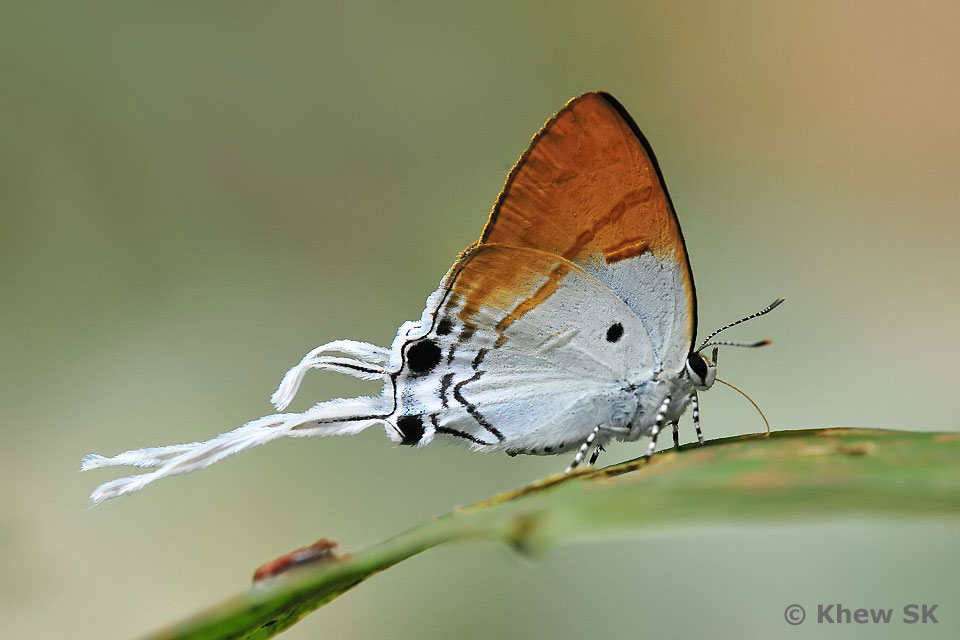
And then there are some surprises amongst the Lycaenidae and Hesperiidae that will appear from time to time. If you are lucky, you may be able to encounter some of them. Some years back, I came across this pristine Fluffy Tit (Zeltus amasa maximinianus) feeding on some moss on a leaf. The occasional Arhopala and Jamides may flutter by, and when in season, you should be able to spot a couple of Branded Imperial (Eooxylides tharis distanti) around.


As you exit the boardwalk trail, do look out for the flowering bushes of the Bandicoot Berry and Buas Buas along Old Upper Thomson Road. These will usually attract the common butterflies like the Malayan Five Ring, Chestnut Bob, Chocolate Pansy and an occasional rarity that is waiting to surprise you.


The Lower Peirce Reservoir Park cannot be described as a 'butterfly haven', but the shaded habitat can spring the occasional surprise and delight you - particularly amongst the forest-loving species. Do look out for overripe figs and other forest fruits on the ground when in season, for butterflies are attracted to the sugary diets on the forest floor.


How to Get There :
By Bus:
Bus nos. 163, 167, 169, 855, 980.
Alight at the bus stop nearest to the Sembawang Hill Food Court and walk along Old Upper Thomson Road towards Lower Peirce Reservoir Park. The entrance to the trail (Casuarina Entrance) is about five minutes away.

By Car : Follow the direction of Upper Thomson Road. Turn left before the traffic lights at the junction of Ang Mo Kio Avenue 1 into Old Upper Thomson Road. Follow
the road until you see the entrance of the trail. Parking facilities are available along the road near the Casuarina Entrance (Paid parking). Alternatively park at the Lower Peirce Reservoir Carpark towards the south. (Free Parking)

Text by Khew SK : Photos by Khew SK and Horace Tan