Showing posts sorted by relevance for query Flos apidanus. Sort by date Show all posts

01 August 2020

Plushblues of Singapore

The Plushblues of Singapore
Featuring the Flos species in Singapore


A Darky Plushblue perches on some flower buds in the shaded forest understorey

The genus Flos, collectively called the Plushblues, showcases some of the most attractive Lycaenidae species with iridescent ultramarine blue uppersides. Unfortunately, all the species rarely sunbathe with their wings fully opened, and one often only gets a glimpse of its attractive blue uppersides. Globally, there are 15 species of Flos recorded, although some researchers have re-classified at least one species of Arhopala under Flos after studies of its early stages and morphology.


A Plain Plushblue feeds on the sweet secretions on the stem of a Rattlebox weed

A Bifid Plushblue perches on a leaf

There are four Flos species extant in Singapore, and only one can be regularly found in urban parks and gardens. The other three are rare, often encountered singly, and forest-dependent species. They usually prefer the shaded understorey of the forested nature reserves of Singapore. The genus is related to the Arhopala and sometimes found in the same heavily-shaded localities.


A Shining Plushblue perches at the edge of a leaf

The Plushblues are generally skittish and easily spooked. They fly quite rapidly and settle on the top surfaces of leaves to perch with their wings folded upright. The underside of the Plushblues is dark purple brown with cryptic bands and spots on both wings. In some of the species, there is a patch of deep red or crimson at the wing bases.

1. The Plain Plushblue (Flos apidanus saturatus)


The Plain Plushblue is the only Flos species that can be found in urban parks and gardens more often than in the forested areas. It is skittish and flies rapidly amongst the shrubbery. It can sometimes be observed feeding on the sap of stems and branches. It stops to rest on tops of leaves with its wings folded upright.


A male Plain Plushblue shows its ultramarine blue uppersides

A Plain Plushblue feeding on the ripened fruits of the Singapore Rhododendron

The male Plain Plushblue is a deep ultramarine on its uppersides, with a thin forewing border. The female is a shining blue with broad black borders on both wings. The underside is a pale purple brown with dark markings across both wings. In pristine individuals, there is often a deep red patch at the base of both wings. The hindwing bears a stubby white-tipped tail at vein 2 and is toothed at veins 1b and 3. There are pale green iridescent scales at the tornal eyespots on the underside of the hindwing.

2. The Bifid Plushblue (Flos diardi capeta)


A Bifid Plushblue feeding on the ripened fruits of the Singapore Rhododendron

The Bifid Plushblue is mainly found in the forested nature reserves of Singapore, and is not seen in urban gardens. Other than the Plain Plushblue, all the other three species are considered rare and usually occur singly in heavily shaded habitats. It is a strong flyer and alert to movements. It is one of the Plushblues of which the female is more regularly observed to sunbathe with wings opened.


A female Bifid Plushblue opens her wings to sunbathe

A Bifid Plushblue shares the sugars from the ripened fruits of the Singapore Rhododendron with an ant

The male Bifid Plushblue is a dark purple-blue above with thin black borders. The female is a paler purple-blue with broad black borders on both the fore- and hindwings. The underside is cryptic in appearance, with dark brown and pale markings. There is a characteristic "V" shaped costal spot that is not connected to the other brown markings on the hindwing that separates this species from the other Plushblues. There is a white-tipped tail at vein 2 of the hindwing and is toothed at veins 1b and 3. The pale green iridescent scales at the tornal area is more extensive that the other species in the genus.

3. The Shining Plushblue (Flos fulgida singhapura)


A Shining Plushblue perches on a leaf in the shaded understorey in the nature reserves

This 3rd Plushblue has the distinction of bearing the word "Singapore" in Malay in its subspecies name. It is a rare forest-dependent species and prefers the heavily-shaded forest understorey in the nature reserves of Singapore. Also another skittish and rapid-flying species, it tends to prefer to fly closer to the ground and stop on the tops of leaves until disturbed.


A newly-eclosed male Shining Plushblue

A newly-eclosed male Shining Plushblue opens his wings to sunbathe

The Shining Plushblue can easily be distinguished from its other cousins in that it has a shorter stumpy tail at vein 2 of the hindwing, and is correspondingly toothed at veins 1b and 3. It is darker in appearance on the underside, and has a dark brown band stretching from costa to base. The males are deep ultramarine blue on the upperside, whilst females are shining blue with broad black borders.

4. The Darky Plushblue (Flos anniella anniella)


A Darky Plushblue perches at the edge of a leaf

The last Plushblue is considered the rarest of the four, and also prefers heavily-shaded forested habitats in the nature reserves of Singapore. It is the least encountered of the four Plushblues and has the same skittish disposition and rapid flight of its other relatives in the genus. It has been bred on various species of Lithocarpus which is a preferred genus on which the other Flos species (except Flos apidanus) feeds.


The Darky Plushblue is tailless, unlike the other 3 species, but the hindwing is toothed at veins 2 and 3. The upperside of the male is a lustrous violet blue with a thin black border. Females are lighter purple with broad black borders on both wings. The underside is mostly dark purple brown with white edging on the darker brown bands. The apical area is distinctly whitened, whilst the iridescent scaling at the tornal area of the hindwing is the least distinct amongst the four species.

Text by Khew SK : Photos by Huang CJ, Khew SK, Loh MY and Horace Tan

19 December 2009

Life History of the Plain Plushblue

Life History of the Plain Plushblue (Flos apidanus saturatus)


Butterfly Biodata:
Genus: Flos Doherty, 1889
Species: apidanus Cramer, 1777
Subspecies: saturatus Snellen, 1890
Wingspan of Adult Butterfly: 34mm
Caterpillar Host Plants:
Terminalia catappa (Combretaceae, Common name: Sea Almond), Syzygium glaucum (Myrtaceae), S. grande (Myrtaceae) and other Syzygium species (yet to be identified).


A Plain Plushblue perching on a leaf in the nature reserve.

Physical Description of Adult Butterfly:
Above, the male is deep bluish violet, with a narrow forewing border (about 1.0mm); the female is bluer and more shining, with rather regular black borders on the costal and distal margins of both wings. Below, the wings are pale yellowish to darker brown with whitish markings featuring a purple tinge. The discal and post-discal bands are evenly curved on the forewings, and there is a pale yellowish end-cell bar on the forewing. Hindwings have irregular discal whitish bands from mid-costa to mid-dorsum. There is a small ochrous brown patch at the base of the costa on both wings. The hindwing is tailed at vein 2 and toothed at veins 1b and 3. The compound eyes are dark yellow brown (see the cover picture of this earlier blog article).


A close-up view of the front portion of a Plain Plushblue.
Note that the ochrous brown patches at behind the head.
Field Observations of Butterfly Behaviour:
Worldwide, Flos apidanus is the most widely distributed member of the Flos genus. This is also true locally in Singapore as it can be found in multiple locations, in and out of the nature reserves, and it is the most commonly sighted of the four Flos species residing here. The fast flying adults are usually spotted near flowering shrubs and their host plants. Typically they perch with their wings closed, but they can also be seen to open their wings fully to sunbathe in warm weather.


A female Plain Plushblue perching on a leaf in the Southern Ridges.

Early Stages:

It is mentioned in C&P4 that the Plain Plushblue utilizes a number of Syzygium species as larval hosts. So far we have established that Syzygium glaucum and S. grande serve this role in Singapore. In addition, Terminalia catappa (Sea Almond) has been recorded as another host. This latter plant can grow to be a rather large tree with a pagoda shape. Its leaves are obovate, 20-30cm long, often spirally crowded at ends of branches, and turning orange or red before they fall. The 4-5cm long fruits are flattened ovoid and keeled all round. The seeds are edible. Sea Almond is common in Singapore, either growing wild or cultivated as roadside trees.


Host plant: Sea Almond. Leaves and fruits are featured here.


Host plant: a Syzygium species yet to be fully identified.


A female Plain Plushblue laying eggs at the petiole of a Syzygium species.
Eggs are laid in small groups of 2-5 on the petiole or the underside of a relatively young leaf of the host plant. Each egg is about 0.9mm in diameter, white with a light yellowish green tinge. It is shaped like a pressed bun with a slightly depressed micropylar area atop. The surface has a coarsely reticulated pattern of intersecting ridges.
Groups of eggs of the Plain Plushblue on young shoots of the Sea Almond.


Closer looks at groups of eggs of the Plain Plushblue.

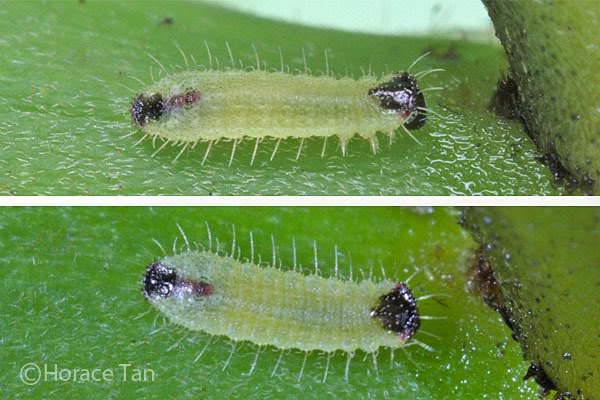
It takes 2-3 days for the egg to hatch. The newly hatched is pale yellowish in body color and has a length of about 1.5mm. It has a rather flattened woodlouse appearance with a large semicircular prothorax, a yellowish brown head and
long dorso-lateral and lateral setae. There are also a fair number of very short setae on the body surface.
Two views of a newly hatched caterpillar, length: 1.5mm.

The 1st instar caterpillar feeds by skimming the surface of a young leaf, but later instars are able to consume the lamina in whole.
Larval stages of the Plain Plushblue are gregarious and a few caterpillars have been observed in the field sharing a feeding site with no animosity towards each other. As the 1st instar caterpillar grows, its body color becomes more yellowish green. Pinky red patches also appear on the front portion of the prothorax and the posterior abdominal segments. After 2-3 days of growth, and reaching a length of about 2.5mm, the caterpillar moults to the next instar.
Two views of a 1st instar caterpillar, length: 2mm.

The 2nd instar caterpillar features long lateral hairs and a black head. Long dorso-lateral setae are no longer present, but many short setae with blobbed endings appear on the entire body surface. A pair of faint dorso-lateral line runs along the length of the body. The prothorax is marked by a large black patch with a leading edge in pinky red. The dorsal nectary organ (DNO) is already visible on the 7th abdominal segment and highlighted with a small dark reddish patch stretching to the 8th segment. A large anal plate, black in color, dominates the remaining posterior segments.


Two views of a 2nd instar caterpillar, early in this stage, length: 2.5mm.

2nd instar caterpillar, late in this stage, length: 3.5mm.
The 2nd instar caterpillar has a functional DNO as ants living in its proximity are observed to actively attend to the young caterpillars, having been attracted to the nectary fluid excreted via the DNO. The ant-caterpillar association continues for all remaining larval stages of the Plain Plushblue.
A 2nd instar caterpillar being tailed by an ant which is eyeing the nectary fluid excreted by the caterpillar.

A sequence of three pictures showing an ant receiving its pay packet of a nectary droplet from the 2nd instar caterpillar.

The 2nd instar caterpillar reaches a length of about 4mm, and after about 3 days in this stage, it moults again. The 3rd instar caterpillar resembles the 2nd instar caterpillar closely. New to this instar is a dorsal band in darker green against the yellowish green base colour. The DNO is now rather prominent with an dark brown oval ring marking its outer boundary. The 3rd instar takes about 3-4 days to complete with the body length reaching about 7mm.
Two views of a 3rd instar caterpillar, length: 5.5mm.

A small group of two 3rd instar caterpillars attended by ants.

The 4th instar caterpillar has similar markings as the 3rd instar. One notable change is in the prothoracic dark patch which now has two small white patches embedded at its posterior. Another change is in the dark red patch stretching from the DNO to the anal plate as it now has two side-branches reaching the tentacular organs (TOs) on the 8th abdominal segment. The 4th instar takes about 4-6 days to complete with the body length reaching 11mm.

4th instar caterpillar, length: 11mm.

Two views of a 4th instar caterpillar being attended to by three ants.
The 5th instar caterpillar has similar but more striking markings. Visible changes are 1) a white intermittent line running down the middle of the dark patch on the prothorax; 2) both the dark patch on the prothorax and the anal plate are now flanked by white borders which are moderate in thickness.

5th intar caterpillars, legnths: 15.5mm (top) and 19mm (bottom).


A group of three 5th intar caterpillars sharing one leaf.


The DNO and the TOs at the posterior segments of a 5th intar caterpillar.
The right picture shows the wet DNO after a recent excretion.


Dorsal views showing the newly excreted droplet atop the DNO.
Lateral views of the same nectary droplets at the DNO.

After 7-8 days of feeding and reaching a length of about 20mm, the caterpillar slows down and stops food intake for about 1 day. During this time, its body length gradually shortened. Soon it becomes an immobile pre-pupa in its leaf shelter.

Two views of a pre-pupa of the Plain Plushblue.

The pre-pupa caterpillar prepares for pupation by spinning a silk girdle and a silk pad to which it attaches via claspers at its posterior segments. After 1 day as a pre-pupa, pupation takes place. The pupa, with a length of 12-14mm, has a shape typical of any Lycaenid species, but with a somewhat produced anal segment. It is yellowish green in coloration.
A time-lapse sequence of the pupation event for a Plain Plusblue caterpillar.


Two views of a pupa of the Plain Plushblue, length:12mm.

Nine days later, the pupa matures enough to show the markings on the forewing upperside. The next day, the pupal stage comes to an end with the emergence of the adult butterfly.

Mature pupae: female (top) and male (bottom).


A newly eclosed Plain Plushblue resting on a leaf.

Unlike most of the Lycaenidae species, the caterpillars of the Plain Plushblue have the habit of constructing leaf shelters in which they rest and seek safety between feeds on the lamina of nearby leaves and part of the shelter. Pupation also takes place within a leaf shelter.


Leaf shelters used by Plain Plushblue caterpllars on Syzygium gauclum.


A leaf shelter formed by joining two adjacent leaves.
Can you spot the caterpillar?


References:
  • The Butterflies of The Malay Peninsula, A.S. Corbet and H.M. Pendlebury, 4th Edition, The Malayan Nature Society.
  • Butterflies of Thailand, Pisuth Ek-Amnuay, 1st Edition, 2006

Text by Horace Tan, Photos by Federick Ho, Khew SK and Horace Tan.

18 February 2017

Butterfly of the Month - February 2017

Butterfly of the Month - February 2017
The Plain Plushblue (Flos apidanus saturatus)


The first two months of 2017 have been interesting from a global perspective, as the world watched the 45th President of the USA Donald Trump dish out interesting, but controversial executive orders. These ranged from building a 1,000 mile wall between the US and Mexico and immigration orders that barred visitors from seven Muslim-majority countries. There appears to be a shift to nationalistic and protectionist policies in many countries in the world today.


Whilst the rest of the world waits and wonders how all these changes in politics are going to affect each country's economy and trade, 2017 moves into a very uncertain and potentially tumultuous era as the Chinese population around the world heralded the year of the Fire Rooster. Predictions by soothsayers and geomancers from Nostradamus to local experts didn't have much positive news for the rest of the year. So it remains to be seen if their forecasts hold true.


Speaking of roosters, the Year of the Rooster didn't start too auspiciously for a group of free-ranging chickens in Singapore. Apparently acting on complaints of noise nuisance, about 20 of these birds were rounded up by the authorities and summarily culled. This raised the ire of local animal activists and the more tolerant public, which created a lot of buzz on social and mainstream media.


The rationale for the culling was later amended to public health safety reasons, but this appeared more of a bit of back-stepping by the authorities which didn't go down too well with the public. But the news of this fowl play provided quite a bit of chatter and amusement in cyberspace, and everyone, from the local coffeeshop auntie to our politicians gave their two cents worth on the matter.


Then a life was lost when a massive 270-year old Tembusu tree fell at the Singapore Botanic Gardens. The tree, which was over 40m tall with a girth of 6.5m, had just been recently given a clean bill of health by government arborists, when it inexplicably uprooted, tilted over and crashed onto the hapless family who were waiting for a concert to start. Deepest condolences to the family of the deceased.


Investigations are ongoing, but this is going to leave a lot more questions than anyone has answers for, as the tree fell on a normal fair day (albeit it was an exceptionally windy day on that day). I can only hope that the authorities do not adopt a knee-jerk reaction and start chopping down our large and beautiful trees around our City in a Garden.


Our Butterfly of the Month for February 2017 is the Plain Plushblue (Flos apidanus saturatus). This is one of four species of Plushblues of the genus Flos that are extant in Singapore. It is the most regularly encountered of the four, and is moderately common. It can be encountered from our urban parks and gardens to the forested reaches of our nature reserves.


The male Plain Plushblue is deep blue-violet on the upperside, with a thin black forewing border. The female is a shining purple-blue with broad black borders on both wings. The upperside of this species is seldom seen nor photographed, except with the butterfly is encountered in the late evening hours of the day with the full sun shining at a low angle.


The underside of the species bears dark brown cryptic patterns with a purplish wash. There is a small reddish patch on the base of both wings that is more distinct in freshly-eclosed individuals. The hindwing bears a stubby white-tipped tail at vein 2 and is toothed at veins 1b and 3.


The butterfly is skittish and has a strong erratic flight when disturbed. The caterpillar of the Plain Plushblue feeds on a variety of host plants amongst which are two species of the Syzygium which are relatively common roadside bushes. Usually, the species is encountered singly either feeding on the sap of certain plants, on the ripened fruits of the Singapore Rhododendron or on flowering plants.

Text by Khew SK : Photos by Chng CK, Huang CJ, Khew SK, Koh CH, Loke PF, Billy Oh, Jonathan Soong, Horace Tan and Anthony Wong