Showing posts sorted by relevance for query Elymnias panthera panthera. Sort by date Show all posts

19 November 2010

Butterfly of the Month - November 2010

Butterfly of the Month - November 2010
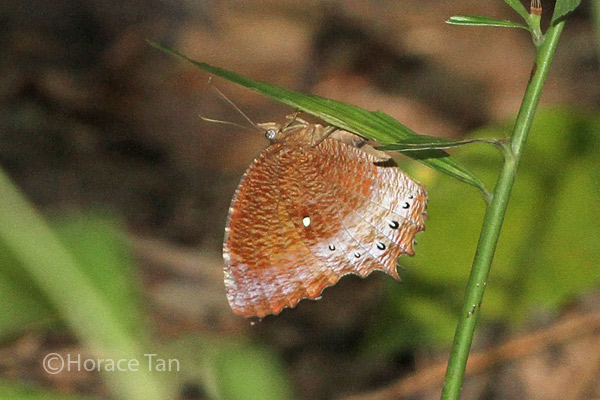
Tawny Palmfly (Elymnias panthera panthera)


The winds have shifted and now the prevailing winds are coming from a North-Easterly direction, usually bringing heavy rains to many parts of South-East Asia. The monsoon months traditionally brings closure to many activities in nature areas in Malaysia, where the national parks and nature reserves are closed for the safety of visitors. I recall being shown the flood level at Endau-Rompin National Park in Malaysia, where the debris from a recent flood clearly indicated the water line before the water receded. Nothing out of the ordinary, except that the debris line was about two-thirds up a line of trees that was about 15m high!


The 11th month of the year, November always brings happy anticipation of the Christmas holiday season. Indeed, cheery and glittering decorations are already up in many shopping malls in Singapore. In multi-cultural Singapore, November 2010 also saw the celebration of Deepavali and Hari Raya Haji by the Hindu and Muslim communities respectively.


This month, we feature a relatively 'plain-Jane' butterfly, the Tawny Palmfly (Elymnias panthera panthera). The English common name of the butterfly is rather curious, as "tawny" often refers to a "warm sandy colour" which the species displays very little of. Perhaps the pale buff submarginal border on the upperside of the hindwing is distinctive enough to give the butterfly a 'tawny' descriptor.


Another unique feature of this species is its scientific name. It is one of only a handful of butterfly species to share the name of mammals and in this case, a specific genus of the big cats, Panthera. A rather interesting reference, since the butterfly bears no resemblance in any way to the famous carnivorous and predatory cats.


The Tawny Palmfly is a forest denizen, where it skulks close to the forest floor in well-shaded localities. It is usually very skittish and flies off the moment it senses any movement towards it. The species is best observed when feeding on the ripened fruits of the Singapore Rhododendron (Melastoma malabathricum) - when it is less skittish and allows an observer to move in closer to it.


It doesn't fly rapidly but displays an erratic flight when flying around, searching for food sources or moving around its preferred habitats. Very often, it stops and perches on the upper surfaces of leaves with its wings folded upright. In the field, we have, thus far, not encountered an individual sunbathing with its wings opened flat before.


The Tawny Palmfly is dark brown above and the hindwing has a pale buff border bearing a series of white-centred black submarginal spots. The underside bears the usual reddish-brown striations of the genus Elymnias (collectively called the Palmflies) which helps to camouflage the butterfly when settled amongst the forest litter.


The female of this species makes an interesting audible clicking sound with its hindwings when it flutters about its host plant laying eggs. The caterpillar of this species feeds on a variety of palms found in the forests.


Although it is a species that is primarily found in forested areas, and in particular, in habitats where various species of Palmae grow, it has also been observed with regularity at urban parks and gardens as well. Sometimes it flies in the company of its closely related species, the Common Palmfly.


Text by Khew SK : Photos by James Chia, Chng CK, Federick Ho, Khew SK, Koh Cher Hern, Loke PF, Bobby Mun, Ellen Tan & Anthony Wong

19 May 2012

Life History of the Tawny Palmfly

Life History of the Tawny Palmfly (Elymnias panthera panthera)


Butterfly Biodata:
Genus: Elymnias
Hübner, 1818
Species: panthera Fabricius, 1787
Subspecies: panthera
Fabricius, 1787
Wingspan of Adult Butterfly: 50-60mm
Caterpillar Local Host Plants:
Caryota mitis (Arecaceae, common name: Fish Tail Palm), Licuala spinosa (Arecaceae, common name: Mangrove Fan Palm), Ptychosperma macarthurii (Arecaceae, common name: MacArthur Palm).


Physical Description of Adult Butterfly:
Termens of both wings are prominently scalloped. The hindwing is strongly toothed at vein 4. Above, the wings are dark brown. On the hindwing, there is  a submarginal pale buff band bearing fuscous interneural (between the veins) spots.  Underneath, the wings are strongly mottled brown, with the submarginal to post-discal areas pale buff. On the hindwing there is a series of black-crowned white interneural spots in spaces 1b,2,3,4,5 and 6, with the white spot in space 6 much larger and ringed in black.


Field Observations of Butterfly Behaviour:  
The Tawny Palmfly is moderately common in Singapore and can be found in the nature reserves, forested areas of wastelands in the west, Sungei Buloh wetland reserve and Kranji nature trail.  The adults are typically shade-loving, and are usually sighted flying along the edge of forested area and in the vicinity of a clump of palm trees. The adults have the habit of  visiting flowers and ripened fruits of the Singapore Rhododendron for mineral and energy intakes.


Early Stages:
The early stages of the Tawny Palmfly is polyphagous and feed on the leaves of a number of host plants in the Arecaceae (Palmae) family. Thus far, three of the local host plants haven been  confirmed and identified (see list of host plants given earlier).

Host plant: Fish tail Palm.
  
A mother Tawny Palmfly laying an egg on the underside of a frond of the Fish Tail Palm.

The eggs of the Tawny Palmfly are laid singly on a leaf blade of the host palm tree, typically on the underside. Each white egg is nearly  spherical with a diameter of about 1.5mm. Unlike the  eggs  of the Common Palmfly, the egg does not turn yellow as it develops. 

Two views of an egg of the Tawny Palmfly.

Two views of a mature egg of the Tawny Palmfly.

The egg takes about 4-4.5 days to hatch. The young caterpillar emerges by eating away part of the egg shell. The rest of the egg shell becomes the first meal for the newly hatched, which has a length of about 2.8mm. Its cylindrical body is pale whitish. The large head capsule is dark brown to black in color and has three pairs of prominent protuberances lining the perimeter with the apical pair being the largest and longest. Each protuberance ends with a thick setae bearing a transparent droplet at its tip. Rows of fine setae, also bearing terminal droplets, run along the length of the body dorso-laterally and laterally. A pair of long whitish processes occur at the posterior end of the body, each of which ends with a droplet-bearing black setae.

A newly hatched Tawny Palmfly caterpillar pausing next to its empty egg shell, length: 3mm.

Once the newly hatched moves on to feed on the young leaves, its body turns yellowish green in colour. Several contrasting longitudinal bands, pale yellowish  in color and of varying widths, adorn the body surface dorso-laterally and laterally. This instar lasts 4-6 days with the length reaching up to 6.5-8mm.

Two views of 1st instar caterpillar, length:6.75mm.

The body of the 2nd instar caterpillar is similarly marked as in the late 1st instar. The most obvious change is in the head capsule where the three pairs of protuberances becomes longer and the setae they bear shorter. The apical pair also takes on a few short side branches.  The pair of anal processes are longer proportionately and mostly black in coloration. Numerous short fine setae cover the body surface. Of the several yellowish bands running lengthwise, the dorso-lateral pair running up to the upperside of the anal processes becomes the most prominent of all. This instar lasts about 3-5 days with the body length reaching up to 11-13mm before the moult to the 3rd instar.

Head capsules: 1st instar (left) and 2nd instar (right).

Two views of a newly moulted 2nd instar caterpillar.

Two views of a 2nd instar caterpillar, length: 11mm

The 3rd instar caterpillar is similar in appearance to the 2nd instar caterpillar with the only obvious change being in the appearance of the head capsule. Small pale yellow patches appear laterally and apically on the head capsule which also has its two lower pairs of protuberances turn yellowish to orangy brown  with their short terminal setae still brown to black in color.  The yellow dorso-lateral longitudinal bands are enlarged slightly in each of abdominal segments. This instar takes about 4-5 days to complete with body length reaching about 18-20mm.

Two views of a newly moulted 3rd instar caterpillar.

Two views of a 3rd instar caterpillar, length: 20mm.

Retaining very much the same body features from the earlier two instars, the 4th instar caterpillar distinguishes itself in having a head capsule with proportionally longer apical protuberances (with the base of side protuberances in orangy brown)  and larger lateral and frontal yellowish patches. The anal processes being mostly yellowish to salmon red in coloration. The nodal enlargement in the dorso-lateral yellow bands is also more pronounced in this stage. This instar lasts about 5  days with the body length reaching about 32-34mm.

Head capsules: 3rd instar (left) and 4th instar (right).

Two views of a 4th instar caterpillar, length: 25mm.

Two views of a 4th instar caterpillar, dormant before its moult, length: 33mm.

The 5th and final instar brings about another change in the appearance of the head capsule. Now white patches cover the frontal and middle area, stretching up into the two apical protuberances. The long and slender anal processes are mostly salmon red in coloration. The nodes in the dorso-lateral yellow band are much more prominent and could be rather large in certain specimens. A variable aspect of these nodes is that each node could be entirely yellow,  or be adjoined with a dark green spot, or has a pale orange patch embedded in it.

Two views of a newly moulted 5th instar caterpillar, length: 31mm.

Head capsule of the 5th instar caterpillar.

Two views of a  5th instar caterpillar, length: 32mm.

Two views of another 5th instar caterpillar, length: 42mm.

The 5th instar lasts for 8-10 days, and the body length reaches up to 48-51mm. On the last day, the caterpillar ceases feeding, its body becomes shortened but with essentially no change in body color. It wanders around in search of a pupation site. Typically it comes to a halt on the underside of leaf blade (of the host plant)  where the caterpillar spins a silk pad to which it attaches its claspers and then rests in a head-down posture.

Two views of a pre-pupa of the Tawny Palmfly in a head-down posture.


The pupation event of a Tawny Palmfly caterpillar.

Pupation takes place 1 day after the caterpillar assumes the haed-down posture. The green pupa has yellowish strips running on the dorsum of the thorax, dorso-laterally and laterally on the abdomen and the leading edges of the wing case. These yellow strips are outlined in a reddish to deep pink. The pupa also has a pair of short cephalic horns, and the dorsum of its thorax is sharply raised. Length of pupae: 20-24mm.

Two views of a pupa of the Tawny Palmfly.

Two views of a mature pupa of the Tawny Palmfly.

After about 7 days of development, the pupal skin turns translucent as the development within the pupal case comes to an end. The pupa is mostly black at this point. The following day, the adult butterfly emerges from the pupal case. It then perches on the pupal case or nearby to expand and dry its wings before taking its first flight.


The eclosion event of a Tawny Palmfly.

A newly eclosed Tawny Palmfly.

References:
  • The Butterflies of The Malay Peninsula, A.S. Corbet and H.M. Pendlebury, 4th Edition, The Malayan Nature Society.
  • A Field Guide to the Butterflies of Singapore, Khew S K, Ink on Paper Comm. Pte. Ltd., 2010.
  • Butterflies of Thailand, Pisuth Ek-Amnuay, 1st Edition, 2006
Text by Horace Tan, Photos by James Chia, Bobby Mun, Nelson Ong, Anonthy Wong, Loke P F,  Federick Ho and Horace Tan

27 November 2009

When the Melastoma Blooms...

When the Melastoma Blooms...
The Singapore Rhododendron and Butterflies


The Singapore Rhododendron (Melastoma malabathricum) is a rather amazing plant. Despite being mistakenly named so, it is neither a Rhododendron, not is it confined to Singapore only. From the plant family Melastomaceae, the Singapore (or sometimes also called Straits) Rhododendron is a common plant that springs up almost anywhere where land is cleared, or along open forest paths. The seeds of this plant are dispersed mainly by birds and mammals that feed on its rather sweet fruits, and the plant appears as commonly in the nature reserves as well as urban parks and gardens.


Though an under-appreciated plant by horticulturists, the Singapore Rhododendron is a favourite with bird watchers and butterfly enthusiasts. This is because the flowers and fruits are targeted by birds, butterflies and small mammals. In particular, the Scarlet Backed Flowerpecker is a regular visitor to fruiting Melastoma bushes.


The Singapore Rhododendron usually grows as a "weed" in untended areas, normally up to a metre high, and if left to grow, can reach heights of up to 3 metres. It is a small shrub, that has tiny scales on its branches and petioles. The leaves are narrow and lanceolate, about 5-10 cm long, usually with 3 prominent veins running from the base.


The flowers are light pink-purple, with elbowed anthers surrounding the style, and are borne in clustered inflorescences. The fruit is interesting, a sort of pod, usually about 1.5 cm long, which is covered in small bumps and topped with a persistent calyx.


The greenish pod splits open halfway and flips over to reveal a fleshy deep purple structure studded with numerous (about a thousand) tiny seeds, and is usually 5-sectioned. The fruits are berry-like and break open irregularly. The seeds stain the mouth when eaten, and is sweet and slightly astringent.


A Purple Duke extends its proboscis deep into the fruit of the Singapore Rhododendron. Note the white seeds covering the fruit


The Singapore Rhododendron and Butterflies


Whilst butterflies are occasionally observed to feed on the nectar of the purple-pink flowers, the primary pollinators appear to be bees and wasps.

A small bee approaching the flower of the Singapore Rhododendron for nectar

It is the ripening fruits that are irrestible to butterflies, and when a bush has many such ripened fruits, there will often be swarming with butterflies of the Nymphalidae and Lycaenidae families.


The Colonel (Pandita sinope sinope), a Tawny Palmfly (Elymnias panthera panthera) and a Grey Pansy (Junonia atlites atlites) feed on the Singapore Rhododendron fruits

From many such encounters, ButterflyCircle members have observed that many butterflies that feed on the sweet ripened fruits can sometimes be so intoxicated as to be able to be picked off the fruits with our fingers! They can stay still and continue feeding for long periods of time, allowing the photographer to shoot many shots of a species that is usually skittish and difficult to approach.


A Commander (Moduza procris milonia), a Common Palmfly (Elymnias hypermnestra agina) and a Grey Sailor (Neptis leucoporos cresina) feeding on the fruits of the Singapore Rhododendron

Interestingly, butterflies of the Papilionidae, Pieridae, Riodinidae and Hesperiidae families seem to have less preference for the fruits of the Singapore Rhododendron.

A female Malay Baron (Euthalia monina monina) perched on the fruits of the Singapore Rhododendron

For the butterflies that feed on the ripened fruits, they often have to share the sweet bounty with ants, bees and wasps. The latter two feeders tend to also scare the butterflies away as they barge in onto the fruits.

A Yellow-vented hornet (Vespa analis) helps itself to the fruits of the Singapore Rhododendron

After having their fill of the fruit juices, many of the Nymphalidae, particularly from the genera Tanaecia and Euthalia, will rest in nearby shady spots or sunbathe with their wings opened on sunlit leaves. This gives further opportunities to observe and photograph the butterflies when they are slightly more lethargic than usual.


An Acacia Blue (Surendra vivarna amisena) feeds on the ripened fruit of the Singapore Rhododendron

The ripened fruits tend to be viable to attract butterflies for quite some time - often up to a week or more, as the sugary substance that the butterflies like to feed on appear to regenerate itself during the humidity of the night or after a short shower. During the daytime, the sun dries up the fruits, where it becomes less attractive to the butterflies. We've observed butterflies probing their proboscis deep into the edges of the fruit shell, where the sugars are probably still liquid enough to be imbibed by the butterflies.


A female Purple Duke (Eulaceura osteria kumana) feeds on the ripened fruit of the Singapore Rhododendron next to a goblet-shaped fruit that has yet to ripen

Besides providing a food source for the adult butterflies, the Singapore Rhododendron is also the known host plant to the Horsfield's Baron (Tanaecia iapis puseda) and two Lycaenids - the Long Banded Silverline (Spindasis lohita senama) and Semanga superba deliciosa. The caterpillars of all three species feed on the leaves and shoots of the plant.


A female Horsfield's Baron (Tanaecia iapis puseda) oviposits on the leaf tip of the Singapore Rhododendron, and the 5th instar caterpillar of the Horsfield's Baron


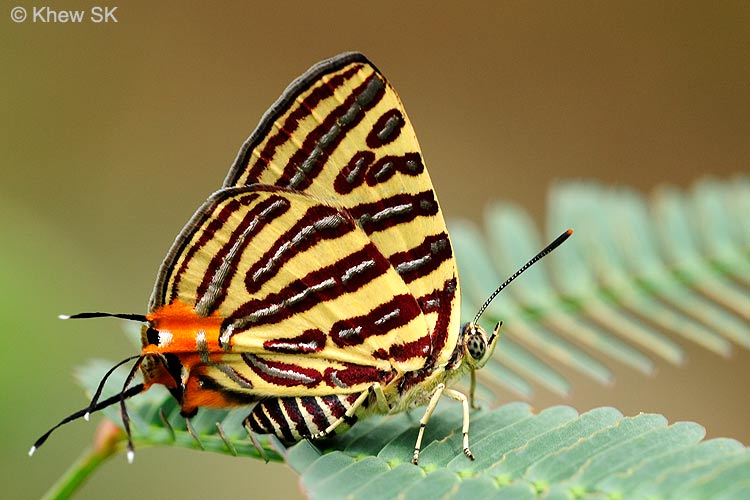
Two pretty Lycaenids - The Long Banded Silverline (Spindasis lohita senama) and Semanga superba deliciosa whose caterpillars depend on the Singapore Rhododendron as one of their caterpillar host plants

And so the humble "weed", the Singapore Rhododendron is a very versatile plant, critical to the survival of many butterfly species in Singapore and South-East Asia, by providing nectar, sugars from the fruits and leaves for the caterpillars.


Text by Khew SK : Photos by Khew SK