Showing posts sorted by relevance for query Cheritra freja. Sort by date Show all posts

09 February 2019

Butterfly of the Month - February 2019

Butterfly of the Month - February 2019
The Common Imperial (Cheritra freja frigga)


Chinese communities all over the world welcomed the Year of the Pig on 5 Feb 2019. The pig is the the twelfth animal in the 12-year cycle of Chinese zodiac sign and 2019 completes the cycle that started in 2006. This year's pig is the "Earth" pig according to the Chinese almanacs.


According to the Chinese astrology , 2019 is a great year to make money, and a good year to invest! 2019 is going to be full of joy, a year of friendship and love for all the zodiac signs; an auspicious year because the Pig attracts success in all the spheres of life. Sounds generally good enough for me! :)


It is always a nice feeling to shed the old and bring in the new, especially when 2018 wasn't a particularly good year on many fronts. It was heartbreaking when my mom left us at the age of 87 in early January. That month was just a total blur of sadness, grief and pain - combined with a flurry of activities.


But thankfully, our family support and well-wishes of friends helped us tide over that period. Mom would have wanted us to carry on and be happy that she no longer had to endure the suffering that she had to go through in the last 4 months of her life. To all the relatives and friends who were there for us, I thank you from the bottom of my heart. My apologies if I could not thank each of you individually, but you know who you are, and you have my humble gratitude that you reached out in my family's moments of darkness.


So life goes on for those of us, as we ponder our own mortality, and what we plan to leave behind us in the time that we have left in this world. Whatever little good that we can contribute to the world around us, we should. And we move on to do our little bit to make the world a better place in our own ways.


And we continue to bring cheer during this Chinese New Year period and look forward to better times that we have to work hard for. Our world is changing rapidly in many tangible and intangible ways. Disruptions of all sorts and sizes abound, and we have to face new challenges all the time. But that's what makes life 'colourful' and less mundane, even though we struggle to maintain order and stability around us.


Let us come back to our colourful friends, the butterflies. This month, we feature the Common Imperial (Cheritra freja frigga), a delicate long-tailed beauty of the Lycaenidae family. It is always a breath-taking experience to see this butterfly flutter amongst the shrubbery with its elegant white tails trailing behind.


Upperside of a male Common Imperial

The Common Imperial is more often seen in urban parks and gardens than within the forested nature reserves in Singapore. This may be because the species' caterpillars depend on a variety of host plants that are more commonly found in urban areas. The caterpillars of the Common Imperial have been successfully bred on Callerya atropurpurea, Duabanga grandiflora, Adenanthera pavonina (Red Saga) and Cinnamomum iners (Wild Cinnamon). The last two host plants are common roadside trees.

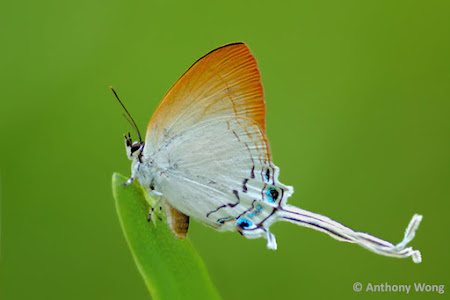


The upper wing surfaces of the butterfly is a deep purple-blue in the male, and dark brown in the female. The tornal area on the upperside features large black quadrate spots. The underside is mainly white on the hindwing with the forewing a shade of orange. The tornal spots on the hindwing is overlaid with iridescent greenish-blue scaling. The Common Imperial has white tails along veins 1a, 2 and 3 of which the one at vein 2 is the longest.


The Common Imperial has a rapid flight and is often skittish, preferring to stay high in the treetops. Where it is found amongst low shrubbery, males have a tendency to perch on a few favourite spots and 'attacks' any intruders into its space. Females descend to the lower levels to oviposit in the mid- to late afternoon hours of the day.


A Common Imperial sometimes displays a behaviour where it hides under a leaf

A Common Imperial puddling at a sandy streambank

At certain hours on hot humid days, males may be seen opening their wings flat to sunbathe. At other times, it displays a behaviour where it hides under a leaf with its wings folded upright. It is not often seen puddling at damp streambanks or muddy trails, but there have been occasions where males are observed puddling.


A mating pair of the Common Imperial

Sightings of this species have been more regular and often in the past decade. However, it appears to have become rarer in the recent few years, having been spotted mainly in the parks of Singapore's Southern Ridges. As with many of the English names of butterflies, those that carry the "common" prefix are often not as common as one is led to believe. The Common Imperial is a species that is considered moderately rare to rare, and is usually observed singly.

Text by Khew SK : Photos by Goh LC, Federick Ho, Khew SK, Jonathan Soong, Horace Tan, Tan Sze Siong and Anthony Wong

16 September 2018

Taxonomic Classification in Butterflies

Taxonomic Classification in Butterflies
What is a Subspecies?


The Swedish naturalist, Carolus Linnaeus (Carl von Linne) pioneered the internationally recognised naming system for every creature and plant. Realising that every organism should be classified systematically according to its relationship with other organisms, he created the Linnaean system in his works, Systema Naturae in 1735 - a catalogue of the names of all known animals and plants. The 10th edition of Systema Naturae in 1758 is often adopted as the starting point for biological classification of animals and plants by family, genus and species.


According to the Linnaean system, all animals and plants are known by a combination of two names - the first indicating the genus, and the second, the species. This system, referred to as binominal nomenclature is also applied to the naming of butterflies. Furthermore, classification of butterflies used by many researchers and authors extend one more level to a rank below species. This is the subspecies. This method of naming the subspecies is known as the trinominal system and is now in general use for the scientific naming of butterflies.


A Pea Blue in Singapore is also known as a Long-Tailed Blue in Australia and Europe.  But its scientific name, Lampides boeticus, is consistent, wherever it is found.

I have sometimes been asked about what a subspecies is, and how a butterfly subspecies comes about. This blogpost discusses the definition of subspecies, and the way it is applied to the scientific naming of butterflies. Although most amateurs and hobbyists prefer to use English common names for butterflies, this can often be confusing, and common names tend to differ amongst different countries and published references. Scientific names, however, are adopted universally and Lampides boeticus is the name used for the species, whether in England or in Singapore. The English common name, however, may vary from Long-Tailed Blue to Pea Blue, depending on where the butterfly is sighted!


Before we examine the concept of subspecies, let's consider what makes a species. A species is a group of living things with very similar traits that can interbreed. For example, elephants can breed with each other, but not with hippopotamuses. Different species rarely interbreed. On the occasions when they do, either by human intervention or naturally, the offsprings of the interbreeding are typically sterile, and are unable to reproduce further.


By definition, a subspecies is an individual or a group within a species that has become somewhat physically different from the species. However, they are still biologically similar enough to interbreed with individuals of the same species. Now let's take a look at why some species branch into subspecies. One major reason for this is the geographic isolation of a particular population of that species e.g. by physical distance or geographical separation, like an island. They are still the same species, but the group that became isolated may take on some different physical features simply due to their location.


The southern Malaysian and Singapore subspecies malayana (left) has less dense striations on its wings than the northern Malaysian subspecies nina (right)

However, we need to understand that the science of taxonomy is ever-evolving. Scientists often find themselves in disputes about which genus a particular species belongs to, or whether two or more butterflies with very similar physical characteristics should be classified as separate species or as subspecies. With recent developments in microbiology, phylogenetics, DNA sequencing, and the study of the early stages of a butterfly often results in new insights on the relationships between species. This newfound knowledge regularly results in the necessity to make revisions to the adopted classifications of butterflies.


Scientific name of the Lime Butterfly is :
[Genus]Papilio [Species]demoleus [Subspecies]malayanus

In the trinominal system of naming of butterfly species, we have the [Genus] followed by the [species name] and then by the [subspecies name]. Hence for a Lime Butterfly, the scientific name would be Papilio demoleus malayanus. Note that only the genus name is capitalised. The species and subspecies name should never be capitalised.


Different subspecies of butterflies found in Singapore vs those found in Northern Thailand
Top : Moduza procris procis (Chiang Dao) vs Moduza procris milonia (Singapore)
Middle : Cheritra freja friggia (Singapore) vs Cheritra freja evansi (Chiang Dao)
Bottom : Lexias pardalis jadeitina (Chiang Dao) vs Lexias pardalis dirteana (Singapore)

For amateur observers (and even for the more knowledgeable enthusiasts), it is sometimes difficult to ascertain the physical differences between two subspecies of butterflies. Very often, purely due to geographical distances, a butterfly that shows very little perceptible physical differences is given a different subspecies name. Others, however, are more obvious where the physical differences are clear.


Examples of butterflies which has only the species name, suggesting that the physical appearance of these species have no significant differences irrespective of where they are found - Lampides boeticus (Pea Blue), Acreae terpsicore (Tawny Coster), Udaspes folus (Grass Demon) and Plastingia naga (Chequered Lancer)

Then what about butterflies with only species name given to it? This suggests that the species is consistent throughout its range and there are no discernible physical differences in its appearance, no matter where it is geographically found. Some examples of such butterflies that are extant in Singapore are the Pea Blue, Grass Demon, Tawny Coster and Chequered Lancer. Interestingly, quite a number of butterflies that have been described down to only species level are from the Lycaenidae and Hesperiidae families.


Left : Subspecies malayana and Right : subspecies parkeri are both found in Singapore

Left : Subspecies bolina and Right : subspecies jacintha are both found in Singapore

Left : Subspecies pratipa and Right : subspecies bisaltide are both found in Singapore. However, subspecies pratipa has not be reliably seen since 2007.

Left : Female subspecies bisalitide and Right : subspecies pratipa showing their differences on the upperside of their wings

In Singapore, there are 3 occurrences of butterflies of which there are two subspecies observed here over the years. These are the Knight (Lebadea martha parkeri and Lebadea martha malayana), the Great / Jacintha Eggfly (Hypolimnas bolina bolina and Hypolimnas bolina jacintha) and the Autumn Leaf (Doleschallia bisaltide bisaltide and Doleschallia bisaltide pratipa). Being an island separated from mainland Malaysia, it is likely that these subspecies' range overlap between Singapore and Malaysia and the evolution of the subspecies may continue until one is eventually eliminated.


Top : Caterpillar of the Autumn Leaf subspecies bisaltide and Bottom : subspecies pratipa

In the case of the Autumn Leaf, the subspecies pratipa which is usually found in Malaysia has a distinctively different caterpillar that is more obvious than the adult butterflies. However, subspecies pratipa was last seen in Aug 2007 at the Mandai Zoo and it is unknown if this subspecies still occurs in Singapore. The other two species continue to have sightings of their respective subspecies to this day.

As taxonomic science continues to evolve, technical methods and new knowledge are gained, it is inevitable that changes and updates to the scientific names of butterflies will continue.

Text by Khew SK : Photos by James Chia, Khew SK, Anthony Wong and Mark Wong

03 April 2011

Life History of the Common Imperial

Life History of the Common Imperial (Cheritra freja frigga)


Butterfly Biodata:
Genus: Cheritra Moore, 1881
Species: freja Fabricius, 1793

Sub-species: frigga Fruhstorfer, 1912
Wingspan of Adult Butterfly: 30-42mm
Caterpillar Local Host Plants:
Adenanthera pavonina (Leguminosae, common name: Red Saga), Callerya atropurpurea (Leguminosae), Cinnamomum iners (Lauraceae, common name: Wild Cinnamon), Duabanga grandiflora (Lythraceae)


A male Common Imperial displaying its upperside

Physical Description of Adult Butterfly:
Above, the male is purplish brown and the female is dark brown. Both sexes have large quadrate tornal spots in spaces 1b and 2 of the hindwing. These spots are outlined in white, more broadly so in the female than in the male. Underneath, both sexes are mostly white and have orange brown shadings on nearly the entire forewing and just the apical area of the hindwing. There is a narrow, indistinct ochreous brown post-discal line on the forewing. On the hindwing, the post-discal line occurs in short stripes and becomes darker and bolder towards the lower half of the wing. In addition, there is an interrupted dark submarginal line, a series of tornal spots on the tornal lobe and spaces 1b, 2 and 3. Metallic bluish green scalings overlay these spots. A long filamentous tail, up to 25mm, occurs at the end of vein 2. In contrast, a much shorter tail occurs at the end of vein 1b.


Field Observations of Butterfly Behaviour:
The Common Imperial is moderately rare in Singapore. The adults are more commonly sighted in the Southern Ridges, in addition to sporadic sightings in the nature reserves and other urban parks and gardens. It frequents forested areas and flies in a similar manner as its more common relative, the Branded Imperial. As the adult butterfly flies from one perch to the next, the long tails trails elegantly behind the butterfly.


Early Stages:
The immature stages of Common Imperial are polyphagous. To date 4 plants have been recorded as its local hosts. Caterpillars of all instars feed on young and tender leaves of the host plants. They are also polychromatic, occurring mainly in either a green form or a pink form.


Local host plant #1: Duabanga grandiflora.


Local host plant #2: Adenanthera pavonina


Local host plant #3: Cinnamomum iners


A mating pair of the Common Imperial.

A mother Common Imperial laying an egg on a young leaf of the Wild Cinnamon.

Eggs are laid on the underside of a young leaf or other parts of a young shoot of the host plant. The white egg, about 0.9mm in diameter, is shaped like a slightly flattened chinese bun. The surface is covered with numerous pits of varying sizes. The polar pit holds the depressed micropylar.


Two views of an egg of the Common Imperial. Diameter: 0.9mm.


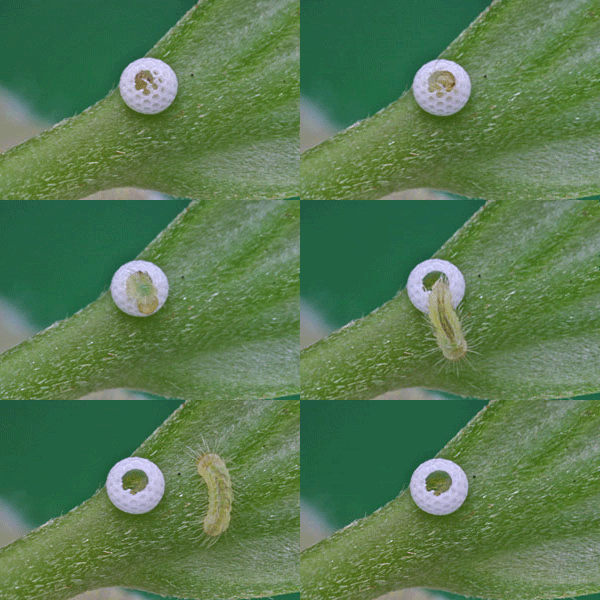
A Common Imperial caterpillar emerges from its egg shell.

Each egg takes about 2 to 2.5 days to hatch. The young caterpillar emerges after nibbling away sufficiently large upper portion of the egg shell. Measured at a length of about 1.1-1.2mm, its pale yellow green body is roughly cylindrical in shape. Dark and long setae run dorso-laterally and whitish long setae run laterally. Its head capsule is pale yellowish, and both its prothoracic shield and anal plate are colored as per the body base colour.


Two views of a newly hatched caterpillar of the Common Imperial, length: 1.2mm


As the caterpillar grows, raised tubercles become apparent on the dorsum, one pair to each of 2nd-3rd thoracic segments, and one to each 1st-7th abdominal segments. Body color is whitish alongside this row of tubercles, forming two white bands visually. Another two yellowish green bands line the outer sides of these white bands. This instar lasts for 2.5 to 3 days with the body length reaching up to 2.7mm.


Two views of a 1st instar caterpillar, length: 2mm.

Covered with numerous short setae, the body of the 2nd instar caterpillar is either whitish with a yellowish green tone or pinky tone. Each of the 2nd and 3rd thoracic segments has a pair of dorso-lateral conical projections, whilst each of the first six abdominal segments have a tall conical projections, taller than those on the thoracic segments. These projections are yellowish brown around the tip and whitish at the base. The 7th abdominal segment is broadened laterally compared to the other segments. In addition to the dorso-lateral white bands, a lateral white band also become discernible along the rim of the body. The growth in this stage brings the caterpillar to a length of about 5mm, and after about 2 days in this stage, it moults again.


Two views of a 2nd instar caterpillar, lengths: 4mm.


Two views of a 2nd instar caterpillar, late in this stage, length: 4.9mm.

The 3rd instar caterpillar resembles the 2nd instar caterpillar closely with minor changes observed. The dorsal projections on the abdominal segments are now much longer and pointed than those on the thoracic segments. The lateral projections on the 7th thoracic segments are also much more pronounced than in the earlier instar. both the prothoracic shield and the anal plate are black and well developed. This instar takes 2.5-3 days to complete with the body length reaching about 10.5mm before the next moult.


Two views of a 3rd instar caterpillar, length: 5mm.


Two views of a 3rd instar caterpillar, late in this stage, length: 10.5mm.

The 4th instar caterpillar bears a few changes from the 3rd instar. One visual difference is the missing white bands flanking the dorsal projections on the abdominal segment. The body base color is either green (green form) or pink (pink form). The dorso-lateral pairs of projections seen on the 2nd-3rd thoracic segments in earlier instars are no longer discernible. Furthermore, yellowish brown to dark brown patches occur laterally in 3rd-5th abdominal segments, increasing in size from the 3rd to the 5th segment. This instar lasts about 3-4 days with length reaching 20-22mm.


Two views of a 4th instar caterpillar, length: 14.5mm.

Two views of a 4th instar caterpillar, red form, late in this stage, length: 20mm.


Two views of a 4th instar caterpillar, green form, late in this stage.

Towards the end of the 4th instar, the caterpillar ceases eating and chooses a spot on an inclined leaf surface or a stem for its pupation site. At this time, the caterpillar's body shrinks in length and its body changes to a shade of green color (even for the pink form). The lateral patches surrounding the dorsal projections also decolorise drastically. It spins a silk pad and then anchors itself on it in a head-down posture.


Two views of a pre-pupatory larva of the Common Imperial.

Pupation takes place after one day of the pre-pupal stage. The pupa has the typical lycaenid shape, yellowish green in base colour with pale yellowish brown markings on the first 6 abdominal segments. The wing case and the dorsum of the thorax is greyish brown to greenish brown. Length of the pupa: 10-12mm.


Two views of a pupa of the Common Imperial.

5.5-6 days later, the mature pupa turns dark in the dorsal and wing case areas, and yellowish brown elsewhere. The next day the adult butterfly emerges from the pupa.


Two views of a mature pupa of the Common Imperial.


A newly eclosed Common Imperial resting near its pupal case.

References:
  • [C&P4] The Butterflies of The Malay Peninsula, A.S. Corbet and H.M. Pendlebury, 4th Edition, The Malayan Nature Society.
  • Butterflies of Thailand, Pisuth EK-Amnuay, 1st Edition, 2006.
Text by Horace Tan, Photos by Anthony Wong, Federick Ho, Sunny Chir, Khew Sin Khoon and Horace Tan