Showing posts sorted by relevance for query Cephrenes trichopepla. Sort by date Show all posts

23 January 2010

An Aussie Skipperoo Comes to Town

An Aussie Skipperoo Comes to Town
Introducing the Yellow Palm Dart (Cephrenes trichopepla)


It took quite some time of careful research and breeding the entire life history of this species before ButterflyCircle members finally confirmed that this Hesperiidae, which is usually found in Northern Australia, is now a permanent resident of Singapore (and also Malaysia!)


This skipper, which superficially resembles the local Telicota species, escaped notice for many years. It all started (now that I've had time to dig out my notes and emails from various people) with an email from a butterfly expert from Australia who was on holiday in Singapore. This was back in 1999! Kelvyn Dunn, who wrote me an email later in 2003, said this :

"Recently in Singapore (1999) I observed and examined in the hand (incl photographed) an example of Cephrenes trichopepla (an Australian sp.) in Fort Canning Park. I have video images.

Have you found any evidence of this skipper species as yet? I presume mine was not athe only one. (I can send pics if you want to see them to examine it for yourself).

In Australia my claim has met some scepticism because I did not preserve the adult."


At that point in time, ButterflyCircle hadn't even re-discovered the Plain Palm Dart (Cephrenes acalle niasicus) yet, so I was rather skeptical at Kelvyn's find too. The many lookalikes amongst the Telicota and larger Potanthus spp. didn't help either, so I assumed that Kelvyn's find was probably another one of the Telicota and left it at that.


Some time later, more individuals of this rather large skipper turned out in various locations in Singapore - public parks, gardens, flower nurseries and so on. By then, we had confirmation of the existence of the Plain Palm Dart after a few shots of the more distinctive females were validated. Hence I assumed that what Kelvyn observed in 1999 was probably a male Cephrenes acalle.


Although the males of the Plain Palm Dart had more angular apical forewing area, the markings on the undersides are less distinct than this other strange skipper that had clean orange colours and crisp markings on the undersides. The physical appearance of this butterfly didn't really match the markings of any of the Telicota spp shown in the reference books on Malaysian, Singaporean and even Thai butterflies.


So we continued with the belief that this skipper could be just be displaying variations of the markings of the extant species of Telicota or the solitary Cephrenes sp in Singapore.


More shots turned up of this species, which we incorrectly identified as one of the Telicota spp. But the larger size of many of the individuals sighted continued to intrigue me, although I put it down to variations in the sizes of the Hesperiidae, which occurs quite often amongst some other species. Even after managing to capture a mating pair of this species, I left it that it was one of the Telicota.


A mating pair of the Yellow Palm Dart observed near a reservoir park

By good fortune and chance, ButterflyCircle member Anthony Wong discovered a caterpillar feeding on coconut leaf (Cocos nucifera) during a survey of the offshore island of Pulau Semakau. Left in the good hands of our expert caterpillar farmer, Horace Tan, photos of the caterpillar indicated a physical difference from the Telicota caterpillars as shown in various reference books. This caterpillar had unique orange-yellow "cheeks" on both sides of its mandibles.


Close up of the Yellow Palm Dart's caterpillar, showing its orange-yellow "cheeks"

A quick research on Internet resources found a closely-matched early stages of the Australian skipper, Yellow Palm Dart (Cephrenes trichopepla). Shortly before this find on Pulau Semakau, our ButterflyCircle member in Kuala Lumpur, LC Goh, had also recorded complete life history of a an unidentified species of skipper in March 2009. Comparing the photos with more of the caterpillars that were eventually bred in Singapore, it was confirmed that what LC Goh bred, was also a Yellow Palm Dart!


Caterpillar of the Yellow Palm Dart, bred by LC Goh in Kuala Lumpur, Malaysia

Further consultations with Kelvyn Dunn, who generously provided photos and research papers that he had written on two resident Cephrenes in Australia, and also our Malaysian expert lepidopterist, Dr Laurence Kirton, it is now established beyond doubt, that the Hesperiidae species, the Yellow Palm Dart (Cephrenes trichopepla) is now part of the butterfly fauna in Malaysia and Singapore.


Male and Female Yellow Palm Darts - freshly eclosed specimens from caterpillars bred on Cocos nucifera

Both sexes of the Yellow Palm Dart are almost identical in appearance. The uppersides of the wings are dark brown to black, with orange bands on the forewings, and a wide discal band on the hindwings. The undersides are ochreous yellow with the markings distinctly marked in black. The hindwings beneath has a large black spot in the anal fold which separates it from all other species.

Males are exceedingly fast flyers but often stop to perch with its forewings held at an angle with the hindwings opened flat in the typical Hesperiidae fashion.


A male Yellow Palm Dart perches in the usual skipper fashion

The caterpillar host plant on which the species was bred in Singapore is the Coconut Palm. However, the species is known to also feed on various other Palmae in Australia.

So, as we wish "G'day, mate" to this Australian "foreign talent" and new addition to the Singapore (and Malaysian) checklists - the Yellow Palm Dart, we also hope to one day see another similar Australian species the Orange Palm Dart (Cephrenes augiades) reaching the shores of Singapore.


Specimens shots of the Yellow Palm Dart, courtesy of the James Cook University, Australia

In conclusion, Kelvyn, if you are reading this article, you can now assure your skeptics that you indeed saw a Yellow Palm Dart here in Singapore in 1999. Your valued discussions over emails and articles and photos that you sent me are very much appreciated.


Text by Khew SK ; Photos by Sunny Chir, LC Goh, Khew SK & Horace Tan

Further Reading :

30 April 2022

Butterfly of the Month - April 2022

Butterfly of the Month - April 2022
The Yellow Palm Dart (Cephrenes trichopepla)

A Yellow Palm Dart perched on the flower of the Feather Cockscomb

The month of April is almost over, but overall, it has been an optimistic month for most of the world's governments who are dealing with the pandemic. It has been more than two and a half years since the dreaded coronavirus descended on the world and covid-fatigue has set in for most communities around the world. Economies and livelihoods have been battered blue-black for many months, and many countries have begun to deal with the virus as an "endemic".


The virus continues to mutate, but the more recent variants, though highly transmissible, have a milder effect on infected individuals, albeit there are still some fatalities. It is the combination of the milder variants, a highly vaccinated population and healthcare systems in place, that Singapore has reverted to a largely pre-covid normalcy. Malls and places of public resort, food and beverage outlets, recreational facilities and so on, are now open without having entrance restrictions.


Other than certain mask-on requirements in enclosed spaces, our environment in Singapore has gone back to almost pre-covid conditions in 2020 before the lock-downs all started. As the citizenry heave a collective sigh of relief, we pick up the pieces and look forward to a world that we were used to. Travel is no longer the luxury of a privileged few, and cross-border forays are now enjoyed by all and sundry.


Over in northern Europe, the Russia-Ukraine war continues unabated, although the invaders still have to contend with a very tenacious and surprisingly determined defence forces of the Ukrainian. As with all wars, it is the civilians and commoners who suffer and this is no different in Ukraine. No one can tell what the outcome will be, or when the invasion will end. But the world is watching and gleaning learning lessons from such an invasion of a sovereign nation by an aggressive neighbour.


Our Butterfly of the Month for April 2022 is a recent addition to the Singapore butterfly fauna - the Yellow Palm Dart (Cephrenes trichopepla). Originally a native to the Australian region, the Yellow Palm Dart was first confirmed recorded in Singapore in 2009 after some years of skepticism that this species actually existed in Singapore. However, records show that it was probably extant in Singapore as early as 1999 when a sighting of this species was reported but not confirmed.

Yellow Palm Darts are often observed perched on the top surfaces of leaves to rest with their wings folded upright

The Yellow Palm Dart is considered a widespread and common species in Singapore today, where it can be found in various habitats from urban gardens to the forested nature reserves and offshore islands. Where its preferred caterpillar host plant can be found - the common coconut palm (Cocos nucifera), this species is often not too far away. It is now found in Malaysia and has also been reported from as far west as Sri Lanka.

A Yellow Palm Dart feeding on the pink flowers of Lantana camara


The species is swift on the wing, and skittish if disturbed. However, it occasionally perches to rest with its wings opened to sunbathe in the typical skipper fashion. It can sometimes be observed feeding on flowering plants in urban parks and gardens. It is also attracted to bird droppings.

A Yellow Palm Dart perches on the seed pod of a Rattlebox Weed with its wings opened to sunbathe

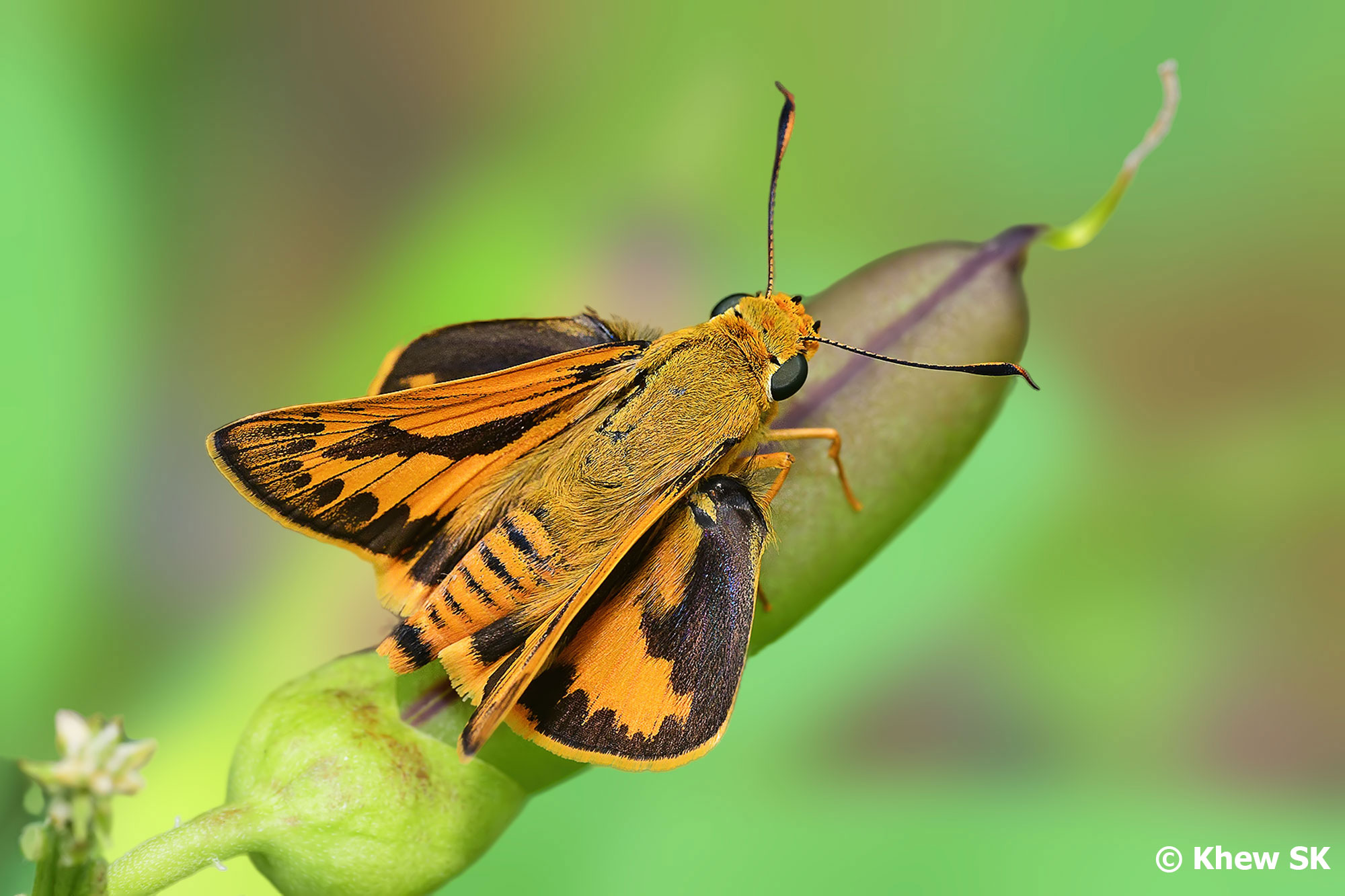
The Yellow Palm Dart's wings are black above with prominent orange-yellow streaks and spots that are typical of the genera Cephrenes. The orange yellow colour of the post-discal band on the forewing above is continued along the veins towards the termen. The males of this species do not possess a sex brand on the forewing above. The abdomen is orange banded and there is a black patch at the abdominal tip.

A mating pair of the Yellow Palm Dart

On the underside, the colour of the wings are a deep orange-yellow. The post-discal band on the underside of the hindwing is distinctly edged with black, and the band itself is a deeper orange than the surrounding ground colour of the wings. The antennal tips are orange on the inward side of the club, whilst the outer side is black.


The species' caterpillar feeds on various palms, like the Coconut Palm (Cocos nucifera), Livistona sp. (Arecaceae) and Lipstick Palm (Cyrtostachys renda). Given the widespread distribution of the Yellow Palm Dart, it is likely that the caterpillars feed on other species of palms. 

Text and Photos by Khew SK

09 May 2012

Random Gallery - The Yellow Palm Dart

Random Butterfly Gallery
The Yellow Palm Dart (Cephrenes trichopepla)

Canon 7D, Tamron 180mm, AV mode, F11, 1/200, ISO640, Handheld, fill-flash

This week's random butterfly photo is a recent immigrant to Singapore, the Yellow Palm Dart (Cephrenes trichopepla).  The species originates from the Indo-Australian region.  Read the blog article of this species when it was first discovered in SIngapore by ButterflyCircle members.  This excellent shot of the skipper perched with the usual Hesperiidae pose was taken by member Loke Peng Fai.


27 July 2019

Butterflies of Australia

Feature Book :
Butterflies of Australia


Recently, a friend who visited Australia sent me some butterfly photos that he took on his trip, for identification. Most were relatively common urban butterflies and were easy to identify. One of the books that I turned to was my favourite personal reference, Butterflies of Australia by Dr Albert Orr and Professor Roger Kitching. Both accomplished and renown biologists and entomologists, the authors intended for the book to be a field guide "for a general readership, and not a scientific monograph".


What is additionally unique about this book, is that all the illustrations of the butterflies, their environment, host plants, caterpillars and so on, are hand-drawn pictures! The amazing pictures in the book itself was illustrated by Dr Orr, an excellent artist in his own right.


The New Guinea Birdwing (Ornithoptera priamus) male

This blogpost introduces this excellent book which is great for beginners and the more sophisticated enthusiast alike. Only sample photos of the book are shown here, and for readers who are interested in getting this large 335-page book, you are strongly encouraged to purchase your own copy from reputable bookshops or online.


Introduction to butterflies and useful information about butterflies in Part I of the book

Part 1 of the book covers the mandatory subjects like introduction to Lepidoptera, classification, life cycle, colours and reproduction in Chapter 1. Chapter 2 features the Australian biogeography in relation to butterfly distribution, and where observers can find the various species. Chapter 3 deals with butterflies' relationships with plants and other animals, competition for food and mates and predators. Chapter 4 discusses conservation, gardening and how one can become an avid student of butterflies. For beginners, these first 60 pages of the book would be good to read in greater detail.


Various chapters featuring Australian species from the 5 families of butterflies

The 2nd and more substantial part of the book covers almost all of the 400+ species of Australian butterflies - divided over the 5 families. At the point of writing, the authors probably stayed with the earlier classification where Riodinidae was still classified as a sub-family of the Lycaenidae. The book then ends with references, a good index, and two important checklists of Australian butterflies and larval host plants of Australian butterflies.


A useful appendix listing all the known caterpillar host plants of Australian Butterflies

Part 2 starts with the Hesperiidae, with plates covering the Australian skippers. In keeping with their intent to make this book a readable field guide, the authors grouped the species by their collective English common names, rather than sort them by taxonomic names. This makes the book an easy reference for the Australian (and other) butterfly enthusiasts to search for the various species by their local vernacular names, instead of look for genera and species names.


Typical pages in the book which organises the species by their collective common names, and illustrations of the butterflies, host plants, life histories and distribution in Australia

The Yellow Palm Dart (Cephrenes trichopepla) an Australian species that is now extant in Singapore and Malaysia

In these sample pages, the Yellow Palm Dart (Cephrenes trichopepla) is featured. This is the same species that was discovered in Singapore back in 1999 by Kelvyn Dunn. The blogpost of that discovery that was documented here on this blog can be found here. This species, a new discovery to Singapore at that time, is now a common species and has even moved up north to Malaysia where it has been spotted regularly.


The New Guinea Birdwing (Ornithoptera priamus) female

The next chapter features the spectacular Papilionidae and the mouth-watering Ornithoptera birdwings found in Australia. Although the Papilionidae is represented by only 19 species in Australia, these are some of the most spectacular butterflies to be found in the continent. Large and showy, some of the species are amongst the world's largest butterflies. It is also interesting to note that many of the species that can also be found in Singapore, bear different common names in Australia.


The Ambrax Butterfly (Papilio ambrax) an Australian butterfly fairly common in rainforest in north Queensland's wet tropics region

Graphium sarpedon - Common Bluebottle in Singapore, Blue Triangle in Australia

For example, the Common Bluebottle (Graphium sarpedon) is called the Blue Triangle in Australia, whilst the Tailed Jay (Graphium agamemnon) is known as the Green-spotted Triangle. Our common urban Lime Butterfly (Papilio demoleus) goes by the name Chequered Swallowtail in Australia, whilst the Five Bar Swordtail refers to the species Graphium aristeus instead of Graphium antiphates.


The Imperial Jezabel (Delias harpalyce) found in Australia

The Pieridae family follows in the next chapter. Australia has amongst the most beautiful and exotic-looking Delias (or commonly known as Jezebels) in the world. In the book, they are called Jezabels. Amongst the Whites and Sulphurs that are usually associated with the family Pieridae, the Australian Jezabels feature prominently with 8 species extant.


Common urban species that are also found in Singapore - Blue Pansy (Blue Argus in Australia) and Common Tiger (Orange Tiger in Australia)

In Chapter 8 of the book, most of Australia's 81 species of Nymphalids are featured, with twelve sub-families occuring in Australia. There are some species that are also found in Singapore, with the Common Tiger (Danaus genutia) called the Orange Tiger as its local common name. The Blue Pansy (Junonia orithya) and the Chocolate Pansy (Junonia hedonia) are known as the Blue Argus and Brown Soldier respectively in Australia.


The Two Spotted Line Blue (Nacaduba biocellata) was a new discovery for Singapore and is now extant on the island

The butterfly families in the book ends with the Lycaenidae, of which more than 140 species are recorded from Australia, and counting! Amongst the many spectacular blues, coppers and hairstreaks, one species was recently recorded as a new species to Singapore - the Two-Spotted Line Blue (Nacaduba biocellata). An Australian species, it has somehow found its way to Singapore, and is now a permanent resident.


The Sword-tailed Flash (Bindahara phocides) is known as the Plane in Singapore

For a butterfly primer and an introduction to Australian butterflies, this book by Dr Orr and Prof Kitching can be considered one of the best and easy-to-read references available. Enthusiasts who have their own library of butterfly books from all over the world should not miss having this book in their collection.

Text by Khew SK : Photos by David Fischer and Khew SK

Photo plates featured here from the book are copyrighted property of the respective authors and publishers, and samples of the pages from the books are featured here under the principles of fair use.

I have also had the privilege of having Dr Albert Orr review my book, A Field Guide to the Butterflies of Singapore 2010, and the review published in the Australian Entomologist  - Volume 38 Issue 4 (Nov 2011)