The Silver Forget-Me-Not (Catochrysops panormus exiguus)

A quarter of 2017 had come and gone. The fourth month of the year seems quiet enough, although the uncomfortable tension that came with two US military strikes on Syria and Afghanistan lingers in the air. It would appear that the Trump administration will not hesitate to show its destructive force in the use of (currently) conventional weapons in sending a strong message to ISIS.


Already, the amassing of US military hardware in South Korea, and the reciprocal response from China is causing consternation in north-east Asia. Will the US, which appears to be emboldened by their military strikes on the ISIS strongholds, also use force to teach North Korea a lesson? Will North Korea stay quiet in the face of US hostilities, as Syria and Afghanistan appear to be? We live in times of great uncertainty indeed.

I was in China waiting for my flight to take off, when news of the US strike on Afghanistan broke. Although far away, the impact of the incident caused quite a bit of delays at airports in China. Despite no one mentioning that the 'temporary closure' of certain airports in China and the flight delays that ensued were a result of the international incident, we can only speculate that China was on high alert during that short period of time.

And then there was the United Airlines incident that buzzed the internet for a few days. Due to the prevailing policy that airlines in the US are allowed to over-sell their flights, whenever a flight is full, the airline will invite passengers to forego their seats (for a little compensation) to accommodate the airline's policy. However, the incident on United Express Flight 3411 where a "booked, paid and seated" passenger was selected at random and physically dragged out of the plane by security personnel.

I recall that some years ago, I was offered to take a later flight when the plane that I was booked on, was full. The American Eagle counter staff was polite and persuasive and I agreed to take a US$150 compensation and took a flight that was 3 hours later. The difference was that I was persuaded not to take the flight before I boarded the plane. The current incident where a passenger was violently dragged off the plane after being seated is totally unacceptable, which is probably why it set off an internet storm all around the world.

Perhaps living the life of a butterfly is a lot less complicated? This month, we feature a small hairstreak or Lycaenidae species called the Silver Forget-Me-Not (Catochrysops panormus exiguus). It was re-discovered in Singapore back in 1997. References indicated that this species was not seen in Singapore since the late 19th century and was therefore considered 'extinct'. However, a small population was observed in the Khatib Bongsu area and Pulau Ubin. Subsequent sightings of this species on Sentosa and various parts of the island indicated that the species is extant and resident in Singapore.

Considered a moderately rare species, the Silver Forget-Me-Not is usually encountered singly where it flies with a rapid erratic flight amongst the low shrubbery. The caterpillar host plant is Pueraria phaseoloides which is a "weed" growing in open wastelands and cleared areas.

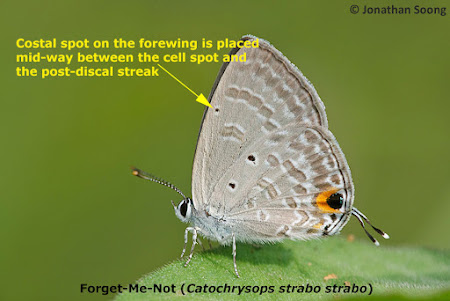
Comparison between the Silver Forget-Me-Not and the Forget-Me-Not showing the position of the costal spot on the forewing edge on the underside of the forewing.
This species is not to be confused with its lookalike cousin, the Forget-Me-Not (Catochrysops strabo strabo). Almost identical in most respects, these two species are hard to separate in the field, as they frequent the same habitats and display the same habits. The key distinguishing difference is the location costal spot on the underside of the forewing.


Upperside of the male and female Silver Forget-Me-Not
The Silver Forget-Me-Not is pale shining blue on the upperside of the male. The female is heavily black dusted with broad black apical area on the forewing, and dull blue wing bases. The underside is greyish white with the usual Lycaenidae streaks and spots. The hindwing has a long filamentous white-tipped tail at vein 2.


Puddling Silver Forget-Me-Nots
At certain times of the day, both males and females of the Silver Forget-Me-Not can be observed to open their wings partially to sunbathe. These are the only times when one can observe the uppersides of the wings, as they normally stop with their wings folded shut, even when they feed on flowers or when they puddle on damp footpaths and streambanks.

Text by Khew SK : Photos by Sunny Chir, Federick Ho, Khew SK, Koh CH, Loke PF, Nelson Ong, Jonathan Soong, Lemon Tea and Mark Wong

And then there was the United Airlines incident that buzzed the internet for a few days. Due to the prevailing policy that airlines in the US are allowed to over-sell their flights, whenever a flight is full, the airline will invite passengers to forego their seats (for a little compensation) to accommodate the airline's policy. However, the incident on United Express Flight 3411 where a "booked, paid and seated" passenger was selected at random and physically dragged out of the plane by security personnel.

I recall that some years ago, I was offered to take a later flight when the plane that I was booked on, was full. The American Eagle counter staff was polite and persuasive and I agreed to take a US$150 compensation and took a flight that was 3 hours later. The difference was that I was persuaded not to take the flight before I boarded the plane. The current incident where a passenger was violently dragged off the plane after being seated is totally unacceptable, which is probably why it set off an internet storm all around the world.

Perhaps living the life of a butterfly is a lot less complicated? This month, we feature a small hairstreak or Lycaenidae species called the Silver Forget-Me-Not (Catochrysops panormus exiguus). It was re-discovered in Singapore back in 1997. References indicated that this species was not seen in Singapore since the late 19th century and was therefore considered 'extinct'. However, a small population was observed in the Khatib Bongsu area and Pulau Ubin. Subsequent sightings of this species on Sentosa and various parts of the island indicated that the species is extant and resident in Singapore.

Considered a moderately rare species, the Silver Forget-Me-Not is usually encountered singly where it flies with a rapid erratic flight amongst the low shrubbery. The caterpillar host plant is Pueraria phaseoloides which is a "weed" growing in open wastelands and cleared areas.


Comparison between the Silver Forget-Me-Not and the Forget-Me-Not showing the position of the costal spot on the forewing edge on the underside of the forewing.
This species is not to be confused with its lookalike cousin, the Forget-Me-Not (Catochrysops strabo strabo). Almost identical in most respects, these two species are hard to separate in the field, as they frequent the same habitats and display the same habits. The key distinguishing difference is the location costal spot on the underside of the forewing.


Upperside of the male and female Silver Forget-Me-Not
The Silver Forget-Me-Not is pale shining blue on the upperside of the male. The female is heavily black dusted with broad black apical area on the forewing, and dull blue wing bases. The underside is greyish white with the usual Lycaenidae streaks and spots. The hindwing has a long filamentous white-tipped tail at vein 2.
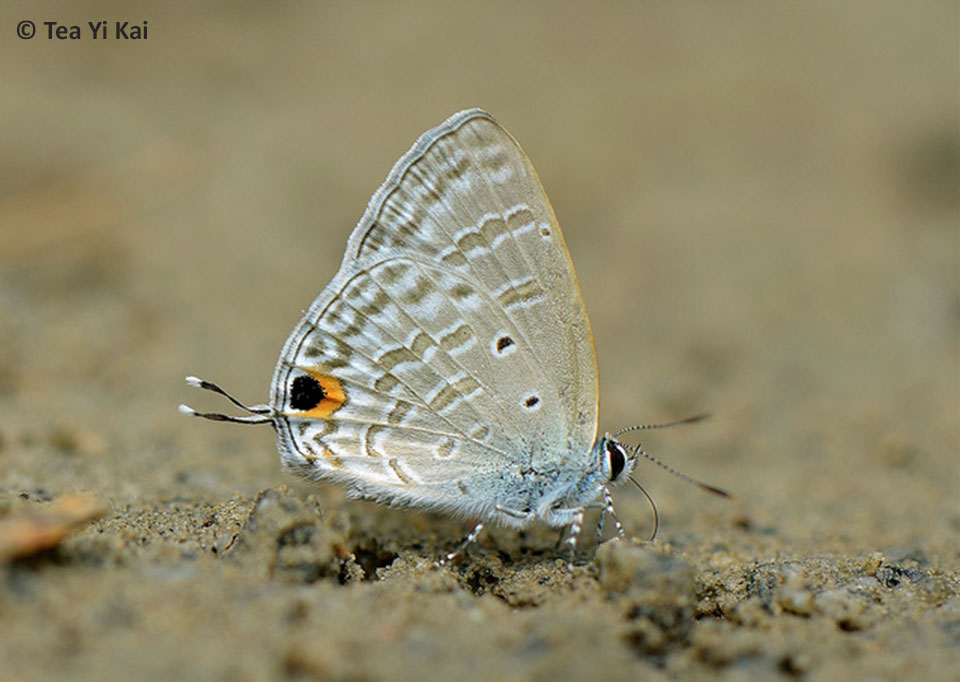

Puddling Silver Forget-Me-Nots
At certain times of the day, both males and females of the Silver Forget-Me-Not can be observed to open their wings partially to sunbathe. These are the only times when one can observe the uppersides of the wings, as they normally stop with their wings folded shut, even when they feed on flowers or when they puddle on damp footpaths and streambanks.

Text by Khew SK : Photos by Sunny Chir, Federick Ho, Khew SK, Koh CH, Loke PF, Nelson Ong, Jonathan Soong, Lemon Tea and Mark Wong


