Showing posts sorted by relevance for query Arhopala abseus abseus. Sort by date Show all posts

31 January 2021

Butterfly of the Month - January 2021

Butterfly of the Month - January 2021
The Aberrant Oakblue (Arhopala abseus abseus)


This is the first blogpost of the year, continuing the Butterfly of the Month series that started way back in December 2007. As mentioned in my previous post in 2020, the long-standing weekly posts will cease, as this blog will take on a slower pace from this year on, with a minimum of one blogpost a month, and depending on any interesting subjects or news to share, there may be additional posts from time to time.


One of the most tumultuous years in history has passed in 2020. But the COVID-19 pandemic is far from over. Many countries all over the world have seen repeated resurgence of infections with multiple waves of the virus attacks coming again and again. The mutation of the virus, yielding even more infectious strains, have started to appear in countries where the virus continues to spread uncontained.


The elections in the US is now over, and the world has seen some really unprecedented un-American things that have happened in the last few months of 2020. Everything that the US criticised about other nations, from "rigged" elections to violent protests and shooting their own citizens happened in the US. And in no less a place than the Capitol in Washington DC, the seat of power. It capped a very strange year, and the pandemic was not the only event that was unprecedented in modern history.


But whatever that was, the world welcomes the 46th President of the US in Joe Biden. How the world order will change, will have to play out in 2021, and everyone hopes that it will be back to normal relations amongst nations, working towards world peace and prosperity. The return of the US to the Paris Climate Change accord within a few hours of the new President taking office is good news for the environment. And it is hoped that new initiatives will be taken to combat climate change and slow down the degradation of the environment in many ways.


Back in Singapore, the vaccination programme has commenced, with healthcare staff, frontliners and senior citizens given the priority of the Pfizer-Biontec vaccine. The government intends to vaccinate the entire population to create herd immunity to contain the virus and despite continued concerns, risks and misinformation flying around social media, that goal is something to strive for as the year wears on.


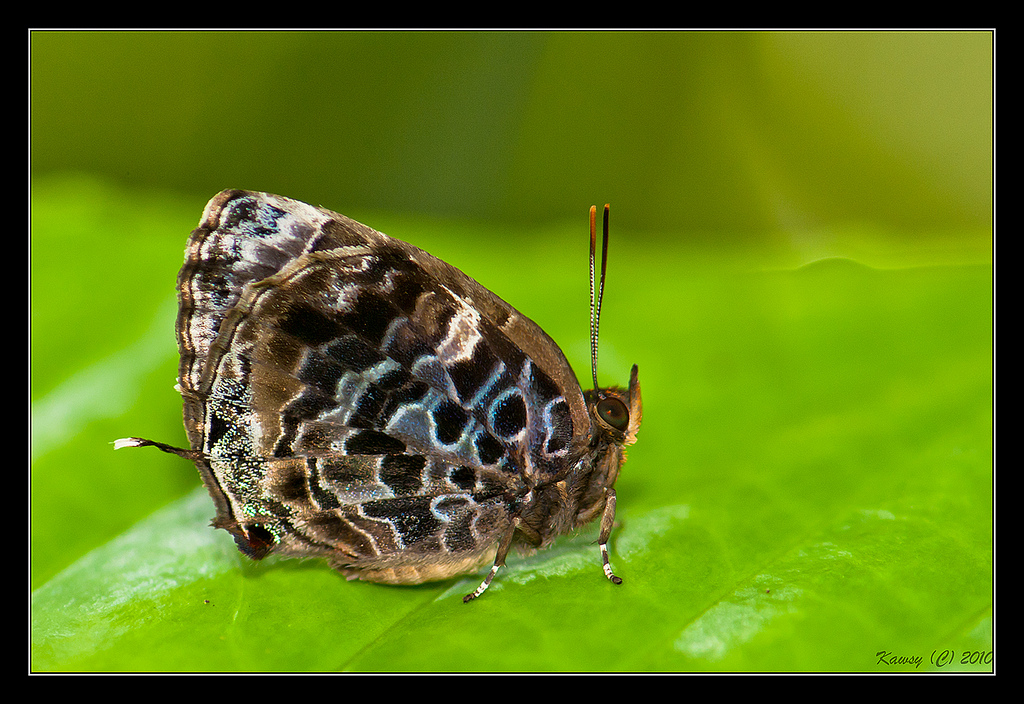
Our first Butterfly of the Month for 2021 is the Aberrant Oakblue (Arhopala abseus abseus). This relatively small butterfly prefers shaded forest understory, but is quite widespread in distribution across the island, from coastal forests to nature parks and reserves. The Aberrant Oakblue displays the same habits as the other species in the Arhopala genus - it lurks in heavily shaded areas and stops with its wings folded upright.

An Aberrant Oakblue with a red mite attached to its thorax

The Aberrant Oakblue is one of the smallest of the genus, and has rather distinctive markings that usually sets it apart from the other species amongst the Arhopala. There have been research findings that place this species under the genus Flos instead of Arhopala and it will be a matter of time before these findings are confirmed and accepted one way or the other. For the time being, I have retained the species under Arhopala until the experts accept it in their widely-accepted literature and publications.

Aberrant Oakblue upperside - Left : Male  Right : Female

The male is a deep lustrous purple with black borders of about 3-4mm thick, whilst the female is shining purple-blue with much broader black borders. The underside is dark brown, with a series of cryptic markings in grey, black and brown giving it a distinctive appearance. Pristine specimens carry a strong purplish sheen in the discal area on the hindwing and white shadings in the forewing's apical and subapical areas.


The hindwing has 3 tails of which the one at vein 3 is the longest. Most specimens feature a moderately large white spot at the mid-costal margin of the hindwing. The compound eyes are dark yellow brown. The antennae are orange-tipped.


The Aberrant Oakblue has been successfully bred on Hopea pachycarpa and H. odorata in Singapore. Both plants are from the Dipterocarpaceae family, members of which are commonly utilized by butterfly species in the Arhopala and Flos genera. There are two other yet-to-be identified host plants in the local catchment reserves, both of which are likely to belong to this plant families as well. The early stages of the Aberrant Oakblue feed on the young tender leaves of the host plants, and often lives in the company of attending ants.

Text by Khew SK : Photos by David Chan, Jerome Chua, Khew SK, Koh CH, Lim CA, Lim WY, Loh MY, Bobby Mun, Richard Ong, Michael Soh, Jonathan Soong, Horace Tan and Catalina Tong

08 October 2011

Life History of the Aberrant Oakblue

Life History of the Aberrant Oakblue (Arhopala abseus abseus)


Butterfly Biodata:
Genus:
Arhopala Biosduval 1832
Species: abseus Hewitson 1862
Subspecies:
abseus Hewitson 1862
Wingspan of Adult Butterfly: 28-30mm
Caterpillar Local Host Plants:
Hopea pachycarpa (Dipterocarpaceae), Hopea odorata (Dipterocarpaceae).


Physical Description of Adult Butterfly:
The Aberrant Oakblue differs from other Arhopala spp. in having a short tail at the end of vein 3 of the hindwing, and a very short vein 9 in the forewing. Both features suggest that Aberrant Oakblue is more closely related to the Flos spp. than its placement in the Arhopala genus would otherwise suggest.
Above, the male is deep violet blue with a dark forewing border expanding towards the apex (where it is about 4.0mm wide); the female is shining blue with broader borders. Below, the wings bear cryptic markings with most spots in blackish brown. Pristine specimens carry a strong purplish sheen in the discal area on the hindwing and white shadings in the forewing's apical and subapical areas. Most specimens feature a moderately large white spot at the mid-costal margin of the hindwing. Also on the hindwings, short white-tipped tails are found at the end of veins 1b and 3, and a moderately long white-tipped tail at the end of vein 2. The compound eyes are dark yellow brown.


Field Observations of Butterfly Behaviour:
In Singapore, the Aberrant Oakblue is not considered rare and adults can be found in the shaded forested areas within the nature reserves, Southern Ridges, Singapore Botanical Gardens and other wooded areas scattered across the island. They have a strong quick flight and are easily spooked by "overzealous" photographers. They typically rest in the shade among the foliage
with upright wings.


Local host plant #1: Hopea pachycarpa.


Local host plant #2: Hopea odorata.

Early Stages:
Thus far it has been established that Hopea pachycarpa and H. odorata are utilized as larval food plants by the Aberrant Oakblue locally. Both plants are in the Dipterocarpaceae family, members of which are commonly utilized by butterfly species in the Arhopala and Flos genera. There are two other yet-to-be identified host plants in the local catchment reserves, both of which are likely to belong to this plant families as well. The early stages of the Aberrant Oakblue feed on the young tender leaves of the host plants, and often lives in the company of attending ants.


Two eggs of the Aberrant Oakblue.

Eggs are laid singly or in small groups of 2-5 on a young shoot or the underside of a leaf of the host plant. Each egg is about 0.8mm in diameter, white with a very light yellowish green tinge. It is shaped like a pressed bun with a slightly depressed micropylar area atop. The surface has a finely reticulated pattern of intersecting ridges and there are short sharp spikes at the intersections of these ridges.


Two empty egg shells of the Aberrant Oakblue.

It takes about 3 days for the egg to hatch. The newly hatched is pale yellowish in body color and has a length of about 1.3mm. It has a rather flattened woodlouse appearance with a large semicircular prothorax, a round anal plate, a yellowish brown head and
long dorso-lateral and lateral setae. There are also a fair number of very short setae on the body surface. The newly hatched does not bother to devour the rest of the egg shell after its emergence.

Two views of a newly hatched caterpillar, length: 1.3mm.


Two views of 1st instar caterpillar, length: 1.9mm.

The 1st instar caterpillar feeds by skimming the surface of a young leaf, but later instars are able to consume the lamina in whole.
Larval stages of the Aberrant Oakblue are gregarious and a few caterpillars have been observed in the field sharing a leaf shelter and adjacent feeding site with no animosity towards each other. As the 1st instar caterpillar grows, its body color becomes more yellowish green. A faint pinky red patch appears on the posterior abdominal segments. After about 2 days of growth, and reaching a length of about 2.5mm, the caterpillar moults to the next instar.

Two views of a 1st instar caterpillar, late in this stage, length: 2.2mm.

The 2nd instar caterpillar features long lateral hairs and a yellowish brown head. Long dorso-lateral setae are no longer present, but many very short setae appear on the entire body surface. A pair of faint dorso-lateral line runs along the length of the body. The prothorax is marked by a large yellowish brown patch. The dorsal nectary organ (DNO) is already visible on the 7th abdominal segment and highlighted with a small dark reddish patch stretching to the 8th segment. A rather large anal plate, black in color, dominates the remaining posterior segments. The pair of the tentacular organs (TOs) on the 8th abdominal segments are also distinguishable at this stage.


Two views of a 2nd instar caterpillar, newly moulted, length: 2.5mm.

Two views of a 2nd instar caterpillar, late in this stage, dormant prior to its next moult, length: 3.2mm.

The 2nd instar caterpillar has a functional DNO as ants living in its proximity are observed to actively attend to the young caterpillars, having been attracted to the nectary fluid excreted via the DNO. The ant-caterpillar association continues for all remaining larval stages of the Aberrant Oakblue. The 2nd instar caterpillar reaches a length of about 4mm, and after about 2-3 days in this stage, it moults again.

A late 2nd instar caterpillar (right) and a newly moulted 3rd instar caterpillar (left) of the Aberrant Oakblue.

The 3rd instar caterpillar resembles the 2nd instar caterpillar closely. New to this instar is a very large black prothoracic shield and a slightly smaller black anal plate. The DNO is now rather prominent with an dark brown oval ring marking its outer boundary. Faint dorsal and dorso-lateral bands are apparent at this stage too. The 3rd instar takes about 3 days to complete with the body length reaching about 6.5mm.

Two views of a 3rd instar caterpillar, newly moulted, length: 4mm.


Two views of a 3rd instar caterpillar, length: 4.9mm.

The 4th instar caterpillar has similar markings as the 3rd instar. One notable change is in the prothoracic dark patch which now has two small white patches embedded at its posterior, and one small white patch at its anterior edge. The dorsal and dorso-lateral bands are now more pronounced than in the previous instar. This penultimate istar takes about 4-5 days to complete with the body length reaching 10mm.

Two views of a 4th instar caterpillar, early in this stage, length: 7.3mm.


Two views of a 4th instar caterpillar, late in this stage, dormant prior to its moult, length: 9.5mm.

The 5th instar caterpillar has similar but more striking markings. Visible changes are 1) a white intermittent line running down the middle of the dark patch on the prothorax; 2) both the dark patch on the prothorax and the anal plate are now flanked by white borders. Another change is in the dark patch stretching from the DNO to the anal plate where there are two side-arms reaching and encircling the TOs on the 8th abdominal segment.


Two views of a 5th instar caterpillar, early in this stage, length: 12mm.


Two views of a 5th instar caterpillar, later in this stage, length: 17mm.

The 5th instar lasts for about 8-9 days and in the last three days of this period, the body of the caterpillar decolorises to a creamy white shade. It continues feeding in this form until the end of the instar.


Two late 5th instar caterpillar in white form, length: 18mm.

After reaching a length of about 18mm, the caterpillar slows down and stops food intake for about 1 day. During this time, its body length gradually shortened. Soon it becomes an immobile pre-pupa in its leaf shelter.

Two views of a pre-pupa of the Aberrant Oakblue in its shallow leaf shelter.

The pre-pupa caterpillar prepares for pupation by spinning a silk girdle and a silk pad to which it attaches via claspers at its posterior segments. After 1-1.5 day as a immobile pre-pupa, pupation takes place. The pupa, with a length of 11-12mm, has a shape typical of any Lycaenid species, but with a somewhat produced anal segment. It is creamy white in coloration.
A small reddish-brown slit, likely the remnant of the DNO, has been found to exude fluid droplets for the first few days of the pupal period. This attracts the ants to attend to the pupa, thus securing some degree of protection from predators or parasitoids.


An Aberrant Oakblue caterpillar molts to become a pupa.


Two views of a pupa of the Aberrant Oakblue, length: 12mm.
.
A sequence showing two caterpillars in various stages of pupation in adjacent sites on the same leaf.
Seven to eight days later, the pupa matures enough to show the shining blue patch on the forewing upperside. The next day, the pupal stage comes to an end with the emergence of the adult butterfly.

Two views of and instar caterpillar, early in this stage, length: 2.5mm.


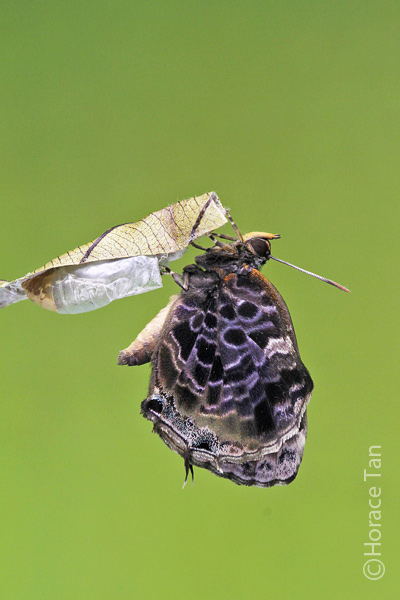
A newly eclosed Aberrant Oakblue drying its wings near its empty pupal case.


Unlike most of the Lycaenidae species, the caterpillars of the Aberrant Oakblue have the habit of constructing leaf shelters in which they rest and seek safety between feeds on the lamina of nearby leaves and part of the shelter. Pupation also takes place within a leaf shelter.


Two views of a 3rd instar caterpillar of the Aberrant Oakblue receiving the attention of an ant.


A leaf shelter found in the field. Partly opened in the right panel to show the 5th instar caterpillar and attending ants.
Can you spot the caterpillar?


References:

  • [C&P4] The Butterflies of The Malay Peninsula, A.S. Corbet and H.M. Pendlebury, 4th Edition, The Malayan Nature Society.
  • Butterflies of Thailand, Pisuth Ek-Amnuay, 1st Edition, 2006

Text by Horace Tan, Photos by Koh Cher Hern, Nelson Ong, Loke PF and Horace Tan

29 June 2025

Butterfly of the Month - June 2025

Butterfly of the Month - June 2025
The Lesser Malayan Oakblue (Arhopala ammon ammon)


The first half of 2025 is almost over, and the world has become even more unstable with at least several wars ongoing that leaves us wondering if emotions will boil over and these hostilities will tear the world apart. With ordinance raining between countries like Russia-Ukraine, Israel-Palestine and Israel-Iran, and the US joining in, pounding Iran's nuclear sites, it is a wonder when other superpowers will join in the skirmishes. Is diplomacy no longer working, that makes these offensive attacks that kill people the only way forward? When will our world enjoy peace again?


All it takes is one of the nuclear powers to lose control that we will experience Armageddon.  There will be no winners in any war in today's context. It's not about counting who has the most nuclear warheads or bombs. Once one is launched, there will be no looking back, or hitting a reset button. We can only hope that common sense and restraint by the political powers is exercised if we want to continue living safely on this earth.


Over in Southeast Asia, governments are voicing concern over the hostilities but are also taking steps to ensure closer collaboration amongst the ASEAN countries in terms of trade and economic partnerships. With the US distracted with tariffs and self-interest, there seems to be no longer a "guardian" of the world anymore. It's every country for itself and for the smaller and weaker countries to form alliances to protect themselves.

A Lesser Malayan Oakblue perched in the forest understorey.  Note the purple wash on the hindwing and forewing apical area.

Our Butterfly of the Month for June 2025 is the rare Lesser Malayan Oakblue (Arhopala ammon ammon). This species is one of the smaller Arhopala species, with a wingspan of about 30mm. A species that prefers the heavily shaded forested areas within the Central Catchment Nature Reserve, it can sometimes be mistaken for the similar sized Aberrant Oakblue (Arhopala abseus abseus) particularly in weathered individuals. Some references incorrectly refer to A. ammon as the Malayan Oakblue, which is actually the common name reserved for another species - Arhopala myrzala lammas. Yet other literature refers to it by another common name - Malayan Bushblue.


The Lesser Malayan Oakblue belongs to the ganesa group of the genus Arhopala and all the species are rare, with this species "seen with some regularity in Singapore" (ref pg 251 C&P5). From our records, it was regularly seen in the forests around Upper Seletar Reservoir Park in very localised patches between 2006 and 2016. There was an outing when 3 individuals were spotted in the same location! During that period, most of active photographers in ButterflyCircle managed to encounter and get shots of the Lesser Malayan Oakblue.


However, in recent years, it seems to have become very rare, with the last sighting of a pristine individual recorded in Aug 2019. Due to its rarity, it has been classified as "Endangered" in the Singapore Red Data Book 3rd Edition. It has been almost 6 years since the last individual was observed, and a mystery as to why the species has been absent from the locations where it used to frequent. The vegetation at its preferred habitats has not changed much, so there could be other reasons for its disappearance.


The Lesser Malayan Oakblue prefers to lurk in the shaded understorey of forested areas and is usually perched on the uppersides of foliage with its wings folded upright. At times, it will stay quite still on the same perch unless disturbed. It can be quite skittish and takes off to the treetops very quickly.


The male Lesser Malayan Oakblue is dark purple blue above with narrow black borders on both wings. Females are a lighter purple blue with broad black borders.  Most of the dark brown spots on the underside of the hindwing are edged in white, giving it a very different appearance than most of the other species in the genus. There is a purple wash on the hindwing underside and the apical area of the forewing in pristine individuals, especially when viewed in a sidelight.


The species is characterised by a large solid white spot in space 7 of the underside of the hindwing. There is a short filamentous white-tipped tail at vein 2 of the hindwing. There are greenish scales crowning the black tornal spots on the hindwing. The eyes are typical Arhopala iridescent green.

Text by Khew SK : Photos by KhewSK, Loh MY, Horace Tan, Anthony Wong and Mark Wong