Showing posts sorted by relevance for query Ancema blanka blanka. Sort by date Show all posts

23 April 2022

Life History of the Silver Royal

Life History of the Silver Royal (Ancema blanka blanka)


Butterfly Biodata:
Genus: Ancema Eliot, 1973
Species: blanka de Níceville, 1894
Subspecies: blanka de Níceville, 1894
Wingspan of Adult Butterfly: 28-33mm
Caterpillar Local Host Plant: Viscum ovalifolium (Santalaceae, common name: Oval-leaved Mistletoe).
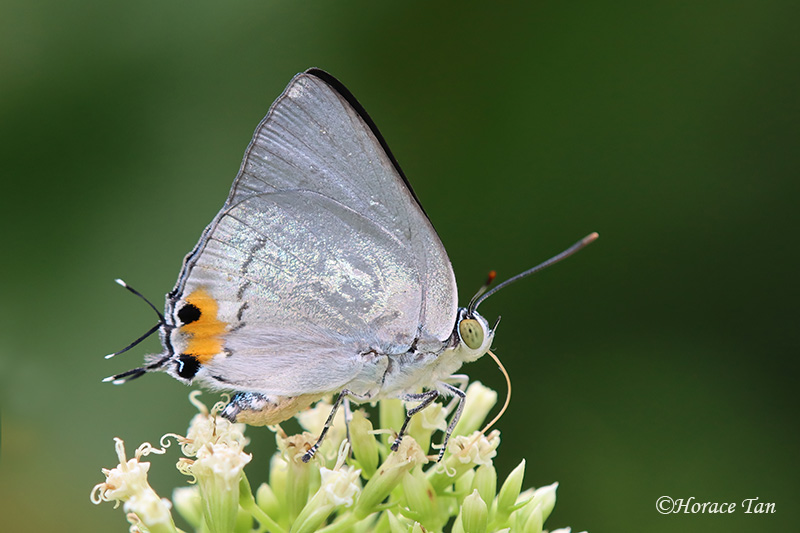

A Silver Royal taking nectary fluid from flowers of the Mile-a-minute.

A female Silver Royal.

A male Silver Royal puddling on muddy ground.

Physical Description of Adult Butterfly:
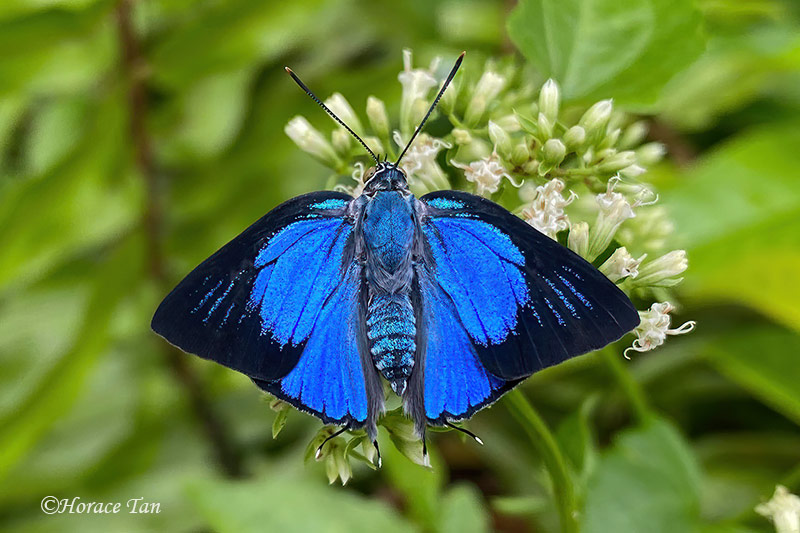
The eyes are greenish. On the wing upperside, the male is bright shining blue with black border and radiating blue streaks towards the termen. The female is of a paler blue with broad black border on both fore- and hindwing which are rounder than those of the male. On the wing underside, the male is greyish white with a slivery sheen whereas the female is pale greyish brown. There is a post-discal series of narrow dark streaks, very much more obscure on the forewing than on the hindwing. In the hindwing, there are black tornal spots in spaces 1a and 2, crowned with orange patches. Each hindwing has a pair of white-tipped black tails at ends of veins 1b and 2.

The upperside view of a puddling male Silver Royal.

The upperside view of a sun-bathing female Silver Royal.

The upperside view of a sun-bathing male Silver Royal.

Field Observations:
The Silver Royal is very rare in Singapore. It was re-discovered in 2005 where a single individual was spotted feeding at the flowers of a Syzygium tree. Since then there have been a few sporadic sightings at various locations in the Southern Ridges. The fast flying adults have often been sighted while visiting flowers at tree top or hill top. The male has also been observed to puddle at damp footpaths.

A female Silver Royal visiting flowers of the Ivy Palm.

A female Silver Royal visiting a flower of the Spanish Needle (Bidens alba).

A male Silver Royal.

A female Silver Royal visiting flowers of the Mile-a-minute.

Early Stages:
In Singapore, so far only one larval host plant for Silver Royal has been identified. This plant is the Oval-leaved Mistletoe (Viscum ovalifolium ), the same parasitic plant utilized by the early stages of the Golden Royal (Pseudotajuria donatana donatana). On this plant, the early stages of the Silver Royal in all instars feed mainly on the leaves, and occasionally the flower buds of the host plant.

Local host plant: Viscum ovalifolium (Oval-leaved Mistletoe).

Eggs are laid singly on various parts of the host plant, such as the leaf, flower buds and fruits. Each whitish egg is about 0.8mm in diameter. It is dome-shaped with a depressed micropylar at the pole and its entire surface is covered with pits. When freshly laid, the egg has a strong greenish tone in the micropylar and surface pits.

Two vlews of an egg of the Silver Royal, diameter: about 0.8mm.

Left: mature egg with a hole made by the soon-to-emerge caterpillar. Right: newly emerged caterpillar of the Silver Royal.

It takes about 3 days for the egg to hatch. The young caterpillar consumes just enough of the egg shell to emerge. It is pale yellowish brown in coloration, and has a length of about 1.2mm. Long setae (hairs) run along the length of the body dorsally as well as sub-spiracularly. The head is brown in colour. The newly hatched does not bother to eat the remnant of the egg shell and proceeds to feed on leaf surface in the vicinity. The 1st instar lasts about 2 days with the body length increased to about 2.5mm. Before the moult, the caterpillar typically take up its position on the surface of a leaf, and becomes immobile.

An empty egg shell of the Silver Royal.

Two views of a newly hatched caterpillar taking its first meal on the leaf surface, length: 1.2mm.

Two views of a 1st instar caterpillar, length: 2.5mm.

Two views of a late 1st instar caterpillar of the Silver Royal, dormant prior to the moult to the next instar.

The 2nd instar caterpillar has numerous short setae covering its body surafce. The caterpillar now features a dark-brown diamond-shaped prothoracic shield. The dorsal nectary organ on the dorsum of the 7th abdominal segment is discernible and whitish. As it grows in this instar, the yellowish brown body gradually turns greenish. The 2nd instar lasts about 2 days, with the body length reaching up to about 4.1mm.

A newly moulted 2nd instar caterpillar of the Silver Royal.

Two views of a 2nd instar caterpillar of the Silver Royal, length: 3.4mm.

Two views of a 2nd instar caterpillar of the Silver Royal, taking on a greenish undertone, length: 3.7mm.

Two views of a late 2nd instar caterpillar of the Silver Royal, dormant prior to the moult to the next instar.

The 3rd instar caterpillar resembles the 2nd instar caterpillar initially, but with a prominent and proportionately larger prothoracic shield and greater density of body setae. The prothoracic shield is dark brown with a central white streak and two small lateral white patches. As it grows in this instar, the body turns increasingly dark greenish overall. The dorsal nectary organ at this late stage has the white coloration confined to its central part. The 3rd instar lasts about 2 days and the body length increases up to 7.5mm.

Two views of a newly moulted 3rd instar caterpillar.

Two views of a 3rd instar caterpillar feeding on a flower bud, length: 6.9mm.

Two views of a 3rd instar caterpillar feeding on a young leaf of the host plant.

A view of a 3rd instar feeding on the leaf, showing the damage caused to the leaf.

Two views of a late 3rd instar caterpillar, dormant prior to its moult.

The 4th instar caterpillar resembles the late 3rd instar caterpillar in most body features/markings. One distinguishing feature is that the prothoracic shield is now mostly whitish. The 4th instar lasts about 3 days with the body length reaching up to 13mm.

A newly moulted 4th instar caterpillar of the Silver Royal, yet to begin eating its old skin.

Two views of a 4th instar caterpillar, early in this instar, length: 8mm. Inset: The prothoracic shield.

Two views of 4th instar caterpillar of the Silver Royal feeding on young leaf of the Oval-leaved Mistletoe.

A 4th instar caterpillar of the Silver Royal feeding along the leaf edge, length: 13mm.

Two views of a late 4th instar caterpillar, dormant prior to its moult.

The 5th instar caterpillar resembles the 4th instar caterpillar closely in most body features/markings which are proportionately larger than those in the 4th instar. The 5th (and final) instar lasts about 3 days with the body length reaching up to 22mm.
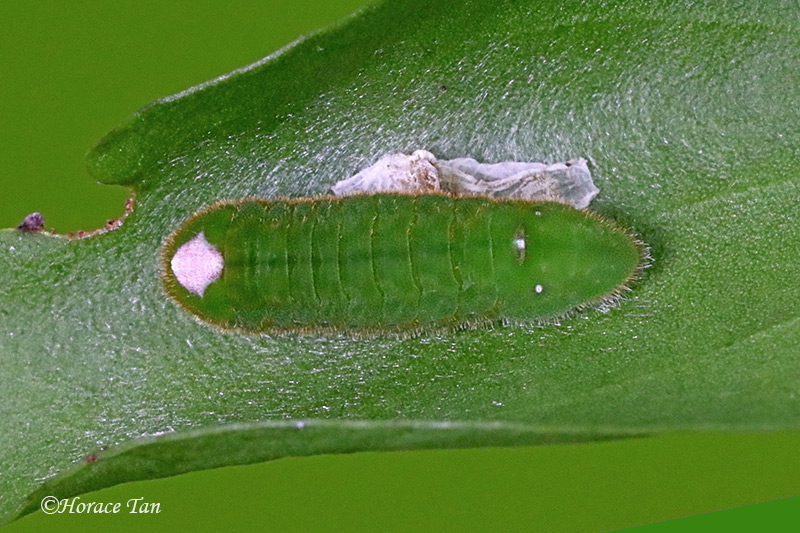
A newly moulted 5th instar caterpillar, yet to eat its old skin.

Two views of a 5th instar caterpillar of the Silver Royal eating along the leaf edge, length: 15.5mm.

Two views of a 5th instar caterpillar of the Silver Royal, length: 20mm. Inset: prothoracic shield.

Two views of a late 5th instar caterpillar eating along leaf edge, length: 22mm.

As it enters the pre-pupatory phase of its life cycle, the caterpillar ceases its feeding activity and wanders around for a pupation site. As is the case for the Golden Royal, the pre-pupatory caterpillar of the Silver Royal settles for a spot on the upperside of a leaf with a strong preference for a leaf with curled up edges offering some degrees of concealment. At the chosen site, it spins a silk pad and a silk girdle to secure itself to the leaf.

Two views of an early pre-pupa of the Silver Royal.

Two views of a late pre-pupa of the Silver Royal.

After about 1 day of the pre-pupal period, pupation takes place. The pupa is held via its cremaster to the silk pad on the leaf surface. It is 12 to 13mm in length, with the typical shape for a lycaenid pupa, albeit more rotund and broader than usual. The pupa is yellowish green with numerous whitish transverse streaks. In addition, reddish brown spots appear on the dorsum of the abdomen. There is near-diamond-shaped reddish brown patch on the dorsum of the metathorax with two small black spots anterior to the patch.

Two views of a pupa of the Silver Royal.

Two frontal views of a pupa of the Silver Royal.

The pupal period is observed to be 7.5 days for the female and 8.5 days for the male. On the night before ecloson, the pupa becomes darkened in color signaling the imminent emergence of the adult. One can now tell the sex of the soon-to-emerge butterfly from the coloration of the wing pad at this stage. The next morning the adult butterfly emerges from the mature pupa.

Two views of a mature pupa of a female Silver Royal.

Two views of a mature pupa of a male Silver Royal.

A newly eclosed female Silver Royal resting next to its empty pupal case.


A male Silver Royal emerging from its pupal case.

References:
  • [C&P5] The Butterflies of The Malay Peninsula, A.S. Corbet and H.M. Pendlebury;  G. and N.  van der Poorten (Eds.),  5th Edition, Malayan Nature Society (2020).
  • Butterflies of Thailand, Pisuth Ek-Amnuay, 2nd Edition, 2012.
  • A Field Guide to the Butterflies of Singapore, Khew S.K., Ink On Paper Communications, 2nd Edition, 2015.
Text by Horace Tan, Photos by Loke PF, Loh Mei Yee, Khew SK and Horace Tan, Video by Horace Tan.

30 September 2023

Butterfly of the Month - September 2023

Butterfly of the Month - September 2023
The Silver Royal (Ancema blanka blanka)


On this last day of September 2023, the Chinese community all around the world herald this year's Mid Autumn Festival (or the month of the moon cakes!). The Hungry Ghost month is over and the "gates of hell close for another year. The month of September belongs to the astrological sign Virgo. For those born between 23 August and 22 September, your zodiac sign is Virgo. We featured Capricorn, Aquarius, Pisces, Aries, Taurus, Gemini, Cancer and Leo in the preceding Butterfly of the Month blogposts and will now move into the next in the series. The 12 zodiac signs are Aries, Taurus, Gemini, Cancer, Leo, Virgo, Libra, Scorpio, Sagittarius, Capricorn, Aquarius, and Pisces.


Virgo (♍︎) (Ancient Greek: Παρθένος, romanized: Parthénos) (Latin for "virgin" or "maiden") is the sixth astrological sign in the zodiac. The constellation Virgo has many different origins, depending on mythology. Most myths view Virgo as a virgin maiden that carries her associations with wheat. This shows Virgo's deep-rooted presence in the material world. Virgos are said to be logical, practical, and systematic in how they see life. Virgos are often the most successful people in the world.

Silver Royal Female (top) and Male (bottom) feeding at flowering plants

Smart, sophisticated, and kind, Virgo gets the job done without complaining. Virgos are amazing friends, always there to lend a hand and also lend advice. Practical Virgos are incredibly adept at big picture thinking, and planning out their life, their vacations, and what they're going to do today. The Virgoan is the ultimate combination of brains and beauty. They have got great organizational skills, not to mention highly developed characteristics and a dedicated work ethic.


Virgoans are deep thinkers, and can sometimes seem shy at first meeting. A Virgo won't spill secrets right away, and it's important to earn a Virgo's trust. But once you do, that Virgin will be a friend for life. Virgos expect perfection from themselves, and they may project those high standards on the other people in their life. Virgoans love and are inspired by beauty. Intelligent and a lifelong learner, Virgo loves trying new things, reading books, and learning about the world. They'll happily sign up for an adult-education course, and they consider an afternoon in bed with a book pretty much ideal.


Virgo's desire to have everything be perfect can manifest in frustration when things don't live up to those (sometimes unrealistic) expectations. Besides occasionally leading to fights with friends and partners, their obsession with perfection can sometimes stall important decisions in their lives. Learning to go with the flow and accept "good enough" is a constant struggle for them.

A male Silver Royal feeding at the flowers of the Mile-A-Minute weed

Our Butterfly of the Month for September 2023 is the Silver Royal. Up to the 2020's it has been seen only a few times in Singapore - at least twice at the Southern Ridges hill tops. It was a re-discovery in 2005 when it was spotted feeding at the flowers of a Syzygium tree. A fast-flying species, it is usually skittish and probably prefers treetop habitats unless individuals descend to the lower shrubbery to feed or oviposit. However, in recent years, it has been making more regular appearances and appears to be less rare than before.

Silver Royal - Male upperside (top) and Female upperside (bottom)

The male of the Silver Royal is a bright shining blue with broad black forewing borders and darkened veins on both wings. The female is a lighter shade of blue and has rounder wings. The underside is distinctive of males of this species and sports a silvery sheen when light shines at a certain angle on the wings. There are two prominent black tornal spots that are orange-crowned and there are two tails at veins 1b and 2 on the hindwing.


The Silver Royal is skittish and flies rapidly like most members of the Theclinae. It is the only representative of its genus Ancema in Singapore. It has been observed feeding on flowering plants like the Mile-A-Minute, Syzygium and the inflorescence of the Common Ivy Palm (Arthrophyllum diversifolium), often in the company of other Lycaenidae.

Male Silver Royals puddling at muddy footpaths 

Males of the species are also observed puddling at muddy streambanks and footpaths, whilst the rarer females are more often seen in forested areas foraging amongst flowering plants.The life history of the Silver Royal has been successfully documented on the local host plant, the Oval Leafed Mistletoe (Viscum ovalifolium). Coincidentally, this parasitic plant is more abundant amongst the tall trees of the Southern Ridges, especially at Telok Blangah Hill Park.

Text by Khew SK : Photos by Khew SK, Loh MY, Loke PF and Horace Tan