Showing posts sorted by relevance for query Abisara savitri. Sort by date Show all posts

18 February 2008

A new Riodinidae species for Singapore?

Is there a new Riodinidae species in Singapore?

Some time back in mid 2004, a small colony of what was first thought to be the Malayan Plum Judy (Abisara saturata kausambioides) was discovered at several locations at Singapore's urban hill parks known as the "Three Ridges".


A side shot of the mystery Abisara sp.

After taking many shots of the species, ButterflyCircle member Sunny Chir noticed that the behaviour of the individuals of this species to be rather unique. As the individuals spotted had a much stronger flight and engaged in "dog-fighting" activity - quite uncharacteristic of the behaviour of females of the Malayan Plum Judy, which these individuals resemble, Sunny continued to observe their behaviour over a period of several months, and highlighted the possibility of a different Abisara species to me.


The mystery Abisara with half-opened wings, perched on a leaf

That initial "gut-feeling" resulted in a long period of observing this species in their natural habitat - the times during which the species is most active, and their frolicking behaviour when two or three other individuals of the species were around in the same place. Thus far, no mating pairs were observed yet.


The mystery Abisara with half opened wings. In a side light, the upper wings show a purple-blue sheen.


Upon closer scrutiny of the photos taken, and by a process of elimination, we came to a tentative conclusion that this species may not be the Malayan Plum Judy (Abisara saturata kausambioides).

Taking reference from Corbet & Pendlebury's "Butterflies of the Malay Peninsula" 4th Edition, in the key for separation of the three extant Abisara species in Singapore we have :


Abisara savitri - Upperside paler, more reddish brown; forewing with inner band diffuse, sullied and from beyond mid-costa to the dorsum before the tornus. Hindwing with a long, white-tipped tail at vein 4.


Abisara geza - Underside of forewing inner postdiscal fascia bent basad above vein 4. Underside of hindwing discal band dislocated at vein 4. Male upperside with ovate paler subapical area on forewing and submarginal spots in spaces 1b, 4 and 5 of the hindwing.


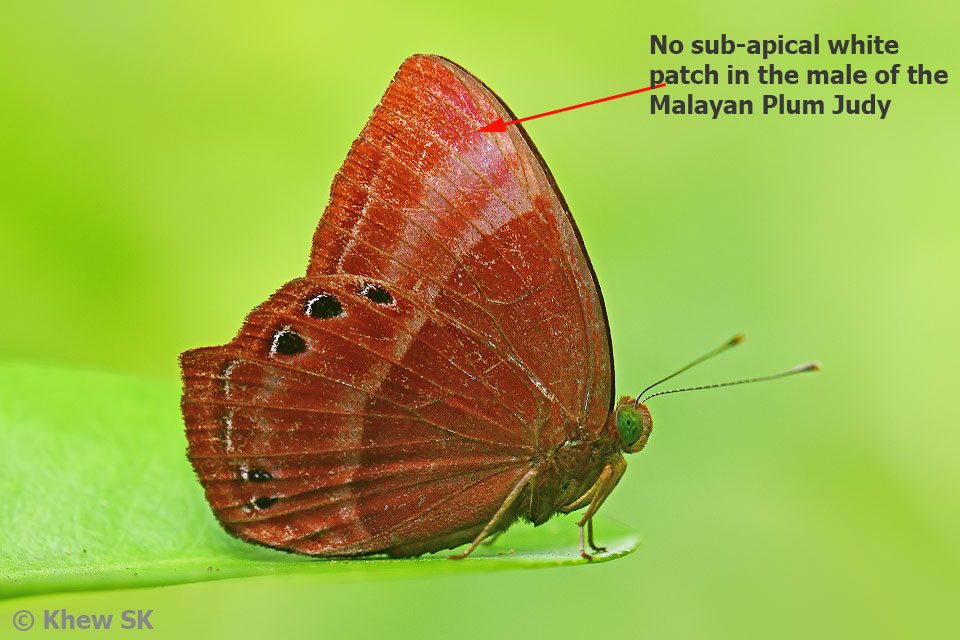
Abisara saturata - Underside of hindwing discal band not dislocated, but may be angled at vein 4. Male upperside dark crimson brown and unmarked.


Male and Female Abisara saturata kausambioides

The first Abisara species - A. savitri can be eliminated due to its very distinct and different appearance from the other two species.

Hence, the unknown species :
  • cannot be Abisara geza as the hindwing discal band is not dislocated at vein 4.
  • cannot be a male Abisara saturata as the males of A. saturata are distinctly difference in appearance.
  • is not a female A. saturata as all the shots taken of this species so far, show clearly that it uses only 4 legs for walking, and this is consistent with the genus that the adult forelegs are non-functional in the male, but functional in the female.
  • is not likely to be female A. saturata due to the observation of the individuals' more robust and speedier flight, as well as "dog-fighting" behaviour - usually typical of males of this genus.


More views of the unknown Abisara sp


So the conclusion up to this point would be that this is a :
  • male specimen of an unknown Abisara sp.
  • is not an Abisara geza as it does not have the dislocated discal band at vein 4 of the hindwing
  • is not a male Abisara saturata as that species' male is distinctly marked.
So what species is this?


Voucher specimens captured of this species suggest that, from the visual inspection of the end of the abdomen of the specimens, that these individuals are males. These specimens have been sent to expert lepidopterists in Japan and Malaysia for a full-fledged dissection to ascertain the identity of this species. We are waiting patiently for the conclusion of these experts. A journal paper has been prepared to this effect, for the purpose of recording this strange and unknown Abisara as well as other discoveries by ButterflyCircle members.

A possible ID of this species flying around the hilltops of Singapore's urban parks could be Abisara kausambi kausambi. The characteristic of "Underside of forewing inner postdiscal fascia straight" and "Male upperside forewing with narrow, obscure, paler subapical area" seems to suggest that this mystery Riodinid matches the description of Abisara kausambi kausambi. However, as this species has not been recorded in Singapore by the early authors, the ID of this species remains a mystery for the time being.

Could our mystery Riodinid be Abisara kausambi? Could it be an endemic sub-species which is hitherto unrecorded in Singapore? Or perhaps a totally new Abisara species which is not even recorded in the region?

Whilst the status of this species remains uncertain in Singapore, and we wait in anticipation for the experts' advice, we would like to place on record this observation which was first made by Sunny Chir.


Who am I???


Text by Khew SK ; Photos by Khew SK, Sunny Chir, Tan CP

01 April 2018

Singapore's Judys

Singapore's Judys
Featuring the Abisara spp. (Judys) of Singapore


The family Riodinidae was previously classified as sub-family Riodininae of the Lycaenidae family (ref : Butterflies of the Malay Peninsula 4th Edition), but raised to family status subsequently in more recent publications. Many species in the family feature metallic markings on their wings, giving rise to their collective common English name of "Metalmarks".


Female Spotted Judy perched on a leaf

In the Southeast Asian region, the Riodinidae is characterised by small, reddish-brown butterflies that prefer deep forest shade habitats. They have a unique, short, hopping flight and alight on the upper surfaces of leaves with half-opened wings. When active, they will twist and turn on the leaf with jerky walking movements, often to the frustration of the butterfly photographer who is trying to get an ideal angle to shoot them.


Male Malayan Plum Judy perched on a fern

Many species of the Riodinidae have yellow-green eyes. A special characteristic of the family is that the forelegs of the males are under-developed, appearing more like hair tufts. The females, on the other hand, have all six legs fully developed.


In Singapore, the Riodinidae is represented by five species in three genera. Of the five species, three belong to the genus Abisara. The species in this genus are collectively named Judy. It is interesting that the common names of the group of butterflies in the Riodinidae originate from the traditional beach puppet or marionette show of "Punch and Judy". The species of another Riodinidae genus, the Dodona, have all their species named after Punch. However, this genus is not extant in Singapore.


Male Spotted Judy

This article introduces the three Judy species found in Singapore. The extant species of the Abisara spp. in Singapore are the Malayan Plum Judy (Abisara saturata kausambioides), the Spotted Judy (Abisara geza niya) and the Malay Tailed Judy (Abisara savitri savitri). It was earlier thought that another Malaysian species, the Straight Judy (Abisara kausambi kausambi) also exists in Singapore, but further research showed that this species is not found here.

The Malayan Plum Judy (Abisara saturata kausambioides)


The most common of the three Abisara species found in Singapore, the Malayan Plum Judy is found at urban parks and gardens as well as in the forested areas of the nature reserves. It can also be found on the offshore island of Pulau Ubin. Males are more often seen, but both sexes display the typical Riodinidae behaviour of hopping from leaf to leaf and turning around with their wings half-opened.


The upperside of the male Malayan Plum Judy shows a deep purple-blue colour in angled lighting


The upperside of the male is a deep crimson brown without any markings. When viewed in a sidelight, the upperside may show a purple-blue colouration. The paler underside features a pair of diffused pale purplish post-discal bands. The outer band on the hindwing has a series of large black, white-edged submarginal spots.


The paler female has a diffused white sub-apical patch on the forewing, whilst the hindwing "tail" is prominently angled at vein 4 and appears to flare out wider than in the male. The Malayan Plum Judy has been successfully bred on two alternative host plants - Ardisia elliptica (Myrsinaceae), Embelia ribes (Myrsinaceae).

The Spotted Judy (Abisara geza niya)


The second of the Judy species found in Singapore is the Spotted Judy. This species is superficially similar to the Malayan Plum Judy in appearance. Also a deep crimson brown in colour, the male of the Spotted Judy differs from the Malayan Plum Judy in the whiter diffused subapical patch on the outer post-discal band.


Female Spotted Judy.  Note less extensive sub-apical white patch on the forewing and the dislocated post-discal band at vein 4 of the hindwing.

In the female, the diffused sub-apical patch is more restricted than in the Malayan Plum Judy. The hindwing "tail" is also prominently angled at vein 4 and displays the similar flare that is wider than in the male. Both sexes can be separated from the Malayan Plum Judy in their diagnostic characteristic hindwing post-discal band that is dislocated at vein 4.


Upperside of the male Spotted Judy.  The structural scales diffract light at certain angles where the wing colour shows a purple-blue.

The Spotted Judy is moderately rare, but can be found in generally the same habitats as the Malayan Plum Judy. Males are sometimes seen 'dog-fighting' in the late hours of the day. The species can be found in urban parks and gardens as well as in the forested nature reserves, preferring heavily shaded environments. It has been successfully bred on Embelia ribes (Myrsinaceae) and Embelia canescens (Myrsinaceae).

The Malay Tailed Judy (Abisara savitri savitri)


The third and rarest Judy found in Singapore is the Malay Tailed Judy. It is found mainly in the heavily shaded forested areas of the nature reserves. This forest-dependent species is generally larger than its previous two related species. It also differs from the other two in that, instead of the crimson brown wings, the Malay Tailed Judy is a pale beige with a light tinge of violet.


It cannot be mistaken for any other species in Singapore. The Malay Tailed Judy features two diffused white transverse sub-apical stripes on the forewing. It has a distinctly longer white tipped tail at vein 4 of the hindwing. It shares the behavioural characteristic of hopping on the upper surfaces of leaves with half-opened wings.


The Malay Tailed Judy has been successfully bred on the same host plants as the Spotted Judy - Embelia ribes (Myrsinaceae) and Embelia canescens (Myrsinaceae). The species can be occasionally observed feeding on overripe fruits on the forest floor.

Text by Khew SK : Photos by James Chia, Huang CJ, Khew SK, Nelson Ong, Jonathan Soong, Horace Tan and Benjamin Yam.

29 May 2021

Butterfly of the Month - May 2021

Butterfly of the Month - May 2021
The Malay Tailed Judy (Abisara savitri savitri)

A Malay Tailed Judy perched on a fern in its typical shaded habitat in the forest understorey

The daily global news of Earth's battle with an "unseen" enemy is beginning to sound like a sci-fi movie, with each battle won or lost and which side is gaining ground in this war. It is not like the storyline hasn't been thought of already, with movies like Outbreak (1995), Contagion (2011), Flu (2013), Containment (2016) Pandemic (2016) and Virus (2019). Today, what the world is experiencing is a real-life experience of fighting Covid19 and trying to get a semblance of what our lives used to be before it struck more than a year ago.


Different countries' effectiveness in combating the pandemic is often a combination of political leadership, residents' compliance, human rights, healthcare facilities, affluence, geography, weather and a whole host of variable factors. Whilst China, a country of over 1 billion people (and where the virus purportedly originated) is able to keep the pandemic at bay, its equally populous neighbour, India is struggling hard to control the outbreak.

A Malay Tailed Judy feeding on a fallen fruit

The US continues to be top on the infections leaderboard, with over 33 million infections, but India is slowly but surely creeping up with 27 million infections and counting. Over the past few weeks, the average rate in India outstrips the US, even as each country manages its own population in their own unique way. Being a producer/exporter of the Covid vaccine, the US certainly has an advantage over India as it moves towards herd immunity across the country.


Closer to home, our neighbours in Malaysia have been scrambling to keep the lid on rising infection cases, which crossed the 8,000 mark yesterday. This prompted the government to announce a full 2-week lockdown from the 1 June. Whilst being mindful of keeping the economy buzzing, each measure of control has to balance the possibility of a resurgence in infections. To add to the confusion, more variations of the virus are being discovered as it mutates and fights back against human interventions.


The sudden surge of daily cases, particularly those that are unlinked, in Singapore caused its slowly re-opening control measures on the backfoot. The appearance of infections attributed to the mutant strain B1-617 sparked off a possibility of a 2nd wave of infections in the community. Swift action by the government and a largely cooperative population appeared to have stemmed the initial exponential increase in daily infections over the past two weeks. And so the story continues...


Our May 2021 feature butterfly is the Riodinid, the Malay Tailed Judy (Abisara savitri savitri). There have been recent changes to the taxonomic classification of the genera in the family Riodinidae and a recent scientific paper has proposed that this species be placed under the genus Archigenes. However, taking after the latest edition of the Butterflies of the Malay Peninsula 5th edition (2020), we will leave the genus as Abisara for the time being, until the taxonomic changes are updated in successive reference literature.


The Malay Tailed Judy is a moderately rare species and prefers the shaded understory of our forested areas in Singapore. It is rarely seen, if ever, in urban parks and gardens. The species belongs to the family better known as the "Metalmarks" which are characterised by reddish-brown butterflies, some of which have pretty iridescent metallic scales on their wings.


The species has a unique habit of stopping with partially opened wings on the top surfaces of leaves in heavily shaded habitats, and then twisting and turning and hopping from perch to perch. They are generally timid and skittish, moving quickly away from any threatening movements. Occasionally, they appear to stop and remain stationary as though to "sleep".

A typical partially-opened wing pose of a Malay Tailed Judy in its natural habitat

The Malay Tailed Judy has been observed to puddle on forest footpaths amongst leaf litter, often foraging for damp decomposed matter and overripe fruits. Like its other cousins in the family, it is seldom seen feeding on flowers but instead uses its proboscis to feed on the surfaces of leaves for some unseen matter.

A rare open winged shot, showing the upperside of the Malay Tailed Judy

The Malay Tailed Judy differs from the other species in the genus in that the ground colour of the butterfly is a pale purple-brown instead of dark red. It has a pair of prominent white tipped tails at vein 4 of the hindwing. On the forewings is a pair of sullied white transverse sub-apical stripes, which is more distinct on the underside of the wings than on the upperside.

A newly-eclosed Malay Tailed Judy perched above its empty pupal case

The basal area of both wings are paler on the underside,  There are large black eyespots at the apical and tornal areas of the hindwing.  The eyes of the species are dark brown and nearly opaque.  The species has been successfully bred in Singapore on the local host plants Embelia ribes and Embelia canescens.

Text by Khew SK : Photos by David Chan, Huang CJ, Khew SK, Nelson Ong, Richard Ong, Nona Ooi, Jonathan Soong, Horace Tan and Benjamin Yam.


23 October 2016

Revision to the Common Names of Butterflies 5

A Revision to the Common Names of Butterflies
Part 5 : An Analysis of Name Changes


In this fifth part of the series where we discuss the Common Names of Butterflies in the region, we continue our discussion to one species from the Riodinidae family and the species of the Lycaenidae family. In Part 2, Part 3 and Part 4, we framed the background of the naming convention of the English Common Names of butterflies, and also some of the changes in the book by Dr Laurence Kirton.


We also indicated the references of available published work, from which we researched into the Common English names of butterflies. However, in recent years, the usage and acceptance of these common names appear to be largely driven by regular usage by hobbyists and butterfly enthusiasts - particularly on social media and cyberspace. Once a name is coined, and used by the larger community on the internet, there is a high chance that the name becomes adopted quickly, especially if the names are repeated by frequent usage on blogs, photo repositories, social media and websites.


Unlike the taxonomic names, which fall in the domain of researchers and experts who pen scientific papers, common names are often coined by amateurs and hobbyists. Today, even some of the scientific names are being debated as new information becomes available, but often, there is no central body to moderate such changes and some new recommendations can take some time to gain acceptance - even amongst the experts. Butterflies' common names' acceptance is more of a result of frequent and regular usage and availability of books and references on the internet, rather than by any scientific means.


Continuing from where we left off in Part 4 of our discussions on common names, we consider the single species of contention in the Riodinidae family - Abisara savitri savitri. This species has been renamed to Malayan Tailed Judy. As rationalised in our earlier discussions on the common names that have been amended from "Malay" to "Malayan", we see no necessity for this change.


The name Malay Tailed Judy had been used since Evans' time (1927) and continued to be used by various authors of several butterfly books without exception. The sole book that shows the name as "Malayan Tailed Judy" is the one by Dr Kirton, and for all intents and purposes, completely outnumbered by all available literature on butterflies in the region.

Recommendation : Abisara savitri savitri should retain its common name Malay Tailed Judy.

We now move on to the Blues and Hairstreaks in the family Lycaenidae. This family is by far the largest family of butterflies in the Malaysian, Singaporean and Thai region. Many of the species are very similar looking, making it even more challenging to associate logical and justifiable common names for the butterflies.


The first species of that has multiple common names across the region, is Curetis saronis sumatrana. In Evans (1927), the species Curetis saronis is given the name Burmese Sunbeam. Dr Kirton adopted this historical reference name for this species. In Thailand, the subspecies Curetis saronis indosinica is known as Indo-Chine Sunbeam. In Singapore, subspecies sumatrana has been given the name Sumatran Sunbeam.


No other Malaysian reference has given a common name for the species Curetis saronis sumatrana other than Dr Kirton's book. The name Sumatran Sunbeam has appeared in at least four references in Singapore - Butterflies of Singapore 2010, Butterflies of Singapore 2nd Edition 2015, Caterpillars of Singapore's Butterflies 2012 and Singapore Biodiversity : An Encyclopedia of the Natural Environment and Sustainable Development 2011. Whilst there is probably no compelling reason to adopt any of the common names over the others, it is probably from common usage that the name Sumatran Sunbeam has gained a wider acceptance in the local scene.

Recommendation : Curetis saronis sumatrana should retain its common name Sumatran Sunbeam.

The next subfamily under Polyommatinae, or the Blues, comprise a large group of mainly small and delicate butterflies of which many have blue uppersides. The first species that had its name changed in Dr Kirton's book, is Neopithecops zalmora zalmora to Inornate Blue. The original name found in most literature across the region, and all the way back to Evans' "The Identification of Indian Butterflies" (1927), is The Quaker.


It is not clearly understood why Dr Kirton amended the name of this species, but it is probably classified under "Where the original name is socially unacceptable / derogatory". A search on the Internet indeed turned out some information that pointed to Quaker as being derogatory in some societies. However, the tenuous link to anything socially unacceptable or derogatory is probably in some obscure circles that is totally irrelevant today.


Even in commercial products, where I previously used the example in Darkie toothpaste being changed to Darlie toothpaste to avoid the minefield of associations to a derogatory or racist word, there are no such changes. Today, we still eat Quaker Oats. The company has a website, and products on the market still carry the word Quaker. I am not aware of any society or group that violently objects to the word "Quaker" in the modern world. Hence I do not believe that there is any issue with the continued use of the name Quaker for the species Neopithecops zalmora zalmora.

Recommendation : Neopithecops zalmora zalmora should retain its common name The Quaker.

The next species of discussion is Megisba malaya sikkima. In Evans' book, the name The Malayan was coined for this species. Thus far, all the publications that I have come across, have retained that common name for this species. The only book that has altered its name to "Malayan Pied Blue" is Butterflies of Peninsular Malaysia, Singapore and Thailand.


Whilst Dr Kirton may have a good reason for changing the name of this species by adding "Pied Blue" to the common name, it is unlikely that the rest of the amateurs and enthusiasts in the butterfly world would agree with him. Hence the name "Malayan", through legacy usage and frequent reference in cyberspace, would continue to be the primary name for this species from India to Southeast Asia and Hong Kong.


Recommendation : Megisba malaya sikkima should retain its common name The Malayan.

Text by Khew SK : Photos by May Chan, Sunny Chir, Khew SK, Simon Sng, Jonathan Soong, Horace Tan and Benjamin Yam.

Earlier articles in this series :
Revision to the Common Names of Butterflies Part 1
Revision to the Common Names of Butterflies Part 2
Revision to the Common Names of Butterflies Part 3
Revision to the Common Names of Butterflies Part 4