
Butterfly Biodata:
Genus: Athyma Westwood, 1850
Species: perius Linnaeus, 1758
Subspecies: perius Linnaeus, 1758
Wingspan of Adult Butterfly: 45-55mm
Caterpillar Local Host Plant: Glochidion obscurum (Phyllanthaceae).


Physical Description of Adult Butterfly:
Forewing cell is wholly open. On the black-and-white forewing upperside, the white cell streak is divided into four portions, with the distal portion being arrowhead-shaped. There are widely separated white post-discal spots in spaces 1b, 2 to 6. The cell streaks of the left and right forewings are connected via a dorsal band on the thorax. On the hindwing upperside, white sub-discal band and post-discal band run from the costa to the dorsum. Small black spots are embedded at the basal end of the post-discal spots. On the underside, the spots and streaks are arranged as on the upperside but with the ground colour rich ochreous. As in the upperside, the white post-discal band on the hindwing has a series of small black spots.


Field Observations of Butterfly Behaviour:
The Common Sergeant was re-discovered in Singapore in 2022 at the northern edge of the central catchment reserve. Since then the fast-flying adults have been sighted at forest fringes, and along forest trails where the host plant is growing. Adults have been observed to visit flowers and ripened fruits for sugary contents. The male has also been sighted puddling on forest trails.


Early Stages:
Thus far only one plant, Glochidion obscurum, has been locally recorded as the larval host for the Common Sergeant in Singapore. It is likely that other local Glochidion spp. can act as larval host plants.
 Local host plant: Glochidion obscurum.
The caterpillars of the Common Sergeant adopt the same feeding and frass management routines as described for other Athyma species in earlier blog articles. The caterpillars feed on mature leaves of the host plant in all five instars of its larval stage. On each leaf, they feed systematically from the leaf tip towards the petiole, leaving the midrib intact. From the 1st to the 4th instar, they build an extension of the exposed midrib using frass pellets held together by silk. Frass pellets are also sewn together beneath the midrib at the base of the extension. The caterpillars rest on either the frass extension or the exposed midrib just beyond the bundle of frass pellets. In the 5th (and final) instar, the caterpillars abandon these habits, and switches to resting on the leaf upperside and feeding along the leaf margin.
 Eggs laid on the leaf underside of multiple leaves on a branch of Glochidion obscurum. How many eggs can you spot in the picture?
The eggs of the Common Sergeant are laid on the underside of a leaf of the host plant. Each dome-shaped egg is yellow in colour, with its surface marked with polygonal ridges which are tipped with fine, translucent spines at intersections of these ridges. Basal diameter is approximately 1.1mm.
 Two views of an egg of the Common Sergeant.
The egg takes about 3 days to hatch. The young caterpillar nibbles away a portion of the egg shell to exit and then proceeds to devour the rest of the egg shell. It has a cylindrical body in pale, dull brown, and an initial body length of about 2.5mm. The body is covered with fine setae, and rows of dorso-lateral, lateral and sub-spiracular tubercles. Dorso-lateral tubercles occur on the 2nd and 3rd thoracic segments, and on the 2nd, 4th, 6th to 8th abdominal segments, are more prominent with darker brown coloration. The head is brown to dark brown in colour.
 Two views of a fully developed egg of the Common Sergeant.
 Two views of a newly hatched caterpillar of the Common Sergeant.
 Two views of a first instar caterpillar of the Common Sergeant, length: 2.5mm.
Soon after its emergence, it feeds on the leaf lamina around the midrib, and builds an extension of the exposed midrib using frass pellets sewn together with silk. The first instar lasts about 2 days with the body length increases to about 4.8mm.
 Two views of an early 1st instar caterpillar, resting on the frass extension, length: 3.2mm.
 Two views of a late 1st instar caterpillar, length: 4.8mm.
 Two views of a late 1st instar caterpillar, dormant prior to its moult, length: 4.8mm.
In the 2nd instar, the caterpillar has an overall dark brown appearance. The dorso-lateral, lateral and sub-spiracular tubercles are now transformed to short spines with small terminal branches. Pale beige dorsal patches occur on the 3rd and 5th abdominal segments. The dark brown head sports short pale brown tubercles and peripheral spines. The 2nd instar lasts about 2 days with the body length reaches about 7.5mm.
 Two views of a 2nd instar caterpillar, newly moulted, length: 4.9mm.
 Two views of a 2nd instar caterpillar, length: 7.5mm.
 Two views of a late 2nd instar caterpillar, dormant prior to its moult, length: 7.2mm.
The 3rd instar caterpillar mostly resembles the the second instar caterpillar, but with the body and head spines longer and more prominent. The body and the head are now much darker, and pale brown dorsal patches more distinct. This instar takes about 2 days to complete with body length reaching about 10.5mm.
 Two views of a 3nd instar caterpillar, early in this stage, length: 8mm. Inset: head.
 Two views of a 3nd instar caterpillar, length: 9mm.
 Two views of a late 3nd instar caterpillar, dormant prior to its moult, length: 10mm.
The 4th instar caterpillar has distinctly longer dorso-lateral branched spines. Peripheral head spines are also longer than those in the previous instar. The 4th instar lasts about 2 days with body length reaching about 16-16.5mm.
 Two views of a 4th instar caterpillar, early in this stage, length: 9.5mm. Inset: head.
 Two views of a 4th instar caterpillar, length: 16mm.
 Two views of a late 4th instar caterpillar, length: 16mm.
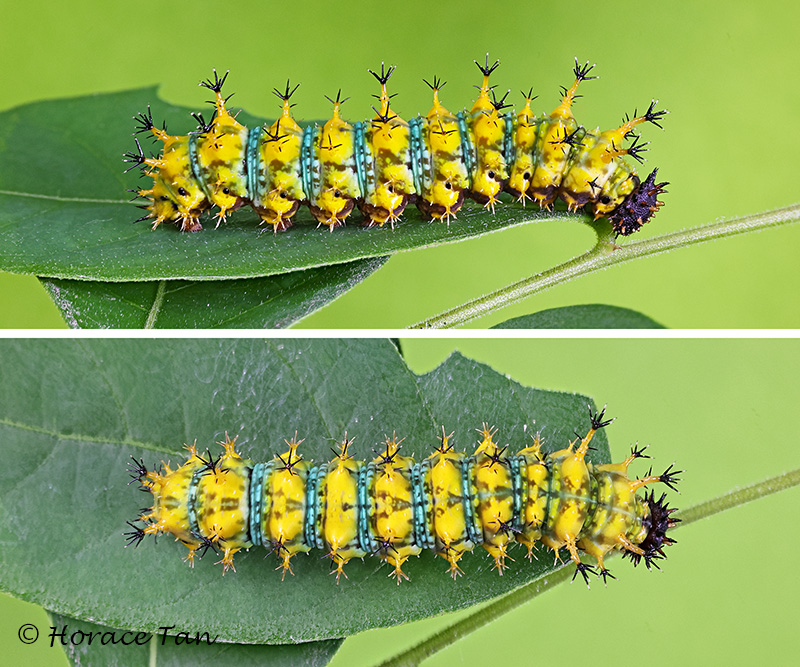
The next moult brings the caterpillar to its 5th and final instar. Now the dorso-lateral spines are elongated and branched distally. Peripheral spines on the head becomes much more pointed. The body colour is initially yellowish brown, but turning green after about a day. At the same time, the dorso-lateral and lateral processes turn reddish (except for the distal branches on the dorso-lateral spines which remain black in color). The base of the dorso-lateral spines is ringed in a bright shade of blue. The head is dark brown to black. Tubercles present on the head are yellowish brown.
 Two views of a newly moulted 5th instar caterpillar.
 Two views of a 5th instar caterpillar, with color change, length: 19mm.
 Two views of a 5th instar caterpillar, length: 23mm.
 Two views of a 5th instar caterpillar length: 28mm. Inset: head.
 Front view of a 5th instar caterpillar found in the field.
Towards the end of the 5th instar, the body ground colour changes to green, then yellow and finally pale beige. The tubercles one the head also turn bluish. The 5th instar lasts about 3.5-4 days, with the body length reaches up to 30mm. On the last day, the caterpillar ceases feeding and seek out a spot on the underside of a leaf (usually on the midrib) or a stem/branch to spin a silk pad. It then anchors itself there via its posterior end, and assumes its upside-down pre-pupatory pose.
 Two views of a 5th instar caterpillar, body color starts to change as the instar drawing to an end, length: 29mm.
 Two views of a 5th instar caterpillar, yellow dominating over green in the color-change process, length: 29mm.
 Two views of a 5th instar caterpillar, body color completely decolorized to a pale beige.
 Two views of a prep-pupa of the Common Sergeant. Left: early. Right: late.
After about 0.5 day of the immobile pre-pupatory phase, the transformation process to the pupal phase takes place. The pale brown pupa has cephalic protuberances with their apices extended laterally. There are also dorsal protuberances on the first thoracic segment and the first abdominal segment which are long and keeled, and pointed towards each other. The pupa is initially pale biege brown but turning orange-brown with golden patches a few hours later. Length of pupae: 23-25mm.
Video: A Common Sergeant caterpillar's journey from the final instar to the pupal stage.
 Three views of a pupa of the Common Sergeant.
After about 6 to 7 days of development, the pupa becomes darkened in color, and the spots/streaks on the forewings are visible through the pupal skin in the wing pads. The next day the eclosion event takes place with the adult butterfly emerges to start the next phase of its life cycle.
 Three views of a fully developed pupa of the Common Sergeant.
 A newly eclosed Common Sergeant.
References:
I would like to express my gratitude to Han Peng Lim for sharing sighting information of early stages of the Common Sergeant in the field.
Text by Horace Tan, Photos by Han Peng Lim, Loh Mei Yee, Khew SK and Horace Tan.
Genus: Athyma Westwood, 1850
Species: perius Linnaeus, 1758
Subspecies: perius Linnaeus, 1758
Wingspan of Adult Butterfly: 45-55mm
Caterpillar Local Host Plant: Glochidion obscurum (Phyllanthaceae).


Physical Description of Adult Butterfly:
Forewing cell is wholly open. On the black-and-white forewing upperside, the white cell streak is divided into four portions, with the distal portion being arrowhead-shaped. There are widely separated white post-discal spots in spaces 1b, 2 to 6. The cell streaks of the left and right forewings are connected via a dorsal band on the thorax. On the hindwing upperside, white sub-discal band and post-discal band run from the costa to the dorsum. Small black spots are embedded at the basal end of the post-discal spots. On the underside, the spots and streaks are arranged as on the upperside but with the ground colour rich ochreous. As in the upperside, the white post-discal band on the hindwing has a series of small black spots.


Field Observations of Butterfly Behaviour:
The Common Sergeant was re-discovered in Singapore in 2022 at the northern edge of the central catchment reserve. Since then the fast-flying adults have been sighted at forest fringes, and along forest trails where the host plant is growing. Adults have been observed to visit flowers and ripened fruits for sugary contents. The male has also been sighted puddling on forest trails.


Early Stages:
Thus far only one plant, Glochidion obscurum, has been locally recorded as the larval host for the Common Sergeant in Singapore. It is likely that other local Glochidion spp. can act as larval host plants.

The caterpillars of the Common Sergeant adopt the same feeding and frass management routines as described for other Athyma species in earlier blog articles. The caterpillars feed on mature leaves of the host plant in all five instars of its larval stage. On each leaf, they feed systematically from the leaf tip towards the petiole, leaving the midrib intact. From the 1st to the 4th instar, they build an extension of the exposed midrib using frass pellets held together by silk. Frass pellets are also sewn together beneath the midrib at the base of the extension. The caterpillars rest on either the frass extension or the exposed midrib just beyond the bundle of frass pellets. In the 5th (and final) instar, the caterpillars abandon these habits, and switches to resting on the leaf upperside and feeding along the leaf margin.

The eggs of the Common Sergeant are laid on the underside of a leaf of the host plant. Each dome-shaped egg is yellow in colour, with its surface marked with polygonal ridges which are tipped with fine, translucent spines at intersections of these ridges. Basal diameter is approximately 1.1mm.

The egg takes about 3 days to hatch. The young caterpillar nibbles away a portion of the egg shell to exit and then proceeds to devour the rest of the egg shell. It has a cylindrical body in pale, dull brown, and an initial body length of about 2.5mm. The body is covered with fine setae, and rows of dorso-lateral, lateral and sub-spiracular tubercles. Dorso-lateral tubercles occur on the 2nd and 3rd thoracic segments, and on the 2nd, 4th, 6th to 8th abdominal segments, are more prominent with darker brown coloration. The head is brown to dark brown in colour.


Soon after its emergence, it feeds on the leaf lamina around the midrib, and builds an extension of the exposed midrib using frass pellets sewn together with silk. The first instar lasts about 2 days with the body length increases to about 4.8mm.


In the 2nd instar, the caterpillar has an overall dark brown appearance. The dorso-lateral, lateral and sub-spiracular tubercles are now transformed to short spines with small terminal branches. Pale beige dorsal patches occur on the 3rd and 5th abdominal segments. The dark brown head sports short pale brown tubercles and peripheral spines. The 2nd instar lasts about 2 days with the body length reaches about 7.5mm.


The 3rd instar caterpillar mostly resembles the the second instar caterpillar, but with the body and head spines longer and more prominent. The body and the head are now much darker, and pale brown dorsal patches more distinct. This instar takes about 2 days to complete with body length reaching about 10.5mm.


The 4th instar caterpillar has distinctly longer dorso-lateral branched spines. Peripheral head spines are also longer than those in the previous instar. The 4th instar lasts about 2 days with body length reaching about 16-16.5mm.


The next moult brings the caterpillar to its 5th and final instar. Now the dorso-lateral spines are elongated and branched distally. Peripheral spines on the head becomes much more pointed. The body colour is initially yellowish brown, but turning green after about a day. At the same time, the dorso-lateral and lateral processes turn reddish (except for the distal branches on the dorso-lateral spines which remain black in color). The base of the dorso-lateral spines is ringed in a bright shade of blue. The head is dark brown to black. Tubercles present on the head are yellowish brown.


Towards the end of the 5th instar, the body ground colour changes to green, then yellow and finally pale beige. The tubercles one the head also turn bluish. The 5th instar lasts about 3.5-4 days, with the body length reaches up to 30mm. On the last day, the caterpillar ceases feeding and seek out a spot on the underside of a leaf (usually on the midrib) or a stem/branch to spin a silk pad. It then anchors itself there via its posterior end, and assumes its upside-down pre-pupatory pose.



After about 0.5 day of the immobile pre-pupatory phase, the transformation process to the pupal phase takes place. The pale brown pupa has cephalic protuberances with their apices extended laterally. There are also dorsal protuberances on the first thoracic segment and the first abdominal segment which are long and keeled, and pointed towards each other. The pupa is initially pale biege brown but turning orange-brown with golden patches a few hours later. Length of pupae: 23-25mm.
Video: A Common Sergeant caterpillar's journey from the final instar to the pupal stage.

After about 6 to 7 days of development, the pupa becomes darkened in color, and the spots/streaks on the forewings are visible through the pupal skin in the wing pads. The next day the eclosion event takes place with the adult butterfly emerges to start the next phase of its life cycle.


References:
- [C&P5] The Butterflies of The Malay Peninsula, A.S. Corbet and H.M. Pendlebury, G. and N. van der Poorten (Eds.), 5th Edition, Malayan Nature Society, 2020.
- Butterflies of Thailand, Pisuth Ek-Amnuay, 2nd Edition, 2012.
I would like to express my gratitude to Han Peng Lim for sharing sighting information of early stages of the Common Sergeant in the field.
Text by Horace Tan, Photos by Han Peng Lim, Loh Mei Yee, Khew SK and Horace Tan.


