10 April 2022

Life History of the Golden Royal

Life History of the Golden Royal (Pseudotajuria donatana donatana)


Butterfly Biodata:
Genus: Pseudotajuria Eliot, 1973
Species: donatana de Níceville, 1889
Subspecies: donatana de Níceville, 1889
Wingspan of Adult Butterfly: 27-29mm
Caterpillar Local Host Plant: Viscum ovalifolium (Santalaceae, common name: Oval-leaved Mistletoe).


A female Golden Royal.

A female Golden Royal.

A female Golden Royal.

A male Golden Royal.

Physical Description of Adult Butterfly:
The eyes are greenish. On the wing upperside, the male is shining blue with broad black border. The female is of a paler blue with broad black border. On the wing underside, both sexes are a rich golden yellow and unmarked on the forewing. In the hindwing, there are black tornal spots in spaces 1a and 2, edged with patches of metallic green scales. Each hindwing has a pair of white-tipped black tails at ends of veins 1b and 2.

The upperside of a female Golden Royal.

A partial view of the upperside of a male Golden Royal.

A male Golden Royal.

A male Golden Royal.

Field Observations:
The Golden Royal (also known as the Dawnas Royal) is rare in Singapore. It was re-discovered in 2005 where a single individual was spotted in a reservior park. Since then there have been a few sightings at various places outside the nature reserve. The most recent sightings were in the Southern Ridges where a few individuals were observed feeding on the inflorescence of the Ivy Palm. The adult has also been sighted puddling at damp streambanks and footpaths at times.

A Golden Royal visiting flowers of the Ivy Palm .


Early Stages:
In Singapore, so far only one larval host plant has been identified. This plant is the Oval-leaved Mistletoe (Viscum ovalifolium ), a relatively rare parasitic plant in Singapore. On this plant, the early stages of the Golden Royal feed on the flower buds, fruits and leaves, with a strong preference for flower buds in the early few instars.

Local host plant: Viscum ovalifolium (Oval-leaved Mistletoe).

A Golden Royal female laying an egg on the leaf of the host plant.

Eggs are laid singly on various parts of the host plant, such as the leaf, flower buds and fruits. At times, two eggs are oviposited close to each other. Each whitish egg is about 0.6-0.7mm in diameter. It is bun-shaped with a depressed micropylar at the pole and its entire surface covered with pits of varying sizes. It is unique in that the lower side of the egg is vertically inclined.
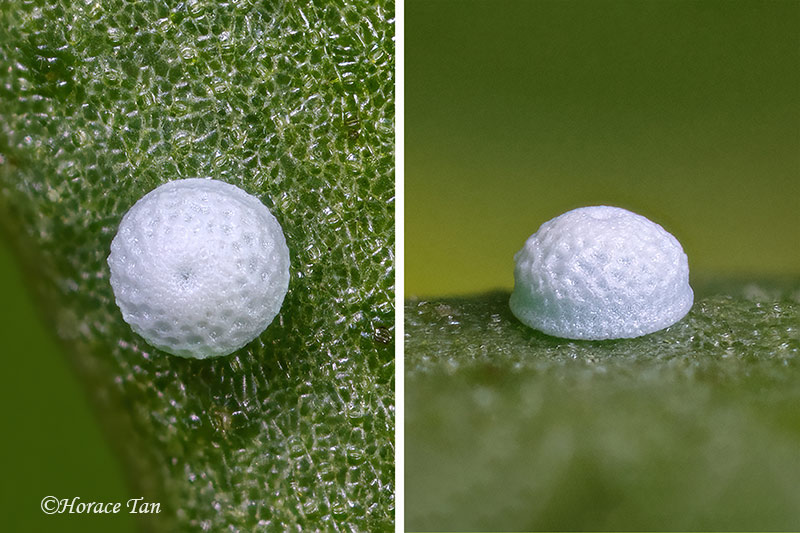
Two vlews of an egg of the Golden Royal.

Two eggs of the Golden Royal oviposited next to each other.

It takes about 3 days for the egg to hatch. The young caterpillar consumes just enough of the egg shell to emerge. It is pale yellowish brown in coloration, and has a length of about 1.2mm. Long setae (hairs) run along the length of the body dorsally as well as sub-spiracularly. The head is brown in colour. The newly hatched does not bother to eat the remnant of the egg shell and proceeds to feed on flower buds present in the vicinity. The 1st instar lasts about 2 to 2.5 days with the body length increased to about 2.1mm. Before the moult, the caterpillar typically take up its position on the surface of a leaf, and becomes immobile.

Empty egg shells of the Golden Royal.

Two views of a newly hatched caterpillar taking its first meal on a flower bud, length: 1.2mm.

Two views of a 1st instar caterpillar feeding on the leaf surface, length: 1.6mm.

A 1st instar caterpillar of the Golden Royal feeding on a flower bud.

A late 1st instar caterpillar of the Golden Royal, dormant prior to the moult to the next instar.

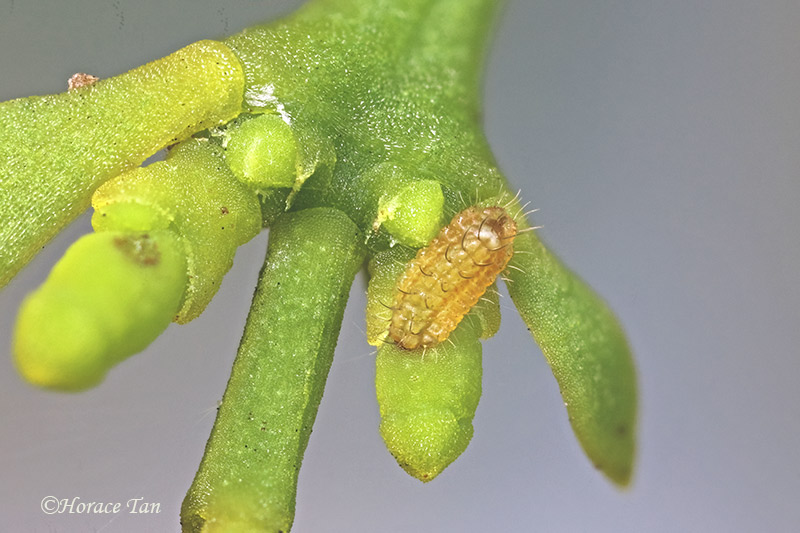
The 2nd instar caterpillar has numerous short setae covering its body surafce. Now the yellowish brown body has a strong greenish undertone. The caterpillar now features a black diamond-shaped prothoracic shield. On the sides of the prothoracic shield and the anterior part of the dorsum of the mesothorax, the body surface takes on a reddish coloration. The dorsal nectary organ on the dorsum of the 7th abdominal segment is discernible and whitish. The 2nd instar lasts about 2 days, with the body length reaching up to about 3.6mm.

Two views of an early 2nd instar caterpillar.

Two views of a 2nd instar caterpillar of the Golden Royal, length: 4.5mm.

A 2nd instar caterpillar of the Golden Royal feeding on a flower bud.

Two views of a 2nd instar caterpillar, late in this stage, dormant prior to its moult.

The 3rd instar caterpillar resembles the 2nd instar caterpillar initially, but with a prominent and proportionately larger prothoracic shield and greater density of body setae. As it grows in this instar, the body turns increasingly greenish overall, and the dorsum of the mesothorax turns yellowish. The dorsal nectary organ at this late stage has the white coloration confined to its central part. The 3rd instar lasts about 2 days and the body length increases up to 6.5mm.

Two views of a newly moulted 3rd instar caterpillar, length: 3.8mm.

Two views of an early 3rd instar caterpillar feeding on a flower bud.

Two views of a 3rd instar caterpillar, length: 6mm.

Two views of a late 3rd instar caterpillar, dormant prior to its moult, length: 6.5mm.

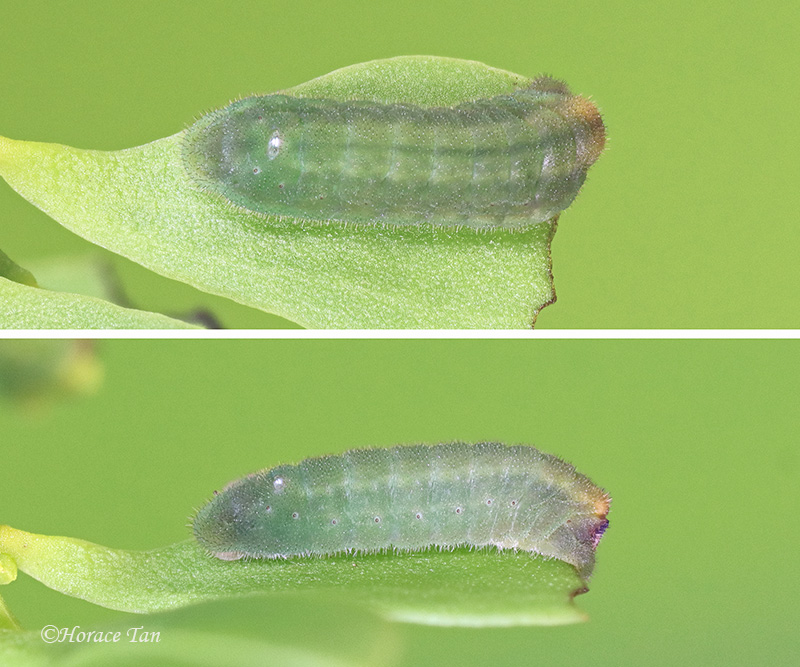
The 4th instar caterpillar resembles the late 3rd instar caterpillar in most body features/markings. One distinguishing feature is that the prothoracic shield is no longer totally black as there are whitish patches present. The dorsum of the mesothorax has become mostly yellowish. The 4th instar lasts about 2 to 3 days with the body length reaching up to 10.5-11mm.

Two views of a newly moulted 4th instar caterpillar, yet to begin eating its old skin.

Frontal view of a newly moulted 4th instar caterpillar, showing the prothoracic shield and yellowish part of the mesothorax behind the shield.

Two views of a 4th instar caterpillar feeding along the leaf edge, length: 10.5mm.

A 4th instar caterpillar feeding on a flower bud.

Two views of a late 4th instar caterpillar, dormant prior to its moult.

The 5th instar caterpillar resembles the 4th instar caterpillar closely in most body features/markings. In some specimens, the white patches in the prothoracic shield are much larger and the shield becomes dominantly white. It is noteworthy that the caterpillar of the Golden Royal also closely resemble those of the Bi-spot Royal (Ancema ctesia, not extant in Singapore) although the two belong to different genera. The 5th (and final) instar lasts about 4 days with the body length reaching up to 21mm.

Two views of a newly moulted 5th instar caterpillar, yet to eat its old skin.

Frontal view of a 5th instar caterpillar, showing the predominantly white prothoracic shield, and the yellowish patch on the mesothorax. The spiracles are yet to turn black.

A 5th instar caterpillar feeding on a flower bud.

Two views of a 5th instar caterpillar feeding on a leaf, length: 13mm.

Two views of a late 5th instar caterpillar, length: 21mm.

Two views of a late 5th instar caterpillar after it has ceased feeding, and ready to enter the pre-pupal stage.

As it enters the pre-pupatory phase of its life cycle, the caterpillar ceases its feeding activity and wanders around for a pupation site. The pre-pupatory caterpillar settles for a spot on the upperside of a leaf with a strong preference for a leaf with curled up edges offering some degrees of concealment. At the chosen site, it spins a silk pad and a silk girdle to secure itself to the leaf.

Two views of a pre-pupa of the Golden Royal.

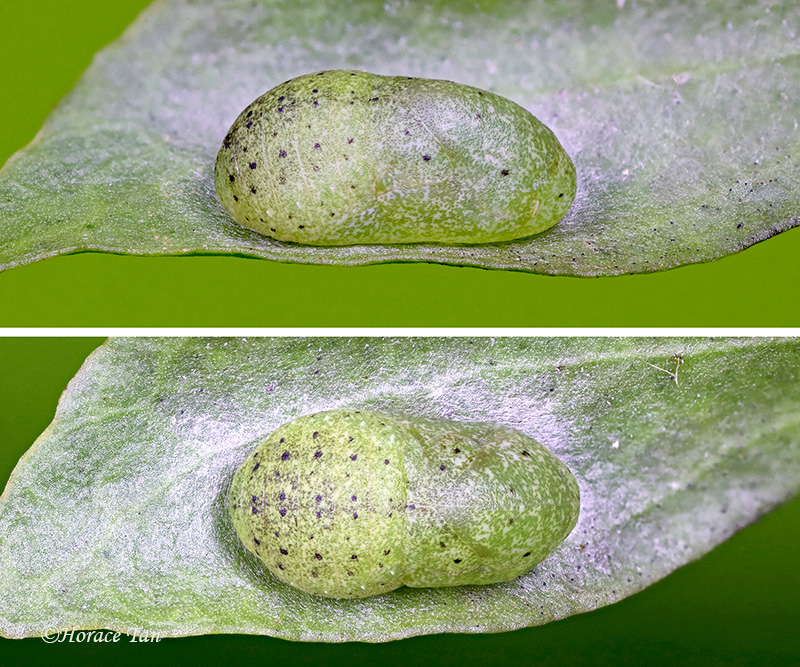
After about 1 day of the pre-pupal period, pupation takes place. The pupa is held via its cremaster to the silk pad on the leaf surface. It is 11 to 11.5mm in length, with the typical shape for a lycaenid pupa, albeit more rotund than usual. The pupa is yellowish green with numerous whitish to yellowish speckles. In addition, black spots in varying number appear on the dorsum of the abdomen and thorax. Some specimens could be totally void of such spots.
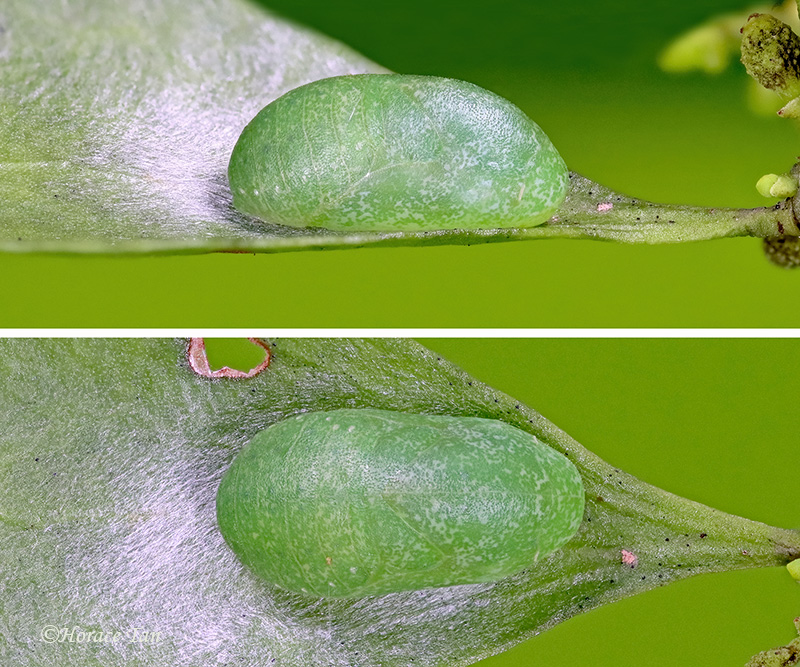
Two views of a pupa of the Golden Royal, without any black spot.

Two views of a pupa of the Golden Royal, with black spots on the abdomen.

Two views of a pupa of the Golden Royal, with black spots on the abdomen and thorax.

The pupal period is observed to be 7 days for the female and 8 days for the male. On the night before ecloson, the pupa becomes darkened in color signaling the imminent emergence of the adult. One can now tell the sex of the soon-to-emerge butterfly from the coloration of the wing pad at this stage. The next morning the adult butterfly emerges from the mature pupa.

Two views of a mature pupa of a female Golden Royal.


A female Golden Royal emerges from its pupal case.


A male Golden Royal emerges from its pupal case.
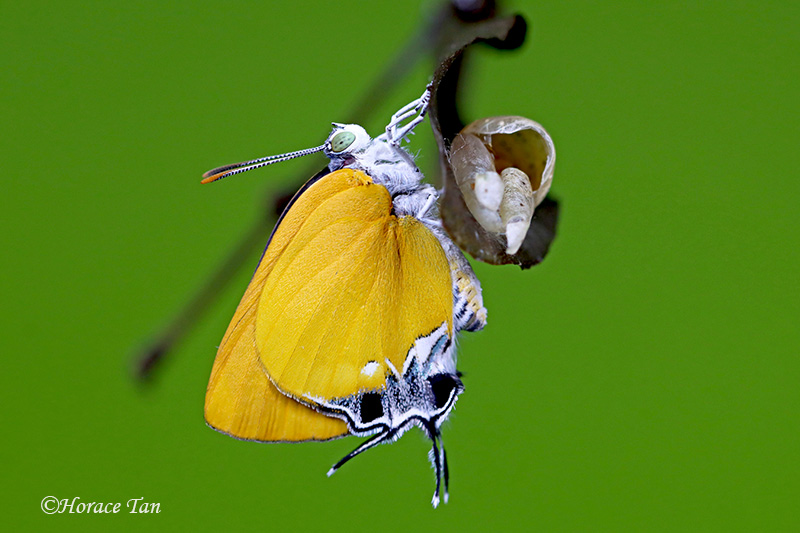
A newly eclosed female Golden Royal resting next to its empty pupal case.

A newly eclosed male Golden Royal resting next to its empty pupal case.

References:
  • [C&P5] The Butterflies of The Malay Peninsula, A.S. Corbet and H.M. Pendlebury;  G. and N.  van der Poorten (Eds.),  5th Edition, Malayan Nature Society (2020).
  • Butterflies of Thailand, Pisuth Ek-Amnuay, 2nd Edition, 2012.
  • A Field Guide to the Butterflies of Singapore, Khew S.K., Ink On Paper Communications, 2nd Edition, 2015.
Text by Horace Tan, Photos by Tan Ben Jin, Loke PF, Gavin Gareth Chan, Loh Mei Yee, Khew SK and Horace Tan, Videos by Loh Mei Yee.

27 March 2022

Butterfly of the Month - March 2022

Butterfly of the Month - March 2022
The Centaur Oakblue (Arhopala centaurus nakula)


The first quarter of the year 2022 is almost over. But it has been another eventful month globally as the world deals with the spectre of a potential world war that has not been seen since the end of 1945. World powers watch by the sidelines, as the Russian invasion of Ukraine continues, and civilian casualties mount. Economic sanctions have been imposed on Russia, but to little apparent effect to stop Russia's onslaught.


How this localised war will turn out in the coming weeks, remains to be seen. The grim reminder that Russia is in possession of the world's largest number of nuclear warheads, capable of reaching anywhere globally, is on the minds of military strategists who may be considering a fast and decisive intervention to end the war. And so Ukraine continues to defend itself with its own conventional military tenacity, as no other sovereign nation would want to involve itself in the fray at the moment.

An uncommon sight of a Centaur Oakblue feeding on nectar from a Spanish Needle flower

Economic sanctions designed to weaken Russia's resolve to conquer Ukraine appear to have undesired side effects on the global economy. When Russia, one of the world's largest oil producers, is affected by any form of sanctions that affect its oil exports, the price of oil shoots through the roof. Today, the price of a barrel of crude oil has soared to almost 6 times the price in Mar 2020 when Covid first hit the world. The implication of this is that everything that depends on oil increases in tandem.

A Centaur Oakblue lurking in the shaded forest understorey

Back in Singapore, the price of a litre of premium 98 octane petrol shot past S$3 per litre - a record price not seen in Singapore in recent history. This not only affects vehicle owners, but everything else that depends on logistics and mobility - deliveries, shipments, travel, etc. In essence, practically everything. And we have already felt the impact of this when many F&B outlets immediately raised the prices of food and drinks, citing rising costs.


Whilst the cost of living has become a major concern for the population for Singapore and elsewhere globally, there is some light at the end of the tunnel on how Singapore is beginning to transition out of the Covid management controls. From 29 March, a major relaxation of the control measures is welcome news to the residents of Singapore. The government's announcement with regard to the easing of these measures has brought more cheer as we move towards living with the virus in our daily lives.


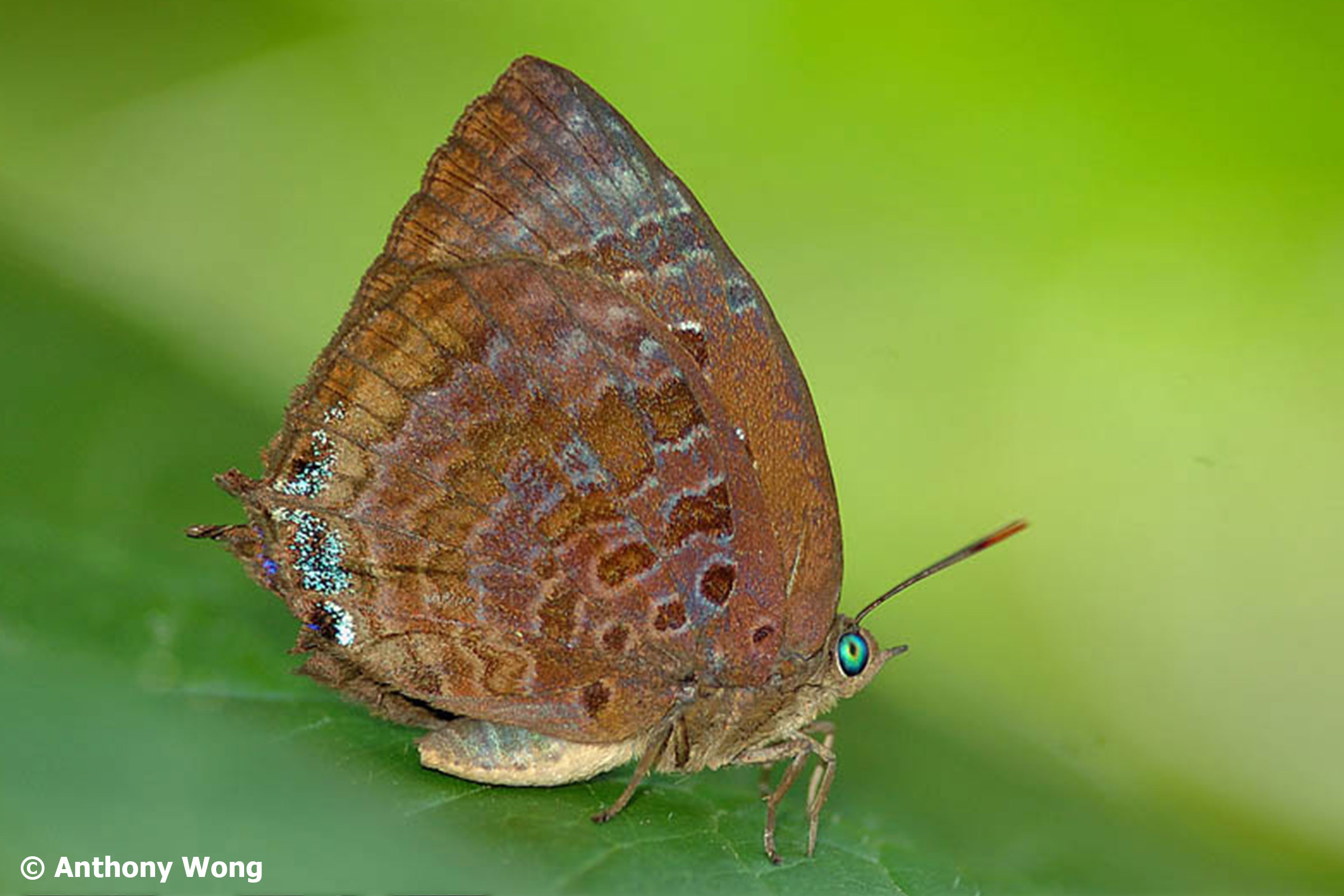
Our Butterfly of the Month for March 2022 is the Centaur Oakblue (Arhopala centaurus nakula). The Centaur Oakblue is one of the largest species of the genus Arhopala found in Singapore. The genus itself comprises many lookalike species that is often frustratingly challenging to identify Their cryptic nature and almost identical markings make their identification difficult. And from the early authors' checklists, a species that has not been recorded as extant in Singapore does not necessarily mean it is not found here. It may mean that a species is very rare, or possibly not positively identified.


However, the Centaur Oakblue is a species that is relatively easy to distinguish from its many lookalike cousins in the genus. It is quite widespread in distribution and can be found from urban parks and gardens to the mangrove areas as well as forested nature reserves. That it has a variety of caterpillar host plants that range from the Sea Almond, several Syzygium spp, and the parasitic Common Chinese Mistletoe, partly explains its presence in many habitats across Singapore.

Male Centaur Oakblue (top) and Female Centaur Oakblue (bottom)

The Centaur Oakblue can immediately be separated from the other species of Arhopalas by the silvery-green edging in the cell markings on the underside of the forewings. The male is a deep purplish blue on the upperside of the wings, with a thin black marginal border. The female is a deeper purplish-blue above with broad black bothers on both wings.


The underside is a medium brown with darker striations and bands arranged in the typical Arhopala fashion. The tornal area of the hindwing has green iridescent scaling, and there is a thick white-tipped tail emerging from vein 2 of the hindwing. Like most of the species in the genus, the eyes of the Centaur Oakblue are greenish blue.

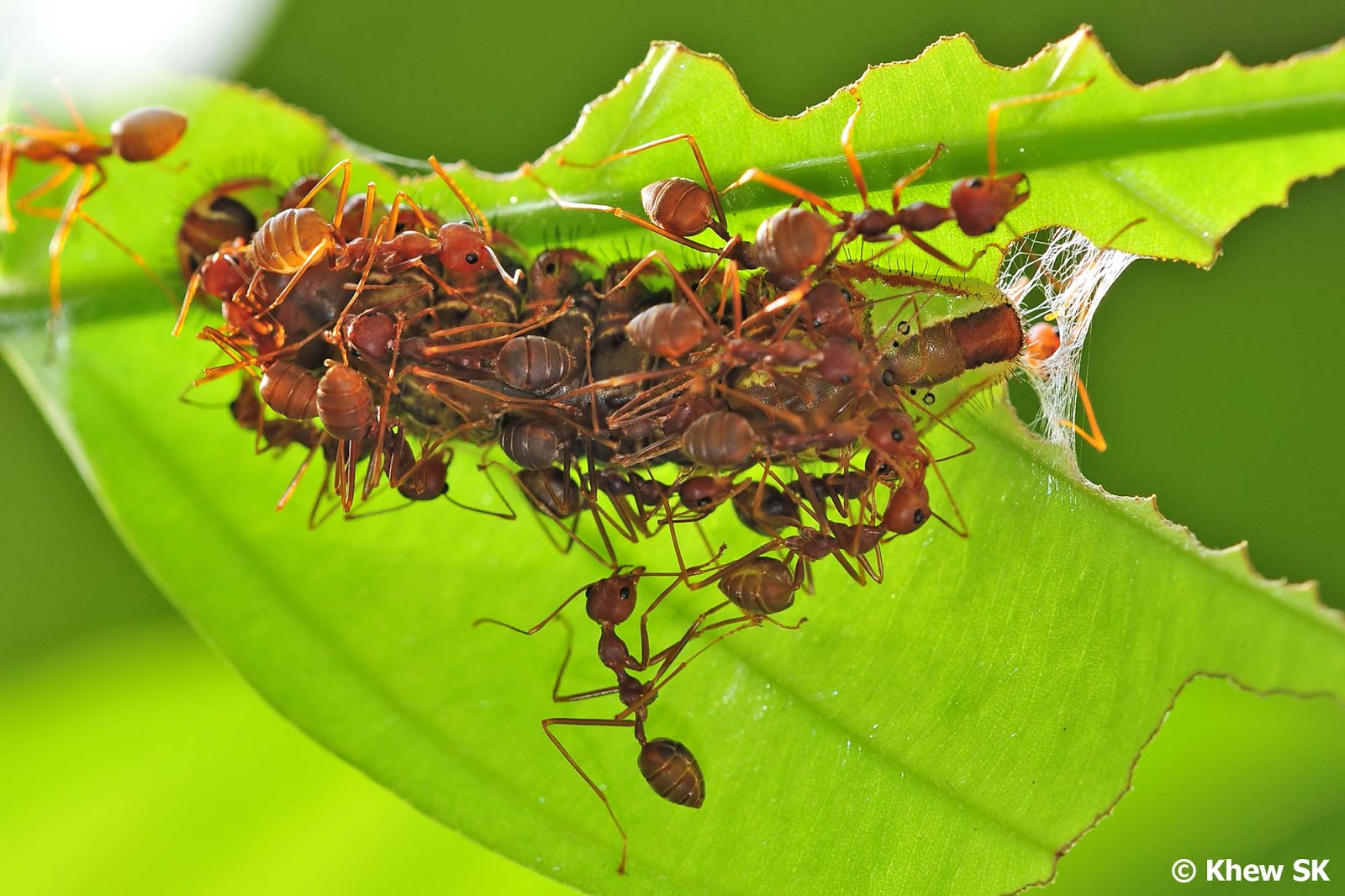
A caterpillar of the Centaur Oakblue protected by Weaver ants

The caterpillars of the Centaur Oakblue display a close association with ants, in particular the aggressive Weaver Ants (Oecophylla smaragdina) that offer protection to the caterpillars in exchange for the sugars that they produce. In many of our field observations, we have found caterpillars of the Centaur Oakblue covered with the Weaver ants, which are ready to attack any potential intruders with painful bites.

Text by Khew SK : Photos by Federick Ho, Khew SK, Loh MY, Bobby Mun, Horace Tan and Anthony Wong