01 November 2020

Bush Browns of Singapore : Part 2

Bush Browns of Singapore : Part 2
Featuring the Mycalesis species of Singapore

A Burmese Bush Brown (Mycalesis perseoides perseoides) puddling at damp sand

In this second part of the article on the Bush Browns of Singapore, we take a look at the remaining 3 species of Bush Browns that are cryptic and are more challenging to distinguish due to their generally similar appearances. These 3 species are not uncommon and are widely distributed across Singapore from parks and gardens to the forested nature reserves.

A Dark Brand Bush Brown (Mycalesis mineus macromalayana) perches on a leaf

The species are not particularly attractive to the casual observer, being typically brown with a series of submarginal ocelli across both wings. As they are alert and skittish and when disturbed, quickly fly off amongst the low shrubbery and grassy habitats where they prefer, many observers will often ignore them in the field.

A Long Brand Bush Brown (Mycalesis visala phamis) perches on a blade of grass

The Bush Browns are sometimes seen feeding on the ripened fruits of the Singapore Rhododendron (Melastoma malabathricum). They are rarely seen feeding at flowers, but occasionally encountered puddling at damp trails and streambanks or feeding on the sap of damaged trees and branches. Most of the time, they are spotted perched on the tops of leaves with their wings folded upright.Occasionally, particularly in the early morning hours, some individuals may be seen opening their wings to sunbathe.

4. The Dark Brand Bush Brown (Mycalesis mineus macromalayana)


The Dark Brand Bush Brown is probably the most common and widespread amongst the Bush Brown species. It can be found in urban parks and gardens and even in pockets of greenery the vicinity of residential estates. The species' caterpillar host plants are grasses - Cow Grass (Axonopus compressus) and Buffalo Grass (Paspalum conjugatum).

Upperside of a sunbathing Dark Brand Bush Brown
A Dark Brand Bush Brown feeding on the ripened fruit of the Singapore Rhododendron

The species is a drab greyish-brown upperside and a paler underside that features a white post-discal band across both wings (this band is much wider in the female compared to the male). There are usually two large ocelli on the underside of the forewing with some obscure smaller ocelli which can be variable in different individuals.


ID Key and Tips - What to Look Out For :
  1. White striae around the eyespots are thin and narrow.
  2. Hindwing inner margins of eyespots form a sharply triangular and deep indentation from the white band in the upper half.
  3. Lower 4 eyespots in line. (This ID Key is used to separate this species with the Dingy Bush Brown featured in Part 1 of this article)
  4. Discal line may be absent in some individuals.
5. The Long Brand Bush Brown (Mycalesis visala phamis)


The Long Brand Bush Brown appears quite similar to the previous species, and found in almost the same localities and habitats. The Bush Browns usually prefer shaded or semi-shaded environments and fly low amongst the grassy undergrowth. The caterpillar host plants are also grasses but different from those of the Dark Brand Bush Brown. The two locally known host plants are Isachne globosa and Ottochloa nodosa, which the species shares with a number of other Satyrinae and Hesperiinae butterflies.

A rare "dry season form" of the Long Brand Bush Brown with reduced ocelli

The Long Brand Bush Brown is very similar to the Dark Brand Bush Brown and is difficult to separate when in flight or from field observations. However, the Long Brand Bush Brown usually has faint squiggly lines on the underside of both wings.


ID Key and Tips - What to Look Out For :
  1. White striae around the eyespots are thickened and enhanced.
  2. Hindwing inner margins of ocelli form a more regular shallow indentation opposite the white band.
  3. Dark discal line less irregular but without a spike or "tooth" at vein 1b of the hindwing.
6. The Burmese Bush Brown (Mycalesis perseoides perseoides)


The Burmese Bush Brown is the last of the lookalike Mycalesis species that is found in Singapore. It closely resembles the preceding two species and the diagnostic physical features should be scrutinised from photographs to distinguish the differences amongst these lookalike species of Bush Browns. It is also found in the same habitats as the earlier two species and occasionally flies together with the other two species in the same localities.

Upperside of a sunbathing Burmese Bush Brown

The Burmese Bush Brown is a dull brown on the upperside with a large yellow-ringed ocellus in space 2 of the forewing. This is typical of the other species of this genus. The underside is a paler brown with the characteristic white post discal band across both wings. The submarginal ocelli are yellow-ringed. On the underside of the forewing, there are occasionally faint lines. The brown discal line is irregular and stretches down to almost the dorsal edge, with a "tooth" at vein 1b.


ID Key and Tips - What to Look Out For :
  1. White striae around the eyespots are thickened and enhanced.
  2. Hindwing inner margins of ocelli form a jagged edged indentation opposite the white band.
  3. Dark discal line is irregular and with a spike or "tooth" at vein 1b of the hindwing.
Hopefully, this article can help in a small way to aid butterfly watchers to distinguish the different species of Bush Browns in Singapore.  There are two other species of lookalikes in Malaysia and it is hoped that we will be able to find them in Singapore one day in the future.

Text by Khew SK : Photos by James Chia, Khew SK, Loke PF, Nelson Ong and Horace Tan

References : 

Special thanks to Dr Seow TL for his help in crafting the ID keys to separate field shots of these Mycalesis species.

25 October 2020

Bush Browns of Singapore : Part 1

Bush Browns of Singapore : Part 1
Featuring the Mycalesis species of Singapore

A female Dingy Bush Brown (Mycalesis perseus cepheus) perches on a moss-covered tree root

The genus Mycalesis, collectively known by their English Common Name of "Bush Browns" is represented by six species in Singapore. The majority of the species are moderately common except for one which is mainly found in forested areas of the nature reserves. In this two-part blog post, we take a look at these Bush Browns that can be found in Singapore.

A Malayan Bush Brown (Mycalesis fusca fusca) perches on a leaf

The Bush Browns are members of the sub-family Satyrinae, usually referred to as "Browns and Arguses" Predominantly brown in colour, all the species of the Bush Browns are adorned with submarginal ocelli (eyespots) on the underside of both the fore and hindwings. As they belong to the family Nymphalidae, their forelegs are under-developed, and all the species stand on the mid- and hindlegs only.

A Purple Bush Brown (Mycalesis orseis nautilus) perches on a leaf

They typically fly in grassy habitats (of which several species' caterpillars feed on as host plants), and fly low amongst the grasses and shrubbery. Their flight is generally weak but they are alert and skittish, and are often quite challenging to photograph. The Bush Browns typically rest with their wings folded upright, although some of the species have been observed to open their wings to sunbathe at certain hours of the day.

A Malayan Bush Brown (Mycalesis fusca fusca) perches on a fern

This weekend's article introduces the three more distinct species that are easier to identify in the field. In next week's article, we will take a look at the more cryptic lookalikes that will require a bit more scrutiny to correctly identify them.

1. The Malayan Bush Brown (Mycalesis fusca fusca)

A Malayan Bush Brown feeding on the ripened fruit of the Singapore Rhododendron
An uncommon shot of the upperside of the Malayan Bush Brown

The Malayan Bush Brown is the most distinctive of the six species currently found in Singapore. It is usually found in forested areas and along the fringes of the nature reserves flying amongst low bushes and grasses, particularly where its caterpillar host plant, Scleria bancana grows.


The Malayan Bush Brown is the only orangey-brown species that occurs in Singapore. It has a pair of reddish-brown longitudinal stripes on both wings. The orange ringed sub-marginal ocelli are distinctive and the Malayan Bush Brown cannot be confused with any of the other species found in Singapore. The upperside is brown with obscure ocelli.

2. The Purple Bush Brown (Mycalesis orseis nautilus)

A Purple Bush Brown (Mycalesis orseis nautilus) with its full set of yellow-ringed ocelli on both wings

The Purple Bush Brown is the rarest of all the Bush Brown species in Singapore. It is a predominantly forest species and is rarely found outside the sanctuary of the shaded nature reserves. Its caterpillar host plant is currently unknown, but is likely to be one of the grasses. It is usually found singly and flies low amongst grassy undergrowth in shaded habitats.


The yellow-ringed submarginal ocelli on the underside of the fore- and hindwings are rather uniform in size and the majority of the ocelli are touching the adjacent ocelli. The broad white post-discal band that stretches across both wings is faintly violet-washed in a side light.

3. The Dingy Bush Brown (Mycalesis perseus cepheus)


The Dingy Bush Brown is easily distinguished from the other lookalike species in the genus in that the ocellus in space 2 of the hindwing is moved inwards and out of line with the other ocelli adjacent to it. The species also usually has a full set of four ocelli on the underside of the forewing. The caterpillar of this species has been bred on the common "Cow Grass" (Axonopus compressus) and most certainly some other species of grasses.

A courting pair of Dingy Bush Brown.  Male - Left, Female - Right

The species is found amongst grassy areas around the fringes of the nature reserves and buffer parks. The males are generally darker brown than the females. The species has a widespread distribution across Singapore, but cannot be considered common. In localised areas, it can regularly be spotted flying around, and sometimes several individuals can be seen together.

Text by Khew SK : Photos by Khew SK and Tan BJ

18 October 2020

Butterfly of the Month - October 2020

Butterfly of the Month - October 2020
The Bush Hopper (Ampittia dioscorides camertes)

A Bush Hopper perched on a grass blade

We trudge cautiously towards the end of 2020, not knowing what is around the corner in a year that has thrown so many unpleasant surprises at us. For once, there is a universal acceptance of each country's unique misfortunes whenever the word "pandemic" is mentioned. Everyone will nod with complete understanding of the situation, as the whole world probably knows the word COVID-19 by now and the havoc it has wreaked on everyones' lives.


The situation in Singapore appears to have turned the corner, as the number of infections in the community has fallen to single digits for a few days now. But that is because our little island is still very much "locked" down, with minimal travel into Singapore, and strict measures in place for community interactions. Life has take a very different outlook now, as wearing a face mask has become the default for everyone, whenever we step outside our homes.


But nothing can be taken for granted on a very compact island where residents are "crammed" into a 720 sq km island, and where the population density per sq m is one of the highest in the world. Like many countries that have somewhat managed to contain the pandemic to low numbers of infections, the prospects of borders re-opening and inter-country travels start again will be something to watch out for, and be concerned about.

A Bush Hopper perched on a grass flower

Our outdoor spaces like parks and nature areas in Singapore are more heavily used than I can ever remember in recent times. Even the outlying parks that are usually peaceful and quiet are seeing unprecedented visitorship with local residents thronging these public amenities as travel is curtailed and most residents are looking for new places to go to get their fair dose of fresh air and sunshine.


As we move into a much-anticipated "Phase 3" of the progressive easing of the safety measures, residents are looking forward to a new norm of social interaction, with lots of controls in place to minimise cross-infections in the community. But with every policy, every procedure is a learning journey, and things will continue to evolve and residents will have to adjust to the life with COVID-19 in our midst.

A Bush Hopper feeding at the purple flower of Duranta sp

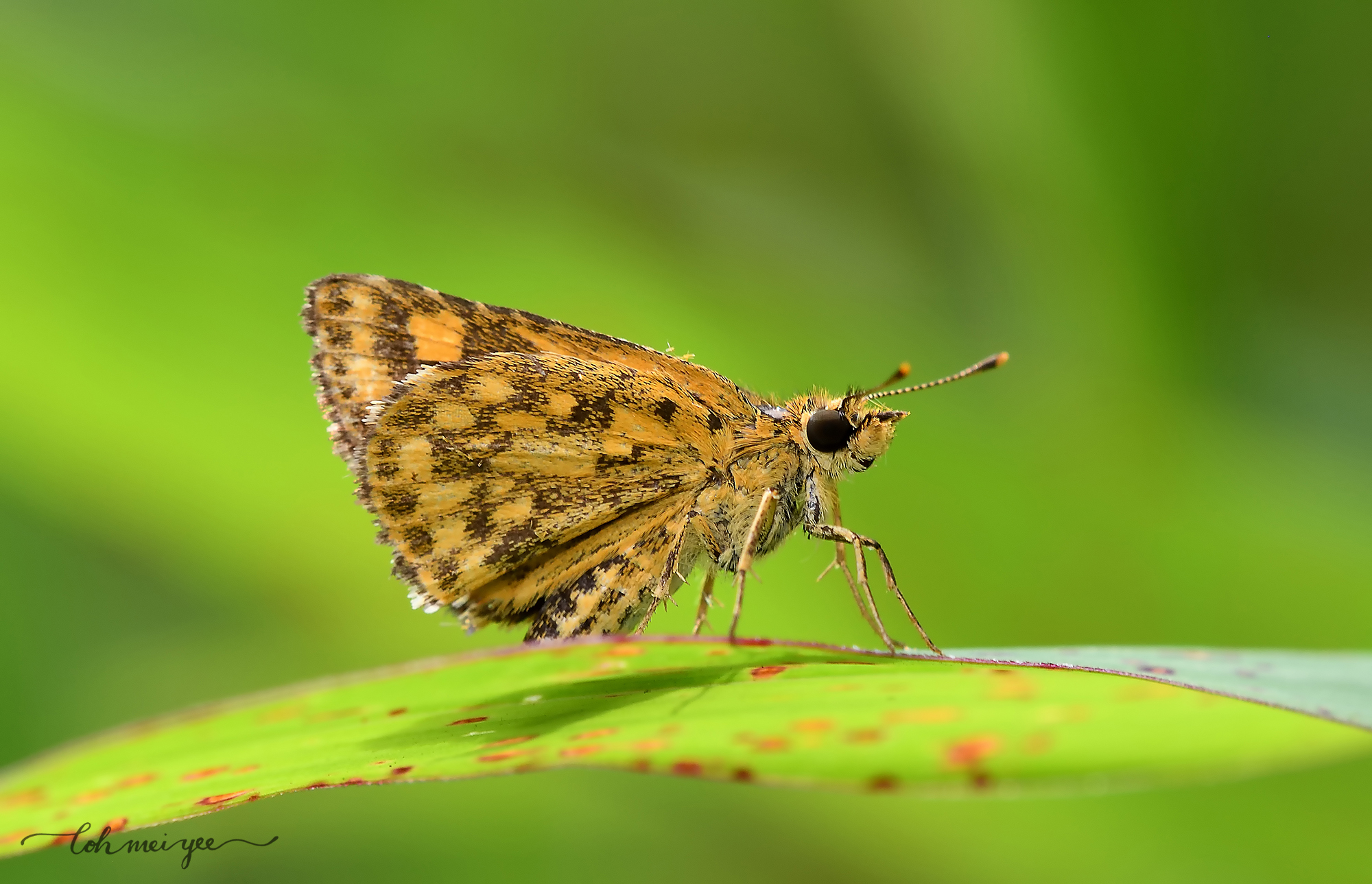
Our Butterfly of the Month for October 2020 is a tiny inconspicuous skipper from the sub-family Hesperiinae. The Bush Hopper (Ampittia dioscorides camertes) is a predominantly orange-and-black skipper that has a wingspan that rarely exceeds 20mm across from wingtip to wingtip. Whilst it is considered only moderately common, it can be found quite regularly in its preferred habitats of grassy open areas in urban parks and gardens.


The Bush Hopper is a small butterfly, and may often be missed by observers due to its diminutive size. It flies rapidly, and is usually seen in the company of other skippers like the Lesser Dart and Small Branded Swift in urban parks. Whilst it stops with its wings in the usual skipper pose, it has an interesting behaviour of keeping its wings in motion, opening and closing its wings when it perches to rest, unlike the similar looking Darts (or Potanthus spp).

The male Bush Hopper (top) has more extensive orange markings on the uppersides whilst the female (bottom) is more brown in appearance with reduced orange-beige spots

The male Bush Hopper is dark brown with generous orange-yellow markings above. The orange markings are arranged with a broad stripe in the cell and large conjoined subapical and postdiscal spots. The paler brown female has smaller and much reduced spots on her wings, and the spots are generally lighter orange in colour.


The underside is light orange-brown with the markings giving a more chequered appearance, especially on the hindwings. In pristine individuals, the cilia on the margins of both wings are chequered. The antennae lacks the typical prominent apiculus (or hook at the clubbed tip of the antennae) such that the Bush Hopper almost resembles the Taractrocera genus of skippers.

Occasionally, male Bush Hoppers are observed to puddle at damp sandy streambanks in the nature reserves

From field observations, males of the Bush Hopper occasionally puddle at damp sandy spots along forest paths and streams - a behaviour that is rarely displayed by the related skippers like the Lesser Dart and other Potanthus species. When puddling, it also opens and closes its wings, a habit that is quite unique to the Bush Hoppers.

A courting pair of Bush Hoppers. Female (Left) and Male (Right)

Although its life history has not yet been successfully documented yet, its caterpillars are highly likely to feed on common species of grasses (Poaceae) found in areas where the butterfly is often seen - sometimes in numbers. Both the males and females are equally common in localised areas where they are observed.

Text by Khew SK : Photos by Khew SK and Loh MY