08 February 2020

Butterfly of the Month - February 2020

Butterfly of the Month - February 2020
The Banded Demon (Notocrypta paralysos varians)


A mating pair of Banded Demon

Today is the 15th day of the 2020 Lunar New Year, also known as the The Lantern Festival or called called Yuan-Xiao Jie 元宵节 Festival in China. Tradition also has it that on this evening, young unmarried Chinese girls write their names on oranges and throw them into a river and the lucky men who pick them up will become their spouse. Yuan-Xiao Jie 元宵节 ends the Lunar New Year festivities as life returns to normal after 15 days of celebrations.


The Year of the Metal Rat has brought the world into a tumultuous start as the coronavirus (designated 2019-nCoV), which had the Chinese city of Wuhan as it epicentre, created havoc and panic around the world as the infection spread rapidly. The latest news reports put the number of deaths caused by this virus at 722, with an estimated 35,000 infected around the world.


As news of the virus spreads around the world, probably at a much faster rate than the virus itself, WHO has declared a global health emergency on 30 Jan 2020. Different countries have instituted their own measures to contain the spread of the virus with varying degrees of severity. Amongst the more recent measures were the banning of any visitor who originates from China from entering a number of countries. China itself swiftly instituted city lock-downs by shutting down transportation in and out of the critical cities and provinces.


Banded Demons sunbathing in the typical skipper open-winged pose

In the past few weeks, it is hard to read any portals of mainstream media or social media with little or no reference to 2019-nCoV or the coronavirus. As the world comes to terms with the health emergency, it remains to be seen when the infections will peak and how long it will take to eventually abate. The potential catastrophe that may impact on the world, as we start a new decade, is a disruption that we have certainly not counted on. Already, as the virus spreads, some panic-stricken populations resort to very irrational behaviour.

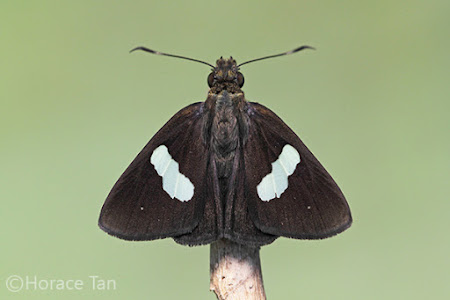


Our Butterfly of the Month for February 2020 is the sombre Banded Demon, perhaps to reflect the mood that our human world is going through these days. It is rather local in distribution and its predictable appearance at certain favourite localities is usually associated with the presence of its caterpillar host plant, the African Spiral Flag (Costus lucanusianus) (a type of ginger).


At times, it can also be found in the vicinity of Torch Ginger (Etlingera elatior) groves. Although its caterpillars have not been bred on this ginger before, it is a possible host plant too, as there are other potential host plants amongst the monocotyledons.


Banded Demons feeding on Chinese Violet (top) and Purple Snakeweed (bottom)

The Banded Demon is a quick flyer, like most Skippers, and generally prefers to remain at low level and maneuvering around low shrubbery. It often forages amongst the low-growing wildflowers like the Chinese Violet, Purple Snakeweed and other ground cover flowering plants. It occurs in some urban parks but primarily found along the forest edges of the nature reserves.


The Banded Demon is blackish-brown above, with a distinct white discal band composed of contiguous patches on the forewing. This discal band is usually conspicuously notched at vein 2. There is usually a white hyaline spot in space 4 of the forewing, but individuals without this spot are quite regularly encountered.


A courting pair of Banded Demons

The underside is paler purplish-brown than the upperside, and is distinctly paler along the wing margins. The antennae has a lighter patch just below the club and one of the characteristics that can be used to distinguish this species from the lookalike female of Quedara monteithi monteithi.

Text by Khew SK : Photos by David Chan, Goh YL, David Ho, Khew SK, Michael Soh, Horace Tan and Tan CP

01 February 2020

Emigrants of Singapore

Emigrants of Singapore
Featuring the Catopsilia butterfly species


A Mottled Emigrant feeding on the flowers of the Javanese Ixora (Ixora javanica)

Amongst the bright and noticeable urban butterfly species that are often spotted by nature enthusiasts, is a group of butterflies called "Emigrants". These species belong to the Pieridae family and classifed under the genus Catopsilia. They are medium-sized, fast-flying butterflies that are often seen in Singapore's urban parks and gardens.


An Orange Emigrant feeding on the flowers of Lantana camara

Collectively, the three species can be considered common urban butterflies that are regularly seen flying all over the island, sometimes even in the heart of the built-up Central Business District of Singapore. The three species, Lemon Emigrant, Orange Emigrant and Mottled Emigrant show migratory habits, particularly the Lemon Emigrant, hence their English common names.


A Lemon Emigrant f-hilaria feeding on the flowers of Lantana camara

If my memory serves me well, in the late 80's/90's I have observed many individuals of the Lemon Emigrant flying in one direction in the morning, and then in the reverse direction in the late afternoon. Since then, I have never seen this phenomenon again in recent years. The Orange and Mottled Emigrants do not seem to display this behaviour of mass 'migrations'.


A mating pair of Orange Emigrants

The Orange and Mottled Emigrants are single-formed species, with the morphological features of the butterflies quite consistent in both species. Males and females have subtle differences - enough to distinguish between the sexes if they stop long enough to be examined closely. The Lemon Emigrant, however, has multiple forms in both the males and females and has a wider variety of distinguishing features compared to its two cousins.

1) The Lemon Emigrant (Catopsilia pomona pomona)


Male Lemon Emigrant f-alcmeone puddling at sandbanks

The Lemon Emigrant is a common and very variable butterfly that is found in urban parks and gardens. It is represented by no fewer than seven different 'forms' in Singapore. There are two main groups - the 'crocale' group with the antennae black above, and without silver spots on the underside of the wings; and the 'pomona' forms with the antennae red above and with red-ringed silver spots on the underside of the wings.


Female Lemon Emigrant f-pomona (left) and male Lemon Emigrant f-alcmeone (right)

Female Lemon Emigrant f-crocale

Female Lemon Emigrant f-catilla

This fast-flying species has a strong erratic flight. The colour of the wings range from pale green to orange yellow, with the wing borders on the upperside of the wings varying from a thin black border to wide marginal borders with thick markings. One of the forms - form-catilla is unique in having blood red patches on the underside of both wings that give the butterfly a very different appearance from its other typical forms.

2) The Mottled Emigrant (Catopsilia pyranthe pyranthe)


The Mottled Emigrant is more common than before when its caterpillar host plant, the Seven Golden Candlesticks (Senna alata) became more common as a species that is planted in urban parks and gardens. It can be found in urban parks and gardens where its host plant is found. Another species with a strong erratic flight, the Mottled Emigrant appears whitish in flight and can sometimes be mistaken for another Pieridae.


Male Mottled Emigrant - upperside view of its wings


The wings of the Mottled Emigrant are greenish-white above with a narrow black apical border with a prominent black cell-end spot. The underside is of a slightly darker greenish hue, and numerous reddish-brown striations that gives the underside of the wings a "mottled" look. Females have broader black marginal borders on both wings.

3) The Orange Emigrant (Catopsilia scylla cornelia)


Upperside view of a male Orange Emigrant

The Orange Emigrant has white forewings with black borders and deep orange-yellow hindwings on the upperside. On the underside, both the fore and hindwings are orange-yellow with dark brownish spots and markings. The female has a series of irregular sub-marginal spots on the forewing above and a broad black marginal border on the hindwing. The underside markings of the female are more prominent and the ground colour of the wings is often of a deeper orange than the male.


A female Orange Emigrant trying to oviposit on its host plant, Senna alata

A male Orange Emigrant perches on a leaf of its host plant, Senna alata

Also more regularly found in urban parks and gardens than in the forested nature reserves, the Orange Emigrant with its strong and erratic flight flies amongst the treetops and shrubbery looking for its preferred caterpillar host plants.

Text by Khew SK : Photos by Sunny Chir, Khew SK, Koh CH, Horace Tan and Anthony Wong

25 January 2020

Gong Xi Fa Cai 2020

Gong Xi Fa Cai 2020
Chinese New Year Butterfly Tea Cups


The series of six Chinese New Year butterfly teacups with a feature butterfly for each year from 2015 - 2020

Just a little over six years ago, when Ms Ho Ching was thinking of a Chinese New Year memento for the volunteers and grassroots supporters of one of the constituencies, she thought of a Chinese tea cup adorned with a photo of a butterfly. I suggested a few shots of some colourful butterflies for her consideration, and this started an annual journey of designing a CNY butterfly teacup since the first edition in 2015.


In selecting the shots for the CNY butterfly teacup, I chose a few criteria to shortlist the photos.
  • The butterfly must be colourful and not be too drab, as it is after all, for a CNY teacup
  • The butterfly should be feeding or perched on a flower to add to the colour and composition
  • It has to be locally shot in Singapore


The Chinese New Year teacup series with their respective boxes

In subsequent years, ButterflyCircle members generously contributed their photographs for the CNY  butterfly teacups. It was always a challenge to select the photos as there were many excellent shots to choose from. And so, every Spring Festival since 2015, there was a photo of a pretty butterfly on each year's CNY butterfly teacup.

2015 - Year of the Sheep (19 Feb 2015) - The Malay Lacewing (Cethosia hypsea hypsina)


The first CNY butterfly teacup design features the Malay Lacewing, a local species of butterfly with bright colours and intricate lace patterns on its wings. It is a species that frequents the forested nature reserves in Singapore, and is relatively rare in recent years. It flies in a slow unhurried manner and is known to be distasteful to predators.


2015 edition of the CNY butterfly teacup featuring the Malay Lacewing

Each ceramic teacup is designed with a lid and a saucer, and comes in a customised box. The description of the butterfly and flower are also annotated on the box. For each year, a Chinese couplet is inscribed on the box as well as the teacup. For the 2015 edition, the couplet reads "蝶恋花 喜迎春" or roughly translated as "Butterflies Love Flowers, Happiness of the New Year".

2016 - Year of the Monkey (8 Feb 2016) - The Lime Butterfly (Papilio demoleus malayanus)


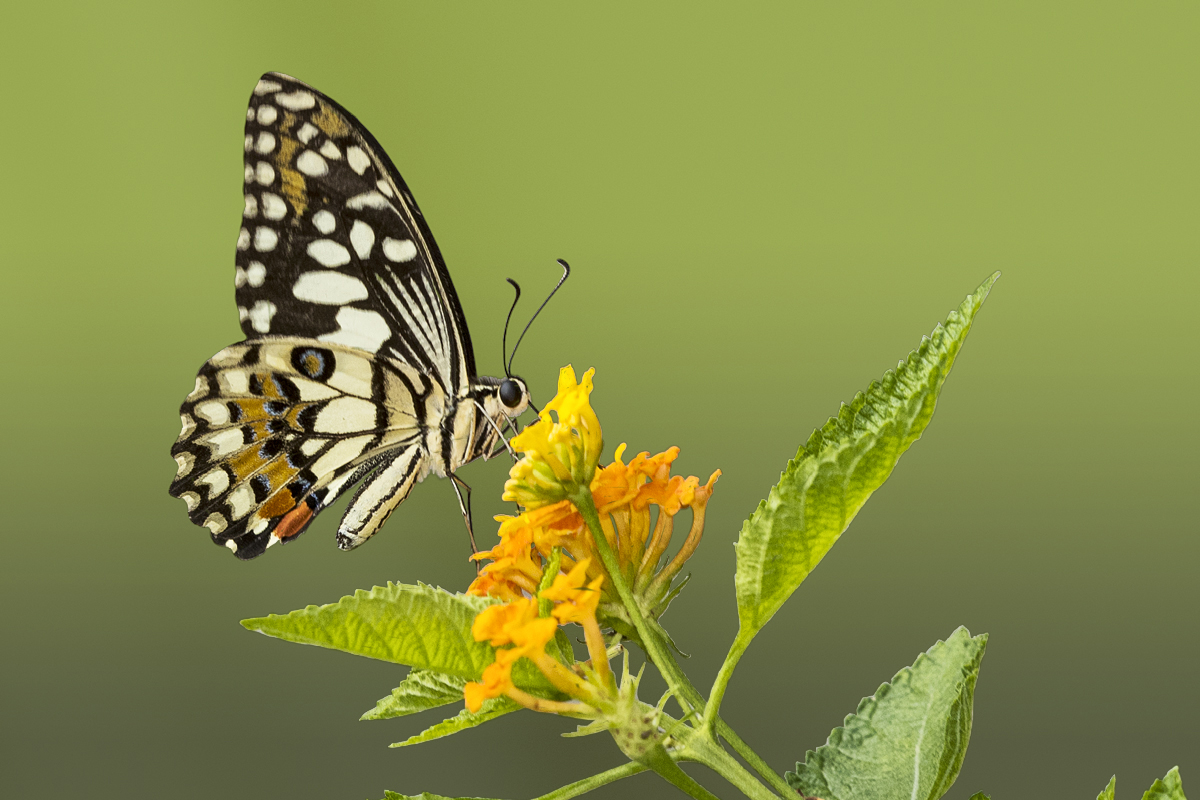
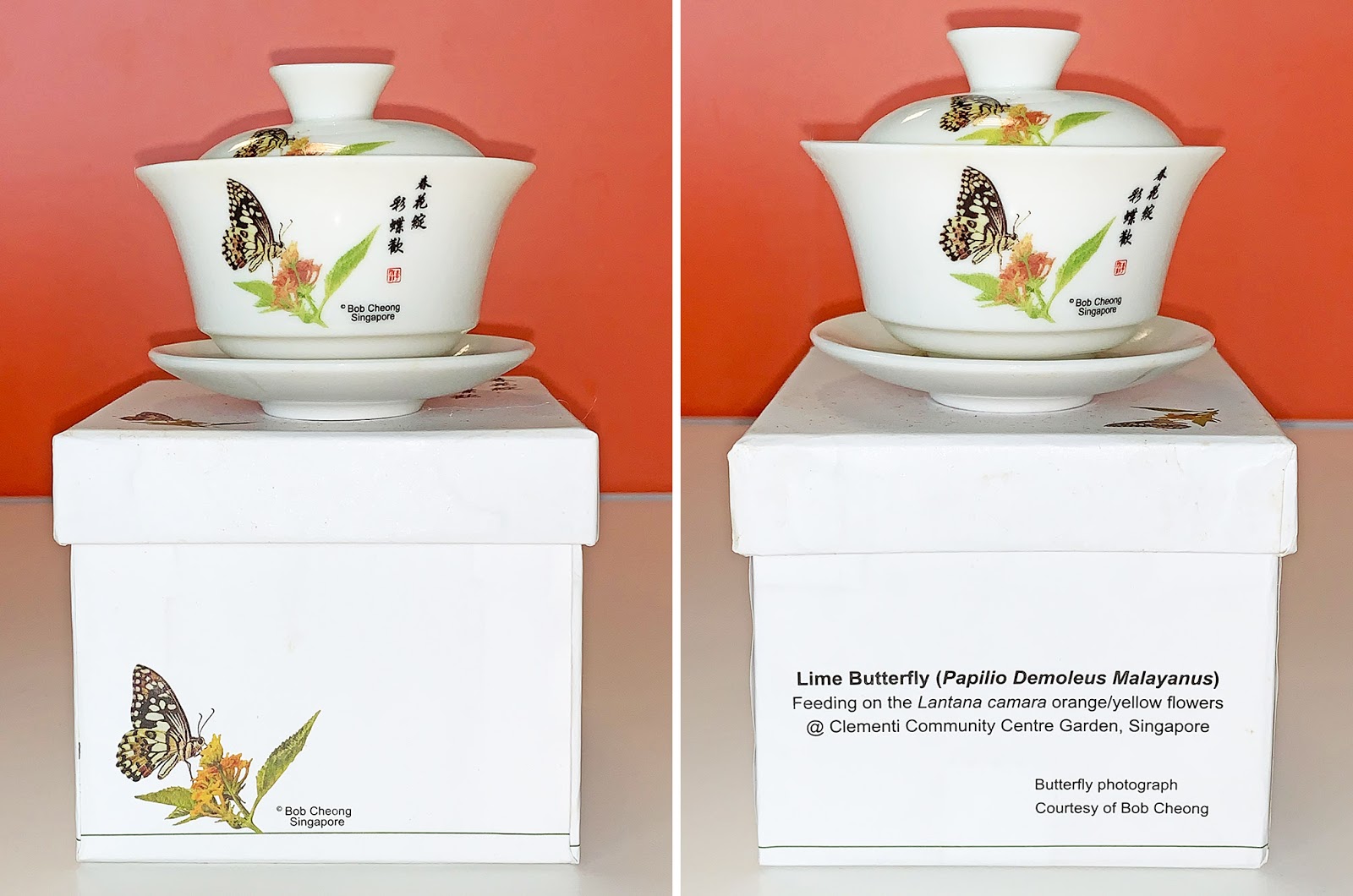
The 2016 CNY butterfly teacup featured the common Lime Butterfly, an urban species that is more regularly seen in our urban parks and gardens. Its caterpillars feed on various species of lime plants, which are usually found in abundance, especially during the CNY season as the ripening orange lime fruits signify gold and prosperity to the owner of the plants.


2016 edition of the CNY butterfly teacup featuring the Lime Butterfly

The 2016 Chinese couplet was "春花绽 彩蝶欢" translated to mean "Spring Flowers Blossom, Beautiful Butterflies Dancing". A most appropriate and poetic couplet that goes well with the Lime Butterfly feeding on the flowers of the Lantana bush. The ButterflyCircle photographer, Bob Cheong, shot this at the Clementi Community Centre Garden in Singapore.

2017 - Year of the Rooster (28 Jan 2017) - The Painted Jezebel (Delias hyparete metarete)


The pretty urban butterfly, Painted Jezebel was featured on the 2017 edition of the CNY butterfly teacup. This common species can often be spotted at urban gardens, parks and roadside greenery in Singapore. It flies leisurely at treetops, and often seen frolicking with other individuals of the species.


2017 edition of the CNY butterfly teacup featuring the Painted Jezebel

Draft Artwork for the 2017 CNY butterfly teacup

The 2017 teacup Chinese couplet was "福盈门 蝶花舞" or "Prosperity Comes to the Home, Butterflies Dance amongst Flowers". The photo was taken by the late ButterflyCircle member Sunny Chir who passed away in May 2018. The Painted Jezebel featured on the teacup was feeding on the red flowers of the red Shanghai Beauty (Jatropha interrigima) at the Upper Seletar Reservoir Park.

2018 - Year of the Dog (16 Feb 2018) - The Club Silverline (Spindasis syama terana)


This small and pretty Lycaenid is one of two species of its genus that can be found in Singapore. The Club Silverline has silver lined black markings on pale beige wings. It is a fast flyer, but is often spotted feeding on flowers in the early hours of the day. It can be found in urban parks and gardens as well as the forested nature reserves in Singapore.


2018 edition of the CNY butterfly teacup featuring the Club Silverline

ButterflyCircle member Loke Peng Fai shot this Club Silverline feeding on the red flowers of the Red Tree Shrub (Leea rubra) at one of our urban parks, Tampines Eco Green, where this butterfly species has been often spotted. The Chinese couplet for 2018 reads "蝶嬉花 颂春乐" meaning "Butterflies Frolick amongst the Flowers, Singing a Happy New Year Song".

2019 - Year of the Pig (5 Feb 2019) - The Orange Emigrant (Catopsilia scylla cornelia)


The bright and cheery Orange Emigrant was the feature butterfly on the 2019 edition of the CNY butterfly teacup. The species is another common urban butterfly, often seen in urban parks and gardens where its preferred caterpillar host plant, the Scrambled Egg Bush or Golden Senna (Senna surattensis) grows. It is a fast-flying butterfly with white forewings and yellow hindwings on the upperside, and a golden yellow underside.


2019 edition of the CNY butterfly teacup featuring the Orange Emigrant

Draft Artwork for the 2019 CNY butterfly teacup

The Orange Emigrant on the CNY 2019 butterfly teacup was photographed by lady ButterflyCircle member Loh Mei Yee. The butterfly was feeding on the flower of the Peacock Flower (Caesalpinia pulcherrima) at the Butterfly Hill on Pulau Ubin. The 2019 Chinese couplet reads "花迎春 蝶纳福" which roughly translates into "Spring-greeting Flowers, Fortune-blessing Butterflies".

2020 - Year of the Rat (25 Jan 2020) - The Blue Pansy (Junonia orithya wallacei)


This year, for the first time, we feature 3 individuals of the same species of butterfly on the CNY teacup. The common urban Blue Pansy is a sexually dimorphic species with the male and female with a different appearance. The underside of the butterfly is pale and cryptic, whilst the bright colours of the upperside of the wings are attractive and pretty.


2020 edition of the CNY butterfly teacup featuring the Blue Pansy

Draft Artwork for the 2020 CNY butterfly teacup

The Blue Pansy was photographed perched on the flower of the Nut Grass Flower (Cyperus rotundus) at the Gardens by the Bay in Singapore. The male with its attractive blue wings and orange-ringed eyespots is depicted on the left of the perched individual, and "chasing" the female. The Chinese couplet reads "蝶生姿 花吐艳" meaning "Butterflies Dance, Flowers Blossom".


Chinese New Year Butterfly Teacup series from 2015 - 2020

And with the sixth edition of the CNY butterfly teacup series, we start a new decade with the Year of the Rat, which is also coincidentally the first animal in the Chinese horoscope. With new beginnings and exciting and unpredictable time ahead of us, I would like to take this opportunity to wish all our readers and members a...

"HAPPY LUNAR NEW YEAR and May the Year of the Metal Rat bring good fortune, prosperity, good health and happiness to Everyone!"

Text by Khew SK : Photos by Bob Cheong, Sunny Chir, Khew SK, Loh MY and Loke PF

Special thanks to Ms Ho Ching for generously sponsoring the CNY teacups for the past 6 years and for giving the privilege to ButterflyCircle members to feature their photos on the teacups.