03 February 2019

The Malayan Jester - Permanent Resident?

The Malayan Jester - Permanent Resident?
A Species here to stay? 


A Malayan Jester perches on top of a leaf with its wings opened flat to sunbathe

Last weekend, we discussed the establishment of a colony of a species that had long disappeared from Singapore - the Angled Castor. Very rare in Singapore for many years, the species made a surprising comeback and became locally common again on Pulau Ubin where its caterpillar host plant, the Castor Oil Plant, grows in abundance.


A puddling Malayan Jester shows its marbled undersides with its cryptic patterns

Over the past few months, another species, the Malayan Jester (Symbrenthia hippoclus selangorana) was repeatedly observed in the Dairy Farm Nature Park area, at the foothills of Bukit Timah Nature Reserve. The Malayan Jester was first recorded as a new discovery for Singapore back in Feb 2012 when a few individuals were spotted at the Nanyang Technological University area. However, no other sightings were made after that year.


Recently, more sightings of the Malayan Jester were recorded, at the northern part of Singapore in Admiralty Park, and many sightings of both males and females at the Dairy Farm area. Again, the appearance of pristine individuals implied that these were not stray vagrants that came from Malaysia. It is therefore highly likely that a breeding population has now been established in Singapore.


From the recent flurry of postings of the Malayan Jester on social media, this is strong evidence of a relatively healthy but small population of the species around the Dairy Farm area. Again, has something changed in the ecology of the area, or has some species of plant that the caterpillars of the Malayan Jester feeds on, become more abundant? Between 2012, when it was first discovered, and 2018, was the species slowly establishing itself somewhere within the forests of Singapore?


We probably have more questions than answers. But let us take a closer look at the Malayan Jester. There are several species of the genus Symbrenthia in West Malaysia. The early authors did not record any of the species in Singapore. It was added to the Singapore checklist only in 2012. The cryptic species has many lookalikes and with more recent photos available, and the keen eye of Dr TL Seow, he opined that the Singapore population is S. hippoclus (Malayan Jester) and not the closely related S. lilaea (Common Jester).


© Life Histories of Asian Butterflies Vol I by Igarashi and Fukuda

The life history of the Malayan Jester has been recorded from Malaysia by Igarashi and Fukuda . The host plants that they bred the caterpillars of this species on, are Boehmeria glomerulifera, Oreocnide trinervis and Oreocnide pedunculata all from the Urticaceae family. It is likely that one or all of these plants are also found in Singapore and in that location if there is a breeding population of this species.


Left : Records of the life history of the Malayan Jester in Malaysia show that the female lays between 20-50 eggs at one sitting. 
Right : One of the host plants recorded for the Malayan Jester in Malaysia - Oreocnide pedunculata

The species has been described as "common in low mountains from 700-1400m". In Malaysia, the species has been observed to lay "egg masses consisting of 20-50 ova, each laid on the undersurface of leaves. The newly hatched larvae aggregate and feed on the hostplant leaves leaving the veins uneaten in web patterns." Given that the female can lay that many eggs, the species can possibly become more common in the years to come, if there is a sustainable supply of its caterpillar host plants, and that the species is not vulnerable to predators or in-breeding problems.


The Malayan Jester is black with orange bands arranged horizontally across both wings. There is a short pointed tail on the hindwing. The underside is pale orange-brown and highly variegated. The underside hindwing is a pale purple with the post-discal area more heavily dark-dusted and more prominently marked than in the Common Jester.


In the Common Jester, the discal spot in space 3 on the underside of the forewing is unicolourous orange in the male and very nearly so in the female, whilst in the Malayan Jester, this spot is outwardly pale pinkish in the male and nearly all pinkish in the female.


The two species are difficult to separate with the physical characteristics alone, but we will go with Dr Seow's view that this is Symbrenthia hippoclus selangorana (Malayan Jester) until more evidence is available to prove that his conclusion otherwise. In Butterflies of the Malay Peninsula 4th Edition, it was also mentioned that Symbrenthia lilaea luciana (Common Jester) is "most often found in the hills above 3,000 feet." - making the Singapore species more likely to be the Malayan Jester, which is a lowland species.


The Malayan Jester is skittish and flies rapidly. Males are usually encountered puddling at damp muddy footpaths in forested areas, whilst females are more likely observed foraging amongst low shrubbery. In the early morning hours, both sexes can sometimes be observed sunbathing on the tops of leaves with their wings opened flat.


Whether or not the Malayan Jester will continue to stay in Singapore will depend on a number of variable factors. For the moment, should the status of another "very rare" seasonal migrant be amended to "moderately common" at this locality at the foot of Bukit Timah Hill, where it has been observed with regularity over the past few months? It is hoped that the early stages can be recorded and conservation action taken to sustain the colony here in Singapore.

Text by Khew SK : Photos by Alan Ang, Federick Ho, Khew SK, Koh CH, Jonathan Soong, Tea Yi Kai and Alson Teo

References:


  • [C&P4] The Butterflies of The Malay Peninsula, A.S. Corbet and H.M. Pendlebury, 4th Edition, The Malayan Nature Society
  • The Life Histories of Asian Butterflies Vol.1, Igarashi S. & Fukuda H., Tokyo University Press, 1997


27 January 2019

Return of the Angled Castor

Return of the Angled Castor
Angled Castor Colonises Ubin!


An Angled Castor perches on a blade of grass with its wings opened flat to sunbathe

Some time back in mid-Oct 2013, a solitary individual of the Angled Castor (Ariadne ariadne ariadne) was spotted in the Mandai forests in the northern part of the Central Catchment Area. Recorded as a re-discovery over 5 years ago, there were no further sightings of this species thereafter. Until recently, that is. Late last year, the Angled Castor was observed on Pulau Ubin.


A skittish Angled Castor beats a hasty retreat from its perch on a leaf of its caterpillar host plant, Castor Oil Plant (Ricinus communis)

Then there were more sightings of this species and the pristine condition of the individuals spotted suggested that they were not chance observations of seasonal migrants. This led to the theory that the Angled Castor had somehow managed to sustain a breeding population and that a colony of the species has established itself on Pulau Ubin.


A large grove of the Castor Oil Plant can be found on Pulau Ubin

Locating this colony was not too difficult, as the Angled Castor is not a rare species in Malaysia and Thailand, where the species can be locally common where it occurs. The key is to look for its preferred caterpillar host plant called the Castor Oil Plant (Ricinus communis). There is a site on Pulau Ubin where after clearance, the Castor Oil Plant grows in abundance.


An Angled Castor perched on a blade of grass in the early morning hours

When we visited this area on Pulau Ubin over the weekend, we found that a small colony of the Angled Castor had established itself in the vicinity of the host plants. A rough estimate of at least 30 adults and caterpillars were counted. Two adult female Angled Castors were even observed ovipositing on its host plant.


The leaves of the caterpillar host plant, Castor Oil Plant, reminds us of tapioca leaves

Firstly, let us consider the caterpillar host plant, the Castor Oil Plant. It has been described as an invasive species that colonises wastelands and cleared areas that have been neglected. It tends to form monospecific stands at the expense of other species of native plants and can displace other species due to its aggressive growth and the way the seeds can be distributed. In terms of plant biodiversity, it is considered an unwelcome "weed" that needs to be managed or eradicated.


Flowers, fruits and seed pods of the Castor Oil Plant

The Castor Oil Plant has a reputation of being a noxious weed and its seeds, if chewed and ingested, can have potentially fatal consequences to humans and animals. One deadly toxin, the notorious ricin is extracted from its seeds. Having been used as a terrorism weapon will not help its case! Furthermore, its commercial value of having the seed oil extracted for a variety of uses from cosmetics to lubricating oil and biodiesel does not exist in Singapore. Hence the plant faces the risk of being managed out of the eco-system in favour of other more useful plants.


A female Angled Castor ovipositing on the underside of a leaf of the Castor Oil Plant

Let us come back to the butterfly that depends on this plant of "ill-repute" for its survival, the Angled Castor. It is likely that a female of the species flew over from nearby Johor where it exists, and managed to oviposit on the host plants that grows on Ubin. That chance moment then started the next generations of individuals that now populate this area of Pulau Ubin.


An Angled Castor sunbathing on the top of a leaf

Besides the potential eradication of its caterpillar host plants, what are the other risks to the continued sustainability of the colony of this species in Singapore? Firstly, genetics should be considered. Will this very localised colony suffer from in-breeding and wipe itself out after a few generations? It is known that some species of butterflies are more vulnerable to in-breeding than others. If there are no new genetic material coming into Singapore from up north, can this colony survive?


Different instars of the Angled Castor's caterpillars found on the Castor Oil Plant on Pulau Ubin

What about predation? Given that the caterpillars and butterflies of this species are not known to be distasteful to birds and other predators, the delicate existence of this colony may also be wiped out by predation. The caterpillars are also in full view of areas with human activity and may be deemed as pests and eradicated.


Angled Castors appear to favour the flowers of this grass species for its nectaring source

Whilst observing the adult butterflies, they appear to be depending on their sustenance from the flowers of a particular species of wild grass. Several adults were seen feeding on the grass flowers. Other individuals were puddling on the damp muddy areas at the site. Whilst there are areas nearby with nectaring flowers, the Angled Castor has not been seen beyond the confines of this small area, nor to feed on other flowering plants so far.


The Angled Castor is the sole representative of the subfamily Biblidinae of the family Nymphalidae in Singapore. The butterfly is dark reddish brown with thin black squiggly lines on the upperside of its wings. There is a prominent white sub-apical spot on the upperside and underside of the forewing. The underside is a duller brown and similarly streaked with black lines but having a more 'banded' appearance in the darker areas between the lines.


The butterfly superficially appears like the Chocolate Pansy (Junonia hedonia ida) and is equally as skittish. Males of the Angled Castor have been observed to engage in 'dogfights', probably in their quest for territorial space. From our observations, the butterflies can fly for long periods of time with occasional stops to rest with their wings opened flat.


A newly-eclosed Angled Castor still hanging on to its pupal case

A puddling Angled Castor feeding on moisture along a footpath

At the Ubin site, several instars of caterpillars were found on a single host plant, suggesting that the eggs have been laid at different times over the past month or so. A newly-eclosed female was chanced upon, still hanging onto its pupal case. From the number of individuals observed this weekend - both pristine and tattered/weathered adults, it is obvious that the colony has been thriving at this location for the past few weeks, if not months.


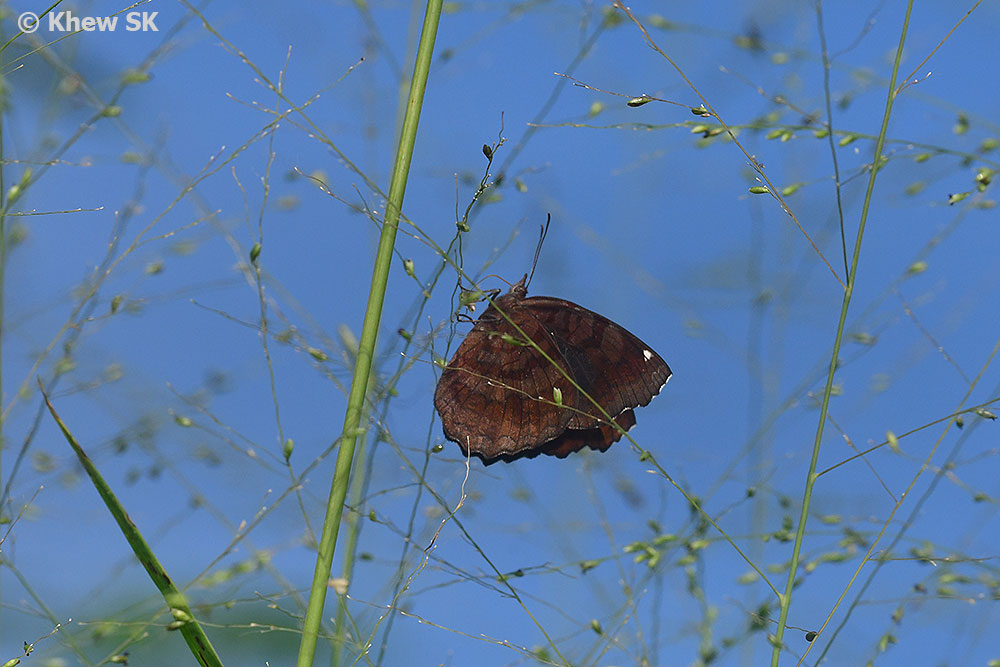
An Angled Castor perched with wings folded upright, showing its undersides

For a species that is considered a "very rare" seasonal migrant to Singapore, it is now "very common" at this localised area on Pulau Ubin and from the breeding population, it can be now be assumed to be an extant species here. The status of various species can change from time to time, depending on circumstances and ecological and environmental changes that affect their existence in a country. It remains to be seen for how long this re-discovered species can continue to survive in Singapore, and whether natural or human-initiated threats affect this colony in the longer term.

Text by Khew SK : Photos by Khew SK, Loh Mei Yee and Tea Yi Kai.

20 January 2019

Blue Skies Above!

Blue Skies Above!
Butterflies Against a Blue Canvas


A Common Mime feeds on the pink hybrid of Lantana camara against a clear blue sky

The storm has passed. Dark clouds dissipate quickly, as the sun peeks through. The blue sky reappears as the foreboding darkness gives way to rejuvenating light and the world is bright and cheery again. The sight of a pretty butterfly against a clear blue sky is often uplifting and brings delight to our hearts.


A female Striped Blue Crow feeding on the flowers of Syzygium zeylanicum

The ominous darkness that brings sadness, grief, sorrow and pain to many aspects of our lives does not last forever. Whether at work or at home, such times of torment and trouble will come to pass, and the sunshine and blue skies will breathe healing, revival and positivity into our lives once again.


A Blue Glassy Tiger feeding on the flower of Syzygium zeylanicum

For us butterfly watchers and photographers, the sight of sunshine and a bright blue sky brings joy to our souls. For this is the type of weather that wakes up our beloved butterflies and where we will enjoy their fluttering activity and Mother Nature's beauty and works of art.


A Plain Tiger perches on a high twig

A male Plain Tiger (right) harassing a feeding female Plain Tiger

This weekends blogpost is about butterflies photographed against a blue sky - a canvas of blue that is a refreshing difference from the typical natural backgrounds and green environments that we normally see butterflies in.


Painted Jezebels feeding on high flowering plants against a clear blue sky

Ever so often, a tree blooms and the flowers attract a myriad of butterflies to feed on the delectable nectar within. In many cases, the flowers are way above eye-level, and the feeding butterflies are isolated against a bright blue sky on a clear day. This gives an opportunity to photograph the butterfly in a unique setting against a backdrop of the blue sky.


A Common Bluebottle high up at the flowers of Syzygium zelanicum

Somehow, a butterfly feeding against a blue background elicits a feeling of lightness and uplifts the spirit. The complementary colours of a butterfly's wings against the cool blue background bring the beauty of the butterfly to life.


A Common Rose feeding on the flowers of Buas-Buas (Premna serratifolia)

Never pass up an opportunity to photograph a butterfly against the backdrop of a clear blue sky whenever the situations arises. From a photographer's perspective, it is an ideal lighting situation as the brightness of the open skies usually allows you to use a low ISO that reduces 'noise' in your shots.


A Copper Flash on the flower of Syzygium zeylanicum

Remember that due to the bright background, your subject (the butterfly) will be in shadow if you are using a matrix (or average) metering mode. This will darken the subject and you may end up with a lack of detail on the butterfly although the background is correctly exposed.


A female Common Birdwing flies high up after feeding on the flowers of the Javan Ixora

For such photography situations, a fill-flash is almost always necessary to provide illumination to the wings of the butterfly against a bright background. In many cases, you may have to increase the power (compensate +EV) on the flash to adequately illuminate the butterfly. Alternatively, you may choose to use spot metering to correctly expose for the butterfly but this often ends up with an overexposed sky that is either washed out and even appear white!


A Dark Glassy Tiger feeding on the flower of the Water Jasmine (Wrightia religiosa) against a blue sky canvas

I find that using smaller apertures like f/10 or f/11 helps to increase the saturation of the blue sky when shooting upwards. Other than the fact that you will have good depth of field and will be able to get the subject in sharp tip-to-tip focus, the blue of the sky is also deeper and more saturated. In shooting situations like this, you will not have to worry about the background being cluttered as the sky is obviously very far away from your subject butterfly.


A King Crow feeding on the flower of Syzygium zeylanicum

Shooting a butterfly against a clear blue sky also frequently shows up 'dust bunnies' on your camera's sensor, especially if you have not been cleaning the sensor for some time. This does not pose a big problem that a little post-processing cannot solve. But it is a good reminder for your next trip to the camera servicing agent to do some sensor maintenance!


A Common Tree Nymph soars high amongst the treetops with the blue sky in the background

So when the opportunities present themselves when you are out in the field, look for situations where you can pose your butterfly subject against the blue sky and fire away! Let your butterfly spirit soar and enjoy the exhilaration of capturing the beauty of nature's flying jewels against a crystal clear blue backdrop.  And to all our fellow butterfly watchers and photographers, may you always have sunshine, blue skies and beautiful butterflies all year round! 

Text by Khew SK : Photos by Bob Cheong, James Chia, Khew SK, Loke PF, Mei Hwang and Neo TP