19 November 2016

Favourite Nectaring Plants #8

Butterflies' Favourite Nectaring Plants #8
The Singapore Daisy (Sphagneticola trilobata)


A Rustic (Cupha erymanthis lotis) rests amongst the leaves of the Singapore Daisy

Our 8th instalment of Butterflies' Favourite nectaring plants features another invasive "weed" that is common in disturbed or cleared sites in Singapore. It is used by landscape designers and gardeners as a ground cover or a 'filler' plant in cultivated gardens. The pretty yellow flowers that dot a mat of deep green ground cover give a certain amount of aesthetic appeal in garden settings.


The plant has a number of English common names, but is often referred to as the "Singapore Daisy". That the name "Singapore" is associated with an invasive plant and often unwelcomed weed is indeed curious! This is especially more so, when the plant is not even a native of Singapore nor Southeast Asia, but originated from tropical America, Mexico and the Caribbean!


A female Plain Tiger feeds on the flower of the Singapore Daisy

Sphagneticola trilobata is listed in the IUCN's “List of the world's 100 worst invasive species”. In Queensland, Australia, for example, the Singapore Daisy is a restricted invasive plant under the Biosecurity Act 2014. It must not be given away, sold, or released into the environment without a permit. It is widespread as an invasive species on the Pacific Islands, Hong Kong, South Africa, Australia, Indonesia, and Sri Lanka.

Plant Biodata :
Family : Asteraceae
Genus : Sphagneticola
Species : trilobata
Recent synonyms : Wedelia trilobata, Complaya trilobata
Country of Origin : Tropical America - native to Mexico, Central America, and the Caribbean, but now grows throughout the Neotropics.
Status : Exotic; Naturalised. Cultivated.
English Common Name : Yellow Creeping Daisy, Singapore Daisy, Creeping Ox-eye, Trailing Daisy, Rabbit's Paw
Other Asian Names : 地锦花, 穿地龙, 三裂蟛蜞菊 (Chinese)


The Singapore Daisy is a perennial herb with a creeping, scrambling or climbing habit, growing up to 30 cm tall and 4 m long. This mat-forming plant is often cultivated as an ornamental dense ground cover. It may also climb a short distance up trees or over other vegetation and is known to crowd out and displace other species of plants in its way.


The three-lobed leaves of the Singapore Daisy

The leaves are simple, opposite, sessile or borne on very short petioles, slightly fleshy, mostly hairless, glossy, 4-9 cm long and 2-5 cm wide. The species name trilobata - three-lobed, referring to the 3-lobed lamina with irregularly toothed margins . Colour of the leaves is dark green above, paler below.


The stems of the Singapore Daisy are rounded, solid, green or pinkish-red and are somewhat hairy to almost hairless. They grow up to 4 m long and regularly develop adventitious roots at their joints. Short, semi-upright flowering branches are produced off these creeping stems.


From bud to full flower - Singapore Daisy

The yellow-orange flower-heads are about 3-4 cm across, and are axillary and terminal, borne singly on an erect stalk ranging from 3-11 cm long. They are composed of 8-13 yellowish petals that are 6-15 mm long with finely toothed tips. In the centre of these flower-heads, there are numerous tiny yellow tubular florets 4-5 mm long. The base of each flower-head is enclosed in a row of narrow green bracts of about 1 cm long.


The fruit is a brown, elongated achene, 3-5 mm long, topped with a crown of short irregular scales. However, viable seeds are rarely produced. The Singapore Daisy reproduces vegetatively by stem fragments. Where the stem nodes touch nutrients, whitish roots will sprout and these will easily grow and spread horizontally across the substrate. It is easily propagated by stem cuttings and stolons.


The Singapore Daisy has a very wide ecological tolerance range and does equally well in both dry and moist sites. Although it prefers full sun, it can also survive well in shady conditions. It is very adaptable to wide range of soil types, including nutrient-poor sand, saline soils, swampy or waterlogged areas, and even bare limestone. It is tolerant of dry periods and periodic innundation as well as high levels of salinity. Its fast growth may smother nearby groundcovers, so the plant should be pruned back regularly.


The plant is also known for several traditional medicinal uses. It is used for hepatitis, indigestion due to sluggish liver, white stools, burning in the urine / stopping of urine, and for infections. A concoction of the plant is used to bathe those suffering from backache, muscle cramps, rheumatism, or swellings, by boiling the fresh stems and leaves in 2 gallons of water for 10 minutes. For painful joints of arthritis, the fresh leaves and stems are mashed and the paste spread on a cloth and applied to area, wrapped securely with a warm covering. The plant extract is also used to clear the placenta after birth.


The Singapore Daisy is a butterfly nectaring plant. It is relatively attractive to certain species of butterflies and they have been observed to feed on the flowers of the Singapore Daisy from time to time. However, in the presence of other more attractive nectaring plants, the Singapore Daisy is usually less preferred by butterflies as a source of nectar.


Amongst the larger butterflies, I have rarely seen the Papilionidae (Swallowtails and Birdwings) feeding on the flowers of the Singapore Daisy locally. Perhaps the physical attributes of the yellow flowers do not lend themselves well to the thicker and longer proboscis of the Papilionidae? The Danainae, however, do not have any problems with these flowers and they have been often photographed feeding on the flower of the Singapore Daisy.


Amongst the Danainae, the Plain Tiger, Common Tiger, Black Veined Tiger, Blue Glassy Tiger have all been seen feeding on the flowers of the Singapore Daisy. However, the flowers of the plant are usually at low level and in open areas, the the butterflies tend to be quite skittish and alert. Unlike other nectaring plants' flowers, the Singapore Daisy is a low creeper and perhaps the flowers tend to leave the feeding butterflies more "exposed" and hence more alert to potential predators swooping down on them as they feed.


Amongst the other species in the Nymphalidae subfamily, I have observed the Blue Pansy, Chocolate Pansy, Peacock Pansy and Great Eggfly visiting the flowers of the Singapore Daisy. The Tawny Coster stops to feed on the flowers of the plant, but not as often as compared to other favourite nectaring plants like the Snakeweed and Spanish Needle flowers. Amongst the Pieridae, I have observed some Grass Yellows (Eurema spp) feeding on the flower.


Lycaenidae feeding on the yellow flower of the Singapore Daisy

There are probably more Lycaenidae that feeds on the Singapore Daisy flowers than have been observed and photographed. Some examples are the Pea Blue, Pale Grass Blue, Silver Forget-Me-Not and Cycad Blue, just to name a few. Again, these butterflies tend to choose other nectaring plants where available, and they only feed on the Singapore Daisy flowers when their other preferred nectaring sources are unavailable.


Skippers on the yellow flower of the Singapore Daisy

The Hesperiidae (Skippers) are also seen on the Singapore Daisy flowers, particularly in the early morning hours. Amongst the Skippers, the Lesser Dart, Yellow Grass Dart, Contiguous Swift, Conjoined Swift and Paintbrush Swift have been seen feeding on the flower of the plant.


As a nectaring plant, the Singapore Daisy can be considered reasonably attractive to certain species of butterflies. However it is not universally a preferred source of nectar for butterflies, even though there are enough photos as evidence that butterflies do feed on the flowers of the plant. As part of the landscaping horticultural palette of plants that make up a butterfly garden, the Singapore Daisy also plays its part to attract butterflies to our butterfly-friendly environments in Singapore.

Text by Khew SK : Photos by Bob Cheong, Khew SK and Loke PF

12 November 2016

Butterfly of the Month - November 2016

Butterfly of the Month - November 2016
The Striped Black Crow (Euploea eyndhovii gardineri)


A Striped Black Crow feeding on the flower of the String Bush

All too soon, we are now in the 2nd last month of 2016. It has been an eventful year indeed, and no one can doubt that. The number of disruptive incidents internationally, from China to the US; Britain to the Philippines, took the world by storm, as each bit of news ended up with a conclusion that often defies the norm. One wonders at the frenetic pace of change that our world is facing. Is stability no longer the watch word?


A Striped Black Crow feeding on the False Dill (Artemisia scoparia)

Not many believed that Britain would leave the European Union in June this year, when the country voted on the referendum. But it did. No one could believe that the Philippines would start to turn its back on the US - its long-time ally since World War II. But it did. Few believed that Republican candidate Donald Trump would become the 45th President of the United States of America. But he did.


Indeed a year of unprecedented disruptive events. Defying expectations and norms. Is the world looking for drastic changes and thirsting for a new norm? Even news on extremists and terrorism had to take backstage to the strange tumultuous events that unfold in the democratic world. Will autocratic and authoritative leadership styles come back in fashion?


And if we thought that "cash is king" in today's world, Indian Prime Minister Narendra Modi just put that notion to rest. If you were holding 500 and 1,000 Indian rupee notes, they have become worthless overnight! Modi had announced the bank notes would be withdrawn from the financial system overnight in an effort to crack down on corruption and illegal cash holdings. And for overseas holders of such notes, you will have to make your way to banks in India to exchange them for the new notes.


Back to our Butterfly of the Month for November 2016, we feature one of the drab-coloured "Crow" butterflies, the Striped Black Crow (Euploea eyndhovii gardineri). If we take a look at the recommended English common name for this species, it should be referred to as the Lesser Striped Black Crow, as there is a larger species, Euploea doubledayi evalida that flies in Malaysia and Thailand, laying claim to the name Striped Black Crow.


However, given that the larger Euploea doubledayi does not fly in Singapore and is less common than Euploea eyndhovii even in Malaysia and Thailand, it is likely that the name Striped Black Crow will be, by common usage, be more often used for the latter species. Or perhaps the name Greater Striped Black Crow be eventually the name more regularly used for Euploea doubledayi.


The Striped Black Crow (Euploea eyndhovii gardineri) can be considered rare and when observed, usually seen singly, mostly feeding at flowering plants. At times, it can be seen flying at tree top level in the nature reserves and forested areas. It flies with a slow gliding and unhurried flight, unless alarmed.


The Striped Black Crow has velvety dark brown wings on the upperside, with the forewing usually unmarked. The hindwing has a series of white submarginal spots and a corresponding row of white submarginal streaks. The underside is lighter brown and has a series of spots at the discal area of both wings, besides the stripes on the hindwing, of which its common name aptly describes the species.


A male Striped Black Crow showing its upperside. Note the curved dorsum of the forewing and the dark brand

The dorsum of the forewing is curved in the male but straight in the paler female. The males have a dark brand on the forewing. The thorax is spotted with white in the usual Danainae fashion, and like all Nymphalidae, only four legs are fully developed and used for walking and holding on to perches.


A Striped Black Crow feeding on the flowers of the Syzygium tree

If handled, the male Striped Black Crow extrudes a pair of yellow hair pencils. These hair pencils are pheromone-signalling structures often present in male Danainae butterflies. Males Danainaes use hair-pencils in courtship behaviours with females. The pheromones excreted by the hair-pencils serve as both aphrodisiacs and tranquilizers to females as well as repellents to conspecific males.


The Rattleweed bush is a good attractant for this species as it likes to feed on the dead leaves, stems, flowers and seed pods of this bush

The Striped Black Crow can be found in the forested nature reserves of Singapore, often appearing when there are flowering Syzygium trees along the forest fringes. It is most regularly seen on the offshore island of Pulau Ubin, coming down to feed on the flowers of shrubs like the String Bush and Bandicoot Berry. It is attracted to the dried leaves and seed pods of the Rattleweed like many species of Danainae.


The Malayan Eggfly is a good mimic of the Striped Black Crow and even mimes the flight of the Striped Black Crow to fool predators (and human observers!)

The Malayan Eggfly (Hypolimnas anomala anomala) form-nivas, a species from the Nymphalinae subfamily, is a very good mimic of the Striped Black Crow. The white stripes on the hindwing and brown colour of the Malayan Eggfly allows it to mimic the distasteful Striped Black Crow for protection against predators. Hence many beginner butterfly watchers have confused the Malayan Eggfly with the Striped Black Crow.

Text by Khew SK : Photos by Bob Cheong, Khew SK, Henry Koh, Loke PF, Tan KY and Anthony Wong

06 November 2016

Larval Host Plant for Butterflies: Common Chinese Mistletoe

Butterflies' Larval Host Plants #12
The Common Chinese Mistletoe (Macrosolen cochinchinensis )


This 12th instalment of our Butterflies' Larval Host Plants series features Macrosolen cochinchinensis (Common Chinese Mistletoe), a member of Loranthaceae which is a family of flowering plants containing 75 genera and about 1,000 species, many of which are hemiparasites (parasitic plants which derive water/nutrients from the hosts and are photosynthetic themselves). As is the case of  the Malayan Mistletoe, the Common Chinese Mistletoe is a stem hemiparasite, attaching itself to the stem/branch of their hosts.

Common Chinese Mistletoe residing on a Lagerstroemia turbinata (Malayan Crape Myrtle) plant in the Japanese Garden.

In terms of commonness among the 10 extant parasitic plant species in Singapore, the Common Chinese Mistletoe is only second to the Malayan Mistletoe. Trees and shrubs (of many species across multiple families) growing in urban areas, residential estates, parks and gardens, wastelands, wetland and nature reserves have been observed to carry it, sometimes appearing together with the Malayan Mistletoe on the same hosts.

Left: The Common Chinese Mistletoe on a Ficus plant along the Jurong Park Connector. Right: A closer view.

Plant Biodata :
Family: Loranthaceae
Genus: Macrosolen
Species: cochinchinensis
Synonyms: M. fordii, Loranthus cochinchinensis, L. ampullaceus, L. fordii, Elytranthe ampullacea, E. cochinchinensis, E. fordii.
Country/Region of Origin :  Southern China, Nepal, India and South East Asia.
English Common Name: Common Chinese Mistletoe
Other Local Names:  鞘花
Larval Host for Butterfly Species: Arhopala centaurus nakula (Centaur Oakblue), Tajuria cippus maxentius (Peacock Royal), Tajuria mantra mantra (Felder's Royal), Euthalia adonia pinwilli (Green Baron), Jacoona anasuja anasuja (Great Imperial), Manto hypoleuca terana (Green Imperial), Semanga superba deliciosa.

Common Chinese Mistletoe found on a Polyathia longifolia (False Ashoka) plant in the Chinese Garden.

The Common Chinese Mistletoe is an epiphytic shrub between 0.5m to 1.3m in height. Branches/stems are greyish, usually with lenticels scattered on the surface. The leathery leaves are broadly elliptic or ovate to lanceolate, and sizes (5-10cm in length, 2.5-6cm in width). Leaves are initially pale reddish brown, but turning yellowish green and finally dark green when fully mature.

Tiny young shoots of the Common Chinese Mistletoe with a young caterpillar of the Green Imperial well concealed among the leaves.

Another young shoot, with longer stem, bearing an egg of the Peacock Royal.

Maturing leaves of the Common Chinese Mistletoe, yet to lose their pale brown coloration.

A branch showing mature and maturing leaves. Note the leaf arrangement.

A branch of the Common Chinese Mistletoe bearing mature leaves, one of which is adorned with an egg of the Green Baron.

Similar to the Malayan Mistletoe, fruits of the Common Chinese Mistletoe are typically dispersed by birds. The sticky coat of the seed allows it to easily adhere to the stem/branch surface of the host plant it lands on (after being carried there by birds or another forces of nature). The germinating seed will grow a green bending stalk with a disc-like tip, which eventually makes contact with the host's surface and develop into the first haustorium. The haustorium is a specialized root which penetrate into the host's tissues and connect to the xylem/phloem of the host, allowing it to draw water and non-organic nutrients from the host. The first leaves of the young plant come in an elongated form, in contrast to the more ovate form in grown plants.

The exposed seed of the Common Chinese Mistletoe sticking to the surface of a host's branch.

A young seedling of the Common Chinese Mistletoe on a branch of a Kopsia fruticosa, note the elongated leaves.

A young seedling of the Common Chinese Mistletoe with both elongated and lanceolate leaves.

As it grows, the Common Chinese Mistletoe develops side roots running alongside the branch of the host, with haustoria occur at intervals to penetrate into the host plant for more anchorage and nutrient-intake points.

Side roots and secondary hautoria of a Common Chinese Mistletoe.

Flowers of the Common Chinese Mistletoe are bisexual and occur in racemes, each of which bearing 4 to 8 flowers. Each flower is green with yellow-tipped petals. The basal part of the corolla is slightly inflated.

Young flower buds of the Common Chinese Mistletoe.

A closer view of flowers of the Common Chinese Mistletoe.

Fruits are small and sub-globose, about 5mm in diameter, initially orange, turning green as it develops, and finally dark reddish brown when fully ripened.

A branch of the Common Chinese Mistletoe bearing developing fruits.

Close-up view of two fruits of the Common Chinese Mistletoe.

In Singapore, the Common Chinese Mistletoe serves as the larval host plant for seven butterfly species in two families: Centaur Oakblue, Peacock Royal, Felder's Royal, Great Imperial, Green Imperial, Semanga superba deliciosa and Green Baron. The first six are lycaenid and the last is a limenitid.

A Centaur Oakblue.

A Peacock Royal.

A Felder's Royal.

A Green Imperial.

A Great Imperial.

A Semanga superba deliciosa.

A female Green Baron.

A male Green Baron.

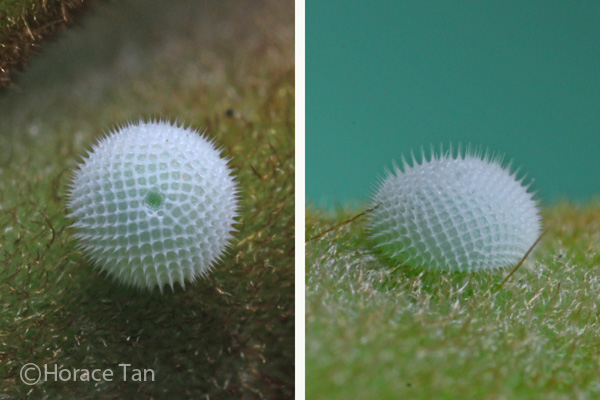
Eggs of the six lycaenid species are typically laid singly on young shoots or underside of young leaves. One exception is Semanga superba deliciosa which have been observed to lay eggs in small clusters of 2-3. In contrast, the eggs of the Green Baron are laid singly on the upperside of a mature leaf.

Two views of an egg of the Centaur Oakblue.

Two views of an egg of the Peacock Royal.

Two views of an egg of the Felder's Royal.

Two views of an egg of the Green Imperial.

Two views of an egg of the Great Imperial.

Two views of an egg of the Semanga superba deliciosa.

Two views of an egg of the Green Baron.

Caterpillars of all six lycaenid species feed on young leaves and young shoots of the Common Chinese Mistletoe, with those of the Semanga superba deliciosa have the added habit of feeding on flowers and flower buds. These lycaenid caterpillars are usually sighted with ants in attendance. Caterpillars of the Green Baron, in contrast, feed on mature leaves of the Common Chinese Mistletoe and have the habit of resting on the upperside of a leaf.

Two views of a 5th instar caterpillar of the Centaur Oakblue.

Two views of a 4th instar caterpillar of the Peacock Royal.

Two views of a 4th instar caterpillar of the Felder's Royal.

Two views of a 4th instar caterpillar of the Green Imperial.

Two views of a 4th instar caterpillar of the Great Imperial.

Two views of a 5th instar caterpillar of the Semanga superba deliciosa.

A final instar caterpillar of the Green Baron resting on a leaf of the Common Chinese Mistletoe.

A pupa of the Green Baron found on the underside of a Ficus leaf in the vicinity of its mistletoe host.

References:
Text and Photos by Horace Tan.