15 August 2015

Butterfly of the Month - August 2015

Butterfly of the Month - August 2015
The Blue Spotted Crow (Euploea midamus singapura)


It's the month of August already! We're into the 8th month of 2015, and it's a month of celebrations for our little red dot island in the sun. On 9th August, Singapore celebrates its 50th birthday after independence. How far we've come from being a sleepy colonial trading outpost to the vibrant economic powerhouse whose GDP per capita is one of the highest in the world.


Fireworks display at the National Day celebrations

There have been numerous articles and discussions about Singapore during the past week and leading up to the Golden Jubilee celebrations, highlighting the little island state that has punched way above its weight (or, in Singapore's case, size) in terms of economic success. A little island of just above 700 sq km with virtually no natural resources, it has recorded a stellar rise in the standard of living since its separation from Malaysia back in 1965.


Singapore night skyline showing the Marina Bay Sands complex

Today, Singapore boasts some of the most modern infrastructure in Southeast Asia, with its economy humming along relatively healthily for a developed country. Its order (things work efficiently!), security, clean & green environment are some of the attributes that residents of Singapore are thankful for. Despite a reputation for being the world's most expensive city to live in, there are many things going for this little island that makes Singapore the envy of many other cities around the world.


Black Knights flight display on National Day

Even as the spectacular fireworks, the screaming Black Knight jets and singing of nationalistic songs at our SG50 celebrations begin to just fade away, news of the coming General Elections and rumours about when Polling Day will be, fill the mainstream news portals and social media. It will be exciting months ahead as Singaporeans ponder about the future and which political party we will choose to govern and lead Singapore for the next five years.


As the sea of red-and-white continues to decorate Singapore in all manner of ways to remind us of our national flag's colours, we take a look at our feature Butterfly of the Month for August 2015. Readers may be wondering why a drab black-and-white butterfly is being featured during a month of celebrations? In an attempt to be less literal in terms of a visual treat featuring our national colours, there is a special reason why we are featuring the Blue Spotted Crow for this SG50 month on this blog.


The clue is in the scientific name of this butterfly. It is one of three of our local butterflies that make reference to "Singapore" in their subspecies names. In the case of the Blue Spotted Crow, its scientific name is Euploea midamus singapura. What can be more befitting than to celebrate Singapore's 50th birthday with a butterfly that bears the name of our beloved little island?


A Blue Spotted Crow puddling on a sandy streambank

The Blue Spotted Crow subspecies singapura has predominantly black wings with white spots arranged in a similar fashion as in the lookalike Spotted Black Crow (Euploea crameri bremeri). However, the subapical spots on the forewing of the Blue Spotted Crow is more quadrate rather than elliptical, and there are four spots instead of five in the Spotted Black Crow. These diagnostic characteristics of the white subapical spots distinguish between the two similar-looking species.


The subspecies singapura of the Blue Spotted Crow is described to be found only on Singapore Island, Pulau Tioman and Pulau Aur - the latter two islands on the eastern side of the Malay Peninsula. Up to date records of this subspecies on the two Malaysian islands are few, making the existence of this subspecies on Singapore island the most reliable records in recent years. Could it even be suggested that the population of this subspecies on Singapore island be considered "endemic", if no further sightings of singapura on the Malaysian islands are recorded in future?!


The Blue Spotted Crow has a slow and unhurried flight, and can be observed in urban as well as nature reserve habitats. It is usually spotted singly either feeding at flowers, or puddling. The butterfly is sometimes observed to puddle on concrete, brick and wood surfaces of buildings in the vicinity of forested areas. It is an alert butterfly, and takes flight at the slightest movement, even when it is feeding.


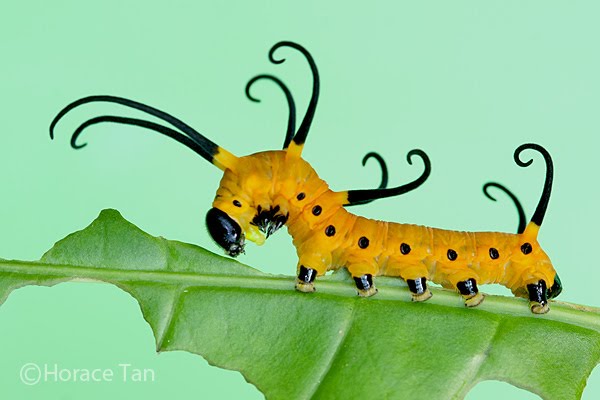
Caterpillar of the Blue Spotted Crow

As it feeds on lactiferous vines of the Apocynaceae family, it is likely to be distasteful to predators like the related species in the genus. The mature caterpillar is spectacular and unique, making it a very pretty caterpillar and almost "unreal".


Finally, we would like to wish all our Singaporean readers a Happy 50th National Day and Majulah Singapura!

Text by Khew SK : Photos by Chng CK, Khew SK, Henry Koh, Loke PF, Nelson Ong, Horace Tan, Wong Chee Ming and Mark Wong

08 August 2015

Life History of the Common Evening Brown

Life History of the Common Evening Brown (Melanitis leda leda)


Butterfly Biodata:
Genus: Melanitis Fabricius, 1807
Species: leda Linnaeus, 1758
Subspecies: leda Linnaeus, 1758
Wingspan of Adult Butterfly: 50-60mm
Caterpillar Local Host Plant: Megathyrsus maximum (Poaceae, common name: Guinea Grass).


Wet season form of the Common Evening Brown.

Wet season form of the Common Evening Brown.

Wet season form of the Common Evening Brown.

Physical Description of Adult Butterfly:
The wings have falcate (sickle-shaped) termen (outer margin), more so in the female. On the upperside, the wings are dark brown with a large sub-apical patch which is black with two white spots embedded and shaded with orange brown on the inner side. On the underside, both wings differ markedly between the wet season and dry season forms. In the wet season form, the wings are bluff or greyish brown, bearing series of transverse striae in dark brown and there is a series of submarginal black eye-spots which are white-centred and yellow-ringed. In the dry season forms, the wing markings are more cryptic and the submarginal spots are less prominent, reduced in size or even obsolete. In some specimens, the markings on the wings exhibit drastic contrast between (very) dark brown and (very) pale brown patches.

Dry season form of the Common Evening Brown.

Dry season form of the Common Evening Brown.

Dry season form of the Common Evening Brown.

Field Observations of Butterfly Behaviour:
The Common Evening Brown is a moderately rare butterfly in Singapore. Adults are typically sighted flying at dawn and before dusk, at and around grass patches, thickets or dense vegetation. The adults fly rapidly at low level and in short hops, and have been observed to puddle on wet grounds and visiting flowers for nectar. In Singapore, the wet season form is more commonly seen than the dry season form.

01 August 2015

Butterfly Photography at Our Local Parks - Jurong Eco Garden

Butterfly Photography at Our Local Parks
Featuring : Jurong Eco Garden


Jurong Eco Gardens' Butterfly Garden

Over on the "western front" of Singapore, sits a quiet and serene park near the Nanyang Technological University campus. This 5Ha park, developed by Jurong Town Corporation (JTC), was planned as part of the CleanTech Park (CTP) masterplan. The park offers tenants and neighbouring community a venue for social, educational and recreational activities, and the natural wildlife that make up the unique ecology of the site.


An overview of Jurong Eco Garden

The CleanTeck Park development by JTC attempts to push the boundaries of sustainable masterplanning for a largely industrial development. Typically, industrial parks in Singapore are densely planned to optimise land use, with buildings organised in a rather regimented and utilitarian manner. The CTP departs from the compact planning that is usually associated with industrial parks. At the heart of the CTP masterplan sits a lush park called the Jurong Eco Garden. JEG has four areas - Summit Forest, Wildlife Corridor, Stream Ravine and Freshwater Swamp Forest - seamlessly interspersed with the CleanTech building parcels.


Bioswales and stairs leading to the Summit Forest

Efforts were made to conserve the natural environment and biodiversity of the area during planning and development stages. Through the implementation of green initiatives (e.g. tree conservation) and a phased development approach, JTC made a laudable effort to preserve the biodiversity within the business park. From a baseline biodiversity survey conducted before development commenced, subsequent comparisons with post-development observations showed that the diversity of butterflies did not suffer too much of an adverse impact.


In a holistic effort to promote a sustainable development JTC worked with the landscape designers to create a wildlife corridor and a green "heart" to the overall development masterplan. Fruit- and nectar-producing plants are spaced carefully around the gardens to attract wildlife into the park. Where possible, trees were conserved to provide shade and promoting walkability in CTP. Raw material from felled trees on site were used for signage and site furniture. Rich topsoil was harvested during construction and used for softscape planting in JEG.


Recycled rocks from Jurong Rock Caverns used in the bioswales and hardscape at JEG

Over 11,340 tons of excavated rocks from JTC's Jurong Rock Caverns were used in the construction of Summit Lookout, swales, gabion walls, signage and art sculpture. Stormwater management is one of the most ambitious green features of JEG. When the estate is fully developed and occupied (by 2030), this storm water management system will leverage the undulating terrain to channel and detain 65% of the estate run offs.


Storm-water detention ponds and a system of phytoremediation strategies using plants to cleanse the water for re-use

The water collected is cleansed during conveyance by the biotopes put in place. It is then reused for non-potable use like toilet flushing and irrigation of plants during dry periods. This system is estimated to save 12,600 litres of water each month. Swales run throughout JEG, connecting microhabitats within the park and serving as a source of water for fauna. Various aquatic animals, dragonflies, damselfies and butterflies can be found along the swales.


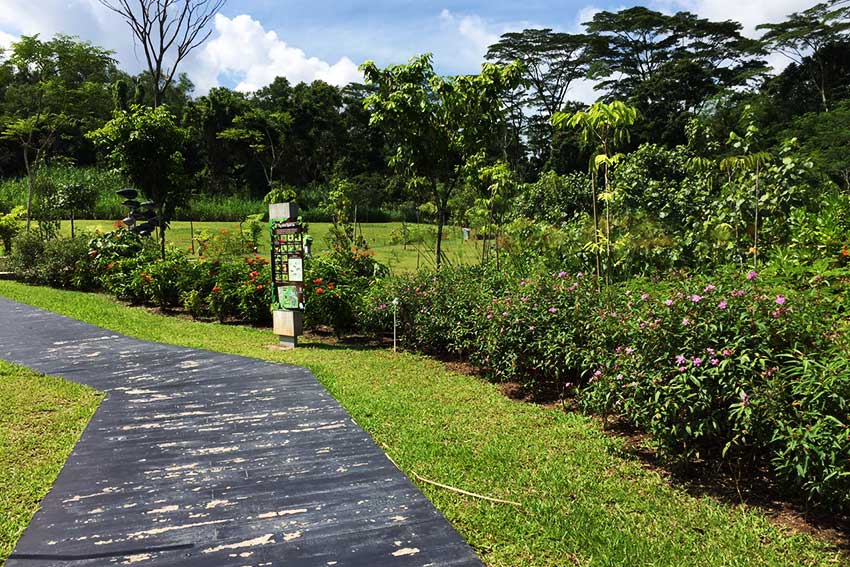
JEG Butterfly Garden

For butterfly enthusiasts, a dedicated butterfly garden was developed within JEG. Situated near the Central Plaza and next to the Composting Station, the butterfly garden features specially-selected butterfly attracting nectaring and host plants. Covering an area of about 1,500 m2, the JEG butterfly garden teems with butterfly life on a good sunny day.


Swallowtails shot at JEG's Butterfly Garden

Of particular interest is the presence of the Common Birdwing (Troides helena cerberus) which is considered vulnerable in Singapore. We have found this species' caterpillar host plant, Aristolochia acuminata, growing wild in the adjacent forests. This host plant is also being cultivated to sustain the population of the Common Birdwing and also the Common Rose, which shares this host plant. Other Papilionidae that have been spotted here include the Common Mormon, Lime Butterfly, Common Rose and Tailed Jay.


Lime Butterfly feeding in Stachytarpheta mutabilis flowers

The lush Lantana and Ixora bushes are the best places to park yourself, if you want to see these butterflies fluttering and feeding.  Many of the other nectaring plants like Leea indica, Leea rubra, Stachytarpeta indica and mutabilis also attract many species of butterflies.


Caterpillar host plants for species like the Plain Tiger, Blue Pansy, Great Eggfly, Autumn Leaf are interspersed within the butterfly garden to attract a greater variety of butterflies to the area. With the forested catchment in the vicinity of JEG, other species that are forest dependent are occasionally spotted feeding on the buffet of nectaring plants in the butterfly garden.


A skipper feeding on the red Ixora javanica flowers

In the early hours of the day, a butterfly watcher should be able to spot many Hesperiidae zipping around the bushes and feeding greedily on the nectar-rich flowers. As the sun warms the butterfly garden, the faster-flying Pieridae like the Lemon, Orange and Mottled Emigrants appear, flying strongly from flower to flower to feed.


On a good day, a butterfly watcher/photographer can expect to see at least 10-15 different species at the butterfly garden. As the butterflies are distracted whilst feeding on the flowers, it is also easier to approach and photograph these skittish creatures.


Combination of conserved trees and introduced flora at JEG

There is even a nature trail next to the butterfly garden where one can walk in the shady forest understorey, to look for the shade-loving butterflies like the Common Faun (Faunis canens arcesilas) and other denizens that lurk in the low-light environment.


As the butterfly garden matures and more butterfly-attracting plants are brought into the area, we can expect the diversity of the butterfly population will continue to grow in the coming years. JEG is JTC’s first attempt to develop a community space within an industrial estate focusing on sustainability and biodiversity. JEG can also be used to engage the different communities such as residents from nearby housing estates, neighbouring schools, as well as interest groups, in particular nature photographers and biodiversity enthusiasts.


School groups are involved in various programmes at JEG

Today, a total of 13 schools have been involved in programmes hosted in JEG, which focus on the areas of sustainability, biodiversity and the arts. For example, River Valley High School uses JEG as an educational platform for their students to learn about topography studies, microclimate studies and water monitoring. In addition, Rulang Primary School also uses JEG to showcase their students' artwork. Since the official opening of JEG in June 2014, it has hosted over 200 students through various school curriculum and community programmes.


CleanTech One building.  Development will invariably sacrifice biodiversity.  Can we find a balance?

Whilst JTC has made a good start to create a man-made garden to conserve the biodiversity of the CTP, it is important not to overlook the "wilder" areas in the vicinity. Stronger focus should be made to conserve these areas, instead of converting them for people, rather than the fauna that exists within these forests. It is primarily because of these sanctuaries of biodiversity that thrive within these undisturbed areas that JEG is successfully attracting birds, butterflies and other fauna for its visitors to enjoy.


Ample directional signage at JEG to guide you around

So, if you have some time to enjoy a nature walk on a nice weekend, do pay Jurong Eco Garden a visit. You will be surprised to see the diversity of wildlife in this small patch of greenery. As it is located away from the hustle and bustle of urban residential areas, JEG is usually quieter and less crowded.

How to Get There :
By Bus : Take the feeder service No 199 from Boon Lay Interchange and alight at Nanyang Ave. Walk past CleanTech One building as shown on the map, and there will be signs to show you where JEG is.

By Car : See map for details. Park at either CleanTech One (ERP parking) or just outside the Thow Kwang Dragon Kiln (free parking but limited lots).


Text by Chen Yimin & Khew SK : Photos by Bob Cheong, Khew SK and Simon Sng.

Special thanks to Chen Yimin of JTC for added information for this article.

Checklist of Butterflies Observed at JEG to date :

  1. Troides helena cerberus (Common Birdwing)
  2. Pachliopta aristolochiae asteris (Common Rose)
  3. Papilio clytia clytia (Common Mime)
  4. Papilio demoleus malayana (Lime Butterfly)
  5. Papilio demolion demolion (Banded Swallowtail)
  6. Papilio polytes romulus (Common Mormon)
  7. Graphium sarpedon luctatius (Common Bluebottle)
  8. Graphium agamemnon agamemnon (Tailed Jay)
  9. Delias hyparete metarete (Painted Jezebel)
  10. Leptosia nina malayana (Psyche)
  11. Appias libythea olferna (Striped Albatross)
  12. Catopsilia pyranthe pyranthe (Mottled Emigrant)
  13. Catopsilia pomona pomona (Lemon Emigrant)
  14. Catopsilia scylla cornelia (Orange Emigrant)
  15. Eurema hecabe contubernalis (Common Grass Yellow)
  16. Eurema blanda snelleni (Three Spot Grass Yellow)
  17. Danaus chrysippus chrysippus (Plain Tiger)
  18. Danaus genutia genutia (Common Tiger)
  19. Danaus melanippus hegesippus (Black Veined Tiger)
  20. Parantica agleoides agleoides (Dark Glassy Tiger)
  21. Ideopsis vulgaris macrina (Blue Glassy Tiger)
  22. Euploea mulciber mulciber (Striped Blue Crow)
  23. Elymnias panthera panthera (Tawny Palmfly)
  24. Elymnias hypermnestra agina (Common Palmfly)
  25. Mycalesis mineus macromalayana (Dark Brand Bush Brown)
  26. Mycalesis perseus cepheus (Dingy Bush Brown)
  27. Mycalesis visala phamis (Long Brand Bush Brown)
  28. Orsotriaena medus cinerea (Dark Grass Brown)
  29. Ypthima baldus newboldi (Common Five Ring)
  30. Hypolimnas anomala anomala (Malayan Eggfly)
  31. Doleschallia bisaltide bisaltide (Autumn Leaf)
  32. Junonia hedonia ida (Chocolate Pansy)
  33. Junonia almana javana (Peacock Pansy)
  34. Junonia orithya wallacei (Blue Pansy)
  35. Acraea terpsicore (Tawny Coster)
  36. Cethosia cyane (Leopard Lacewing)
  37. Phalanta phalantha phalantha (Leopard)
  38. Cupha erymanthis lotis (Rustic)
  39. Pandita sinope sinope (Colonel)
  40. Neptis hylas papaja (Common Sailor)
  41. Phaedyma columella singa (Short Banded Sailor)
  42. Tanaecia iapis puseda (Horsfield's Baron)
  43. Polyura hebe plautus (Plain Nawab)
  44. Taxila haquinus haquinus (Harlequin)
  45. Allotinus unicolor unicolor (Lesser Darkwing)
  46. Zizula hylax pygmaea (Pygmy Grass Blue)
  47. Lampides boeticus (Pea Blue)
  48. Jamides celeno aelianus (Common Caerulean)
  49. Anthene lycaenina miya (Pointed Ciliate Blue)
  50. Surendra vivarna amisena (Acacia Blue)
  51. Iraota rochana boswelliana (Scarce Silverstreak)
  52. Hypolycaena thecloides thecloides (Dark Tit)
  53. Tajuria cippus maxentius (Peacock Royal)
  54. Badamia exclamationis (Brown Awl)
  55. Iambrix salsala salsala (Chestnut Bob)
  56. Udaspes folus (Grass Demon)
  57. Suastus gremius gremius (Palm Bob)
  58. Plastigia naga (Chequered Lancer)
  59. Unkana ambasa batara (Hoary Palmer)
  60. Potanthus omaha omaha (Lesser Dart)
  61. Telicota besta bina (Besta Palm Dart)
  62. Pelopidas mathias mathias (Contiguous Swift)
  63. Pelopidas conjunctus conjunctus (Conjoined Swift)
  64. Polytremis lubricans lubricans (Small Branded Swift)