Butterfly of the Month - March 2014
The Common Jay (Graphium doson evemonides)
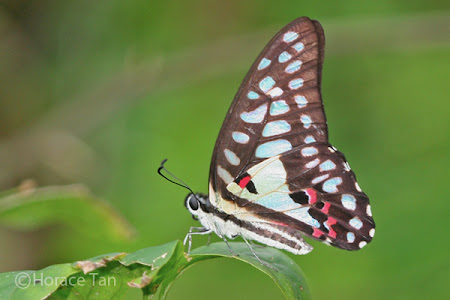
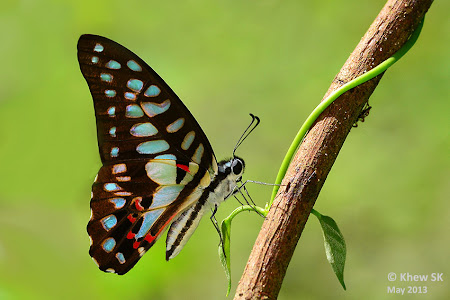 A Common Jay perched on a branch after getting its fill of nutrients whilst puddling
It has been an interesting start to the first few months of 2014 ever since the cold and wet months of 2013, where Singapore had to struggle with flash floods and an over-abundance of water everywhere. Then suddenly, the North East monsoon winds dried up, starting in mid January, all the way through February and March. The weather swung from too much rain in November and December 2013, to dry and parched days that saw previously green fields and verdant vegetation turn a sickly brown all over Singapore.
The National Environment Agency's website recorded day after day of fair sunny weather and after more than a month with virtually no rain, we've moved from worrying about flash floods to worrying about whether the government would start water rationing. Reservoir levels began to drop alarmingly, as with many ponds and water features all over the island. It was reported that over the past six weeks, a paltry 0.2mm of rain was recorded last month at Changi climate station. This is the least rain that has fallen since 1869!, and is well below the previous record of 6.3mm recorded in February 2010 and the mean February rainfall of 161mm.
Interestingly, although the urban butterfly population suffered quite drastically as a result of the parched vegetation and plants, the forest butterfly population did not seem to be affected much. Strangely, over the past few weekends, ButterflyCircle members have spotted a higher diversity of butterfly species within the forested nature reserves, with some rare ones making their appearance all of a sudden. It would be interesting to have a reason for this strange phenomenon, but we have none to postulate at this present moment.
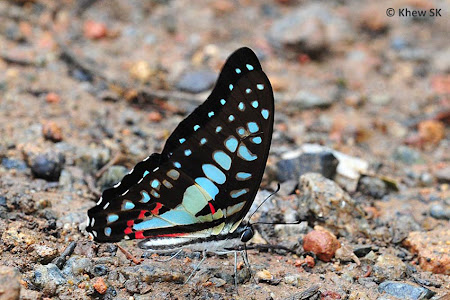
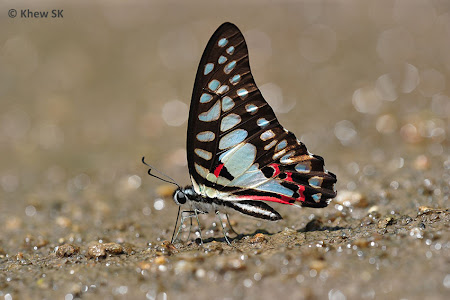 A Common Jay puddling at a muddy footpath
Social and mainstream media were abuzz with the news of the mysterious disappearance of Malaysian Airlines Boeing 777 flight MH 370 en route to Beijing from Kuala Lumpur, with 239 passengers and crew on board. On 8 March, the plane took off from Kuala Lumpur on a standard scheduled flight to Beijing. That it suddenly disappeared without a trace over the sea somewhere between Malaysia and Vietnam is something that continues to stump the experts. A multi-national search effort involving many countries over the past week turned up nothing so far.
A whole range of theories and speculations swamped the media - from pilot suicide to terrorist attack, hijacking and plane malfunction. But no wreckage nor any evidence has been found thus far. Latest news suggest that the plane's transponder and communications has been intentionally switched off, pointing to an "inside job" and someone who is technically conversant with avoiding civilian radar and rendering the plane "invisible" to all but military radars. This alludes to a hijacking of some sort, but until the facts are established, even this theory remains speculatory until someone claims responsibility for it.
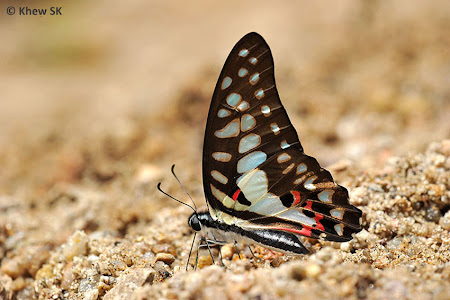
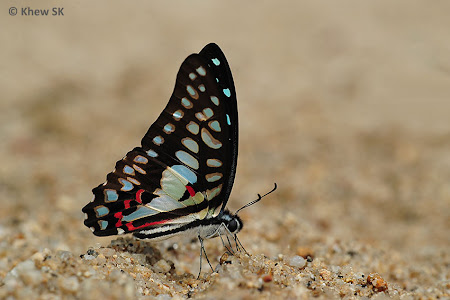 A puddling Common Jay shows a glimpse of its upper forewing blue spots
No matter what the reasons are for the disappearance of the plane, we must remind ourselves of the agony and grief of the families all the 239 passengers on board MH 370. Lots of unanswered questions add to the ever-increasing anxiety of these families, who have feared the worst for their loved ones. When will the answers come? How is it that no one can explain why something as huge as a Boeing 777 with 239 people on board, can disappear without a trace, with all the fancy technology and electronic gizmos that our generation is endowed with? Let us hope that we will know soon, and that there is still hope for the unfortunate 239 on flight MH 370.

This month, we feature a butterfly that was recently discovered in Singapore. First seen on Pulau Ubin some time in March 2004, it regularly appears and is resident on Pulau Ubin. On the main island of Singapore, another individual was spotted at an urban hill park some time later in late 2006. After close observation of the species, the early stages of the Common Jay was recorded by Horace Tan and documented in detail
here. The caterpillar host plant that an egg-laying female was discovered ovipositing on Pulau Ubin, is
Desmos chinensis (Dwarf Ylang Ylang).
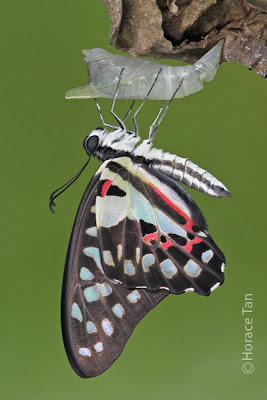 A newly eclosed Common Jay clinging onto its pupal case
As the caterpillar host plant is not uncommon in several locations on Pulau Ubin, the Common Jay continues to survive as an extant species on Ubin to this day. The Common Jay is one of several lookalike butterflies of the
Graphium genus. Over in Malaysia, there are at least five "Jays" which are basically blue in colour with black margins. We have only two in Singapore - the Blue Jay (
Graphium evemon eventus) and the Common Jay (
Graphium doson evemonides).
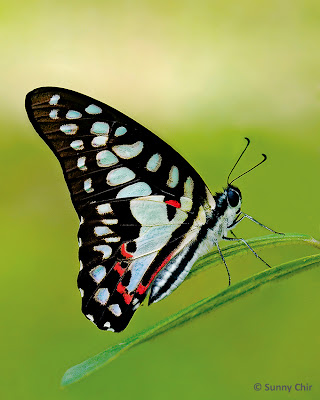
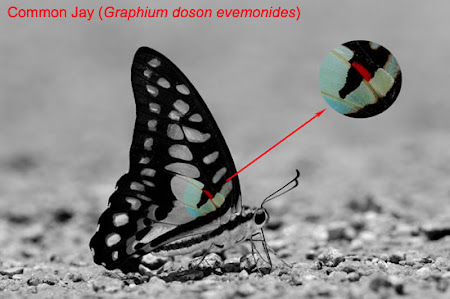 The distinguishing red-centred costal bar which separates the Common Jay from its lookalike cousins
The Common Jay is fast-flying, like the other species in the genus, and is often seen flying erratically along open paths and also at treetops. The wings are black above with a blue macular band across both wings. There are sub-marginal blue spots on both wings. The distinguishing feature of the Common Jay is the dark, red-centred costal bar which is separated from the inner and distal black bars.
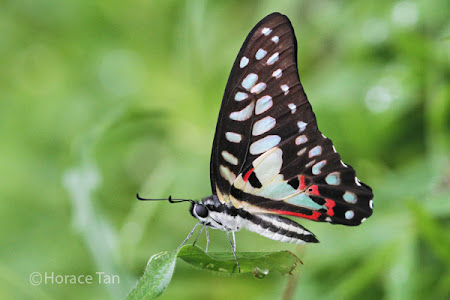
Its status in Singapore can be considered endangered, due to the very localised occurrence on Pulau Ubin. Although the species is common in Malaysia, it has not yet become as widespread on the main island of Singapore, where only one reliable sighting has been recorded thus far. This means that its existence is limited to only Pulau Ubin at the moment, and is critically dependent on the availability of its main caterpillar host plant,
Desmos chinensis for its continued survival on the island.
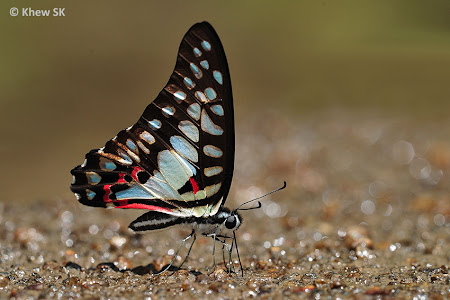
The Common Jay was not recorded by the early authors and hence taken as a new discovery for Singapore. Despite being an endangered species, it has regularly been observed on Pulau Ubin and it is hoped that there will be no significant developments in the near future that would wipe the colony out.
 Text by Khew SK : Photos by Sunny Chir, Khew SK & Horace Tan


