17 August 2013

Life History of the Tree Flitter

Life History of the Tree Flitter (Hyarotis adrastus praba)


Butterfly Biodata:
Genus: Hyarotis Moore, 1881
Species: adrastus Stoll, 1780
Sub-species: praba Moore, 1865
Wingspan of Adult Butterfly: 34-38mm
Caterpillar Local Host Plant: Daemonorops augustifolia (Arecaceae; common name: Water Rattan Palm).


Physical Description of Adult Butterfly:
Above, the wings are dark brown with the forewing adorned with white hyaline spots in the cell-end and spaces 2, 3, subapical spots in spaces 6,7 and 8, and another in space 1b. Underneath, the wings are dark brown with an irregular white discal fascia on the hindwing. The cilia are chequered on both wings. The antenna has a white patch below the apicus.

A sun-bathing Tree Flitter.

A newly eclosed Tree Flitter with partially open wings.

A Tree Flitter taking nectar from Syzygium flowers.

Field Observations of Butterfly Behaviour:
The Tree Flitter is moderately rare in Singapore. Infrequent sightings are restricted to the edges of the nature reserve and at times in urban parks and gardens. The adults are fast flyers and zipped around rapidly at close to ground level most of the time. They have been observed to visit flowers and sunbath in sunny weather, and to puddle on bird dropping.

16 August 2013

Happy 6th Birthday, ButterflyCircle Blog!

Happy 6th Birthday, ButterflyCircle Blog!


Over 6 years ago, I was persuaded by my nature-lover friends, Ria Tan and November Tan, to start a blog to share all the photos, stories and information about butterflies in Singapore. Already veteran bloggers at that time, both Ria (who blogs at Wild Shores of Singapore) and November (who maintains her Midnight Monkey Monitor) were sharing useful nature conservation news and initiatives on the Internet.  At that time, I was also inspired by Dr Wee Yeow Chin's Bird Ecology Study Group's articles, where Dr Wee's frequent posts brought the behaviour and observations of birds to life in a very simple and engaging manner to the nature community.


After fiddling around with various blog software packages, I settled on Blogspot, as it was a popular platform, and relatively easy to use. A maiden post on 16 Aug 2007 started off this journey of blogging.  Even so, I was still hesitant about blogging, as I knew that it would take time, research and a lot of commitment and perseverance to sustain the effort. It was only a few months later in November 2007 that I began posting articles in earnest, setting myself a conservative target of at least one article per week.


After starting the blog, I also noticed that there were other local butterfly enthusiasts jumping on the blogging bandwagon, and recording their own experiences and observations about butterflies. In fact, some even had two or more blogs! However, it's often easy to start something, but to sustain it is another matter altogether. The majority of these blogs are now covered with cobwebs and some of them last posted something back in 2009 and have not been updated since! I wonder why these people don't just shut down the blogs completely, rather than leave a trail of miserable 'ghost town' blogs in their wake.


Anyway, with nearly 500 posts on this blog, we have come a long way since that initial post back in 2007. I must convey my sincere thanks to Horace Tan, who has done awesome work on the Life History series on this blog, that is second to none in this region. Horace has meticulously documented many butterfly life histories with such detail that each article is actually a research project in itself!


Special thanks also, to the occasional contributors like Sunny Chir, Ellen Tan, Federick Ho, Tan BJ, Goh LC, and all the wonderful photos from the larger community at ButterflyCircle, who have generously agreed to allow Horace and me to feature their work in our articles.


This blog is dedicated to the hardworking photographers and members of ButterflyCircle, and I hope that this blog will continue to spread the awareness and beauty of Nature's Flying Jewels for many more years to come! Happy 6th Birthday to the Butterflies of Singapore Blog!

Main Contributors : Khew SK & Horace Tan


Down Memory Lane - Clipper

Down Memory Lane
The Clipper (Parthenos sylvia lilacinus)


This large and showy butterfly used to fly in the forested areas of Singapore, according to the early authors, who listed this species, the Clipper, as extant on their checklist for Singapore. The upperside of the Clipper is black with blue and green lines and stripes, with a large white post-discal patches on the forewing. The underside is similarly marked, but paler, and with the wing bases shaded a light blue. With an average wingspan of 40mm and more, it can hardly be missed.


It is able to fly strongly, gliding rapidly from perch to perch, usually stopping with its wings opened flat. The Clipper is a 'regular' at commercial butterfly parks in Malaysia. It is one of the species that is often seen at the Changi Airport Terminal 3 Butterfly Garden's butterfly aviary, which imports pupae from the Penang Butterfly Farm on a regular basis. It has not been reliably seen in the wild in Singapore for over 30 years. Why did it disappear from Singapore? Were its host plants wiped out? Will it be back here again one day? Or will it remain only in our memories and is gone forever from Singapore?

14 August 2013

Butterflies Galore! : King Crow

Butterflies Galore!
The King Crow (Euploea phaenareta castelnaui)


This "Crow" is the largest representative of its genus Euploea, which comprise butterflies that are predominantly black or blue with white streaks and spots. As the caterpillars of the species of this genus feed on mainly lactiferous plants which are known to be toxic, all the Euploea species are believed to be distasteful to predators. Hence collectively, the black/blue with white streaks/spots appearance of the "Crows" are considered to be a form of aposematic colouration display to warn predators of their distastefulness.

This King Crow was photographed at Pasir Ris Park Butterfly Garden. It is a "resident" species at the Pasir Ris Park Mangrove area, where its preferred caterpillar host plant, Cerbera odollam (Pong Pong Tree) grows in abundance. The butterflies are often spotted making forays to feed at the flowering plants at the nearby Butterfly Garden or when the Syzygium trees along the footpaths of the park bloom.

13 August 2013

Butterflies Galore! : Narrow Spark

Butterflies Galore!
The Narrow Spark (Sinthusa nasaka amba)


This small butterfly was a new discovery for Singapore when it was first discovered in 1995 during a survey. It is rather local in distribution in Singapore, preferring to remain in the shady understorey of the forested nature reserves. It can be considered a forest-dependent species, as it is rarely, if ever, seen in urban parks and gardens. At a glance it resembles the Common Tit or Dark Tit. However, having only two white-tipped filamentous tails will distinguish it from the four-tailed Common or Dark Tit.

Photographing this species is always challenging, as it prefers to lurk in areas where there is low light. Coupled with its small size and often having to deal with the light breezes under the forest canopy pushes the photographer and his equipment to the limit. This well-taken shot, by ButterflyCircle member Jonathan Soong, certainly does justice to this pretty little butterfly and demonstrates the skill and determination of the photographer too!

12 August 2013

Butterflies Galore! : Common Bluebottle

Butterflies Galore!
The Common Bluebottle (Graphium sarpedon luctatius)


A puddling Common Bluebottle photographed in the nature reserves. This fast-flying "Swallowtail" species would otherwise be very challenging to photograph if not for its habit of needing to puddle for essential minerals for its physiological functions. An earlier article on this blog explains some of the reasons why a butterfly needs to puddle. Another article deals with the types of food sources that an adult butterfly seeks out.

In a recent article, Dr Wee Yeow Chin of the Bird Ecology Study Group shares his observations about the feeding behaviour of butterflies on his blog. The article includes two video clips of feeding butterflies. So the next time you come across a butterfly with its proboscis extended and probing a flower, a rotting fruit or just on some damp sand, you will be more aware of why the butterfly feeds, and what its diet consists of.

10 August 2013

Butterfly of the Month - August 2013

Butterfly of the Month - August 2013
The Mangrove Tree Nymph (Idea leuconoe chersonesia)


A magnificent individual of the Mangrove Tree Nymph spotted on Pulau Ubin last month

The aftermath of the haze that affected Singapore and southern Johor in the month of June appears to have created some delayed effect on the butterfly population. Although the haze has abated, perhaps due to the combination of the rains and also the Indonesian government's timely action to curtail the open burning of forests in Sumatra, the particles in the air during the height of the haze may have been fatal to the caterpillars of various stages.


Interestingly, if we tracked the average time lag between the early caterpillar instars, pupation and eclosion of the majority of butterfly species, it appears to correlate with the time that these butterflies would have eclosed in early August. All over Singapore, there is an apparent reduction in the numbers of butterflies in many areas where they are usually found. Is this a coincidence? Or really a result of the environmental damage caused to butterflies by the recent haze? Perhaps this is a study that academic researchers may want to pursue to ascertain the extent of the damage caused by the haze.


August saw the celebration of Singapore's 48th birthday on 9th, as the Muslim community also celebrated Hari Raya Puasa a day earlier. The long 4-day weekend is a much welcomed break for many, although ButterflyCircle members' outings in Singapore seemed to re-affirm the low butterfly activity across the island. It is hoped that our winged jewels will spring back again in numbers, as they have been doing so in past years.


We feature the very rare Mangrove Tree Nymph (Idea leuconoe chersonesia) as our Butterfly of the Month for August. This species was first re-discovered on the military training island of Pulau Tekong in the early 2000's during an NParks survey of the island. Subsequent trips indicate that there was a small but highly threatened population of this large Idea species in the mangrove areas on the north of the island. Since then, there were some unconfirmed sightings of the species in the neighbouring island of Pulau Ubin.


The Mangrove Tree Nymph feeding on the flowers of the Peacock Flower bush

Late last month, during a ButterflyCircle outing to Pulau Ubin, members spotted a large black-and-white butterfly flying slowly and feeding on the Peacock Flower (Caesalpinia pulcherrima). It was confirmed to be the Mangrove Tree Nymph! The large individual, which appeared to be a female, was flying up and down, teasing our members who were trying hard to get a good shot of it. After feeding at a few flowers, it decided to take refuge in the shaded forested area nearby, and rested a few times. We continued following it until it decided to move off elsewhere and flew high above the treetops and out of sight.


The Mangrove Tree Nymph soaring high in the air

It was indeed exciting to see the Mangrove Tree Nymph after so many years, and we hope that it is successfully breeding in the mangrove areas of Pulau Ubin. The caterpillar host plant is probably one of the lactiferous plants of the Apocynaceae family. It would be great if the life history could be recorded before this species disappears from its preferred mangrove habitats that is progressively disappearing from Singapore and Malaysia.


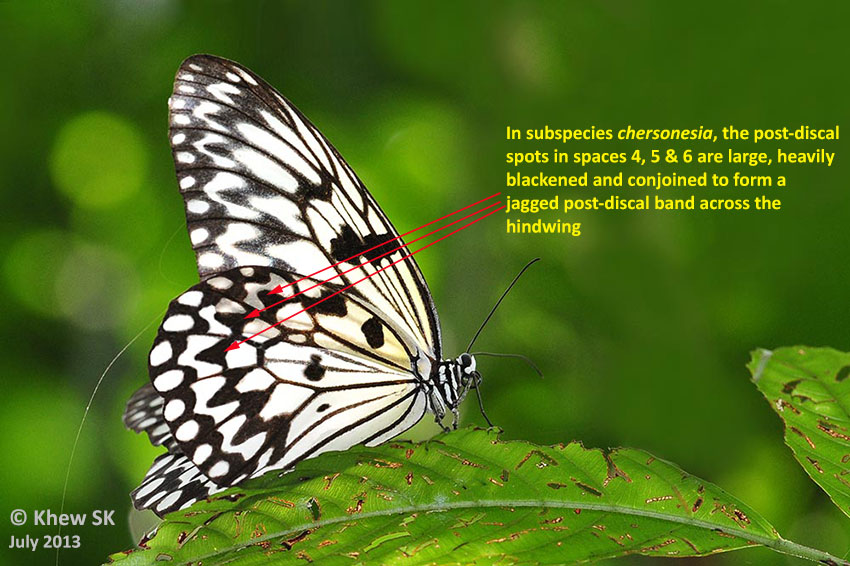
The Mangrove Tree Nymph is a large butterfly, with a wingspan usually exceeding 130mm and often reaching 150mm or more. It displays the aposematic black and white colours like the other species of its genus. It features large black spots on both wings where the marginal and submarginal black spots are conjoined to form an irregular black band. The post-discal triangular spots on the hindwings are large and always touching the black veins, forming a jagged black band. The wing bases are yellow tinted.


The Mangrove Tree Nymph is a very rare species that occurs in coastal mangrove habitats. It is known to occur in Pulau Tioman in Malaysia and believed to also occur in the mangrove areas of Johor. A recent survey on one of the small offshore islands near the Indonesian resort island of Batam also yielded a sighting of the Mangrove Tree Nymph in the mangrove area of the island.


The Taiwan Tree Nymph (Idea leuconoe clara) shot at Sentosa Butterfly Park

The species is not to be confused with the abundant and easily bred subspecies clara that originates from Taiwan. Another possible subspecies would be siamensis that occurs in Thailand.  This subspecies (either clara or siamensis) occurs in many butterfly parks and farms across the globe and is bred for its showy appearance - popular with visitors to these butterfly enclosures.

Thus far, it has been seen regularly in butterfly parks in Penang, Kuala Lumpur, Malacca and as far north as the Phuket Butterfly Farm in Thailand. In Singapore, it is a regular "resident" species found at the Fragile Forest enclosure at the Singapore Zoo, the Sentosa Butterfly Park, Changi Airport Terminal 3 Butterfly Garden and the Hort Park Butterfly Garden.


A mating pair of the Tree Nymph shot at Phuket Butterfly Park.  Possibly subspecies siamensis?

The subspecies clara as it is known at the moment, has a whiter appearance, with the black markings on the wings reduced as compared to subspecies chersonesia. Another related subspecies, siamensis which has a similar appearance to subspecies clara also occurs in Thailand. A characteristic feature is that the post-discal spots on the hindwings, particularly in spaces 4, 5 and 6 are much reduced and not conjoined.  


Given the relative abundance of this non-native species, there is a high possibility of escapees from the various butterfly parks. Indeed, two individuals were spotted in the Sime Forest of the Central Catchment area (and captured) in 2004 and 2005. It is interesting that no escapee has been able to colonise any area in Singapore as yet. Perhaps its preferred caterpillar host plant is not available in abundance, and unable to support any succeeding generations of these escapees.


In any case, we hope that the opportune sighting of the real McCoy, the Mangrove Tree Nymph ssp chersonesia at Pulau Ubin is a good sign that the species still exists in Singapore. Though its hold on to survival is tenuous and is considered a critically endangered species, we hope that it will continue to survive in the remaining mangrove habitats of Singapore for many years to come.

Text by Khew SK : Photos by Chng CK, Goh EC, Khew SK, Loke PF, Nona Ooi, Simon Sng, Anthony Wong & Mark Wong.

Special footnote : In the Butterflies of the Malay Peninsula, it was suggested that the various subspecies of Idea leuconoe could in reality be two distinct species, due to differences in their caterpillars. In which case, the Mangrove Tree Nymph would be assigned the name Idea engania (Doherty, 1891). Until there is a definitive research and a published paper on this, the Mangrove Tree Nymph remains subspecies chersonesia of Idea leuconoe for the time being.